Table of Contents
Is the FCRA Amendment Bill Anti-Christian? Eexpose the falseness Myths & Setting Record Straight
Claims that the FCRA Amendment Bill, 2026 is an "anti-Christian" law have generated significant debate. However, a reading of the proposed provisions suggests that the legislation is primarily focused on regulating foreign funding, improving transparency, and strengthening accountability, rather than targeting any particular religion or community.
What the Critics Claim- FCRA Amendment Bill Anti-Christian
Some critics have alleged that the amendments would allow the government to take over churches and Christian charities, thereby restricting religious freedom and discriminating against Christians
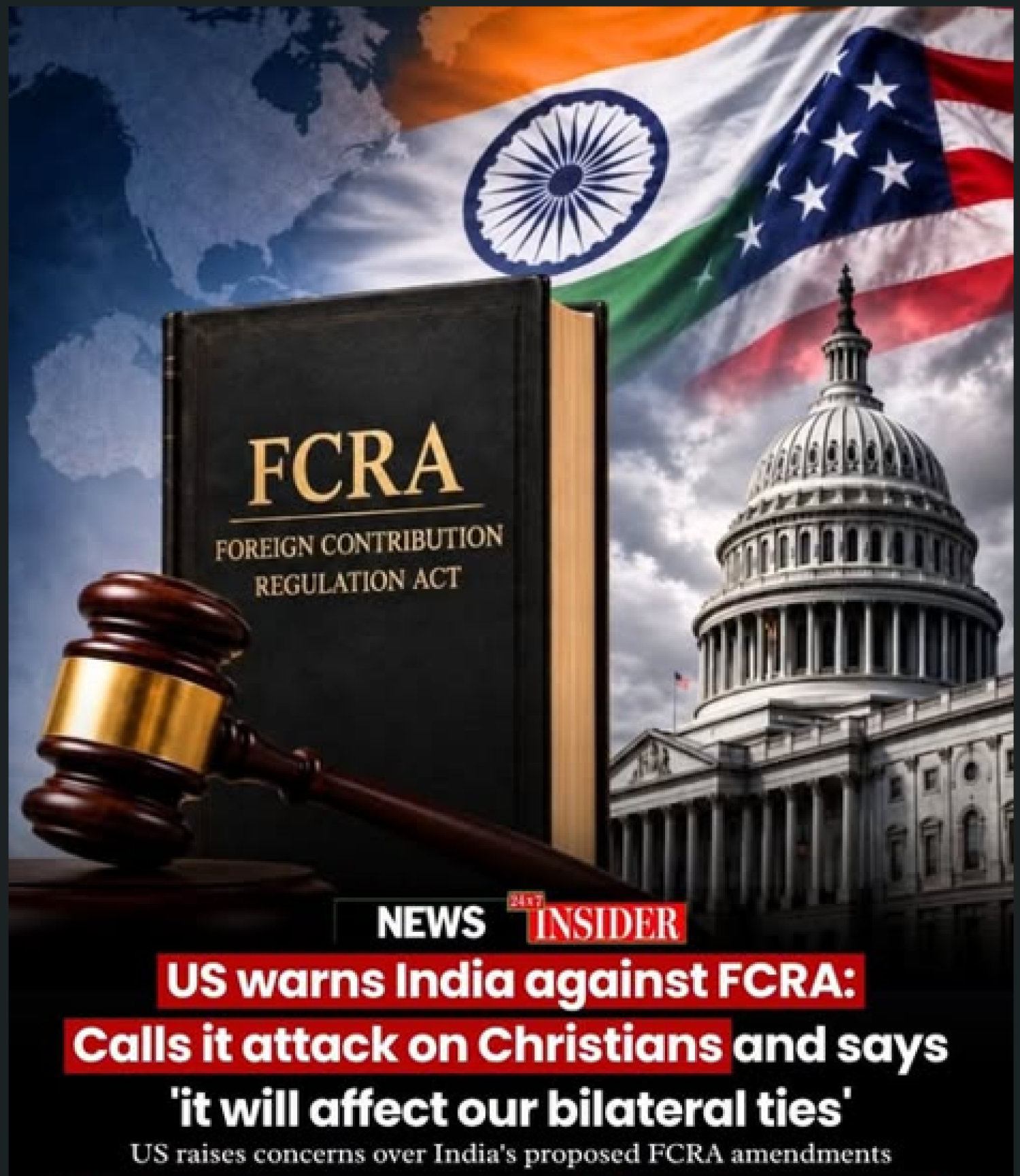
The article argues that US Congressman Riley Moore's criticism of India's proposed FCRA Amendment Bill, 2026 is based on a misinterpretation of the legislation. Moore alleged that the bill could allow the Indian government to take over churches and religious charities, describing it as an attack on Christians and a potential concern for India-US relations.
Key Points of the FCRA Amendment Bill, 2026
✅ Bill Is Religion-Neutral
- The proposed amendments apply to all organisations receiving foreign funding, regardless of religion or ideology.
- The objective is to improve transparency, accountability, and proper utilisation of foreign contributions.
✅ Places of Worship Are Explicitly Protected
- The bill contains a specific provision requiring authorities to preserve the religious character of churches, temples, mosques, gurudwaras, and other places of worship.
- Religious institutions cannot be converted, secularised, repurposed, or closed under the law.
✅ No Arbitrary Government Takeover
- The Designated Authority can manage only assets created through foreign contributions and only when an organisation's FCRA registration lawfully ceases.
- Even then, the focus is on managing assets, not interfering with religious practices.
✅ Legal Safeguards Exist
- Organisations have the right to administrative review and judicial appeal against decisions affecting their registration or assets.
- This ensures oversight and protection against arbitrary actions.
✅ Foreign Funding Remains Permitted
- Churches and other religious organisations may continue receiving foreign donations for legitimate religious and charitable activities.
- Regulatory action arises only when there is non-compliance or misuse of foreign funds.
✅ Government Assurances
- Union Home Minister Amit Shah and Minority Affairs Minister Kiren Rijiju have publicly stated that the amendments are non-discriminatory and will not target Christian or other religious organisations.
- Discussions were held with church leaders and religious representatives to address concerns.
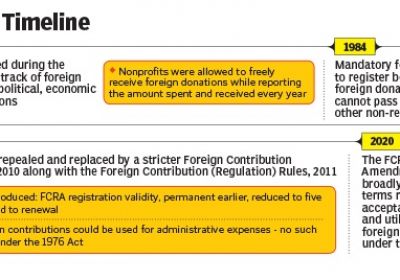
✅ FCRA Is Not a New Concept
- The article notes that previous governments, including the UPA government, supported and enforced FCRA regulations.
- Former Prime Minister Manmohan Singh and former Home Minister P. Chidambaram had also expressed concerns about foreign-funded organisations influencing domestic policy matters.
✅ Comparison with the United States
- The article highlights that the US itself regulates foreign influence through laws such as the Foreign Agents Registration Act (FARA).
- It argues that India's effort to regulate foreign funding should be viewed as a sovereign policy decision similar to practices followed by other democracies.
Conclusion
According to the article, the FCRA Amendment Bill, 2026 is intended to strengthen transparency and accountability in the use of foreign funds, while explicitly protecting places of worship and providing judicial remedies. It contends that claims of an anti-Christian agenda are not supported by the text of the bill and that the legislation should be viewed as a governance and regulatory measure rather than a religious issue
Based on the provisions publicly discussed, the FCRA Amendment Bill, 2026 is a regulatory measure governing foreign contributions and is not expressly targeted at Christians or any other religious community. The bill retains protections for places of worship, permits lawful foreign funding, and provides avenues for judicial review. The central debate therefore revolves more around the scope and administration of foreign-funding regulation than around religious discrimination.