Table of Contents
- Salary Tax Planning For Tax Year 2026-27: New Regime Vs Old Regime Under The Income-tax Act, 2025
- From "fy/ay" To "tax Year": What Has Changed
- New Regime Or Old Regime: Making The Choice
- Tax Slabs For Tax Year 2026-27
- New Tax Regime (section 202)
- Old Tax Regime
- Standard Deduction, Rebate, Surcharge And Cess
- Deductions Available Under Each Regime
- Payroll And Tds: A Step-by-step Checklist
- Which Regime Should You Choose?
- Key Due Dates For Tax Year 2026-27
- Worked Example: Salary Of Inr 15 Lakh
- New Regime Computation (taxable Income Inr 14,25,000)
- Old Regime Computation (taxable Income Inr 12,25,000)
- Common Mistakes Salaried Employees Make
- Frequently Asked Questions
Salary Tax Planning for Tax Year 2026-27: New Regime vs Old Regime under the Income-tax Act, 2025
From "FY/AY" to "Tax Year": what has changed
- The Income-tax Act, 2025 came into force on 1 April 2026, replacing the Income-tax Act, 1961. One of its most visible changes is terminology. The two-part Financial Year / Assessment Year structure is replaced by a single "Tax Year."
- Income earned between 1 April 2026 and 31 March 2027 is Tax Year 2026-27. It should not be described as "AY 2027-28."
- Section numbers have also been reorganised. Familiar references such as 80C, 80D, 192 and Form 24Q are still useful as search terms, but they are no longer the operative legal references. Use the mapping below before quoting any section:
- Payroll software, TDS certificates and quarterly TDS statements for Tax Year 2026-27 must use the new numbering. If your employer's portal still shows "Section 192" or "Form 24Q," that is outdated labelling in the software. It does not mean the 1961 Act still applies.
New regime or old regime: making the choice
- The new regime is the default. If you do not tell your employer which regime you want, TDS will be deducted under the new regime. Telling payroll your choice is an operational instruction for TDS only. It does not legally lock in your regime. The regime is actually applied when you file your return of income.
When to compare both regimes carefully. Run the numbers under both regimes if any of these apply to you:
- home loan interest on a self-occupied property,
- a substantial HRA exemption,
- large existing 80C-type commitments (PF, life insurance, ELSS, tuition fees, home loan principal), or
- significant medical insurance premiums, especially for senior-citizen parents.
If none of these apply, the new regime is very likely to be better, because of its higher standard deduction and its INR 12 lakh rebate threshold.
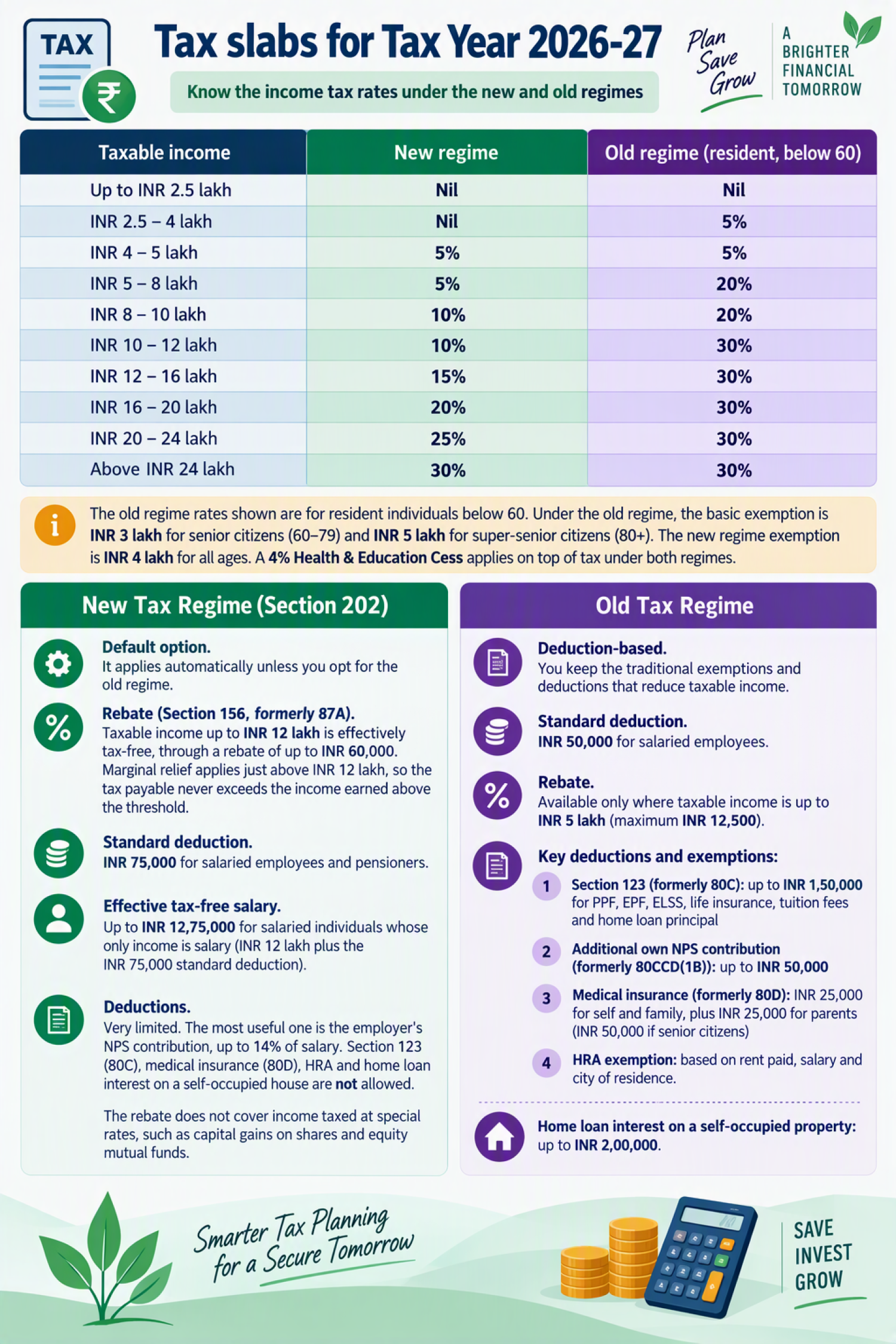
Tax slabs for Tax Year 2026-27
|
Taxable income |
New regime |
Old regime (resident, below 60) |
|---|---|---|
|
Up to INR 2.5 lakh |
Nil |
Nil |
|
INR 2.5 – 4 lakh |
Nil |
5% |
|
INR 4 – 5 lakh |
5% |
5% |
|
INR 5 – 8 lakh |
5% |
20% |
|
INR 8 – 10 lakh |
10% |
20% |
|
INR 10 – 12 lakh |
10% |
30% |
|
INR 12 – 16 lakh |
15% |
30% |
|
INR 16 – 20 lakh |
20% |
30% |
|
INR 20 – 24 lakh |
25% |
30% |
|
Above INR 24 lakh |
30% |
30% |
The old regime rates shown are for resident individuals below 60. Under the old regime, the basic exemption is INR 3 lakh for senior citizens (60–79) and INR 5 lakh for super-senior citizens (80+). The new regime exemption is INR 4 lakh for all ages. A 4% Health & Education Cess applies on top of tax under both regimes.
New Tax Regime (Section 202)
- Default option. It applies automatically unless you opt for the old regime.
- Rebate (Section 156, formerly 87A). Taxable income up to INR 12 lakh is effectively tax-free, through a rebate of up to INR 60,000. Marginal relief applies just above INR 12 lakh, so the tax payable never exceeds the income earned above the threshold.
- Standard deduction. INR 75,000 for salaried employees and pensioners.
- Effective tax-free salary. Up to INR 12,75,000 for salaried individuals whose only income is salary (INR 12 lakh plus the INR 75,000 standard deduction).
- Deductions. Very limited. The most useful one is the employer's NPS contribution, up to 14% of salary. Section 123 (80C), medical insurance (80D), HRA and home loan interest on a self-occupied house are not allowed.
The rebate does not cover income taxed at special rates, such as capital gains on shares and equity mutual funds.
Old Tax Regime
- Deduction-based. You keep the traditional exemptions and deductions that reduce taxable income.
- Standard deduction. INR 50,000 for salaried employees.
- Rebate. Available only where taxable income is up to INR 5 lakh (maximum INR 12,500).
- Key deductions and exemptions:
- Section 123 (formerly 80C): up to INR 1,50,000 for PPF, EPF, ELSS, life insurance, tuition fees and home loan principal
- Additional own NPS contribution (formerly 80CCD(1B)): up to INR 50,000
- Medical insurance (formerly 80D): INR 25,000 for self and family, plus INR 25,000 for parents (INR 50,000 if senior citizens)
- HRA exemption: based on rent paid, salary and city of residence
- Home loan interest on a self-occupied property: up to INR 2,00,000
- Verify before relying on these figures: The slab rates above follow the Finance Bill, 2026 as introduced on 1 February 2026. Cross-check them against the enacted Finance Act, 2026 before finalising any planning.
Standard deduction, rebate, surcharge and cess
|
Item |
New regime |
Old regime |
|---|---|---|
|
Standard deduction (salaried/pensioners) |
INR 75,000 |
INR 50,000 |
|
Rebate (equivalent of old Section 87A) |
Up to INR 60,000 where total income does not exceed INR 12 lakh, with marginal relief just above the threshold |
Up to INR 12,500 where total income does not exceed INR 5 lakh |
|
Surcharge |
10% (INR 50 lakh–INR 1 crore); 15% (INR 1–2 crore); 25% above INR 2 crore (maximum) |
10% (INR 50 lakh–INR 1 crore); 15% (INR 1–2 crore); 25% (INR 2–5 crore); 37% above INR 5 crore |
|
Health & Education Cess |
4% of tax plus surcharge |
4% of tax plus surcharge |
About the "INR 12.75 lakh tax-free salary." This commonly quoted figure is correct only for salaried taxpayers. It is the INR 12 lakh rebate threshold plus the INR 75,000 standard deduction. The rebate limit itself is INR 12 lakh of taxable income, not INR 12.75 lakh. The distinction matters because income from other sources, such as interest, counts towards the INR 12 lakh limit. Certain incomes taxed at special rates, such as capital gains under special provisions, do not qualify for the rebate at all.
Deductions available under each regime
|
Deduction |
Limit |
Available under |
|---|---|---|
|
Section 123 (formerly 80C): PF, life insurance, ELSS, tuition fees, home loan principal, etc. |
INR 1,50,000 in aggregate |
Old regime only |
|
Own contribution to NPS (formerly 80CCD(1B)) |
Additional INR 50,000 |
Old regime only |
|
Employer's contribution to NPS (formerly 80CCD(2)) |
14% of salary for Government employees. For other employees: 10% (old regime) or 14% (new regime). Subject to conditions. |
Both regimes |
|
Medical insurance (formerly 80D) |
INR 25,000 for self and family, plus up to INR 25,000 for parents. INR 50,000 where the insured person is a senior citizen. |
Old regime only |
|
Savings account interest (formerly 80TTA) |
Up to INR 10,000 |
Old regime only |
Planning point: Employer NPS contribution is the one significant deduction available under both regimes. Salary restructuring conversations should consider it whichever regime you choose.
Payroll and TDS: a step-by-step checklist
Salary TDS for Tax Year 2026-27 is deducted under Section 392(1) of the Income-tax Act, 2025. Your employer:
- estimates your annual taxable salary,
- takes into account your regime choice and any declared deductions,
- computes the tax for the year, and
- spreads it over the remaining salary payments.
- Step-1: Tell payroll your regime choice early. Do this at the start of the year. If you don't, the new regime applies by default.
- Step-2: Declare and prove your investments. If you choose the old regime, submit your investment declaration. Then submit actual proofs before the payroll cut-off: premium receipts, the home loan interest certificate, rent receipts and investment statements.
- Step 3: Report salary from a previous employer. If you changed jobs during the year, give your new employer details of the salary paid and TDS deducted by your previous employer. Use the form or workflow your employer prescribes, and confirm the form number with them, since forms were renumbered from 1 April 2026.
- Step-4: Check your TDS certificate. Compare your TDS certificate and Annual Information Statement with the tax actually deducted from your salary.
- Step 5: Reconcile and file on time. Your regime is finally determined in your return of income under Section 263. File by the due date if you want the old regime (see the caution below).
Caution on timing: For salaried individuals without business income, the option to be taxed under the old regime can generally be exercised only in a return filed on or before the due date. If you miss the due date and file a belated return, the new regime will normally apply. Confirm this against the final provisions of Section 202 and the rules.
Which Regime Should You Choose?
The old regime saves tax only when your total deductions and exemptions (over and above the standard deduction) exceed the break-even level for your salary:
|
Gross Salary |
Old regime becomes better only if deductions exceed about |
|---|---|
|
INR 13 lakh |
INR 6.8 lakh |
|
INR 15 lakh |
INR 5.4 lakh |
|
INR 18 lakh |
INR 6.4 lakh |
|
INR 20 lakh |
INR 7.1 lakh |
|
INR 24 lakh and above |
INR 7.9 – 8 lakh |
These are approximate figures for a resident individual below 60 with salary income only.
Choose the new regime if:
- your deductions are below the break-even level for your salary (true for most salaried taxpayers), or
- you want higher monthly take-home pay and minimal paperwork.
Consider the old regime if:
- you pay substantial rent in a metro city and have home loan interest, and
- Taxpayer fully use Section 123, NPS and medical insurance, taking the total past the break-even level.
Important: Salaried employees can switch regimes each year. However, the old regime can generally be chosen only in a return filed by the due date. A belated return will normally be taxed under the new regime.
|
Legacy reference (1961 Act) |
Income Tax Act, 2025 reference |
|---|---|
|
Financial Year / Assessment Year |
Tax Year |
|
Section 80C-type deductions |
Section 123 |
|
Section 115BAC (new tax regime) |
Section 202 |
|
Section 192 (TDS on salary) |
Section 392(1) |
|
Section 139 (return of income) |
Section 263 |
|
Form 24Q (quarterly salary TDS statement) |
Form 138 |
Not Sure Which Regime Saves You More?
Share these details with us and we will prepare a side-by-side tax computation for you:
- Your estimated annual gross salary
- Rent paid and HRA received
- Home loan interest (if any)
- Section 123 (80C) investments, NPS and medical insurance premiums
Key due dates for Tax Year 2026-27
|
Compliance |
Due date |
|---|---|
|
Quarterly salary TDS statement (Form 138), Q1 (Apr–Jun) |
31 July 2026 |
|
Quarterly salary TDS statement (Form 138), Q2 (Jul–Sep) |
31 October 2026 |
|
Quarterly salary TDS statement (Form 138), Q3 (Oct–Dec) |
31 January 2027 |
|
Quarterly salary TDS statement (Form 138), Q4 (Jan–Mar) |
31 May 2027 |
|
Salary TDS certificate (Form 16 equivalent) |
15 June 2027, subject to the timeline prescribed under the new Rules |
|
Return of income (non-audit salaried taxpayers) |
31 July 2027 |
|
Belated return |
31 December 2027, or before completion of assessment, whichever is earlier |
|
Revised return |
[Verify before publishing] Proposed to be 12 months from the end of the tax year (31 March 2028) under the Finance Bill, 2026. Confirm against the enacted Finance Act, 2026. |
Worked example: salary of INR 15 lakh
Assumptions: resident employee below 60, gross salary INR 15,00,000, no HRA exemption, no home loan interest, and no other income. Under the old regime, the employee has actually paid:
- INR 1,50,000 in Section 123 investments,
- INR 50,000 in additional NPS contributions, and
- INR 25,000 in medical insurance premium.
|
Particulars |
New regime |
Old regime |
|---|---|---|
|
Gross salary |
INR 15,00,000 |
INR 15,00,000 |
|
Less: Standard deduction |
INR 75,000 |
INR 50,000 |
|
Less: Section 123 |
– |
INR 1,50,000 |
|
Less: Own NPS contribution |
– |
INR 50,000 |
|
Less: Medical insurance |
– |
INR 25,000 |
|
Taxable income |
INR 14,25,000 |
INR 12,25,000 |
|
Income tax |
INR 93,750 |
INR 1,80,000 |
|
Rebate |
Not available (income above INR 12 lakh) |
Not available (income above INR 5 lakh) |
|
Cess @ 4% |
INR 3,750 |
INR 7,200 |
|
Total tax payable |
INR 97,500 |
INR 1,87,200 |
New regime computation (taxable income INR 14,25,000)
- Up to INR 4,00,000: Nil
- INR 4,00,001 – INR 8,00,000: INR 4,00,000 × 5% = INR 20,000
- INR 8,00,001 – INR 12,00,000: INR 4,00,000 × 10% = INR 40,000
- INR 12,00,001 – INR 14,25,000: INR 2,25,000 × 15% = INR 33,750
- Tax: INR 93,750 + cess INR 3,750 = INR 97,500
Old regime computation (taxable income INR 12,25,000)
- Up to INR 2,50,000: Nil
- INR 2,50,001 – INR 5,00,000: INR 2,50,000 × 5% = INR 12,500
- INR 5,00,001 – INR 10,00,000: INR 5,00,000 × 20% = INR 1,00,000
- INR 10,00,001 – INR 12,25,000: INR 2,25,000 × 30% = INR 67,500
- Tax: INR 1,80,000 + cess INR 7,200 = INR 1,87,200
Result: the new regime saves INR 89,700 in this case.
The employee claims INR 2.25 lakh of deductions under the old regime and still pays more tax. The higher standard deduction and the much lower new-regime rates on income between INR 5 lakh and INR 12 lakh outweigh those deductions. The answer can change with larger deductions, especially home loan interest or a substantial HRA exemption, which this example does not include. Always run the comparison with your own figures.
Common mistakes salaried employees make
- Believing the payroll declaration locks in the regime. The regime is decided in the return of income u/s 263, not by what you tell your employer.
- Treating INR 12.75 lakh as the rebate limit. The rebate limit is INR 12 lakh of taxable income. INR 12.75 lakh is the salary equivalent after the INR 75,000 standard deduction.
- Claiming deductions without actual payment. Section 123, NPS and medical insurance deductions require payments actually made and valid proof. Declarations alone are not enough.
- Not reporting a mid-year job change. If your new employer doesn't know your previous salary and TDS, too little tax will be deducted, and you will face a tax shortfall with interest at return time.
- Missing the due date when opting for the old regime. A belated return will generally be taxed under the new regime.
- Quoting 1961 Act sections as current law. For Tax Year 2026-27, cite Section 123, Section 392(1), Section 202 and Section 263, especially in written submissions and correspondence.
- Treating Finance Bill figures as final. Confirm rates and dates against the enacted Finance Act, 2026 before making any salary-structuring decision that cannot be reversed.
Frequently Asked Questions
Is Tax Year 2026-27 the same as AY 2027-28?
It covers the same income period (1 April 2026 to 31 March 2027). However, under the Income-tax Act, 2025 the correct term is Tax Year 2026-27. "Assessment Year" is no longer used.
Which regime is better for a salary of INR 15 lakh?
With typical deductions of about INR 2.25 lakh, the new regime is better by roughly INR 90,000, as the example above shows. The old regime may come out ahead only if you have large additional deductions, such as home loan interest or a significant HRA exemption.
Do I need to submit proofs to claim old-regime deductions?
Yes. Your employer will ask for proofs before the payroll cut-off to give effect to deductions in TDS. You must also hold valid evidence of payment to support the claim in your return.
What is Section 392(1) and how does it affect my salary TDS?
Section 392(1) of the Income-tax Act, 2025 replaces Section 192 of the 1961 Act. It requires your employer to deduct tax from your salary based on your estimated annual income and your chosen regime. The mechanism is the same as before; only the section number has changed.
When is my Tax Year 2026-27 return due?
For salaried taxpayers whose accounts are not required to be audited, the return is generally due on 31 July 2027.
Can I change my regime after informing payroll?
Yes. A salaried employee without business income can choose a different regime when filing the return, provided the return is filed by the due date. Any difference between TDS deducted and actual tax liability is settled in the return, either as additional tax payable or as a refund.
Need help choosing the right regime or restructuring your salary?
Rajput Jain & Associates, Chartered Accountants
📠P-6/90 (2F), Connaught Circus, New Delhi – 110001
📱 +91-98-11-322-785 | â˜Žï¸ 011-4352-0194
âœ‰ï¸ info@carajput.com | 🌠www.carajput.com
Disclaimer: This article is for general guidance only and does not constitute personalised tax advice. Figures, especially surcharge and marginal relief at higher income levels, should be confirmed with a qualified professional or against official CBDT and Income Tax Department sources.