Table of Contents
ICAI's 60 Tax Audit Limit Now Enforced Through UDIN: What Every Chartered Accountant Must Know
Introduction
For many years, the ceiling on the number of tax audits that a chartered accountant could undertake functioned largely as a matter of professional self-regulation. That position is now set to change. The Institute of Chartered Accountants of India (ICAI) has shifted from a compliance-based approach to a technology-driven enforcement mechanism by integrating the audit ceiling with the UDIN (Unique Document Identification Number) system.
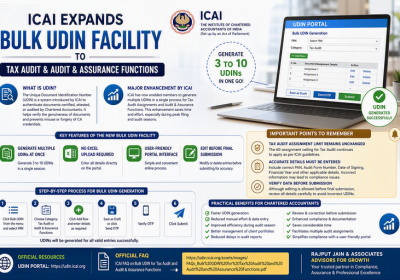
To facilitate implementation, ICAI has issued a comprehensive set of FAQs explaining the manner in which the audit-limit framework will operate through the UDIN portal. The ceiling has been formally notified under the Chartered Accountants (Limit on Number of Tax Audits) Guidelines, 2025, published in the Gazette of India, and will come into effect from 1 April 2026.
With the UDIN portal acting as the enforcement gateway, compliance with the prescribed limit will no longer depend solely on professional discipline. Instead, the audit ceiling will be monitored and enforced through system-based controls, marking a significant shift in the regulation of tax audit assignments. Key Improvements
- Enhanced readability and flow.
- Removed repetitive references to the audit ceiling.
- Strengthened the transition from the old self-regulatory regime to system-based enforcement.
- Adopted a formal tone suitable for a professional article, newsletter, or tax commentary.
In this article, we explain what the new regime means, which audits count, which do not, and how practitioners and firms should prepare.
Background: The Tax Audit Limit Is Not New
The concept of capping tax audits is not new. The current limit of 60 tax audits per chartered accountant was introduced in FY 2014-15, replacing the earlier cap of 45 audits, which had itself succeeded the original limit of 30 audits. What has changed now is not the cap itself, but its enforcement.
The legal validity of the audit ceiling has also been conclusively settled. In Shaji Poulose vs ICAI (judgment dated 17 May 2024), the Supreme Court upheld the cap as constitutionally valid, effectively closing the avenue for further legal challenges.
The foundation for technology-driven enforcement was laid last year. At its 442nd meeting held on 26-27 May 2025, the ICAI Council approved a proposal to impose a ceiling on UDIN generation in the tax audit category. This move is intended to operationalize and strengthen compliance with the existing audit-limit framework through system-based controls. Key improvements:
- Removed duplicate paragraphs.
- Improved readability and logical flow.
- Reduced repetition of the audit-cap history and Supreme Court ruling.
- Enhanced professional tone suitable for articles, newsletters, or policy analysis.
What Is the Ceiling, and How Is It Counted?
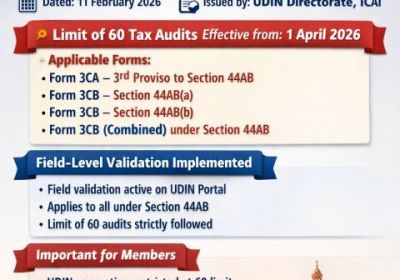
Effective from 1 April 2026, a chartered accountant can undertake a maximum of 60 tax audit assignments in a financial year. While the limit itself is straightforward, its application depends on certain important counting rules:
1. Date of Signing Determines the Count
The ceiling is calculated based on the date on which the Tax Audit Report is signed, rather than the date on which the UDIN is generated. Consequently, an audit will be counted in the financial year in which the report is signed, preventing the deferment of counts through delayed UDIN generation.
2. Multiple Forms for the Same Assessee Are Counted Once
Where a member generates UDINs for the same assessee under more than one applicable form, the assignment will be counted only once, provided that all reports relate to the same PAN and the same assessment year. This ensures that a single audit engagement is not counted multiple times merely because multiple forms are involved.
3. Changes in Sub-category Affect the Available Limit
The audit count is dynamically adjusted if the classification of an assignment changes:
- If an assignment is moved from a non-applicable sub-category to an applicable sub-category, it will be included in the count and the member's available limit will reduce accordingly.
- Conversely, if an assignment is reclassified from an applicable sub-category to a non-applicable sub-category, it will be excluded from the count and the available limit will increase correspondingly.
These rules are designed to ensure accurate, transparent, and consistent monitoring of compliance with the 60-audit ceiling
Sub-Categories That Count Towards the 60 Limit
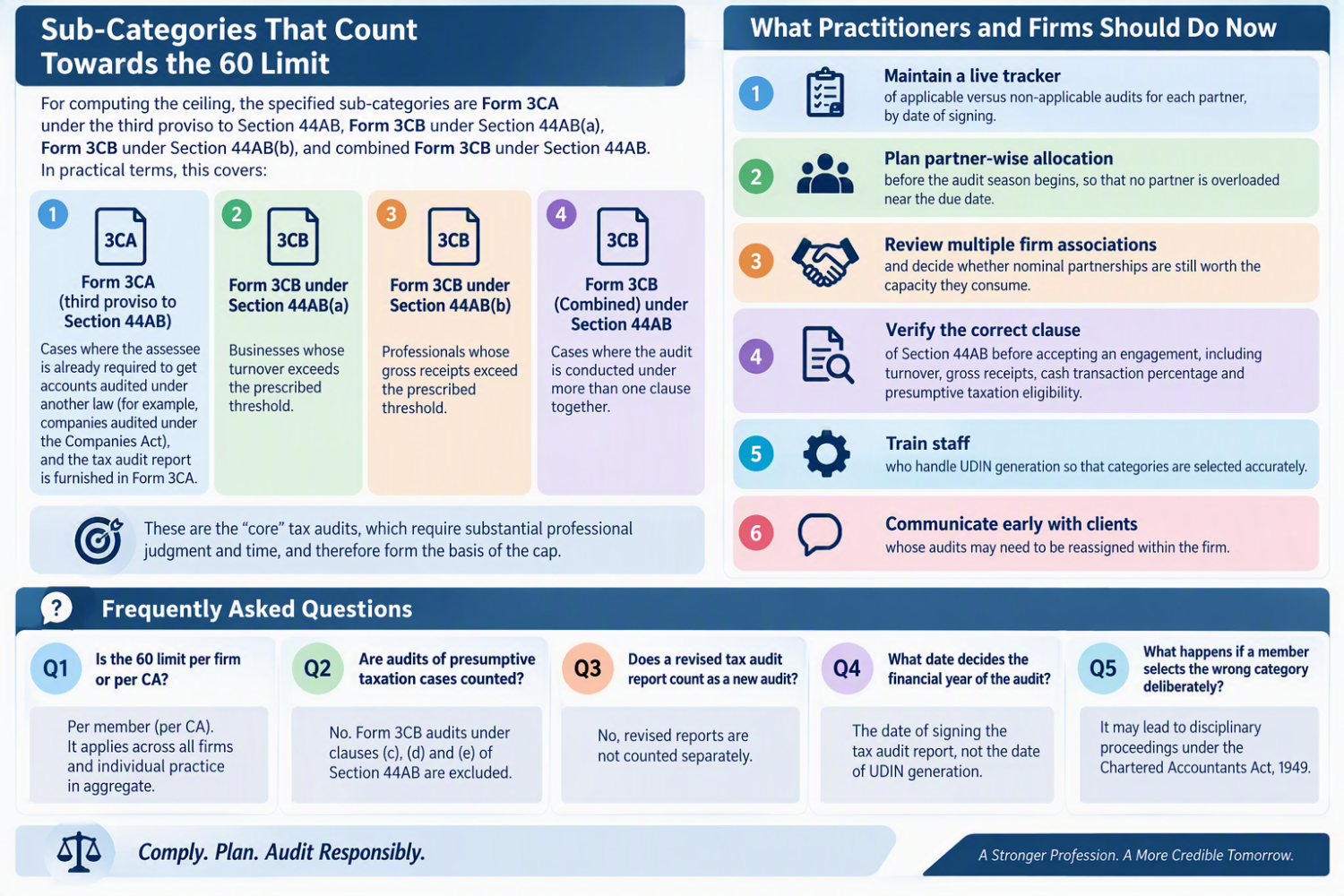
For computing the ceiling, the specified sub-categories are Form 3CA under the third proviso to Section 44AB, Form 3CB under Section 44AB(a), Form 3CB under Section 44AB(b), and combined Form 3CB under Section 44AB.
In practical terms, this covers:
- Form 3CA (third proviso to Section 44AB): Cases where the assessee is already required to get accounts audited under another law (for example, companies audited under the Companies Act), and the tax audit report is furnished in Form 3CA.
- Form 3CB under Section 44AB(a): Businesses whose turnover exceeds the prescribed threshold.
- Form 3CB under Section 44AB(b): Professionals whose gross receipts exceed the prescribed threshold.
- Form 3CB (Combined) under Section 44AB: Cases where the audit is conducted under more than one clause together.
These are the "core" tax audits, which require substantial professional judgment and time, and therefore form the basis of the cap.
Treatment of Revised Tax Audit Reports
ICAI has also clarified that a revised Tax Audit Report will not be regarded as a separate audit assignment for the purpose of determining the audit ceiling. Accordingly, where an existing tax audit report is revised to rectify errors, incorporate additional information, or comply with regulatory requirements, such revision will not consume an additional slot from the member's annual audit limit.
This provides practical relief to chartered accountants, as genuine corrections and revisions can be undertaken without affecting their permissible capacity to accept and complete tax audit assignments.
Strengthened Validation and Disciplinary Consequences: No Misclassification of UDINs
Any attempt to circumvent the prescribed tax audit ceiling or incorrectly classify audit assignments may attract disciplinary proceedings under the provisions of the Chartered Accountants Act, 1949 and the relevant rules framed thereunder. Since the UDIN system is integrated with the member's PAN details and the tax audit reports filed with the Income-tax Department, discrepancies between the UDIN category selected and the actual audit report submitted can be easily identified and scrutinized.
To further enhance compliance, ICAI has implemented robust field-level validation mechanisms within the UDIN portal. Before a UDIN is generated, the system verifies key parameters such as turnover limits, gross receipt thresholds, cash transaction ratios, eligibility for presumptive taxation schemes, and the applicability of Sections 44AD, 44ADA, 44AE, 44BB, and 44BBB of the Income-tax Act. A UDIN is issued only when the details entered satisfy the prescribed validation criteria.
Additionally, PAN details have been made mandatory for generating UDINs under the Tax Audit and GST certification categories. While these details remain confidential and are not disclosed publicly, they play a crucial role in strengthening the authenticity, traceability, and integrity of professional certifications and audit reports.
The message is clear: the category chosen at UDIN generation must reflect the true nature of the audit.
Key Operational Guidelines
Aggregation Across Firms and Individual Capacity
The ceiling of 60 tax audits applies to an individual chartered accountant and not to the firm. Accordingly, the UDIN system consolidates all eligible tax audits signed by a member in any capacity, whether as a partner in one or more firms or as a sole proprietor. Therefore, if a CA is associated with multiple firms and also undertakes audits independently, all such audits will be aggregated and counted towards the single limit of 60 tax audit assignments.
This clarification carries significant implications for senior practitioners. Many experienced CAs maintain partnerships in multiple firms primarily for professional or client relationship purposes. However, every eligible tax audit signed through such firms will now be counted towards the member's overall ceiling, irrespective of the extent of their active involvement in those firms.
Head Office and Branch Audits
For the purpose of calculating the audit ceiling, the audit of a head office and its branches belonging to the same assessee for the same assessment year is regarded as a single tax audit assignment. However, audits conducted for different assessment years are treated as separate assignments and are counted individually while determining the overall audit limit.
Illustrations
Example 1: CA Sharma signs 40 tax audits in Form 3CB under Section 44AB(a) and 15 audits in Form 3CA. He also signs 20 audits under Section 44AD(4). His count is 55 (40 + 15). The 20 presumptive-case audits are excluded, so he can sign 5 more applicable audits in the year.
Example 2: CA Mehta is a partner in Firm X (35 applicable audits) and Firm Y (30 applicable audits). Her aggregate is 65, which exceeds the limit. The UDIN portal will not permit UDIN generation beyond the 60th applicable assignment.
Example 3: A company has a head office in Delhi and branches in Mumbai and Chennai. If CA Gupta audits all three for AY 2026-27, it counts as one tax audit assignment.
Example 4: An audit initially recorded under Section 44AD(4) is later found to fall under Section 44AB(a). Once the sub-category is changed, the assignment moves into the count and the member's available limit reduces by one.
What Practitioners and Firms Should Do Now
- Maintain a live tracker of applicable versus non-applicable audits for each partner, by date of signing.
- Plan partner-wise allocation before the audit season begins, so that no partner is overloaded near the due date.
- Review multiple firm associations and decide whether nominal partnerships are still worth the capacity they consume.
- Verify the correct clause of Section 44AB before accepting an engagement, including turnover, gross receipts, cash transaction percentage and presumptive taxation eligibility.
- Train staff who handle UDIN generation so that categories are selected accurately.
- Communicate early with clients whose audits may need to be reassigned within the firm.
A note for readers: from 1 April 2026, the Income Tax Act, 2025, has replaced the 1961 Act. The ICAI FAQs refer to Section 44AB and Forms 3CA/3CB, and practitioners should keep an eye on ICAI updates for any realignment of sub-categories with the corresponding provisions of the new Act.
Frequently Asked Questions
Q1. Is the 60 limit per firm or per CA?
Per member (per CA). It applies across all firms and individual practices in aggregate.
Q2. Are audits of presumptive taxation cases counted?
No. Form 3CB audits under clauses (c), (d) and (e) of Section 44AB are excluded.
Q3. Does a revised tax audit report count as a new audit?
No, revised reports are not counted separately.
Q4. What date decides the financial year of the audit?
The date of signing the tax audit report, not the date of UDIN generation.
Q5. What happens if a member selects the wrong category deliberately?
It may lead to disciplinary proceedings under the Chartered Accountants Act, 1949.
Conclusion
The 60 tax audit ceiling has always been part of the profession's code, but the UDIN-based enforcement from 1 April 2026 turns it into a hard, system-controlled limit. Combined with field-level validation and cross-firm aggregation, the new framework strengthens audit quality and closes the loopholes that allowed over-certification. For CAs, the priority now is careful planning, accurate categorization, and strong internal controls.
Need help with tax audit planning, compliance, or UDIN-related queries?
M/s Rajput Jain & Associates, Chartered Accountants, assists businesses and professionals with tax audits, income tax compliance, and advisory services.
P-6/90 (2F), Connaught Circus, Connaught Place, New Delhi-110001 +011-43-52-0194 | 91-98-11-322-785 âœ‰ï¸ info@carajput.com | 🌠www.carajput.com