Table of Contents
- Fcra 2010 (incorporating Amendments Up To June 2026)
- 1. Purpose Of Fcra:
- 2. Major 2026 Changes Currently In Force:
- 3. Registration And Prior Permission
- 4. New Renewal Requirement (rule 14a)
- 5. New Condition For Release Of Subsequent Instalments
- 6. Fcra Bank Account Rules
- 7. Fc-4 Annual Return Changes
- 8. Administrative Expense Limit
- 9. Transfer Of Foreign Contribution Prohibited
- 10. Treatment Of Interest And Income
- 11. Gifts From Relatives:
- 12. Common Audit Findings In The Foreign Contribution (regulation) Act, 2010 (fcra):
- 13. Penalties Under The Foreign Contribution (regulation) Act, 2010 (fcra)
- Key Takeaway For Ngos And Chartered Accountants

FCRA 2010 (Incorporating Amendments up to June 2026)
Comprehensive analysis of the Foreign Contribution (Regulation) Act, 2010 (FCRA), including the major amendments introduced through the 2024, 2025, and 2026 Rules. It also distinguishes between provisions that are currently in force and those merely proposed under the pending FCRA Amendment Bill, 2026.
1. Purpose of FCRA:
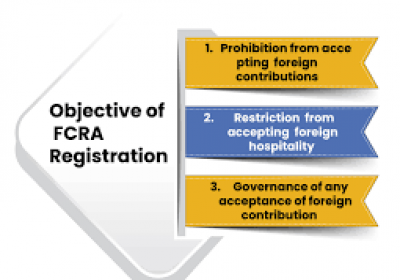
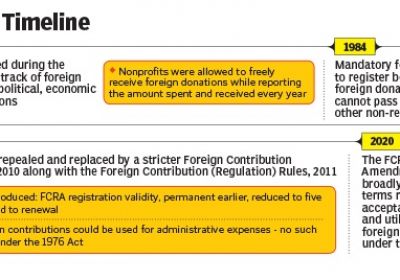
The objective of FCRA is to regulate the acceptance and utilization of foreign contributions and foreign hospitality to ensure that such funds do not adversely affect India's sovereignty, public interest, national security, or democratic institutions. The Act is administered by the Ministry of Home Affairs (MHA).
2. Major 2026 Changes Currently in Force:
The 2026 Rules have significantly changed the compliance framework for NGOs and charitable organizations receiving foreign funds.
A. Purpose-Based and State-Based Registration
FCRA registrations must now specify approved purpose(s) and approved state(s)/UT(s). Foreign contributions can only be utilized for the approved purposes and within the approved geographical areas. Existing NGOs are required to file FC-6F within one year to update their registrations.
B. Definition of Key Functionary
A new definition of "Key Functionary" has been introduced, covering directors, trustees, partners, members of the governing body, Karta of HUF and Any person controlling management. This definition is now central to all FCRA compliance requirements.
C. New Schedule of Activities
Only activities falling under approved categories can receive and utilize foreign contributions Religious, Cultural, Economic, Educational and Social. The schedule contains detailed sub-classifications for each category.
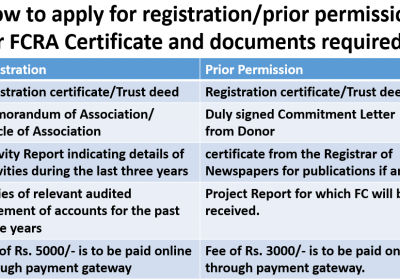
3. Registration and Prior Permission
Organizations can receive Foreign Contribution through:
- Registration (FC-3A) : Valid for 5 years, Suitable for established NGOs, Minimum 3 years track record and Minimum INR 15 lakh programme expenditure
- Prior Permission (FC-3B): Project-specific approval, donor-specific approval, and suitable for newly formed NGOs. provides a detailed comparison between FC-3A and FC-3B.
4. New Renewal Requirement (Rule 14A)
One of the most significant amendments. An organization must have utilized at least INR 10 lakh of foreign contribution in the last two financial years. Only expenditure from foreign contributions is considered. Domestic donations and activities funded through Indian sources do not count. This is called the Reasonable Activity Test and is crucial for renewal applications.
5. New Condition for Release of Subsequent Instalments
For organizations operating under prior permission: Before receiving the next installment At least 75% of earlier installments must be utilized, the MHA field inquiry must verify utilization, and the application must be filed through FC-3BB. This ensures stricter monitoring of project implementation.
6. FCRA Bank Account Rules
All foreign contributions must be received only in SBI, New Delhi Main Branch (NDMB), 11 Sansad Marg, New Delhi. Key restrictions under the Foreign Contribution (Regulation) Act, 2010, are that no domestic funds can be deposited into FCRA accounts, Separate books of accounts must be maintained, and additional utilization accounts may be opened in other banks, but receipts cannot be directly credited there.
7. FC-4 Annual Return Changes
The annual return filing process has become more stringent. New requirements include a detailed activity report, project-wise utilization, location-wise utilization, Disclosure of publications, Website and social media details, Donor disclosures in certain cases, Mandatory UDIN on CA certificate, and a separate UDIN on audited financial statements. FC-4 remains due on 31 December every year. Even NIL returns are compulsory.
8. Administrative Expense Limit
Administrative expenses continue to be restricted to 20% of foreign contributions. Typical administrative expenses include salaries of key functionaries, Rent, utility expenses, professional fees, and accounting expenses. The 2024 amendment introduced a beneficial provision allowing unspent administrative capacity to be carried forward to the next year, subject to disclosure.
9. Transfer of Foreign Contribution Prohibited
Following the Foreign Contribution (Regulation) Act, 2020 amendment: No NGO can transfer foreign contribution to another NGO. Earlier sub-grant models are no longer permissible. Penalty: INR 100,000 or 10% of the amount transferred, whichever is higher.
10. Treatment of Interest and Income
The Foreign Contribution (Regulation) Act, 2010, treats interest earned on FCRA deposits, interest on FD, rent from assets purchased through FC and income derived from foreign contributions as foreign contributions themselves. Accordingly, such income must remain within FCRA accounts, must be reported in FC-4, and Can be used only for approved objectives.
11. Gifts from Relatives:
A very important practical provision. Foreign remittances from relatives Do not require FCRA registration, and Do not require prior permission. However If aggregate receipts exceed INR 10 lakh in a financial year. FC-1 must be filed within 3 months as an intimation to MHA. No approval is required.
12. Common Audit Findings in the Foreign Contribution (Regulation) Act, 2010 (FCRA):
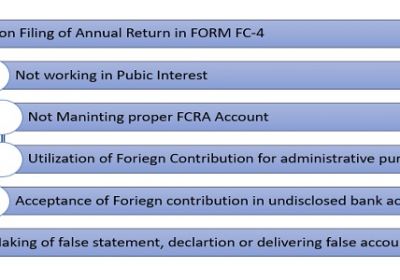
The Foreign Contribution (Regulation) Act, 2010 (FCRA), identifies major mistakes noticed during audits:
- Mixing domestic and FCRA funds.
- Late filing of FC-4.
- Failure to file FC-6 changes.
- Wrong treatment of OCI donations.
- Investment in mutual funds.
- Direct receipt in utilization accounts.
- Ignoring Rule 14A renewal threshold.
13. Penalties Under the Foreign Contribution (Regulation) Act, 2010 (FCRA)
Major penalties include:
|
Violation |
Penalty |
|
Unauthorized foreign hospitality |
INR 10,000 |
|
Transfer of FC to another NGO |
INR 1 lakh or 10% of FC |
|
Admin expenses above 20% |
INR 1 lakh or 5% of FC |
|
Accepting FC without registration |
INR 1 lakh or 10% of FC |
|
Depositing domestic funds in FCRA account |
INR 1 lakh or 2% of deposit |
|
Non-filing of FC-4 |
INR 1 lakh or 5% of FC |
Key Takeaway for NGOs and Chartered Accountants
The Foreign Contribution (Regulation) Act, 2010 (FCRA) 2026 amendments shift FCRA from a simple registration and reporting regime to a purpose-based, state-based, highly monitored compliance framework. Organizations must now focus on purpose-wise approvals, state-wise approvals, FC-6F compliance, INR 10 lakh utilization requirement for renewal, the 75% utilization condition for subsequent grants, enhanced FC-4 disclosures, strict separation of domestic and foreign funds, and UDIN-based certification by chartered accountants. These amendments significantly increase accountability, transparency, and regulatory oversight over foreign-funded activities in India.