TDS on Buying Property from an NRI: TAN Requirement Removed From 1 October 2026
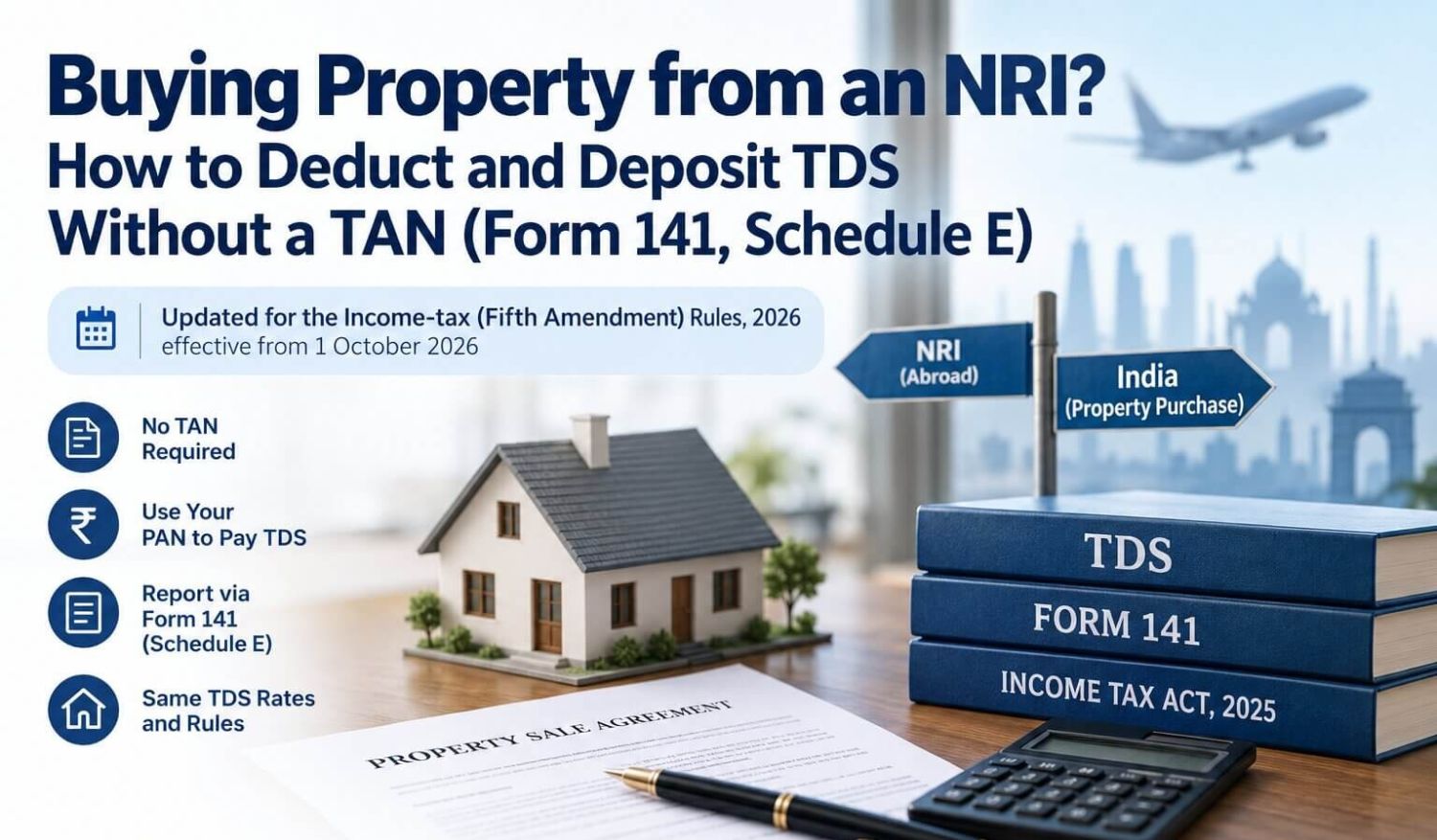
Starting 1 October 2026, a resident individual or HUF who purchases immovable property from a non-resident will not have to obtain a TAN to deduct and deposit TDS. The CBDT has notified the Income-tax (Fifth Amendment) Rules, 2026 (Notification No. 121/2026, G.S.R. 830(E), dated 22 September 2026). Under these rules, the buyer can deduct, pay and report the tax under their own PAN through Form 141, the challan-cum-statement, by completing the newly added Schedule E.
To achieve this, the notification amends Rules 215(1), 218(3) and 219(5) and updates Forms 141 and 132. Together, these changes place purchases from NRI sellers on the same simplified track that has long applied to purchases from resident sellers. An individual buyer no longer has to register as a deductor or file periodic TDS returns merely because of one property deal. The relaxation is, however, limited to resident individuals and HUFs. Companies, firms and LLPs buying from an NRI must continue to obtain a TAN. An NRI purchasing from another NRI also falls outside this route, since the deductor has to be a resident.
Relief for NRI and OCI Sellers
The change also benefits NRIs and OCIs selling property in India. Under the earlier system, the buyer had to obtain a TAN, deduct and deposit the tax, file quarterly TDS returns and then issue a TDS certificate. Buyers unfamiliar with these steps often filed late, filed incorrectly or did not file at all. As a result, NRI sellers frequently found that their TDS credit did not appear in their tax records, even though the tax had already been deducted from the sale price.
Schedule E of Form 141 replaces this multi-step process with a single, transaction-wise filing. The buyer reports the details of the property, the buyers, the non-resident seller, the sale consideration and stamp duty value, the type of capital gain, the rate of TDS and other particulars. It also records any lower or nil deduction certificate, so that tax can be deducted in line with the seller's actual liability.
What Remains the Same
The amendment changes only the procedure; it does not alter the tax.
- Rates. TDS continues at 12.5% plus surcharge and cess where the gain is long-term (property held for more than 24 months). Where the gain is short-term, TDS is at the applicable slab rate, which in practice usually means 30% plus surcharge and cess.
- No threshold. The ₹50 lakh limit applies only to resident sellers. TDS applies to every purchase from an NRI, whatever its value.
- Base of deduction. Tax is deducted on the entire sale consideration, not on the seller's actual gain, unless a lower or nil deduction certificate has been obtained. This can be under section 395(1), which the seller applies for in Form 128, or under section 395(2).
- Buyer's liability. Responsibility for any short deduction or late deposit still rests with the buyer.
To illustrate, take a ₹1.2 crore flat sold by an NRI who has held it for several years, with no certificate in place. The effective TDS rate is 14.95%, so TDS works out to ₹17.94 lakh. Where a husband and wife buy the flat jointly, each is a separate deductor and must file a separate Form 141 for their 50% share.
Information Required in Schedule E
Schedule E asks for considerably more detail than the form used for resident sellers. For every seller, the buyer must provide:
- PAN (where available), status code and the seller's share of the consideration.
- Address in the country of residence, phone number and email. These are compulsory even if the seller holds a PAN.
- Tax Residency Certificate (TRC) number and foreign Tax Identification Number (TIN).
The Schedule also asks for:
- The details of all buyers and the stamp duty value and total sale consideration.
- Whether payment is in instalments, with earlier acknowledgement numbers.
- Whether the seller has opted out of the default tax regime.
- The type of capital gain and any certificate numbers.
- The acknowledgement number of the related Form 145.
Where the seller has no PAN, furnishing a valid TRC and TIN prevents deduction at the higher rate. Even so, the seller should obtain a PAN well in advance, as it will be needed for Form 128, the Indian tax return and any refund claim.
Practical Steps and Pitfalls
The buyer should gather all the seller's details before signing the agreement. On each payment, the buyer deducts TDS including surcharge and cess, deposits it through Form 141 by the due date, and issues the TDS certificate to the seller.
Mistakes seen frequently in practice include:
- Leaving out surcharge and cess from the TDS amount.
- Joint buyers filing only one form between them.
- Deducting at the 1% rate meant for resident sellers.
- Accepting the seller's verbal statement about residential status without documents.
- Misplacing acknowledgement numbers needed for later instalments.
- Applying the new procedure to payments made before 1 October 2026.
Benefit for NRI Sellers
For NRI sellers, the most tangible gain is faster credit. Because each transaction is reported on its own, TDS credit and certificates should reach the seller sooner. This makes it easier to file the Indian income tax return, claim a refund where the TDS exceeds the actual tax, and complete repatriation of the proceeds through the authorised dealer bank.
Overall, the reform lowers the compliance burden on buyers and gives NRI and OCI sellers quicker access to their TDS credit. It should make property transactions involving non-residents smoother and less prone to disputes.
For assistance with TDS computation, Form 141 filings, lower deduction certificates, and repatriation of sale proceeds, contact Rajput Jain & Associates, Chartered Accountants, New Delhi | +91-98-11-322-785 | info@carajput.com | www.carajput.com