Table of Contents
Taxation of Exchange Traded Funds (ETFs) in India
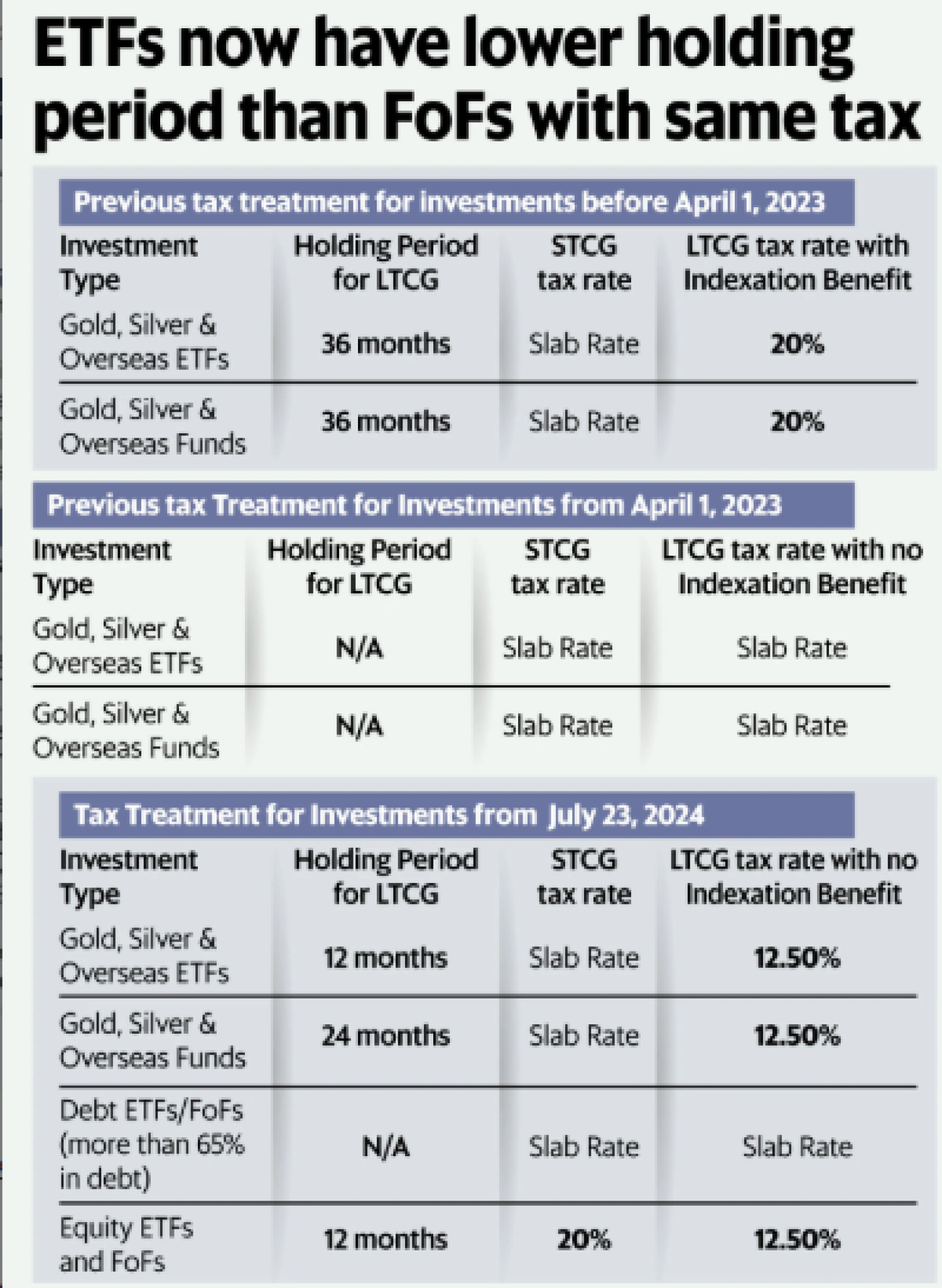
The tax treatment of Exchange Traded Funds (ETFs) depends on the underlying asset (equity, gold, silver, debt, etc.) and the holding period. The classification determines whether the gain is taxed as a Short-Term Capital Gain (STCG) or a **Long-Term Capital Gain (LTCG).**
Why is it non-speculative business income?
A transaction is speculative only when there is no actual delivery of the security. Since Exchange Traded Fund units are purchased and held in a demat account before being sold, delivery takes place. Therefore, ETF trading is generally treated as non-speculative business activity when offered under the head "Profits and Gains from Business or Profession."
Factors supporting business treatment: large number of transactions, short holding period, regular and organized activity, intention to earn trading profits rather than investment returns, and maintenance of closing stock at year-end.
Tax Rate
There is no special tax rate for business income from delivery-based exchange-traded fund trading. The net profit is added to your total income and taxed at normal slab rates. Example
|
Particulars |
Amount (INR ) |
|
Salary Income |
8,00,000 |
|
ETF Trading Profit |
6,00,000 |
|
Total Income |
14,00,000 |
Tax will be calculated on INR 14,00,000 as per the applicable regime.
- Unlike capital gains: No 20% LTCG rate, No 12.5%/15% special STCG rate and Normal slab taxation applies
- Expenses Allowed as Deduction: When ETF trading is treated as business income, you can claim genuine business expenses incurred wholly and exclusively for the trading activity.
- Examples: Brokerage, exchange transaction charges, Demat charges, research and analytical software, trading terminal subscription, Internet expenses, advisory fees, accounting and audit fees, and office expenses attributable to trading activity. Details Example
|
Particulars |
Amount (INR ) |
|
Trading Profit Before Expenses |
7,00,000 |
|
Brokerage |
(40,000) |
|
Internet & Software |
(15,000) |
|
Advisory Charges |
(20,000) |
|
Net Taxable Business Income |
6,25,000 |
Equity Exchange Traded Funds: Examples: Nifty 50 ETF, Sensex ETF, Bank Nifty ETF, Bharat 22 ETF. These ETFs invest predominantly in listed Indian equities.
Short-Term Capital Gain (STCG):
Where Exchange Traded Funds units are sold within 12 months from the date of purchase:
- Gain is treated as STCG.
- Tax rate: 20% under Section 111A.
- STT must be paid for the sale transaction.
Example: Purchase Value: INR 5,00,000, Sale Value: INR 6,20,000, and then Gain: INR 1,20,000. In this case Holding Period: 8 months. Then Taxable STCG = INR 1,20,000. So, Tax = INR 24,000 (20%) + applicable cess.
Long-Term Capital Gain (LTCG)
Where units are held for more than 12 months Gain qualifies as LTCG. Exemption available up to INR 1,25,000 in a financial year. Gain exceeding INR 1,25,000 taxable at 12.5% u/s 112A. for Example:
LTCG = INR 3,50,000
Less: Exemption = INR 1,25,000
Taxable LTCG = INR 2,25,000
Tax = INR 28,125 (12.5%)
Gold Exchange Traded Funds and Silver Exchange Traded Funds
Examples: Nippon Gold ETF, HDFC Gold ETF, ICICI Prudential Silver ETF and SBI Silver ETF.
- Gold and Silver ETFs are non-equity ETFs.
- Short-Term Capital Gain (STCG) : If sold within 12 months: Gain is treated as STCG. And taxed at normal slab rates. Example Assessee in 30% slab:
- Gold ETF Gain = INR 2,00,000
- Holding Period = 8 months
- Tax = INR 60,000 + applicable cess
- No concessional tax benefit is available.
Long-Term Capital Gain (LTCG) : If held for more than 12 months: Tax Rate = 12.5% then No indexation benefit. For Example
- Purchase Cost = INR 5,00,000
- Sale Value = INR 8,00,000
- LTCG = INR 3,00,000
- Tax = INR 37,500 (12.5%)
Debt Exchange Traded Funds (ETFs)
- Examples: Bharat Bond ETF, government bond ETFs, corporate bond ETFs. For units acquired on or after 1 April 2023.
- Tax Treatment: No distinction between short-term and long-term gain. And Entire gain taxed at normal slab rates. Moreover, No indexation benefit.
Dividend Income from ETFs
- Any dividend received from Equity ETFs, Gold ETFs, Silver ETFs, Debt ETFs is taxable in the hands of the investor.
- Tax Treatment: Added to total income. And taxed at normal slab rates. For Example, Dividend Received = INR 50,000, Slab Rate = 30% and then Tax = INR 15,000 + cess
Treatment of Expenses: While computing capital gains:
- Allowed: Brokerage, Exchange charges, stamp duty, and Transfer-related expenses
- Not Allowed: Securities Transaction Tax (STT)
Gold & Silver ETF (Exchange Traded Funds) Trading case:
- 559 Buy transactions, 559 Sell transactions, most trades closed within a week, Maximum holding period 111 days and Closing stock remaining.
- If Treated as Capital Gains: Since all holdings are below 12 months: Entire gain would be STCG and Taxed at slab rates
- If Treated as Business Income: Considering the large volume and frequency of transactions, the Income Tax Department may view the activity as an organized trading business rather than investment activity.
Treatment of Securities Transaction Tax
A common misconception is that STT is deductible. Under current income-tax provisions, Securities Transaction Tax (STT) is not allowable as a deduction while computing business income. Therefore Securities Transaction Tax cannot be claimed as an expense. Brokerage and other trading charges can be claimed.
Loss Set-Off Benefit: One major advantage of business classification is loss treatment.
- Current Year Set-Off: Non-speculative business loss can be adjusted against Business income and Speculation profits (subject to conditions)
- Carry Forward: Unabsorbed non-speculative business loss can be carried forward for 8 assessment years and adjusted against future business income. For Example, FY 2025-26: ETF Trading Loss = INR 4,00,000. FY 2026-27: Business Profit = INR 6,00,000.
- Set-off available: INR 6,00,000 − INR 4,00,000 = INR 2,00,000 taxable profit.
Closing Stock Treatment
- Since you have unsold ETF units at year-end, they will be shown as Closing Inventory/Closing Stock. In case Trading Account
|
Particulars |
Amount |
|
Opening Stock |
xxx |
|
Add: Purchases |
xxx |
|
Less: Closing Stock |
xxx |
|
Cost of Goods Sold |
xxx |
The valuation should generally be cost or net realizable value (NRV), whichever is lower.
Turnover Calculation
- For delivery-based share/ETF trading treated as business income, professionals generally consider: Turnover = Aggregate Sale Value of ETF Units Sold
- Some professionals may also prepare turnover based on ICAI guidance depending upon facts and reporting requirements. For Example
|
Particulars |
Amount |
|
Total Purchases |
INR 1.80 Crore |
|
Total Sales |
INR 1.95 Crore |
|
Net Profit |
INR 15 Lakh |
Business turnover may be considered around INR 1.95 crore for tax audit evaluation purposes.
Tax Audit Applicability on Exchange Traded Funds
- Tax audit u/s 44AB may become applicable if turnover exceeds prescribed limits. For traders having nearly all transactions through banking channels, the enhanced threshold may be available subject to statutory conditions. Therefore, turnover should be computed carefully before determining audit applicability.
ITR Reporting on Exchange Traded Funds
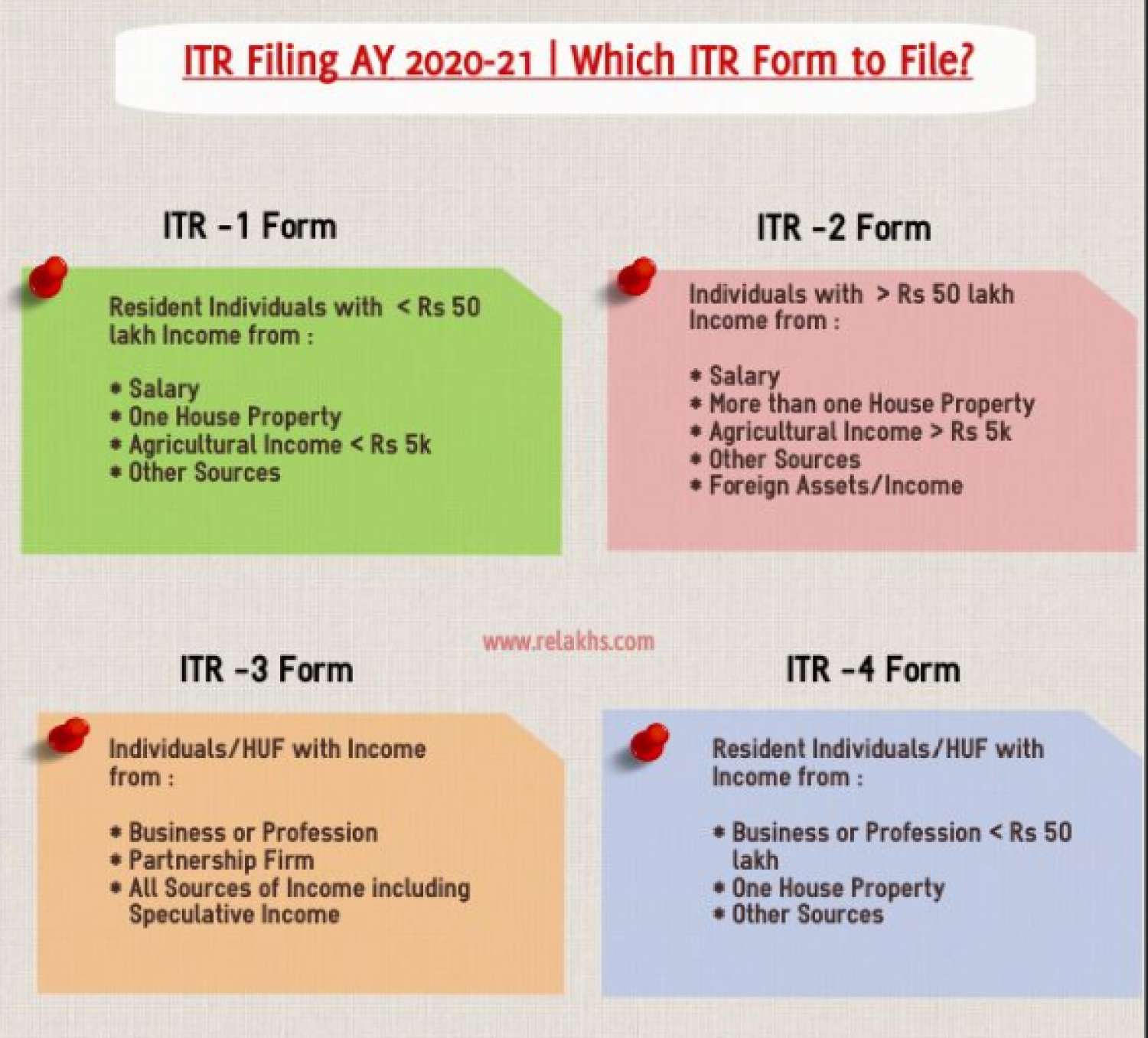
In ITR-3
- Nature of Business Code: 21011
- Head of Income: Business or Profession
- Trading Profit/Loss: P&L Account
- Unsold ETF Units: Closing Stock
- Balance in Demat Account: Closing Inventory
- Claim eligible business expenses
Question:
Regular trading of gold & silver ETFs during FY 2025-26: 559 buys & 559 sells, all buys & sells executed within a week max (111 days), having some closing stock is eligible under which code in Business & Profession in ITR3?
Answer:
Business Code 21011 – Buying and Selling of Shares (Delivery-Based Trading as Business Income)
- For a person who has regularly traded Gold ETFs and Silver ETFs during FY 2025-26 with 559 purchase transactions and 559 sale transactions, most holdings were sold within a week (maximum holding period 111 days), there was frequent and systematic trading activity, and some units remained as closing stock at year-end.
- the activity is more likely to be treated as business income rather than capital gains, based on the volume, frequency, and intention of trading. CBDT Circular No. 6/2016 also recognizes that frequent trading may be treated as business income.
Nature of Business Code in ITR-3
- Since ETF units are securities and the activity involves regular purchase and sale as a business, the appropriate code would generally be 21011 – Buying and Selling of Shares (Delivery-based trading treated as business income).
Why not 21009 or 21010?
- 21009: Speculative Trading (Intraday) applies where no delivery is made.
- 21010: Futures & Options Trading applies only to derivatives.
- Gold ETF / Silver ETF purchased and sold with delivery through a demat account is closest to 21011.
Reporting in ITR-3
If offered as business income:
- Opening Stock: Nil (if first year)
- Purchases: ETF purchases during the year
- Sales/Turnover: ETF sales during the year
- Closing Stock: Value of unsold ETF units as on 31.03.2026
- Business Code: 21011
Practical opinion responses from professionals:
Considering 559 buy transactions, 559 sell transactions, Very short holding period, continuous trading throughout the year, and gold ETFs and silver ETFs held as stock-in-trade. For 559 buy and 559 sell transactions, I would generally recommend File ITR-3, Offer income under Profits and Gains of Business or Profession, selecting Nature of Business Code 21011, and maintaining a working of turnover and profit/loss from ETF trading. The facts strongly support Business Income (Non-Speculative Business) under ITR-3 with Business Code 21011—Buying and Selling of Shares—rather than Capital Gains treatment.
However, if the assessee has historically shown identical ETF transactions as capital gains, consistency of treatment should also be examined before changing the reporting position. So we have to check applicability of tax audit u/s 44AB based on turnover and other conditions. In this case, we have to use Business Code 21011 – Buying and Selling of Shares (Delivery-Based Trading as Business Income). In that case:
- File ITR-3
- Business Code: 21011 – Buying and Selling of Shares
- Income taxable under "Profits and Gains from Business or Profession"
- Deduct eligible business expenses
- Unsold ETF units shown as closing stock
- Losses carried forward as non-speculative business losses