Table of Contents
- Materiality Cannot Override Mandatory Disclosure Requirements: Auditor's Responsibilities Explained
- Mandatory Disclosure And Materiality Are Different Concepts
- Legal Requirement Comes First
- Materiality Matters, But At A Later Stage
- Auditor's Approach When A Disclosure Is Omitted
- Impact On The Audit Report
- Important Icai Disciplinary Committee Guidance
- Key Takeaway—materiality Cannot Override Mandatory Disclosure Requirements:
Materiality Cannot Override Mandatory Disclosure Requirements: Auditor's Responsibilities Explained
A common question during the preparation and audit of financial statements is whether a disclosure prescribed by law can be omitted simply because the amount involved is insignificant. The answer is generally no. While materiality is a key audit concept, it does not provide an exemption from complying with mandatory disclosure requirements prescribed under the Companies Act, 2013, Schedule III, applicable accounting standards, or other statutory regulations.
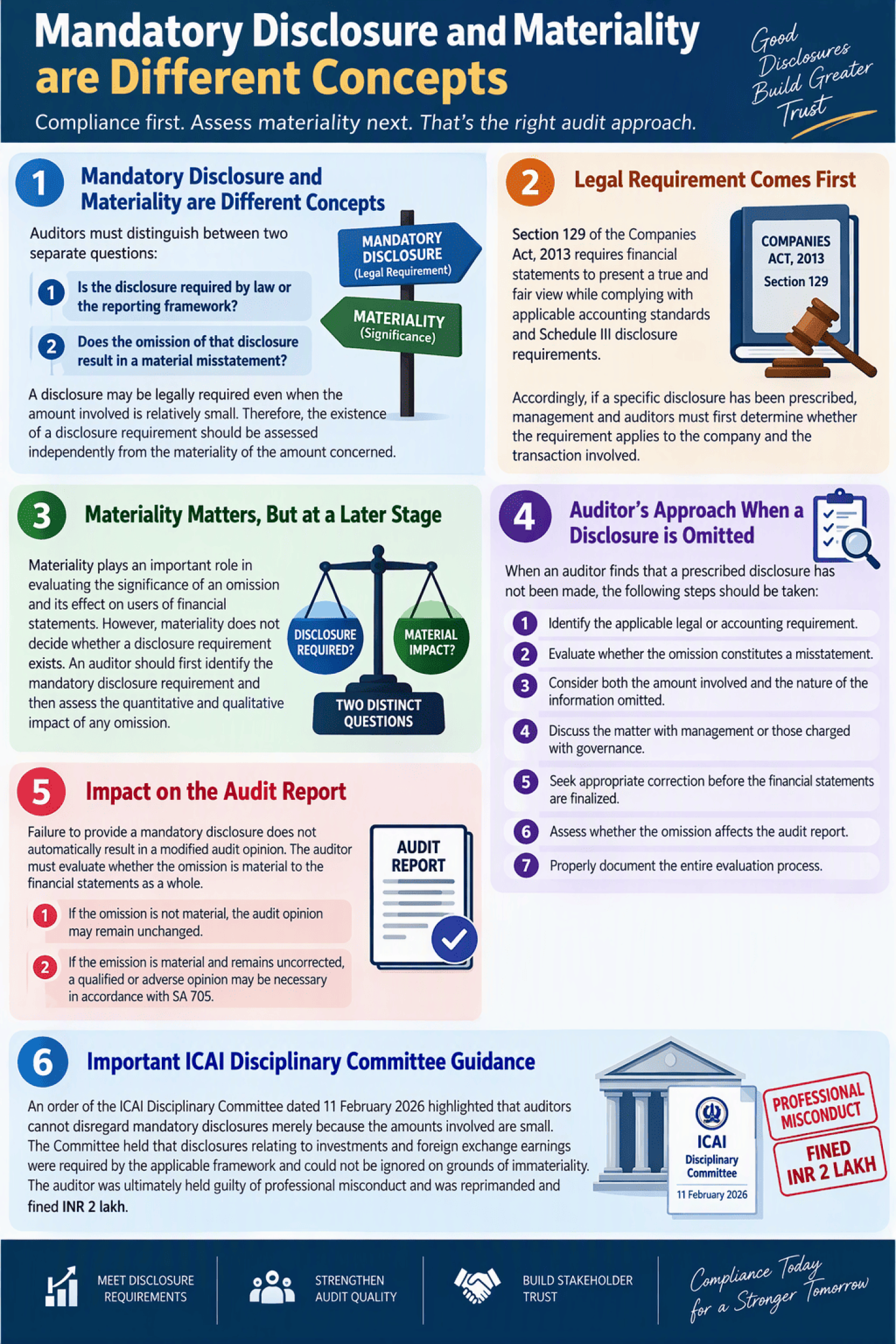
Mandatory Disclosure and Materiality are Different Concepts
Auditors must distinguish between two separate questions:
- Is the disclosure required by law or the reporting framework?
- Does the omission of that disclosure result in a material misstatement?
A disclosure may be legally required even when the amount involved is relatively small. Therefore, the existence of a disclosure requirement should be assessed independently from the materiality of the amount concerned.
Legal Requirement Comes First
Section 129 of the Companies Act, 2013 requires financial statements to present a true and fair view while complying with applicable accounting standards and Schedule III disclosure requirements. Accordingly, if a specific disclosure has been prescribed, management and auditors must first determine whether the requirement applies to the company and the transaction involved.
Materiality Matters, But at a Later Stage
Materiality plays an important role in evaluating the significance of an omission and its effect on users of financial statements. However, materiality does not decide whether a disclosure requirement exists. An auditor should first identify the mandatory disclosure requirement and then assess the quantitative and qualitative impact of any omission.
Auditor's Approach When a Disclosure is Omitted
When an auditor finds that a prescribed disclosure has not been made, the following steps should be taken:
- Identify the applicable legal or accounting requirement.
- Evaluate whether the omission constitutes a misstatement.
- Consider both the amount involved and the nature of the information omitted.
- Discuss the matter with management or those charged with governance.
- Seek appropriate correction before the financial statements are finalized.
- Assess whether the omission affects the audit report.
- Properly document the entire evaluation process.
Impact on the Audit Report
Failure to provide a mandatory disclosure does not automatically result in a modified audit opinion. The auditor must evaluate whether the omission is material to the financial statements as a whole.
- If the omission is not material, the audit opinion may remain unchanged.
- If the omission is material and remains uncorrected, a qualified or adverse opinion may be necessary in accordance with SA 705.
Important ICAI Disciplinary Committee Guidance
An order of the ICAI Disciplinary Committee dated 11 February 2026 highlighted that auditors cannot disregard mandatory disclosures merely because the amounts involved are small. The Committee held that disclosures relating to investments and foreign exchange earnings were required by the applicable framework and could not be ignored on grounds of immateriality. The auditor was ultimately held guilty of professional misconduct and was reprimanded and fined INR 2 lakh.
Key Takeaway—Materiality Cannot Override Mandatory Disclosure Requirements:
Materiality is an essential audit tool for evaluating misstatements, but it does not replace statutory disclosure requirements. Auditors should first determine whether a disclosure is mandatory and then assess the consequences of its omission. A prescribed disclosure should never be treated as optional merely because the amount involved appears insignificant. Compliance with the applicable reporting framework remains the primary obligation