Table of Contents
- Detailed Analysis Of The 57th Gst Council Meeting (8 October 2026)
- 1. Major Itc Reforms
- 2. Refund Reforms
- 3. Arrest, Prosecution, And Penalty Relief
- 4. Relief For Goods In Transit
- 5. Registration And Return Reforms
- 6. Annual Return Quarterly Payment (arqp)
- 7. E-commerce Relief
- 8. No Gst Rate Changes
- Final Takeaway
Detailed Analysis of the 57th GST Council Meeting (8 October 2026)
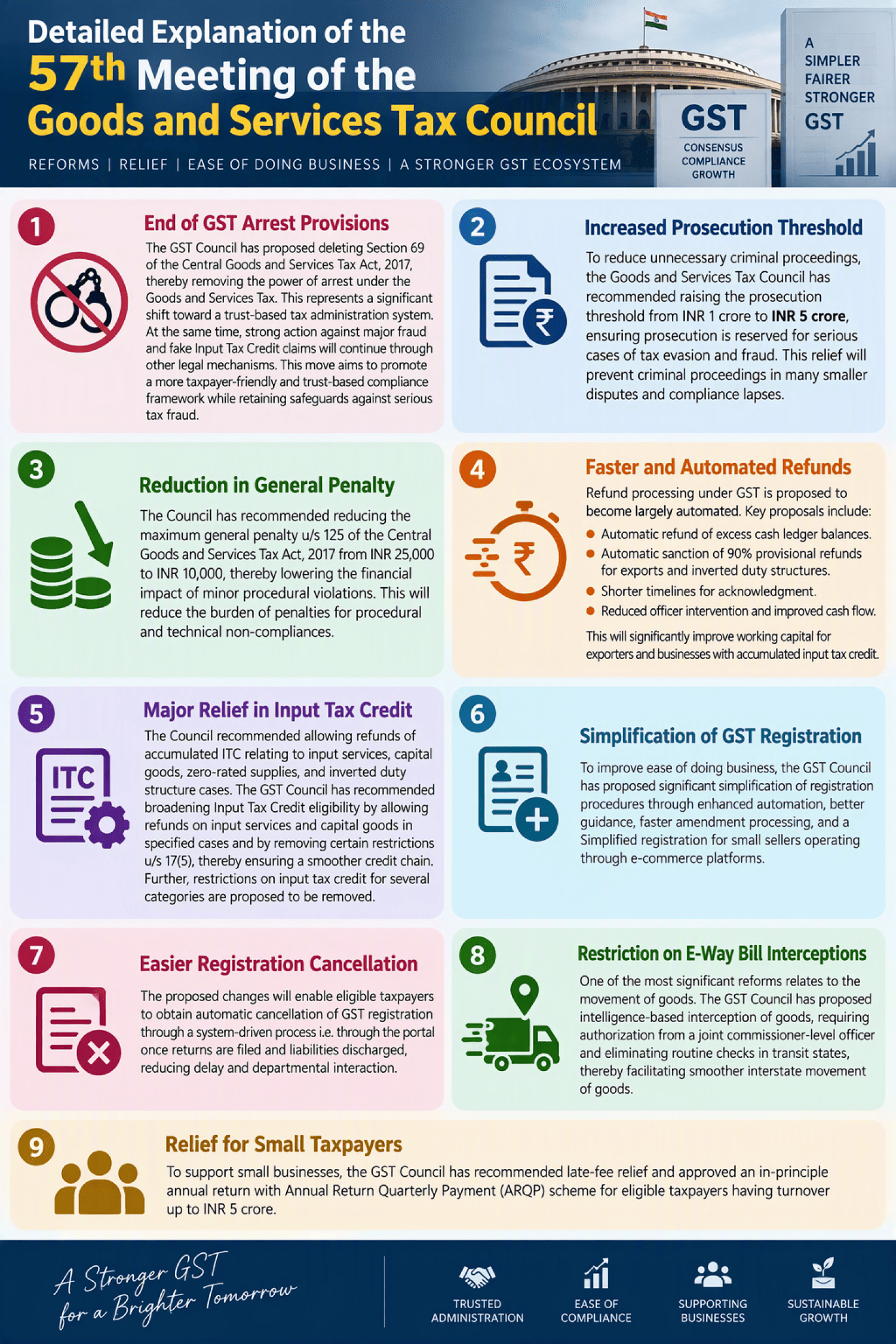
The 57th GST Council Meeting is one of the most significant reform-oriented GST meetings since the introduction of GST. Unlike earlier meetings that focused heavily on GST rate changes, this meeting concentrated on ease of doing business, faster refunds, wider Input Tax Credit (ITC), reduced litigation, and technology-driven compliance.
1. Major ITC Reforms
A. ITC Allowed on Previously Blocked Items
The Council has recommended removal of restrictions on ITC for several categories, including employee health insurance, employee life insurance, telecommunication towers and pipelines laid outside factory premises, and free samples. Goods destroyed or written off due to expiry of shelf life as required under law. This is a major amendment to Section 17(5) of the CGST Act. Businesses will be able to claim credits that were previously blocked, reducing the cascading effect of taxes and lowering operating costs.
B. Same-Line Business ITC Relief
Limited ITC will be permitted where services are procured and resold in the same line of business. Examples:
- Hotel accommodation up to ₹7,500 per room per day supplied through agents
- Restaurant and outdoor catering services
- Passenger transportation services
This will benefit travel companies, aggregators, event management companies, hospitality businesses, and service intermediaries.
C. Protection of Genuine Buyers
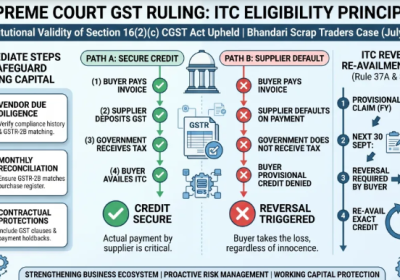
The Council has formed a Committee of Officers to examine safeguards for protecting ITC of bona fide purchasers where defaults occur at the supplier's end. This may significantly reduce disputes relating to Section 16(2)(c), where genuine recipients lose ITC due to supplier non-compliance.
2. Refund Reforms
- Inverted Duty Structure Refund on Input Services
Currently, a refund of accumulated ITC under the inverted duty structure is largely restricted. The Council has recommended allowing a refund of ITC relating to input services for credits availed on or after 1 November 2026. Impact industries such as textiles, pharmaceuticals, chemicals, and renewable energy will receive substantial working capital relief.
- Refund on Capital Goods
A landmark recommendation allows refund of ITC accumulated on capital goods in zero-rated supplies and inverted duty structure cases. The refund will be spread over 60 months (1/60th every month) for capital goods on which ITC is availed on or after 1 April 2027. Impact This will benefit manufacturers, exporters, infrastructure companies, and capital-intensive industries that invest heavily in machinery and equipment.
C. Faster Automated Refunds
The Council has proposed automatic sanction of excess cash ledger refunds, automatic processing without officer intervention, 90% provisional refund through system-based approval, and reduction in refund processing timelines. The objective is to improve liquidity and reduce departmental interaction.
3. Arrest, Prosecution, and Penalty Relief
A. Removal of GST Arrest Powers
The GST Council has recommended complete deletion of Section 69 of the CGST Act. Significance: No GST arrest powers, major move towards a trust-based tax regime, Reduces fear among genuine taxpayers, and Tax administration becomes more compliance-oriented rather than enforcement-driven.
B. Prosecution Threshold Increased
Threshold for prosecution proposed to be increased from INR 1 Crore → INR 5 Crore. This means criminal prosecution will generally be restricted to more serious tax fraud cases. Impact : Fewer criminal proceedings, Reduced compliance burden, Better business confidence.
C. Reduction in General Penalty
Maximum general penalty proposed to be reduced from INR 25,000 → INR 10,000. This will reduce the burden arising from minor procedural defaults.No Notice Below INR 10,000. The Council recommended a minimum threshold of INR 10,000 for issuing GST notices. Impact Small disputes will not result in litigation, Departmental resources can focus on larger cases, Significant reduction in unnecessary compliance costs.
4. Relief for Goods in Transit
This is one of the most taxpayer-friendly changes. The Council recommended interception only based on specific intelligence, prior approval of a joint commissioner or higher officer, transit states cannot routinely stop vehicles, generally, only source or destination states can inspect goods, and confiscation provisions will not apply merely because goods are in transit. Impact: Businesses involved in logistics and interstate trade will benefit through Faster movement of goods, Reduced harassment, Lower transportation delays, improved supply chain efficiency
5. Registration and Return Reforms
A. Auto-Approval of Amendments
The following changes are proposed to be automatically approved Trade name changes, Director changes, Partner changes, and additional places of business. This will drastically reduce processing delays.
B. Automated Registration Cancellation
The Council proposes a system-driven cancellation mechanism. Taxpayers whose Returns are filed and Liabilities are paid. may obtain registration cancellation automatically. The final return process will also be merged into the closure application.
C. ITC Through IMS
The Invoice Management System (IMS) will become central to ITC matching and reporting. Taxpayers will be able to Accept invoices, Reject invoices, Keep invoices pending before they are reflected in ITC statements. This is expected to significantly reduce ITC mismatches and notices.
6. Annual Return Quarterly Payment (ARQP)
The Council approved, in principle, a new compliance scheme for B2C taxpayers, Turnover up to ₹5 crore, Under this scheme Annual return filing may be allowed and Tax payment will be quarterly. Impact This will significantly reduce compliance burden for small businesses and retail traders.
7. E-Commerce Relief
Small sellers supplying through e-commerce platforms will be allowed to Use the warehouse of an Electronic Commerce Operator (ECO) located in another State. Declare it as their Principal Place of Business. without creating a separate physical establishment in that State. Impact : This will Boost online commerce, Help MSMEs sell pan-India, Reduce registration challenges and Improve ease of doing business for small sellers.
8. No GST Rate Changes
Importantly, the Council has made no changes to GST rates. The Council also indicated that future GST rate rationalisation matters may be considered separately in a dedicated annual meeting.
Key Dates:* Inverted duty refund for services from Nov 1, 2026; procedural & capital goods reforms from April 1, 2027.
Final Takeaway
The 57th GST Council Meeting focuses on compliance simplification rather than tax rate changes. The proposed reforms expand ITC eligibility, accelerate refunds, remove arrest powers, increase prosecution thresholds, reduce penalties, simplify registrations, restrict unnecessary vehicle interceptions, and provide major relief to small businesses and e-commerce sellers. If implemented through the necessary legal amendments and notifications, these reforms could represent one of the most business-friendly overhauls of the GST framework since its introduction