Table of Contents
- Cbdt Sharpens Focus On Form 15cb / Form 146 Certifications And Overseas Remittances
- How Did The Investigation Start On Form 15cb / Form 146 Certifications And Overseas Remittances?
- Why Has Form 15cb / Form 146 Come Under Focus For Investigation?
- Legal Responsibility Of The Certifying Chartered Accountant
- Key Takeaways For Businesses Making Foreign Remittances
- Important Message For Chartered Accountants For Issue Of form 15cb / Form 146
- Conclusion
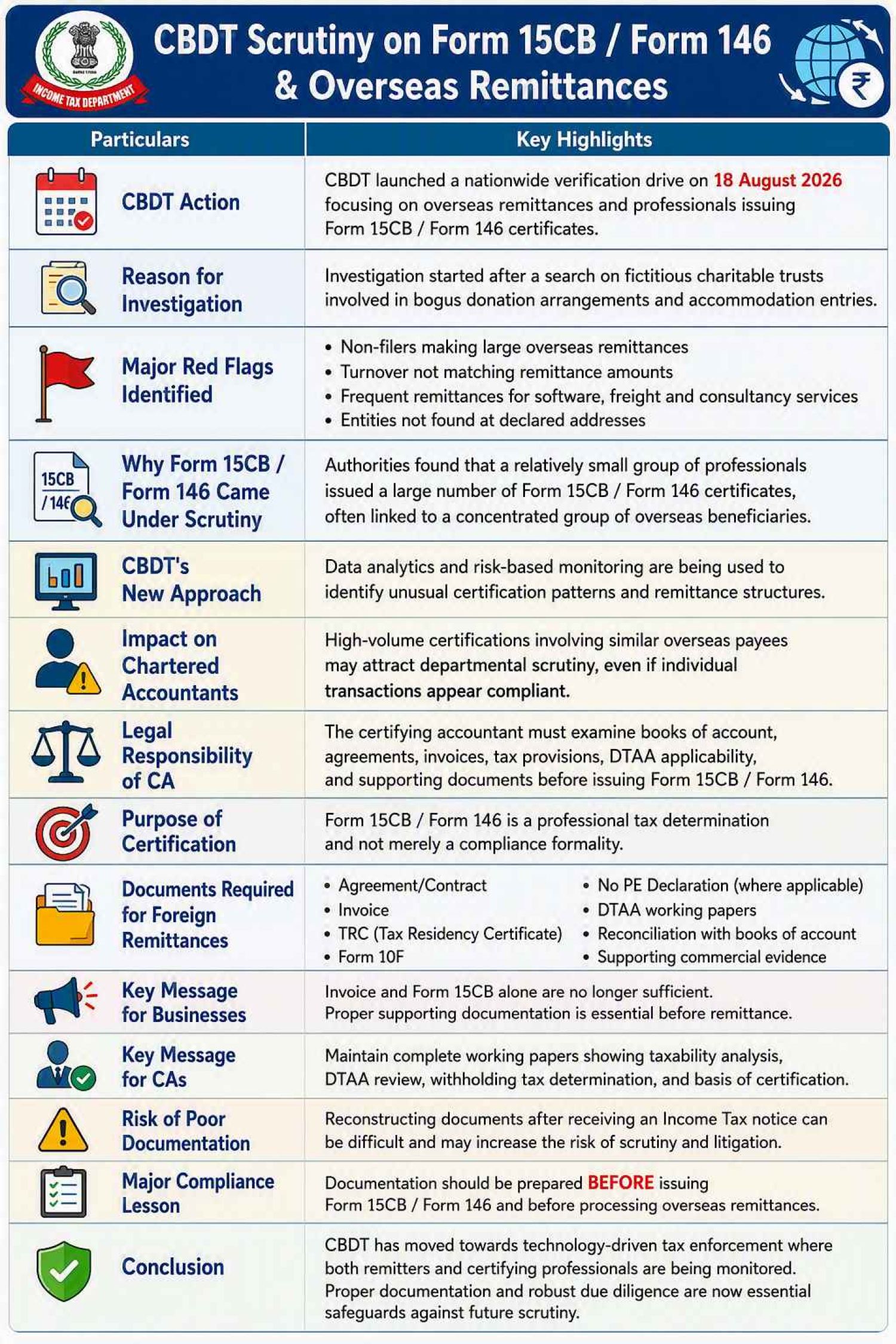
CBDT Sharpens Focus on Form 15CB / Form 146 Certifications and Overseas Remittances
The Central Board of Direct Taxes (CBDT) has significantly intensified its scrutiny of overseas remittances and the professional certifications supporting them. Through a nationwide verification initiative announced on 18 August 2026, the Income Tax Department has targeted hundreds of entities involved in outward foreign remittances and, notably, several professionals who issued Form 15CB / Form 146 certificates. The development serves as a strong reminder that compliance in foreign remittance transactions is no longer limited to taxpayers alone; chartered accountants certifying such transactions are equally under the regulatory spotlight.
How did the investigation start on Form 15CB / Form 146 certifications and overseas remittances?
The investigation originated from a search action conducted on a network of fictitious charitable trusts allegedly engaged in facilitating accommodation entries through bogus donation arrangements.
During the course of the investigation, authorities uncovered a broader network of entities involved in sending funds overseas. Subsequent data analytics and verification of foreign remittance records revealed several red flags, including:
- Taxpayers who were non-filers despite remitting substantial amounts abroad.
- Entities reporting turnovers that were inconsistent with the magnitude of foreign remittances.
- Frequent use of remittance purposes such as Freight charges, Software imports and Consultancy service imports
- Businesses that were either non-existent or untraceable at their declared addresses.
These findings prompted a broader verification exercise focused on both remitters and the professionals certifying such transactions.
Why Has Form 15CB / Form 146 Come Under Focus for Investigation?
Perhaps the most significant aspect of the exercise is the specific attention given to Form 15CB / Form 146 certifications.
- The tax authorities observed that a disproportionately large number of Form 15CB / Form 146 certificates were issued by a relatively small group of professionals, while the remitted amounts were being routed to a concentrated set of overseas beneficiaries.
- This indicates a shift towards data-driven risk assessment rather than traditional case-specific inquiries. In other words, the Income Tax Department is now using analytics to identify unusual certification patterns, making factors such as volume, concentration of beneficiaries, and repetitive remittance structures key triggers for examination.
- As a result, Chartered Accountants issuing a large number of Form 15CB certificates for payments to similar overseas entities may attract regulatory attention, even where individual transactions appear compliant.
Legal Responsibility of the Certifying chartered Accountant
- The legal obligation relating to Form 15CB / Form 146 remains unchanged, but its enforcement is becoming increasingly rigorous.
- Under the Income Tax Rules, the accountant issuing Form 15CB / Form 146 is required to determine the taxability of the proposed foreign remittance after examining books of account, supporting agreements, nature of payment, relevant tax provisions, applicable Double Taxation Avoidance Agreements (DTAAs), and other supporting records and documents.
- The certification is not intended to be a routine compliance formality. Instead, it represents a professional conclusion regarding the tax implications of the remittance based on adequate verification.
Key Takeaways for Businesses Making Foreign Remittances
Businesses can no longer rely on a remittance file consisting merely of an invoice and a signed Form 15CB. A robust documentation file should ideally contain:
- Underlying agreement or contract
- Invoice and supporting commercial documents
- Tax Residency Certificate (TRC)
- Form 10F
- No Permanent Establishment (PE) Declaration, wherever relevant
- Working papers supporting treaty benefits
- Internal note reconciling remittance amounts with books of account
- Supporting evidence for business purpose and commercial substance
Where large remittances are involved, maintaining this documentation before the transaction is processed can significantly reduce future litigation risks.
Important Message for Chartered Accountants for issue of Form 15CB / Form 146
For chartered accountants, the recent action highlights the importance of maintaining comprehensive documentation and professional working papers before issuing Form 15CB / Form 146. A robust certification file should clearly demonstrate the following:
- Basis of taxability determination.
- Examination of agreements and invoices.
- Verification of treaty eligibility.
- Analysis of withholding tax obligations.
- Rationale for tax exemption or reduced withholding rates, where claimed.
Attempting to reconstruct documentation after receiving a departmental notice may prove challenging and could expose the certifying professional to unnecessary scrutiny.
Conclusion
The CBDT's latest verification drive marks a new era of technology-driven tax enforcement in the area of foreign remittances. The focus is no longer limited to the remitting entities but extends to the professionals certifying such transactions. Businesses and chartered accountants should therefore adopt a more disciplined documentation framework, ensuring that every Form 15CB / Form 146 certification is supported by adequate evidence, proper tax analysis, and contemporaneous records. In today's compliance environment, a well-documented remittance file is no longer a best practice; it is an essential safeguard against future scrutiny.