Table of Contents
Residential Status & DTAA Framework: A Comprehensive Guide
Under this blogs, we are going to discuss the residential status of individuals and the residential status of entities. We will explain in Place of Effective Management (POEM)
Residential Status & DTAA Framework
With increasing globalization, individuals are working across countries, businesses are operating in multiple jurisdictions, and investments are flowing across borders. In such a scenario, determining
Residential Status of Individuals
the residential status of a person or entity becomes crucial because it determines the scope of taxation in India. Further, where income is taxable in more than one country, the provisions of the Double Taxation Avoidance Agreement (DTAA) help in allocating taxing rights and preventing double taxation.
Why is Residential Status Important?
The taxability of an individual's income in India depends primarily upon his or her residential status. Residential status determines:
- Whether global income is taxable in India.
- Whether only Indian-source income is taxable.
- Eligibility for certain exemptions and DTAA benefits.
- Foreign income disclosure requirements.
It is important to understand that residential status is not based on citizenship or nationality. An Indian citizen may be a non-resident for tax purposes, while a foreign citizen may become an Indian tax resident.
Classification of Residential Status
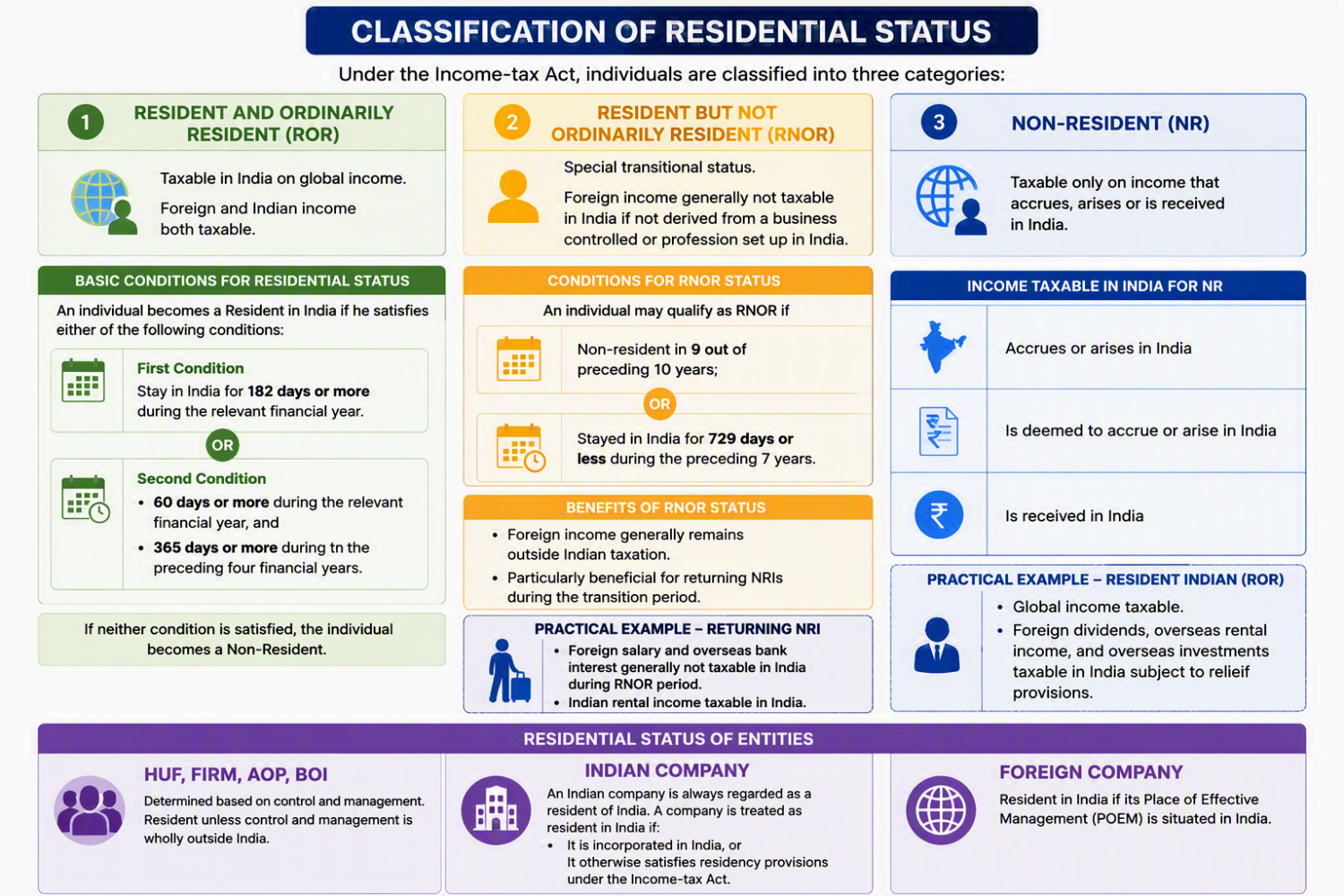
Under the Income Tax Act, individuals are classified into three categories:
1. Resident and Ordinarily Resident (ROR)
A Resident and Ordinarily Resident (ROR) is taxable in India on his or her worldwide income. Resident and Ordinarily Resident (ROR): Taxable in India on global income and Foreign and Indian income both taxable. Basic Conditions for Residential Status : An individual becomes a Resident in India if he satisfies either of the following conditions:
First Condition : Stay in India for 182 days or more during the relevant financial year. OR
Second Condition : Stay in India for:
- 60 days or more during the relevant financial year, and
- 365 days or more during the preceding four financial years.
If neither condition is satisfied, the individual becomes a Non-Resident.
Scope of Taxability: The following income is taxable in India:
- Salary earned in India.
- Salary earned abroad.
- Foreign dividends.
- Interest earned from overseas bank accounts.
- Rental income from foreign properties.
- Capital gains arising outside India.
Example: Mr. Raj is an Indian resident and owns:
- A flat in London.
- Shares of a US company.
- Fixed deposits in Singapore.
Since he is classified as ROR, all these foreign incomes are taxable in India, subject to relief under applicable DTAA provisions.
2. Resident but Not Ordinarily Resident (RNOR)
- RNOR is a special transitional category mainly available to returning NRIs and expatriates shifting to India. Resident but Not Ordinarily Resident (RNOR) : Special transitional status and foreign income generally not taxable in India if not derived from a business controlled or profession set up in India. Under RNOR status:
- Foreign income is generally not taxable in India.
- Income from a business controlled from India or a profession set up in India may still be taxable.
Resident but Not Ordinarily Resident Status: An individual may qualify as RNOR if
- Non-resident in 9 out of preceding 10 years; or
- Stayed in India for 729 days or less during the preceding 7 years.
Benefits of Resident but Not Ordinarily Resident:
Foreign income generally remains outside Indian taxation. And particularly beneficial for returning NRIs during the transition period. Practical Examples Resident Indian (ROR) : Global income taxable. Foreign dividends, overseas rental income, and overseas investments taxable in India subject to relief provisions. RNOR status is highly beneficial for returning NRIs.
Major Benefits
Foreign salary generally not taxable.
Foreign bank interest generally not taxable.
Overseas investments continue to enjoy tax protection.
Foreign rental income generally remains outside Indian taxation.
Opportunity to reorganize global assets before becoming ROR.
Why is RNOR important?
RNOR provides a transition period before an individual becomes fully taxable on global income. Example : Mr. Sharma worked in the USA for 15 years and permanently returned to India.
During his RNOR period:
|
Income |
Taxability in India |
|
US Salary |
Not Taxable |
|
US Bank Interest |
Not Taxable |
|
Rental Income from Mumbai Property |
Taxable |
|
Dividend from Indian Companies |
Taxable |
Thus, RNOR status provides significant tax relief to returning NRIs. Conditions for RNOR Status
A resident individual can qualify as RNOR if:
- Condition 1 : He has been a Non-Resident in 9 out of the preceding 10 years. OR
- Condition 2 : His stay in India was 729 days or less during the preceding 7 years.
3. Non-Resident (NR)
A non-resident is taxable only on income that Accrues or arises in India, Is deemed to accrue or arise in India. Is received in India. Returning NRI : Foreign salary and overseas bank interest generally not taxable in India during RNOR period and Indian rental income taxable in India. Non-Resident (NR): Taxable only on income accrued, arising, or received in India. Example: Mr. A lives and work in Dubai. His income includes: Salary earned in Dubai. Rental income from a property in Delhi. Tax treatment:
- Dubai Salary → Not taxable in India.
- Delhi Rental Income → Taxable in India.
- Therefore, only Indian-source income is taxable for an NR.
Key Principle of Residential Status of Individuals: Residential status is determined under Section 6 based on physical presence in India and is independent of citizenship.
Basic Conditions for Residential Status: An individual is treated as a Resident in India if:
- Present in India for 182 days or more during the relevant financial year; or
- Present in India for 60 days or more during the year and 365 days or more during the preceding four financial years.
Special Rules for Residential Status
Special Rules for the residential status of individuals: Indian citizens leaving India for employment abroad, Crew members of Indian ships., citizens/PIOs visiting India, higher-income individuals (income exceeding INR 15 lakh) and deemed residency provisions introduced by the Finance Act, 2020. Certain special categories are subject to modified residency rules.
- Indian Citizens Leaving India for Employment Abroad: For Indian citizens leaving India for employment outside India, the 60-day condition does not generally apply. Only the 182-day condition is considered.
- Crew Members of Indian Ships : Special provisions exist for Indian seafarers and crew members serving on Indian ships.
- Indian Citizens and PIOs Visiting India : Special residency provisions apply to Indian Citizens, and Persons of Indian Origin (PIOs). who visit India during the year.
- High-Income Individuals: Where Indian income exceeds INR 15 lakh, stricter residency provisions become applicable. For certain individuals, the threshold of 60 days is replaced by 120 days.
- Deemed Residency Provision: Introduced by the Finance Act, 2020. An Indian citizen shall be deemed a resident in India if:
- Income exceeds INR 15 lakh (excluding foreign income), and
- He is not liable to tax in any other country.
- Such individuals are generally treated as RNOR.
Residential Status of Entities
HUF, Firm, AOP, BOI: Determined based on control and management and resident unless control and management is wholly outside India.
Indian Company: An Indian company is always regarded as a resident of India. A company is treated as resident in India if:
- It is incorporated in India, or It otherwise satisfies residency provisions under the Income-tax Act.
- The location of management is irrelevant for determining the residency of an Indian-incorporated company.
- Indian Company: Always treated as a resident in India. A company is treated as a resident of India in any previous year if it is an Indian company, or its PoEM in that year is in India.
- example: An Indian company conducting operations entirely from Singapore will still remain an Indian resident company because it is incorporated in India.
Foreign Company
- A foreign company may become a resident in India if it's. Foreign Company: Resident in India if its Place of Effective Management (POEM) is situated in India.
Place of Effective Management (POEM)
Meaning of Place of Effective Management:
- Place of Effective Management refers to the place where key management and commercial decisions necessary for conducting the business as a whole are, in substance, made. Importance of Place of Effective Management: Determines tax residency of foreign companies and applies primarily to foreign companies with turnover exceeding INR 500 million.
- To bring to tax those companies that are incorporated outside India but controlled from India, the condition of Place of Effective Management has been introduced. PoEM is an internationally recognised concept accepted by the Organisation for Economic Co-operation and Development (OECD).
- A foreign company will be regarded as a resident in India if its PoEM is in India in that year. Since ‘residency’ is determined for each year, Place of Effective Management is also required to be determined on a year-to-year basis.
- The concept of PoEM is one of substance over form. The term Place of effective management" has been explained to mean a place where key management and commercial decisions that are necessary for the conduct of the business of an entity as a whole are, in substance, made.
- To provide clarity and address certain concerns for the implementation of the determination of residency of a foreign company on the basis of PoEM, the Indian Revenue Department has issued a circular laying down guidelines.
- The guidelines laid down the concept of determination of PoEM based on bifurcation of companies engaged in active business outside India and other companies.
- The circulars clarify that the Place of Effective Management provisions will not apply to a foreign company having turnover or gross receipts of INR 500 million or less in a tax year.
Place of Effective Management Determination Factors
Factors Considered for Determining Place of Effective Management
- Board-Level Decision Making: The location where board meetings are held, strategic policies are approved, and major commercial decisions are taken. Example: If directors formally meet in Dubai but all significant decisions are actually taken from Mumbai, POEM may be considered to be in India.
- Presence of Senior Management: The location of the CEO, CFO, Managing Director, and Key Managerial Personnel (KMPs) is examined carefully. Where senior management controls the business from India, it indicates POEM in India.
- Delegated Authority: If powers are delegated by the Board to a management committee, attention shifts to where the committee actually exercises its authority. The place where major business decisions are implemented becomes relevant.
Activities Generally Ignored for POEM
The following functions generally do not determine POEM:
- Routine Operational Activities: Order processing, customer support, and administrative functions
- Shared Service Centers: HR support, IT support, and Finance support
- Back-Office Functions: Data processing, accounting, and payroll administration. These are operational activities and do not reflect strategic management.
Importance of POEM
POEM determines whether a foreign company may be treated as a resident of India.
If POEM is in India:
- The foreign company may become an Indian tax resident.
- Global income may become taxable in India.
- Extensive Indian tax compliance obligations may arise.
Permanent establishment (PE)
- A PE is defined in India as a fixed place of business through which the business of an enterprise is wholly or partly carried on or through an agent who habitually exercises an authority to conclude contracts or regularly delivers goods or merchandise or habitually secures orders on behalf of a non-resident.
Business connection
- The scope of 'business connection' was amended under the Income Tax Act to align with the modified PE Rule as per the Multilateral Instrument (MLI).
- 'Business connection' includes business activities carried on by a non-resident through dependent agents. The scope of 'business connection' under the Income-tax Act is similar to the provisions relating to Dependent Agent Permanent Establishment (DAPE) in India’s tax treaties. The amendment provides that business connection shall also include any business activities carried through a person who, acting on behalf of the non-resident, habitually concludes contracts or habitually plays the principal role leading to the conclusion of contracts by the non-resident. It further states that the contracts should be:
- in the name of the non-resident
- for the transfer of the ownership of, or for the granting of the right to use, property owned by that non-resident or that the non-resident has the right to use, or
- for the provision of services by that non-resident.
Further, as per the provisions of the Income-tax Act, 'significant economic presence' would also constitute a 'business connection' in India.
'Significant economic presence' means:
- any transaction in respect of any goods, services, or property carried out by a non-resident with any person in India, including provision of download of data or software in India, if the aggregate of payments arising from such transaction or transactions during the previous year exceeds INR 20 million, or
- systematic and continuous soliciting of business activities or engaging in interaction with 300,000 users in India.
However, only so much of income as is attributable to such transactions or activities will be deemed to accrue or arise in India. The transactions or activities will constitute significant economic presence in India whether or not the non-resident has a residence or place of business in India or renders services in India.
The income tax return forms applicable to companies (including foreign companies) have been updated starting from FY 2021/22, explicitly including disclosure of the significant economic presence status of a foreign company in India.
Finance Act, 2025, has clarified that transactions or activities of a non-resident in India that are confined to the purchase of goods in India for the purpose of export shall not constitute a significant economic presence of such non-resident in India.
Conclusion
Residential status forms the foundation of taxation under Indian tax law. For individuals, the distinction between ROR, RNOR, and NR determines whether worldwide income or only Indian-source income is taxable. For businesses, residency depends on factors such as incorporation, control and management, and the Place of Effective Management (POEM).
Understanding these concepts is essential for NRIs, expatriates, multinational enterprises, foreign investors, and globally mobile professionals. Proper determination of residential status not only ensures tax compliance but also helps taxpayers effectively utilize DTAA benefits, foreign tax credits, and international tax planning opportunities.