Table of Contents
- F&o Trading Income Tax: Complete Guide For Traders
- Taxability Of Futures & Options Income
- Reporting Futures & Options Income In Itr
- Tax Treatment Of Options Trading
- Intraday Trading Vs Futures & Options Trading
- Set-off Of Futures & Options Losses
- How To Calculate Futures & Options Turnover
- Claiming Business Expenses
- Carry Forward Of Futures & Options Losses
- Reporting Futures Trading
- Tax Audit Applicability
- Key Takeaways
F&O Trading Income Tax: Complete Guide for Traders
- Income earned from futures & options trading is generally treated as business income under the Income Tax Act. Therefore, traders are required to report such income in ITR-3. Taxpayers opting for the presumptive taxation scheme and fulfilling the prescribed conditions may be eligible to file ITR-4.
Taxability of Futures & Options Income
- Profits arising from futures & options transactions are taxed under the head "Profits and Gains from Business or Profession (PGBP)" and are subject to the taxpayer's applicable income tax slab rates. Depending on turnover, profitability, and other statutory conditions, tax audit provisions may also become applicable.
-
F&O turnover is calculated by adding the absolute value of all profits and losses from completed trades, and eligible business expenses such as brokerage, internet, consultancy, and software costs can be claimed as deductions from taxable income.
F&O losses can generally be set off against any income except salary and, if not fully adjusted, may be carried forward for up to 8 assessment years, subject to compliance with income tax provisions
Reporting Futures & Options Income in ITR
- Whether the result of futures & options trading is a profit or a loss, the same must be disclosed in the Income Tax Return. Proper reporting is essential to ensure compliance and to claim eligible set-off and carry-forward benefits in future years.
Tax Treatment of Options Trading
- Income from options trading is also considered business income. In addition, Securities Transaction Tax (STT) is applicable on eligible options transactions as per prevailing tax provisions.
Intraday Trading vs Futures & Options Trading
It is important to distinguish between intraday equity trading and futures & options trading:
- Intraday equity trading is treated as speculative business income.
- F&O trading conducted through recognized stock exchanges is treated as non-speculative business income.
This distinction is important for loss set-off and carry-forward purposes.
Set-off of Futures & Options Losses
- Since Futures & Options income is generally classified as non-speculative business income, Futures & Options losses can be set off against eligible income heads, except salary income, subject to provisions of the Income Tax Act. Such losses may also be carried forward if they cannot be fully adjusted in the current year.
How to Calculate Futures & Options Turnover
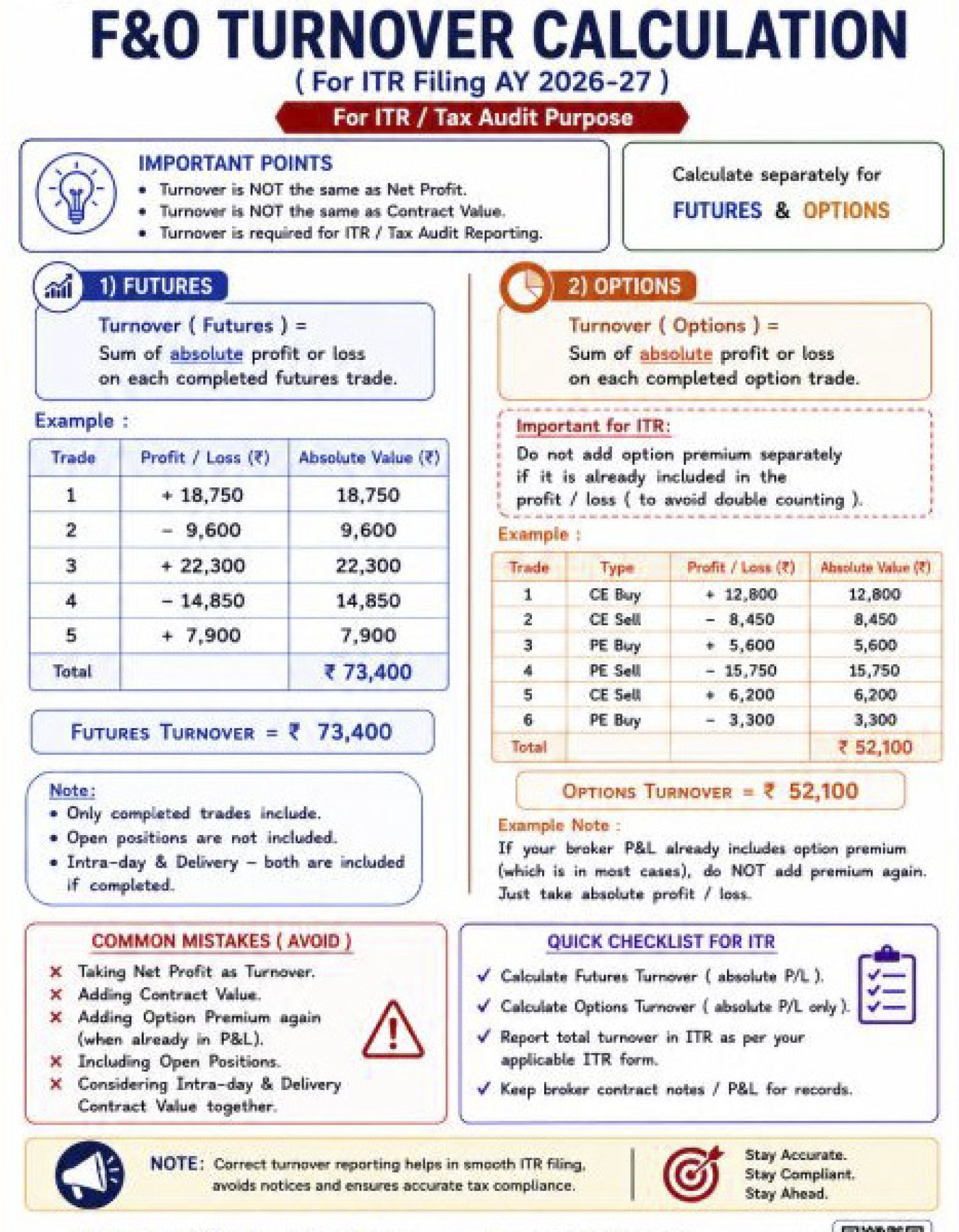
- For income tax purposes, turnover is not calculated on the basis of contract value. Instead, futures & options turnover is generally computed as the aggregate of absolute profits and absolute losses arising from completed trades during the financial year.
- Accurate turnover calculation is critical because it directly impacts Tax audit applicability u/s 44AB, selection of the correct ITR form, business income reporting, and overall tax compliance.
Claiming Business Expenses
- Traders can reduce their taxable business income by claiming legitimate business-related expenses, such as brokerage and transaction charges, Internet and communication expenses, advisory and consultancy fees, trading software and analytical tools, and other expenses incurred wholly and exclusively for trading activities.
Carry Forward of Futures & Options Losses
- Futures & options losses must be reported in the income tax return and should not be omitted. Unabsorbed non-speculative business losses can generally be carried forward for up to 8 assessment years, subject to timely filing of the return and compliance with applicable provisions.
Reporting Futures Trading
- Income or loss arising from futures contracts should also be reported as Business Income in ITR-3 or ITR-4, wherever applicable.
Tax Audit Applicability
- The requirement of a tax audit depends on several factors, including futures & options turnover, profit declared, presumptive taxation provisions, Cash receipt and payment thresholds, and conditions prescribed under Section 44AB. An incorrect turnover calculation can lead to an incorrect assessment of audit requirements and may result in compliance issues.
-
Tax Audit for F&O Trading under Section 44AB depends on turnover, profit percentage, presumptive taxation conditions, and digital transaction limits. Audit may be mandatory for low-profit cases, turnover above ₹10 crore, or where specific Section 44AB conditions are triggered.
Since F&O income is treated as non-speculative business income, all profits and losses must be reported in ITR-3 (or ITR-4 where eligible), with correct turnover computation being critical for tax compliance and audit determination.
Key Takeaways
- Futures & options trading is generally treated as non-speculative business income.
- Report futures & options profits or losses in ITR-3 (or ITR-4 where eligible).
- Calculate turnover using absolute profits and absolute losses, not contract value.
- Disclose all losses to preserve set-off and carry-forward benefits.
- Claim eligible business expenses to reduce taxable income.
- Review tax audit applicability carefully before filing your income tax return.
- Maintain proper records such as broker P&L statements, contract notes, ledgers, AIS, TIS, and Form 26AS for accurate compliance.