Table of Contents
- Carbon Credits – Dedicated Sub-checklist (tax Audit Perspective)
- Quick Decision Framework
- 1, Documentation Requirements
- 2. Method Of Origination
- 3. Retirement / Cancellation Certificate:
- 4. Cost Of Acquisition Method:
- 6. Cdm Project Income Classification
- 7. Foreign Currency Receipts
- 8. Dtaa Review
- 9. Advance Ruling / Legal Opinion
- Auditor's Carbon Credit Working Paper Checklist
- Practical Takeaway
Carbon Credits – Dedicated Sub-Checklist (Tax Audit Perspective)
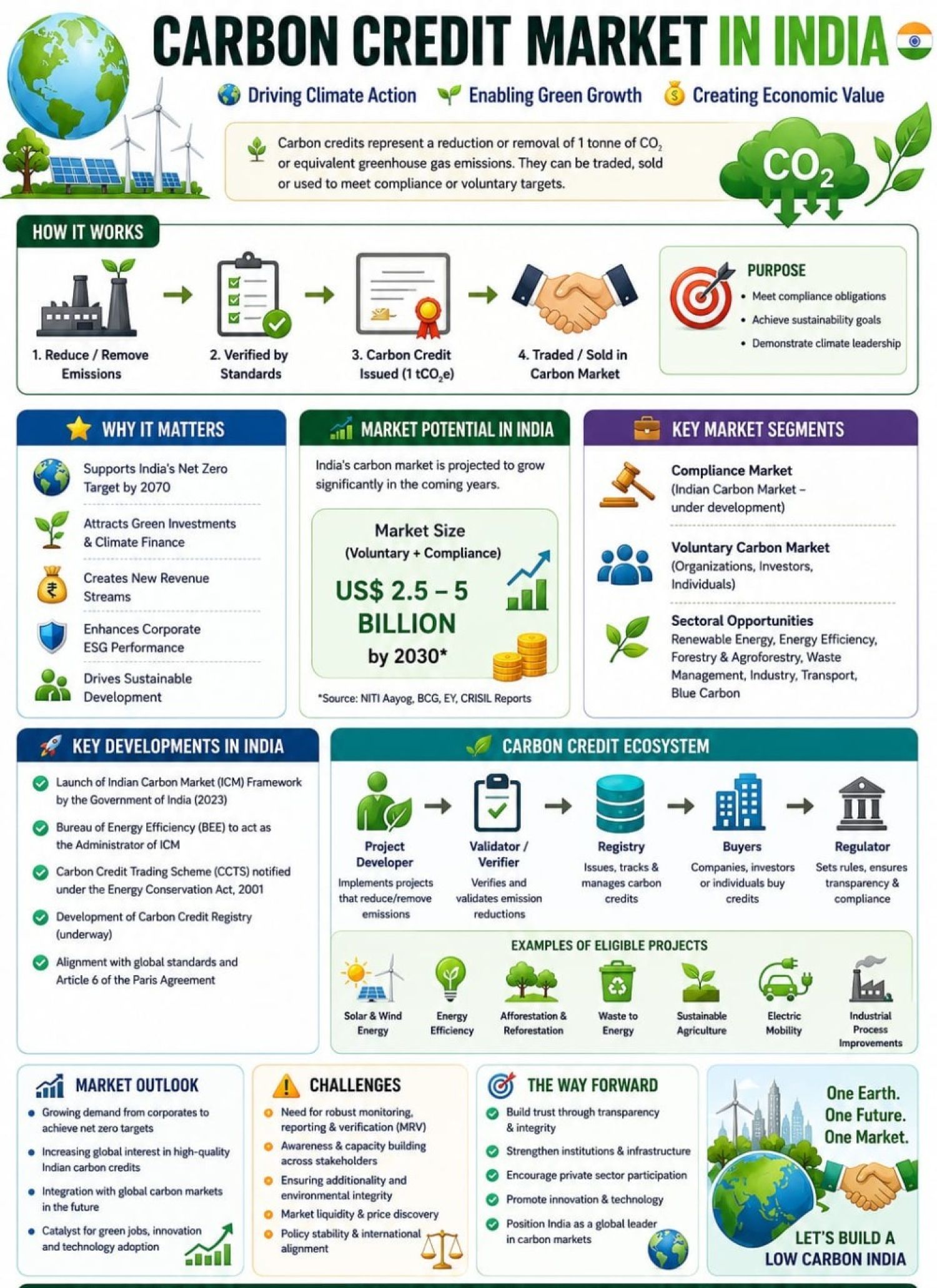
Carbon credits require a separate audit approach because their tax treatment in India is not yet fully settled, especially where credits are tokenized and traded on blockchain platforms. The auditor's first task is to determine whether the carbon credit is a VDA or a traditional carbon credit/commodity right, because the tax consequences can differ significantly.
Quick Decision Framework
|
Step |
Question |
Likely Treatment |
|
1 |
Is the carbon credit issued or traded on a blockchain/DLT platform? |
Likely VDA |
|
2 |
Is it tokenized and transferable through crypto wallets? |
Likely VDA |
|
3 |
Is it a traditional UNFCCC/Kyoto CER held in a centralized registry? |
Likely non-VDA |
|
4 |
Is it a Verra/Gold Standard voluntary credit not tokenized? |
Requires detailed analysis |
|
5 |
Is there any CBDT notification specifically covering the instrument? |
Follow notified treatment |
1, Documentation Requirements
Credit Issuance Certificate: The auditor should obtain a registry-issued certificate. Unique serial number, Vintage year, Quantity of carbon credits issued,
The certificate establishes ownership and origin. Authenticity and Traceability. For Example
|
Particulars |
Details |
|
Registry |
Verra |
|
Serial Number |
VCU-2025-001 |
|
Vintage Year |
2024 |
|
Quantity |
10,000 Credits |
This document is equivalent to a title document for the carbon credits.
2. Method of Origination
The auditor should identify how the credit was created. The following are the common sources.
|
Source |
Example |
|
CDM Project |
Wind power project |
|
Renewable Energy |
Solar energy generation |
|
Afforestation |
Tree plantation projects |
|
Carbon Capture |
Emission reduction technology |
|
Voluntary Offset |
Private sustainability initiatives |
Tax treatment may differ depending upon the nature of project, Source of credits and Business model of the assessee
3. Retirement / Cancellation Certificate:
Carbon credits are often "retired" when utilized by the buyer to offset emissions.
- Auditor should obtain: Retirement certificate, cancellation records, and Registry confirmation
- Purpose: Ensures credit was actually consumed, No double counting, and revenue recognition is appropriate
4. Cost of Acquisition Method:
For credits classified as VDA, the valuation method should be consistently followed. Acceptable Methods
|
Method |
Meaning |
|
FIFO |
First credit acquired deemed sold first |
|
WAC |
Weighted Average Cost |
|
Consistent Method |
Same method year after year |
For Example
|
Purchase |
Quantity |
Cost |
|
Lot 1 |
1,000 |
INR 100 |
|
Lot 2 |
1,000 |
INR 150 |
If 1,000 credits are sold:
- FIFO = Cost INR 100 per credit
- WAC = Cost INR 125 per credit
The auditor should ensure consistency.
5. Own Consumption vs. Trading: One of the most important audit tests.
- Own Use: for example, ESG targets, sustainability commitments, and CSR-linked environmental initiatives
- Trading Inventory: For example, purchase and resale, carbon brokerage, and Carbon exchange participants
|
Purpose |
Possible Treatment |
|
Compliance Use |
Consumption asset |
|
Trading Activity |
Business inventory |
|
Investment |
Capital asset considerations |
The auditor should document management's intention and supporting evidence.
6. CDM Project Income Classification
Where the assessee generates carbon credits through a project: The auditor must determine. Whether income is royalty-like income or business income. For Example
|
Activity |
Possible Classification |
|
Selling self-generated credits through ongoing commercial activity |
Business income |
|
Licensing environmental rights |
Royalty-related analysis |
This classification may affect disclosures and tax treatment.
7. Foreign Currency Receipts
Carbon credits are frequently sold to overseas buyers. The auditor should verify the Foreign Inward Remittance Certificate (FIRC), Bank realization certificate, Foreign exchange receipt and FEMA compliance. For Example,
|
Particular |
Amount |
|
Buyer |
Germany |
|
Sale Value |
USD 50,000 |
|
Receipt Date |
15.10.2025 |
|
INR Conversion |
Verified |
8. DTAA Review
Where buyers are foreign entities, review Tax treaty implications, Character of income and Cross-border taxation exposure Following Areas to Examine
|
Issue |
Review Required |
|
PE Risk |
Yes |
|
Withholding Tax |
Yes |
|
Foreign Buyer |
Yes |
|
Treaty Relief |
Yes |
For significant transactions, a separate tax note should be maintained.
9. Advance Ruling / Legal Opinion
The auditor should verify whether an Advance Ruling (AAR) was obtained, a GST ruling was obtained, a legal opinion was obtained, and a professional tax opinion was relied upon. Carbon credit taxation remains an evolving area. Therefore, if a taxpayer has adopted an aggressive or unusual tax position, supporting legal documentation should be attached to audit workpapers.
Auditor's Carbon Credit Working Paper Checklist
|
Item |
Status |
|
Registry Certificate Obtained |
â–¡ |
|
Serial Number Verified |
â–¡ |
|
Vintage Year Verified |
â–¡ |
|
Source of Credit Identified |
â–¡ |
|
Blockchain Tokenization Checked |
â–¡ |
|
VDA vs Non-VDA Classification Note Prepared |
â–¡ |
|
Retirement Certificate Obtained |
â–¡ |
|
FIFO/WAC Verified |
â–¡ |
|
Own Use vs Trading Determined |
â–¡ |
|
FEMA Compliance Reviewed |
â–¡ |
|
DTAA Impact Reviewed |
â–¡ |
|
Advance Ruling/Opinion Attached |
â–¡ |
Practical Takeaway
For audit purposes, carbon credit should never be treated as a single homogeneous asset class. The auditor must first determine the following:
- Is it tokenized/blockchain-based or traditional?
- Is it held for use, investment, or trading?
- Is it domestically traded or cross-border?
- Is there any regulatory guidance, ruling, or legal opinion supporting the position adopted?
Only after this classification exercise should the auditor determine whether the credit falls under the VDA regime (30% tax + Section 194S implications) or under the normal income-tax and GST framework.