Table of Contents
- Income Tax Rules When Assets Transferred To Family—clubbing Of Huf Income
- Is It A Gift To The Hindu undivided Family By A Clubbed Member?
- Why Does Section 64(2) Exist?
- When Clubbing Applies
- When Clubbing Does Not Apply
- Clubbing income Tracing Principle
- What Happens After Huf Partition?
- How To Fund A Hindu Undivided Family Without Triggering Clubbing?
- What Are The Best Methods In Case Hindu Undivided Family Clubbing Of Income?
- Key Takeaways Related To Assets Transferred To Family- Clubbing Of Huf Income
- Common Mistakes In The Case Of hindu Undivided Family Clubbing Of Income
Income tax Rules When Assets Transferred to Family—Clubbing of HUF Income
Is it a gift to the Hindu Undivided Family by a clubbed member?
- Yes. If a member transfers or gifts personal assets (cash, property, shares, etc.) to the Hindu Undivided Family without adequate consideration, the income arising from those assets is clubbed with the income of the transferor member u/s 64(2) of the Income Tax Act.
Why Does Section 64(2) Exist?
- A Hindu Undivided Family is a separate taxable entity having a separate PAN, separate income tax return, and separate basic exemption limit. Without Section 64(2), an individual could shift income-generating assets to the HUF and split taxable income between two entities. To prevent such tax avoidance, the law clubs income from assets transferred by a member to the Hindu Undivided Family back with the transferor member.
When Clubbing Applies
|
Scenario |
Clubbing? |
|
Member gifts cash to Hindu Undivided Family |
Yes |
|
In case a member transfers shares to Hindu Undivided Family |
Yes |
|
Member transfers property to Hindu Undivided Family |
Yes |
|
In case the member converts personal asset into Hindu Undivided Family property |
Yes |
|
The member blends personal business assets with Hindu Undivided Family assets |
Yes |
Result: Income from such converted assets remains taxable in the members’ hands.
When Clubbing Does NOT Apply
- Ancestral Property: Income from ancestral property belonging to the Hindu Undivided Family is taxed in the Hindu Undivided Family's hands.
- Gifts from Parents or In-laws: If the Hindu Undivided Family receives gifts from Father, Mother, Father-in-law, or Mother-in-law. The gift is exempt u/s 56(2)(x), and future income is taxable in the Hindu Undivided Family's hands.
- Property Received Through Will or Inheritance: Assets received by the Hindu Undivided Family through Will, Inheritance, Succession and are not covered by Section 64(2).
- Hindu Undivided Family's Own Business Income: Income generated from Hindu Undivided Family’s own business activities is taxable in Hindu Undivided Family’s hands.
- Marriage Gifts to Hindu Undivided Family: Where a gift deed specifically mentions the HUF as the recipient, income belongs to the Hindu Undivided Family.
Clubbing Income Tracing Principle
- Section 64(2) follows a strict income tracing principle: For example, Karta gifts INR 10 lakh to the Hindu Undivided Family. The Hindu Undivided Family Invests in Mutual Funds, Sells Mutual Funds, and Purchases Property. And Earns Rent. Then the rental income is still traced back to the original gifted asset. And therefore, the rent continues to be taxable in the hands of the transferor-member.
- Unlike spouse clubbing provisions, where "income on income" may escape clubbing, HUF clubbing is much stricter. Entire income chain continues to be traced back to the original asset transferred to the Hindu Undivided Family.
What Happens After HUF Partition?
- Property Given Back to Transferor: No clubbing issue arises.
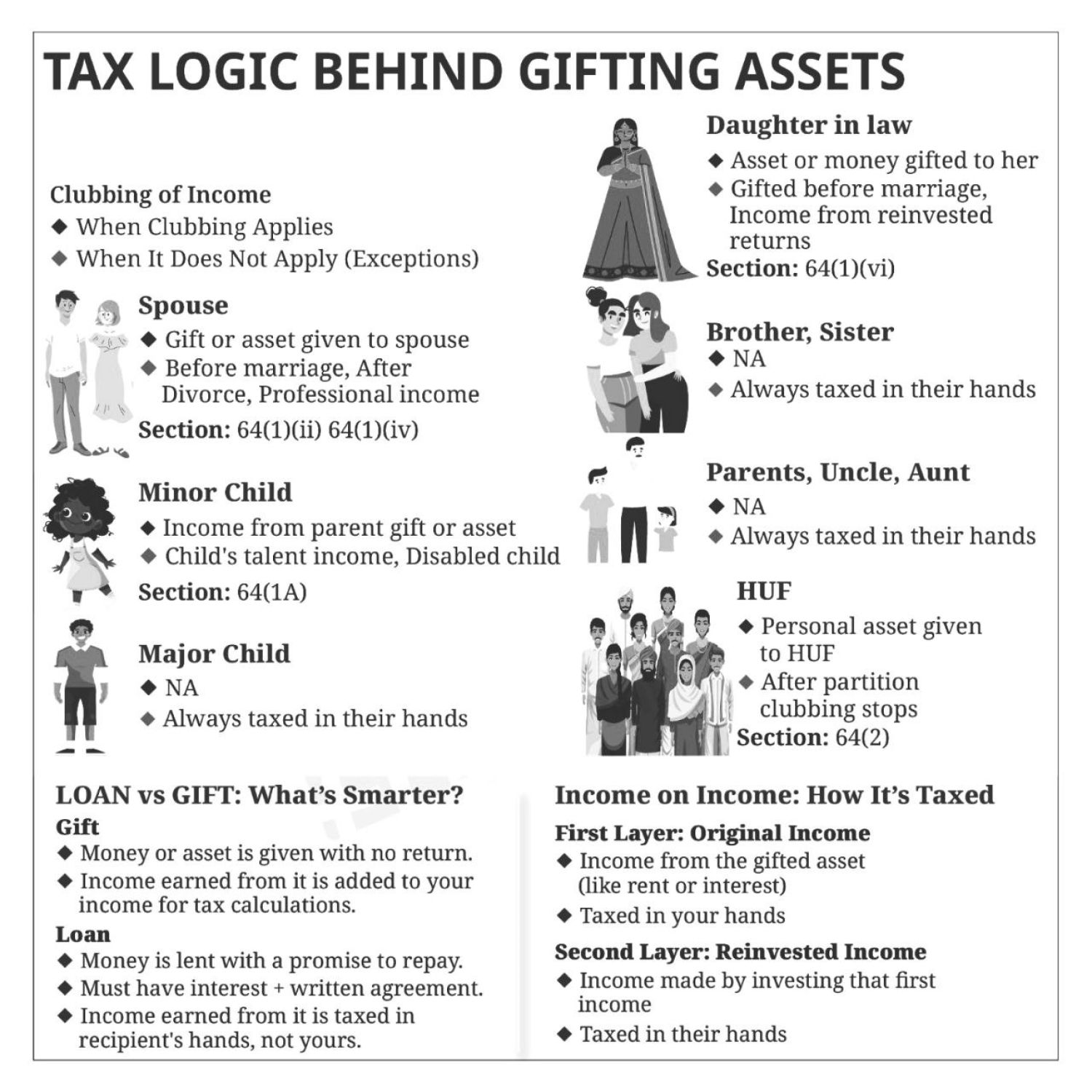
- The Property Given to Transferor's Spouse: Income continues to be clubbed with the original transferor u/s 64(2) read with Section 64(1)(iv).
- Property Given to Minor Child: Income continues to be clubbed u/s 64(1A).
- The Property Given to Adult Son or Other Coparcener: Clubbing stops. : Income becomes taxable in that person's own hands.
How to Fund a Hindu Undivided Family Without Triggering Clubbing?
If the asset originates from a member's personal property, clubbing generally applies. And If the asset originates from ancestral property, inheritance, will, or gifts from relatives to the HUF, income is generally taxed in the HUF's own hands.
What are the best methods in case Hindu Undivided Family Clubbing of income?
- Gifts from parents
- Property received through inheritance
- Gifts from in-laws
- Property received through a will
- Marriage gifts specifically made to Hindu Undivided Family
- Business income earned by Hindu Undivided Family
- Reinvestment of Hindu Undivided Family's own accumulated funds
These sources create genuine Hindu Undivided Family assets and generally do not attract Section 64(2).
Key Takeaways related to Assets Transferred to Family- Clubbing of HUF Income
- Gift to Hindu Undivided Family by a member in case if Hindu Undivided Family Clubbing of Income provision Income is clubbed with the member u/s 64(2).
- Income from ancestral property belongs to Hindu Undivided Family and is not clubbed.
- Gift from parents, in-laws, inheritance, or will as far as Hindu Undivided Family Clubbing of Income there will be No clubbing.
- Income tracing under Hindu Undivided Family provisions is very strict and continues even after asset conversion or reinvestment.
- After partition, clubbing continues if converted property goes to the transferor's spouse or minor child.
- The safest way to build Hindu Undivided Family wealth is through ancestral assets, inheritance, gifts from relatives of members, marriage gifts, and genuine Hindu Undivided Family business activities.
Common Mistakes in the Case of Hindu Undivided Family Clubbing of Income
- Karta is giving personal funds to the Hindu Undivided Family and assuming income will be taxed in the Hindu Undivided Family.
- Reporting income from member-gifted assets in the Hindu Undivided Family return instead of the member's return.
- Mixing ancestral property and gifted property records.
- Assuming clubbing automatically ends after Hindu Undivided Family partition.
- Ignoring tracing of income through multiple investments.