Table of Contents
Detailed Explanation of MSME Accounting Standards Framework for Non-Company Entities
Based on ICAI Compendium of Accounting Standards (1 April 2025)
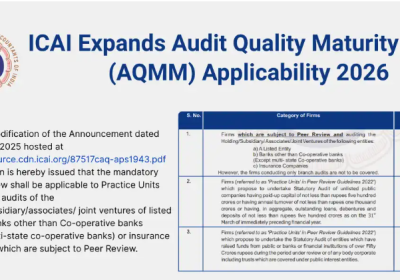
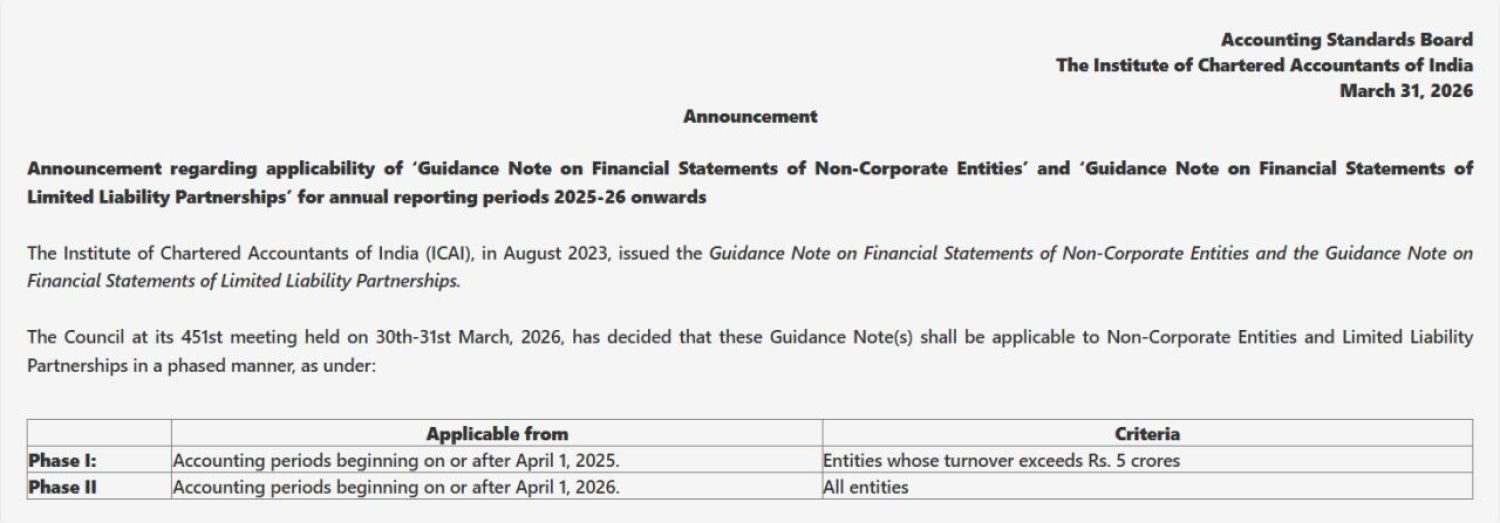
An accounting policy disclosure that an LLP can include in its financial statements when it qualifies as a micro, small, and medium enterprise under the Institute of Chartered Accountants of India framework and avails various exemptions/relaxations. The table specifically explains which accounting standards have been relaxed or exempted and what practical benefit the LLP has taken. This announcement relates to the mandatory applicability of ICAI's Guidance Notes on Financial Statements of Non-Corporate Entities (NCEs) and LLPs from FY 2025-26 onwards. It introduces a phased implementation approach.
What are these guidance notes?
In August 2023, ICAI issued Guidance Note on Financial Statements of Non-Corporate Entities and Guidance Note on Financial Statements of Limited Liability Partnerships (LLPs). These guidance notes prescribe the format of financial statements, minimum disclosures, accounting policy presentation, notes to accounts, and a uniform reporting framework for entities that are not companies.
Phase I
- Effective Date: Accounting periods beginning on or after 1 April 2025.
- Applicable to entities whose turnover exceeds INR 5 crore.
- Practical Meaning: For FY 2025-26:
| Entity Type | Turnover | Applicability |
|---|---|---|
| LLP | INR 8 crore | Applicable |
| Partnership Firm | INR 20 crore | Applicable |
| Proprietorship | INR 6 crore | Applicable |
| LLP | INR 4 crore | Not yet mandatory |
Thus, any NCE/LLP having turnover above INR 5 crore must prepare financial statements according to the Guidance Note from FY 2025-26 onward.
Phase II
- Effective Date: Accounting periods beginning on or after 1 April 2026. Applicable to all entities, irrespective of turnover.
- Practical Meaning: From FY 2026-27 onwards LLPs, Partnership firms, Proprietorship concerns, Trusts, Societies, Other non-corporate entities must follow the Guidance Note irrespective of size.
Basis of Preparation and Accounting Convention
This paragraph states that financial statements are prepared on the historical cost basis, books are maintained on the accrual basis of accounting, and accounts comply with the accounting standards issued by ICAI to the extent applicable to LLPs. The LLP has also followed the Institute of Chartered Accountants of India Guidance Note on Financial Statements of LLPs, wherever applicable. This is a standard accounting policy appearing in most LLP financial statements.
Practical MSME Accounting Standards applicability guide for non-company entities based on the Institute of Chartered Accountants of India Compendium of Accounting Standards (as on 1 April 2025). It explains which Accounting Standards (AS) apply to MSMEs, what exemptions are available, and what disclosure relaxations can be claimed.
1. Purpose of the Framework
Framework explaining applicability, exemptions, and relaxations for accounting standards applicable to non-company micro, small, and medium enterprises. The document helps non-company entities determine: Whether they qualify as an MSME for Accounting Standards purposes, Which AS are fully applicable., Which AS are exempt? Which AS have disclosure/measurement relaxations and additional disclosure requirements when Micro, small, and medium enterprise relief is used?
2. MSME Classification
The framework divides micro, small, and medium enterprises into two categories.
A. General MSME
General MSME: turnover up to Rs.250 crore and borrowings up to Rs.50 crore. An entity qualifies if:
- Securities are not listed and not in the process of listing.
- It is not a bank, financial institution, or insurance company.
- Turnover does not exceed INR 250 crore (excluding other income).
- Borrowings do not exceed INR 50 crore during the immediately preceding year.
- It is not a holding/subsidiary of a non-MSME entity.
B. Small MSME (INR 50 Cr / INR 10 Cr Category)
Small MSME: turnover up to Rs.50 crore and borrowings up to Rs.10 crore. Micro, Small, and Medium Enterprise Categories: In addition to satisfying General Micro, Small, and medium enterprise conditions
- Turnover ≤ INR 50 crore.
- Borrowings ≤ INR 10 crore.
- Not a holding/subsidiary of a larger MSME outside these limits.
Major Benefit: Small, Micro, and Medium Enterprises get complete exemption from AS 18 (Related Party Disclosures) and AS 28 (Impairment of Assets)
3. Meaning of Applicability Labels
The document uses four terms:
|
Label |
Meaning |
|
FULL |
The standard applies completely |
|
RELAXED |
The standard applies with special MSME relief |
|
EXEMPT |
Standard not applicable |
|
CONDITIONAL |
Applies only if specific transaction/event exists |
4. Standards Fully Applicable Without Relief
The following standards apply normally to all micro, small, and medium enterprises:
- AS 1 – Disclosure of Accounting Policies
- AS 2 – Valuation of Inventories
- AS 4 – Contingencies and Events after Balance Sheet Date
- AS 5 – Net Profit/Loss, Prior Period Items and Changes in Accounting Policies
- AS 7 – Construction Contracts
- AS 9 – Revenue Recognition
- AS 12 – Government Grants
- AS 13 – Investments
- AS 16 – Borrowing Costs
No special MSME exemption exists for these standards.
5. Standards Completely Exempt for All MSMEs
These standards are not mandatory:
|
Standard |
Subject |
|
AS 3 |
Cash Flow Statements |
|
AS 17 |
Segment Reporting |
|
AS 20 |
Earnings Per Share |
|
AS 24 |
Discontinuing Operations |
Thus, a non-company MSME need not prepare a cash flow statement under AS 3, segment disclosures, or EPS calculations. And discontinuing operation disclosures.
6. Conditional Standards
These apply only when relevant.
- AS 14 – Amalgamations: Applicable only if there is an amalgamation transaction.
- AS 21 – Consolidated Financial Statements: Applicable only where CFS is required or voluntarily prepared.
- AS 23 – Investments in Associates: Relevant only when consolidated financial statements are prepared.
- AS 25 – Interim Financial Reporting: Applicable only if interim financial statements are prepared.
- AS 27 – Joint Ventures: Applicable only when joint venture arrangements exist.
7. Important MSME Relaxations
AS 10 – Property, Plant & Equipment
- Micro, small, and medium enterprises may omit disclosures regarding Idle assets. Fully depreciated assets are still in use, revalued assets, and assets retired from active use.
- Practical Effect: Accounting remains unchanged. Only disclosures are reduced.
AS 11 – Foreign Exchange
- May omit disclosure regarding foreign currency risk management policies.
Extensive Relief under AS 15 (Employee Benefits)
This is one of the most significant relief areas. Micro, small, and medium enterprises may:
- Compensated Absences: Do not comply with certain requirements relating to non-vesting, accumulating leave benefits.
- Defined Contribution Plans: Can avoid discounting future contributions payable after 12 months.
- Defined Benefit Plans (Gratuity, etc.): Instead of actuarial valuation methods prescribed by AS 15, another rational method may be used to estimate liability.
- Disclosure Relief: Extensive disclosure requirements for gratuity and defined benefit plans need not be provided.
- Termination Benefits: Discounting requirements can be ignored.
AS 19 (Leases)
A very important point: recognition and measurement rules continue to apply. And only disclosure requirements are reduced.
- Lessee Relief: Can omit disclosures relating to lease payment maturity analysis. Sublease receivables. And significant lease arrangement descriptions.
- Lessor Relief: Can omit disclosures regarding gross investment reconciliations, lease arrangement descriptions, and initial direct cost policies. And Future lease payment schedules.
AS 22 – Taxes on Income
This is one of the most valuable MSME exemptions.
- For MSMEs: Only CURRENT TAX provisions are mandatory.
- Consequences: MSMEs generally need not account for Deferred Tax Assets (DTA) and Deferred Tax Liabilities (DTL) under the full framework.
- Transition Rule: When an entity first adopts Micro, Small, and Medium Enterprise relief Existing DTA/DTL balances are adjusted against opening reserves/owners' funds.
AS 26 – Intangible Assets
- Micro, Small, and medium enterprises may omit impairment loss reconciliation disclosures and reversal of impairment disclosures. And disclosure of fully amortized intangibles still in use.
AS 28 – Impairment of Assets
- Small MSMEs: Complete exemption from AS 28.
- General MSMEs: Get major relief; estimate Value in Use (VIU) reasonably; present value calculations are not compulsory. And many detailed disclosures can be omitted.
- Practical Benefit: Significant reduction in valuation complexity and professional cost.
AS 29 – Provisions and Contingencies
Recognition principles remain mandatory. However, micro, small, and medium enterprises may omit the following:
- Para 66: Movement of provisions: opening balance, Additions, Utilisation and Reversals
- Para 67: Detailed disclosures regarding Nature of obligation, Timing uncertainty, assumptions, and Reimbursements
Additional Compliance Requirements
If MSME relief is used, the entity must:
- Disclose MSME Status: Explicitly state that It qualifies as a Micro, Small, and Medium Enterprises. Accounting Standards have been complied with as applicable to MSMEs.
- Disclose Relaxations Availed: Mention which exemptions or relaxations have been used.
- Loss of MSME Status: If eligibility is lost Apply normal AS requirements prospectively; previous figures need not be restated. And appropriate disclosure must be given.
- New MSME: An entity that is newly becoming a micro, small, and medium enterprise can use relief only after remaining an MSME for two consecutive years.
Applicability of Accounting Standards and MSME Exemptions/Relaxations
The LLP has declared itself a Micro, Small, and Medium Enterprise and therefore has availed the exemptions permitted by the Institute of Chartered Accountants of India. Let's understand each standard mentioned in the table.
AS 3 – Cash Flow Statements
- Disclosure in the note: "The Standard is not applicable to the LLP."
- Meaning: MSMEs are completely exempt from AS 3.
- Benefit: The LLP is not required to prepare an operating cash flow, investing cash flow, or financing cash flow statement.
- Practical impact
- Instead of preparing a balance sheet, Profit & loss account, and Cash Flow Statement
- the LLP prepares only a balance sheet, Profit & loss account, and Notes to Accounts
AS 10 – Property, Plant and Equipment
- Disclosure: Exemption from encouraged disclosures specified in paragraph 87.
- What Para 87 requires: Disclosure of Fully depreciated assets still in use, Idle assets, Revalued asset details and Assets retired from active use
- MSME Relief: The LLP may omit these disclosures.
- Practical Example: Suppose a machine purchased for INR 20 lakh is fully depreciated but is still being used. A normal entity may disclose this. An MSME LLP can avoid such disclosure.
AS 11 – Effects of Changes in Foreign Exchange Rates
- Disclosure: Exemption from encouraged disclosure specified in paragraph 44.
- Normal Requirement: Disclosure of Foreign currency risk management policy, hedging policy, and foreign exchange risk strategy
- MSME Benefit: The LLP may omit these disclosures.
- Practical Impact: If an LLP imports goods or has foreign debt, it need not provide an extensive discussion about risk management policies.
AS 15 – Employee Benefits
- Disclosure: Relaxations available to micro, small, and medium enterprises have been availed.
- This is one of the biggest benefits of micro, small, and medium enterprises. Under normal circumstances, AS 15 detailed actuarial valuation may be required; complex gratuity calculations are required. And various disclosures are required.
- MSME Relief: The LLP can use a reasonable method instead of complex actuarial calculations, avoid certain discounting requirements, and avoid extensive defined benefit disclosures.
- Practical Impact: Compliance costs and actuarial certification requirements reduce substantially.
AS 17 – Segment Reporting
- Disclosure: The Standard is not applicable.
- Meaning: The LLP need not disclose Business segments, Geographical segments, Segment revenue, segment assets, and Segment liabilities
- Example: If LLP operates an audit division, tax division, and consulting division. it is not required to report segment-wise profitability.
AS 18 – Related Party Disclosures
- Disclosure: AS 18 is applicable to the LLP.
- Very Important: The LLP is not claiming exemption under AS 18.
- Why? : Because exemption from AS 18 is available only to the smaller Micro, Small, and Medium Enterprises category (Turnover ≤ INR 50 Cr and Borrowings ≤ INR 10 Cr).
- Hence LLP must still disclose Partners, Related entities, Related party transactions and Outstanding balances
- Audit Perspective: Related party disclosure note will continue to appear in the financial statements.
AS 19 – Leases
- Disclosure: Exemption from specified disclosure requirements.
- Relief Available: Disclosure relating to future lease payments, lease maturity analysis, and significant lease arrangements may be omitted.
- What cannot be avoided? Recognition and measurement principles. The LLP must still account for lease expense correctly.
- Practical Impact: Less disclosure burden, but accounting treatment remains unchanged.
AS 20 – Earnings Per Share
- Disclosure: Standard not applicable.
- Reason: Micro, small, and medium enterprises are exempt.
- Benefit: No need to calculate basic EPS and diluted EPS, which are generally more relevant for companies with shareholders.
AS 22 – Accounting for Taxes on Income
- Disclosure: LLP has not availed MSME relaxation regarding deferred taxes.
- This is extremely important. MSMEs may choose:
- Option 1: Take MSME relief and account only for current tax.
- Option 2: Continue with full AS 22 compliances.
- The LLP has chosen Option 2. Therefore, LLP is recognizing Current Tax, Deferred Tax Asset (DTA) and Deferred Tax Liability (DTL)
- Why would LLP do this?
- Reasons may include better presentation of tax impacts. Consistency with previous years. Bankers/financiers prefer full AS compliance. And future conversion into company structure. This is a voluntary decision.
AS 24 – Discontinuing Operations
- Disclosure: Standard not applicable.
- Effect: No separate disclosures are required for a business segment that is proposed to be discontinued.
AS 26 – Intangible Assets
- Disclosure: Exemption from Para 90(d)(iii), 90(d)(iv).
- Normally disclosed: Impairment losses recognized and Reversal of impairment losses
- for intangible assets.
- MSME Relief: Such reconciliation disclosures may be omitted.
- Examples: Software, Trademark, Website development cost and licenses
AS 28 – Impairment of Assets
- Disclosure: Value in use may be determined by using reasonable estimates instead of the present value technique.
- Normal AS 28: Requires Future cash flow projections, Discount rate calculations, Present value computations
- MSME Relaxation: Reasonable estimate approach can be used. Example: Instead of preparing a discounted cash flow model for a machine: Management can make a reasonable estimate of recoverable value.
- Benefit: Substantial reduction in valuation and compliance effort.
AS 29 – Provisions, Contingent Liabilities and Contingent Assets
- Disclosure : Exemption from Para 66 and Para 67.
- What Para 66 and 67 normally require: Detailed movement schedule showing Opening provision, Additions, Utilization, reversal, closing balance, and detailed narrative disclosures.
- MSME Benefit: These disclosures can be omitted.
- Practical Example: For litigation provisions: Instead of giving a complete movement table and narrative explanation, the LLP may provide simpler disclosure.
Audit Summary: Most Important Observation from This Note: From the note, I can conclude that the LLP is
- Availing Micro, Small, and Medium Enterprises Relief For AS 3, AS 10, AS 11, AS 15, AS 17, AS 19, AS 20, AS 24, AS 26, AS 28, AS 29
- Not Availing MSME Relief For: AS 22 (Deferred Tax exemption not taken)
- Not Eligible For Additional Exemption: AS 18 exemptions
- Therefore, this LLP appears to be a general micro, small, and medium enterprise and not necessarily an INR 50 Cr / INR 10 Cr category MSME, because AS 18 continues to apply.
Major Relaxation Areas
- Key Relaxations: Important relaxations are available under AS 10, 11, 15, 19, 22, 26, 28 and 29.
- Fully Exempt Standards: AS 3, AS 17, AS 20 and AS 24 are exempt for all MSMEs. Small MSMEs additionally get exemption from AS 18 and AS 28.
- Completely Exempt for All MSMEs: AS 3, AS 17, AS 20 and AS 24
- Additional Exemptions for Small MSMEs (INR 50 Cr / INR 10 Cr): AS 18, AS 28
Biggest Practical Benefits
- No Cash Flow Statement (AS 3).
- No deferred tax accounting under AS 22.
- Extensive Employee Benefit Relief under AS 15.
- Simplified impairment testing under AS 28.
- Related Party Disclosure Exemption for Small MSMEs under AS 18.
No cash flow statement, simplified employee benefit accounting, current-tax-only model under AS 22, reduced disclosures, and simplified impairment testing. The most impactful audit and financial statement preparation implications of this framework are the AS 22 (current tax only), AS 15 reliefs, AS 18 exemption for small, micro, small, and medium enterprises, and AS 28 exemption/simplification, as these substantially reduce compliance effort and disclosure burden. Entity must disclose MSME status and standards where relief has been availed.
From a CA/audit perspective:
- FY 2025-26: Mandatory only for LLPs/NCEs having a turnover above ₹5 crore.
- For FY 2026-27 onwards: Mandatory for all LLPs and all non-corporate entities, regardless of turnover. Accordingly, the "Significant Accounting Policies" disclosure format, MSME exemption note, and detailed notes to accounts that you shared earlier will gradually become the standard presentation format for LLP financial statements.