Table of Contents
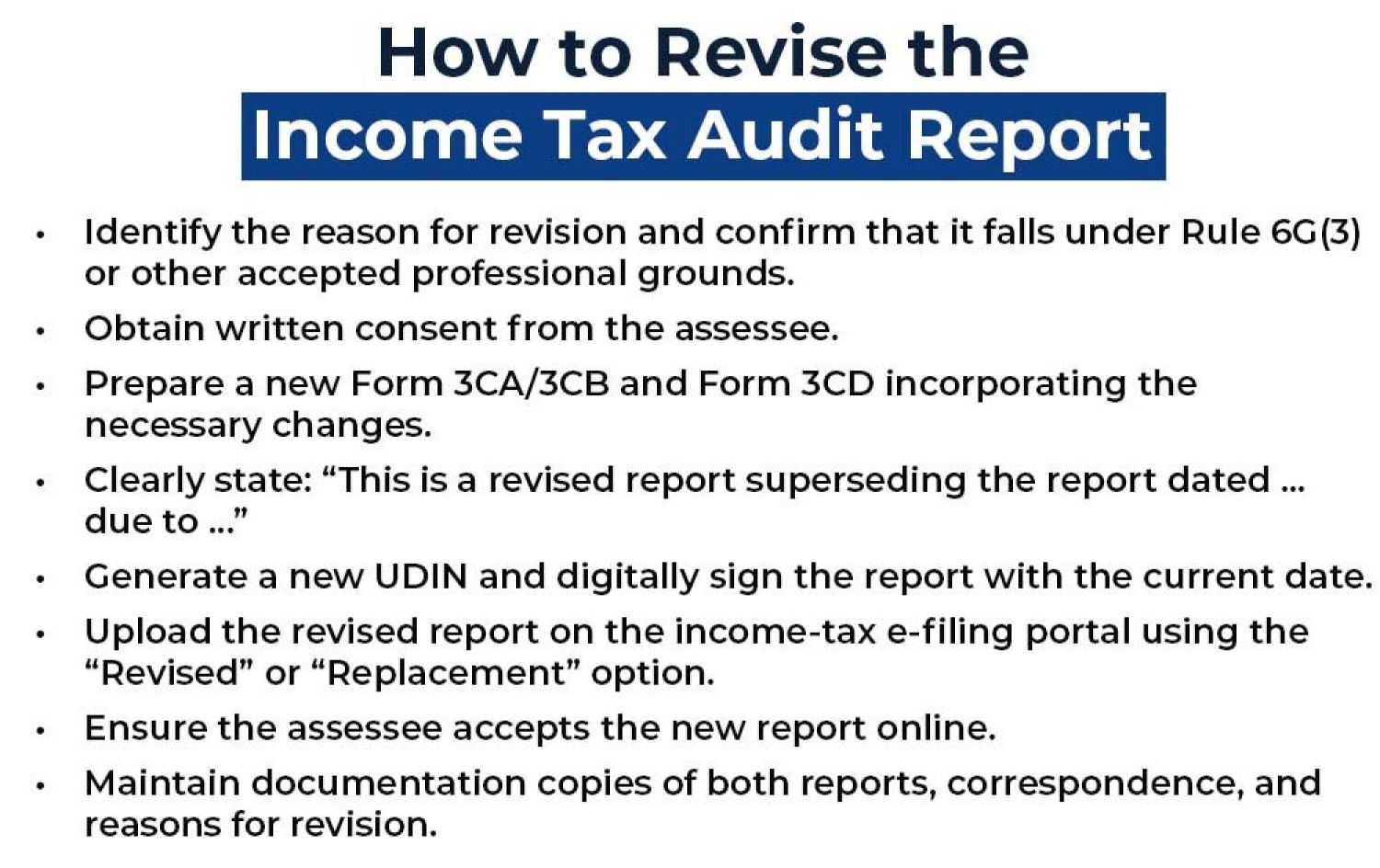
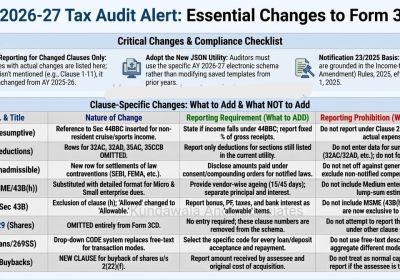
Revision of Tax Audit Report under Rule 6G – Detailed Explanation
The Income Tax Act permits revision of a tax audit report in certain specified situations. Earlier, there was no specific mechanism to revise a tax audit report after filing. However, pursuant to Notification No. 28/2021 dated 01.04.2021, a taxpayer can furnish a revised Tax Audit Report in prescribed circumstances.
Legal provision related to revision of tax audit report under Rule 6G
A Tax Audit Report furnished under Rule 6G in Form 3CA/3CB and Form 3CD may be revised by obtaining a revised report from the Chartered Accountant, duly signed and verified, and furnishing the same before the end of the relevant assessment year.
Why was this amendment introduced?
A common practical issue arose where
- An expense was disallowed in the original Tax Audit Report under Section 40 or Section 43B.
- Subsequently, the assessee made payment of the outstanding amount.
- As a result, the expenditure became allowable under the Income Tax Act.
Before this amendment, there was no effective mechanism to update the Tax Audit Report to reflect the subsequent payment and revised disallowance computation. Hence, Notification No. 28/2021 introduced the concept of a revised audit report.
Situations Where Revision is Allowed
1. Disallowance under Section 43B
Section 43B covers items such as GST liability, PF/ESI contribution (employer's contribution), interest payable to banks and financial institutions, leave encashment, and various statutory dues.
Example: Original Tax Audit Report: GST payable: INR 10,00,000, not paid up to audit report date. And the auditor reports disallowance under Section 43B.
Subsequently, the assessee pays GST before filing the return or within the prescribed period. The expenditure becomes allowable. Accordingly, a revised Tax Audit Report may be furnished reflecting the reduced or nil disallowance.
2. Disallowance under Section 40
Section 40 commonly covers TDS defaults under Section 40(a)(ia), payments to non-residents without TDS, and other specified disallowances.
Example: Original Report: Professional fees of INR 500,000 paid. TDS is not deducted, and the auditor reports disallowance under Section 40(a)(ia).
Later: Assessee deducts and deposits TDS. As the expenditure may become allowable in accordance with law, a revised Tax Audit Report can be issued showing the revised computation.
Time Limit for Revision of Tax Audit
The revised Tax Audit Report must be furnished: Before the end of the relevant assessment year, for example:
|
Particulars |
Date |
|
Previous Year |
FY 2025-26 |
|
Assessment Year |
Assessment Year 2026-27 |
|
Last date for revision |
31 March 2027 |
The revision cannot be made after the end of the relevant assessment year.
Practical Procedure Revision of Tax Audit Report under Rule 6G
- Step-1: Identify the item originally reported as disallowable u/s 40 or 43B.
- Step-2: Verify that the assessee has subsequently complied with the applicable conditions.
- Step-3: Obtain documentary evidence such as GST challans, PF/ESI payment proofs, TDS payment challans, Form 26AS reconciliation and Bank payment records
- Step-4: The auditor issues a revised Form 3CA/3CB and Form 3CD.
- Step-5: The revised report is uploaded on the Income-tax portal before the permitted time limit.
Whether Revision is Allowed for Every Mistake?
Ans: No. The amendment specifically covers situations where revision becomes necessary because an expenditure was initially disallowed u/s 40 or Section 43B, and subsequently becomes allowable due to compliance by the assessee. Examples generally covered Payment of statutory dues after audit report, Deposit of TDS after audit report and Compliance resulting in revised disallowance calculation.
Examples generally not intended Changing audit opinion, Correcting negligence of auditor without proper justification. And altering financial statements merely because management changes its view.
Illustration: Original Tax Audit Report
|
Particulars |
Amount |
|
MSME dues unpaid beyond prescribed period |
INR 8,00,000 |
|
Reported u/s 43B(h) as disallowable |
INR 8,00,000 |
Subsequent Event like Payment made before the prescribed cut-off date. And Liability becomes allowable.
Revised Tax Audit Report
|
Particulars |
Amount |
|
Disallowance u/s 43B(h) |
Nil |
The revised report correctly reflects the changed tax position.
Key Points for Chartered Accountants
- Revision is not automatic; a fresh audit report must be issued.
- The revised report must be duly signed and verified by the auditor.
- Proper audit evidence supporting the revised claim must be obtained.
- Revision should clearly disclose the reason for revision.
- The revised report must be furnished before the end of the relevant assessment year.
Penalty under Section 271B for Failure to Comply with Tax Audit Requirements
Section 271B of the Income-tax Act, 1961 provides for levy of penalty where a person who is required to get his accounts audited under Section 44AB fails to comply with the prescribed requirements. the penalty can be imposed for failure to obtain a tax audit or failure to furnish the tax audit report within the prescribed time.
When is the penalty levied?
The Assessing Officer may impose penalty if the assessee:
- Fails to Get Accounts Audited : Where tax audit is applicable under Section 44AB, but the assessee does not obtain the audit report from a Chartered Accountant.
- Fails to Furnish Tax Audit Report : Even if the audit is completed, a penalty can be attracted if the audit report is not furnished within the prescribed due date.
Quantum of Penalty: The penalty is 0.5% of Total Sales, Turnover or Gross Receipts OR INR 150,000, whichever is Less.
Common Situations Leading to Penalty: Failure to Identify Tax Audit Applicability
- Wrong turnover computation.
- Excluding GST incorrectly.
- Ignoring other business receipts.
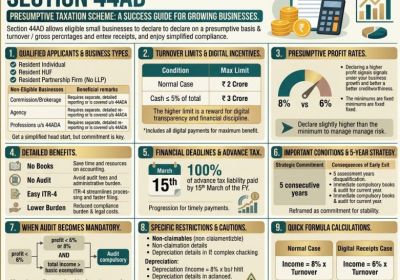
- Misapplication of presumptive taxation provisions.
Delay in Obtaining Audit Report: Audit completed after due date.
Failure to Upload Audit Report: Audit completed but not accepted on the Income-Tax Portal.
Incorrect Clause Selection: Wrong reporting under Section 44AB(a), (b), (c), (d), or (e).
Non-compliance in Multiple Businesses:
An assessee may get one business audited but miss another business which independently attracts Section 44AB.
Case Study: Case of an assessee having:
- Business 1 Turnover = INR 15 Crore
- Business 2 Turnover = INR 70 Lakhs
The assessee obtained audit only for one business and filed the prescribed report within time. The question raised is whether penalty under Section 271B can still be imposed and, if so, on what turnover. The presentation refers to the judicial decision in Smt. Bharti Sharma [2011] 44 SOT 230 (Delhi) for understanding the applicability of penalty provisions in such situations.
Relief from Penalty – Section 273B
Penalty u/s 271B is not automatic. No penalty shall be imposed if the assessee proves that there was a reasonable cause for the failure. Examples of reasonable cause may include serious illness of the assessee, resignation or death of the accountant, loss of records due to fire, flood, theft, etc. Genuine technical issues in audit completion and circumstances beyond the assessee's control. The burden of proving reasonable cause lies on the assessee.
Key Takeaways for Chartered Accountants
- Determine tax audit applicability at the beginning of the engagement.
- Verify turnover, gross receipts and presumptive taxation provisions carefully.
- Obtain the audit report well before the due date.
- Ensure Form 3CA/3CB and Form 3CD are successfully uploaded.
- Maintain supporting documentation for any delay or non-compliance.
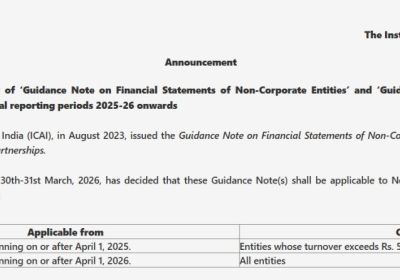
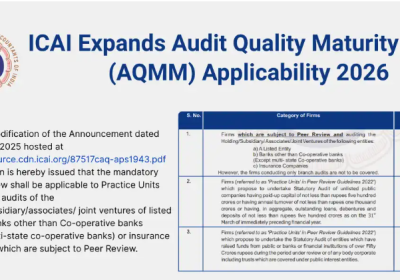
- Be aware that with ICAI's new UDIN validations and audit limits, procedural compliance has become more important than ever.
Conclusion
The revision facility introduced through Notification No. 28/2021 dated 01.04.2021 is a beneficial provision that allows taxpayers to revise a Tax Audit Report where a disallowance reported u/s 40 or 43B subsequently becomes allowable due to compliance after the original audit report. It ensures that the Tax Audit Report reflects the correct tax position and prevents unnecessary disallowances where statutory conditions are eventually satisfied. Section 271B is intended to enforce compliance with Section 44AB. Where an assessee either fails to get the accounts audited or fails to furnish the tax audit report within the prescribed time, the Assessing Officer may levy a penalty equal to 0.5% of turnover/gross receipts subject to a maximum of INR 1,50,000. However, if a genuine and reasonable cause exists, relief may be available under Section 273B