Table of Contents
Guidance on Invoice Numbering Rules under GST
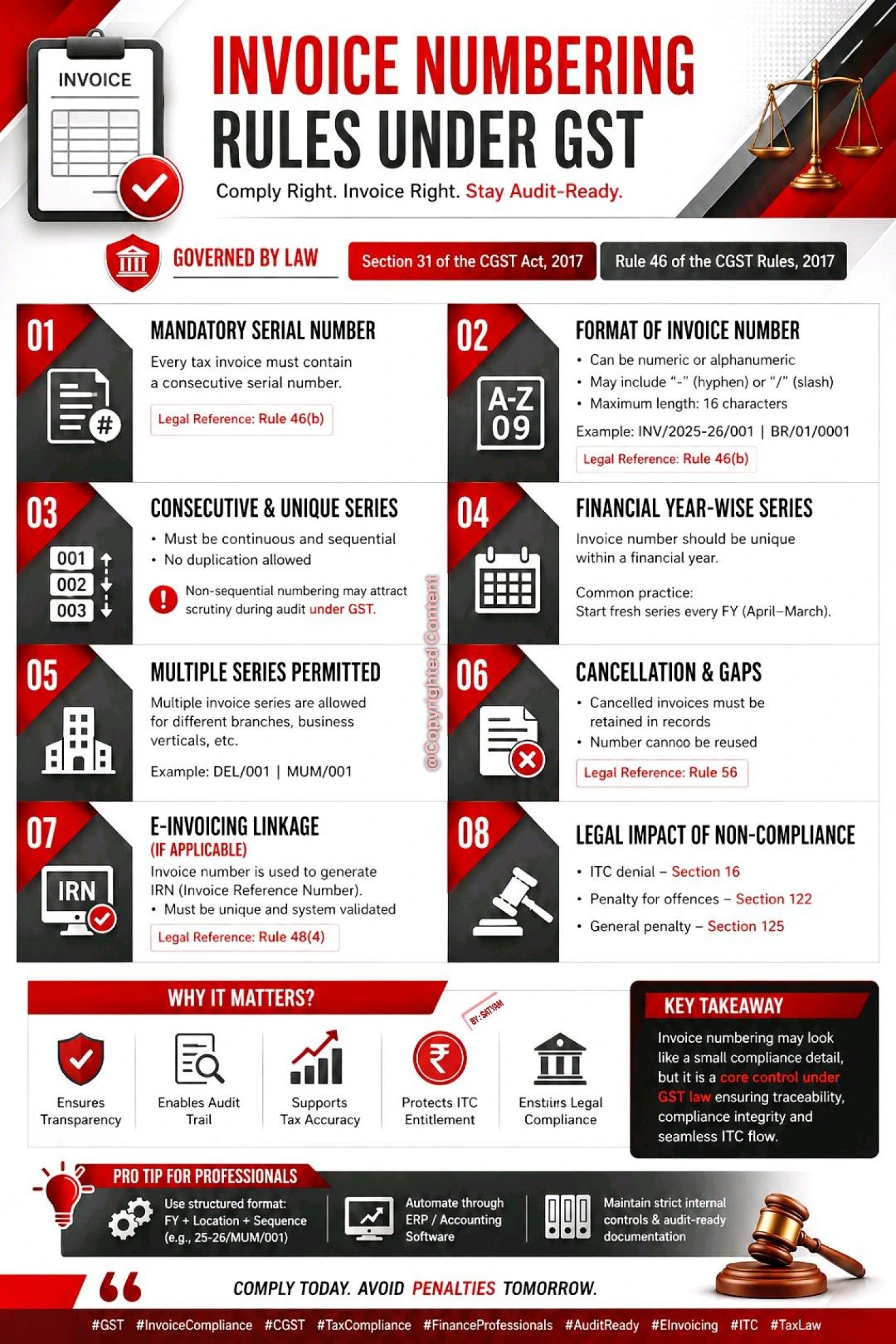
Under Goods and Services Tax and invoice numbering are statutory compliance requirements, not merely an internal accounting practices. Proper invoice numbering ensures traceability, input tax credit eligibility, and audit integrity. The provisions governing invoice numbering are primarily the following:
- Section 31 of the Central Goods and Services Tax Act, 2017
- Rule 46(b) of the Central Goods and Services Tax Rules, 2017
Mandatory Serial Number: Legal Reference: Rule 46(b), Central Goods and Services Tax Rules, 2017: Every tax invoice must contain a serial number that is consecutive, unique, and specific to a financial year. This serial number is a compulsory field in a valid Goods and Services Tax invoice. Absence or improper serial numbering renders the invoice non‑compliant.
Format of Invoice Number: Rule 46(b) specifies flexibility in format
Invoice Number can be numeric or alphanumeric, and Invoice Number may include Hyphen (-), Slash (/) and have a maximum length of 16 characters. Common & accepted formats are INV/2025 26/001, BR/01/0001, and GST/DEL/000123. Businesses may design their own numbering logic, provided it remains unique and sequential.
Consecutive & Unique Series:
Invoice numbers must run in a continuous sequence, and No duplication is permitted within the same series. However, nonsequential numbering often invites departmental scrutiny and reconciliation queries during Goods and Services Tax audits or notices.
Normal Red Flags during Audit related to Goods and Services Tax invoices like missing numbers, duplicate invoice numbers, and manual alterations in sequence.
Financial Year Wise Series
Goods and Services Tax law requires invoice numbers to be unique for a financial year. Moreover, that best industry standard practice: Start a fresh invoice series every FY (April March). Example: FY 2024‑25 → INV/24 25/001 and FY 2025 26 → INV/25 26/001. This approach simplifies the audit trail and reconciliation.
Multiple Invoice Series Allowed:
Goods and Services Tax law permits multiple invoice series, provided conditions are met. Separate series may be maintained for different branches, different business verticals, and different locations. Illustrations like DEL/001, MUM/001, and BLR/001. Each series must still be consecutive, non‑overlapping, and properly documented.
Cancellation & Gaps in Invoice Numbers:
- Rule 56 – Records to be maintained. If an invoice is cancelled: The invoice number must not be reused, and the cancelled invoice must be retained in records.
- Maintaining cancelled invoices ensures an audit trail and explanation for sequence gaps. Gaps are acceptable only if supported by cancelled or voided invoices.
E Invoicing Linkage (Where Applicable)
- Rule 48(4), Central Goods and Services Tax Rules, 2017: For entities covered under e‑invoicing. The invoice number is a key parameter for generating the invoice reference number.
- Invoice numbering must be unique across the financial year and system‑validated on the Invoice Reference Number portal. Duplicate invoice numbers will result in invoice reference number generation failure.
Legal Impact of Non‑Compliance Invoice Numbering Rules
- Improper or defective invoice numbering may lead to Input Tax Credit denial Section 16, Central Goods and Services Tax Act 2017, penalty for wrong invoicing (Section 122), and general penalty (u/s 125). Consequences apply to both supplier and recipient, impacting ITC credibility.
Professional Best Practices in relation to Invoice Numbering Rules
Invoice numbering under Goods and Services Tax is not just formatting compliance. It is a core audit control mechanism ensuring end‑to‑end traceability, seamless input tax credit flow, legal defensibility, and clean departmental audits. A strong invoice‑numbering discipline reflects a well‑governed GST‑compliant business.
- Use a structured format (FY + Location + Series)
- Implement numbering through ERP and accounting software (Tally, SAP, Zoho, etc.).
- Maintain audit‑ready documentation Cancelled invoices, series mapping, and branch-wise configuration.
Common Invoice No. Mistakes Which May Cost Our Business:
When you run your own business, you must be extremely careful with your money. especially how you get paid. Your invoice (or bill) is the most important document you issue to collect payments from customers. While the invoice number may look like a small detail, it plays a crucial role in payment tracking, accounting accuracy, and Goods and Services Tax compliance. A simple mistake in invoice numbering can lead to delayed payments, messy records, goods and services tax noncompliance, and audit issues. Most common invoice numbering mistakes made by business owners & shows practical ways to avoid them.
Mistake 1: Using Handwritten or Jumbled Invoice Numbers
- Many new business owners rely on paper bill books or basic spreadsheets. This often results in random invoice numbers with no consistent structure. This inconsistency creates confusion in accounts, makes it hard to track outstanding payments, and looks unprofessional during Goods and Services Tax verification. It signals weak financial control and poor recordkeeping. So taxpayers can fix, like, use a single, structured invoice numbering format generated automatically by software.
Mistake 2: Duplicate Numbers or Missing Sequence Gaps
- Goods and Services Tax requires invoice numbers to be sequential and unique within a financial year. Common errors like issuing INV‑105 to two different customers and jumping from INV‑107 directly to INV‑109. Duplicate numbers confuse customers and may cause payment rejection. Missing numbers imply a missing invoice, which raises red flags during tax audits. So, taxpayers can fix, like always, maintain a continuous sequence and preserve cancelled invoices as records.
Mistake 3: Overly Complicated Invoice Numbers
- Some businesses create very long invoice numbers hoping to add more information. Example: MUMBAI/RAHUL/OCT/001‑NEW. Such formats are Prone to typing errors. Difficult for accounting software to process and confusing for customers. So, taxpayers can fix it via using best practice in this regard like keep numbers simple and structured, e.g., TVS/25‑26/001.
Mistake 4: Ignoring Goods and Services Tax & E‑Invoicing Rules
- Goods and Services Tax law lays down specific conditions for invoice numbers. Must be unique and sequential for the entire financial year, Maximum length: 16 characters and only permitted symbols (e.g., / and ‑). For businesses under e‑invoicing, invoice numbers must be globally unique before uploading to the Invoice Registration Portal. Non‑compliant invoices Become invalid under Goods and Services Tax, blocking the customer’s input tax credit, can attract penalties and disputes. Taxpayers can fix this via using best practices in this regard, like always aligning invoice numbering with goods and services. Tax rules before issuing invoices.
Mistake 5: Restarting Invoice Numbers Every Month
- Many businesses restart their invoice series from “001” each month. Example: April: INV‑001 and May: INV‑001 again. This results in multiple invoices with the same number in one financial year, causing confusion during annual reconciliation. Normal Goods and Services The tax rule is invoice numbers must be continuous for the entire FY (April–March). Taxpayers can fix this via using best practices in this regard, like restarting numbering only on 1st April, not every month.
Mistake 6: Maintaining Separate Series for Different Sale Types :
- Some businesses use different series for cash sales (CS‑001) and for credit sales (CR‑001). GST rules require one continuous series for all tax invoices. Multiple unlinked series make reconciliation difficult and can be treated as non‑compliance. Taxpayers can fix this via using best practices in this regard, like maintaining a single, consolidated invoice sequence (unless separate series are justified for branches or locations as per law).
Mistake 7: Using Prohibited Special Characters:
- Goods and Services Tax systems allow only limited characters in invoice numbers. Symbols like "#" and "&" are not permitted and can cause like E invoice rejection, Invoice Registration Portal generation failure, and payment delays. Allowed characters: alphabets & numbers, Hyphen (‑) and Slash (/). Automate Invoice Compliance with Accounting Software. Using professional accounting software eliminates almost all invoice numbering errors.
Software helps with invoice numbering errors
- How software helps with invoice numbering errors. Prevents duplication and gaps, auto‑generates uniqueness, and Ensures Goods and Services Tax compliant formats and sequential invoice numbers enable easy e‑invoice generation and improve receivables and payables tracking. Automation removes manual errors and keeps records audit‑ready.
- Taxpayer invoice No, it is the foundation of the taxpayer's business accounting system and goods and services tax compliance. Mistakes in numbering don’t just affect paperwork. They impact cash flow, customer trust, and tax safety. A clean, orderly, and Goods and Services Tax compliant invoice sequence Speeds up payments, strengthens business credibility, simplifies audits, and protects input tax credit.
- Using reliable accounting software is the most effective way to avoid costly mistakes, allowing you to focus on growing your business instead of fixing compliance issues.