Table of Contents
- Goods & Services Tax loopholes & Fraud Areas In India
- Gst Loopholes & Fraud Areas Controlled By Legal Framework And Penal Provisions
- Penal Provisions To Handle For Gst Loopholes/fraud Areas Controlled
- Anti Money Laundering Measures (pmla)
- Technology Driven Enforcement:
- Enforcement Actions And Judicial Support
- Rajput Jain And Associates' Recommendations In Relation To Above Act
- Conclusion
Goods & Services Tax Loopholes & Fraud Areas in India
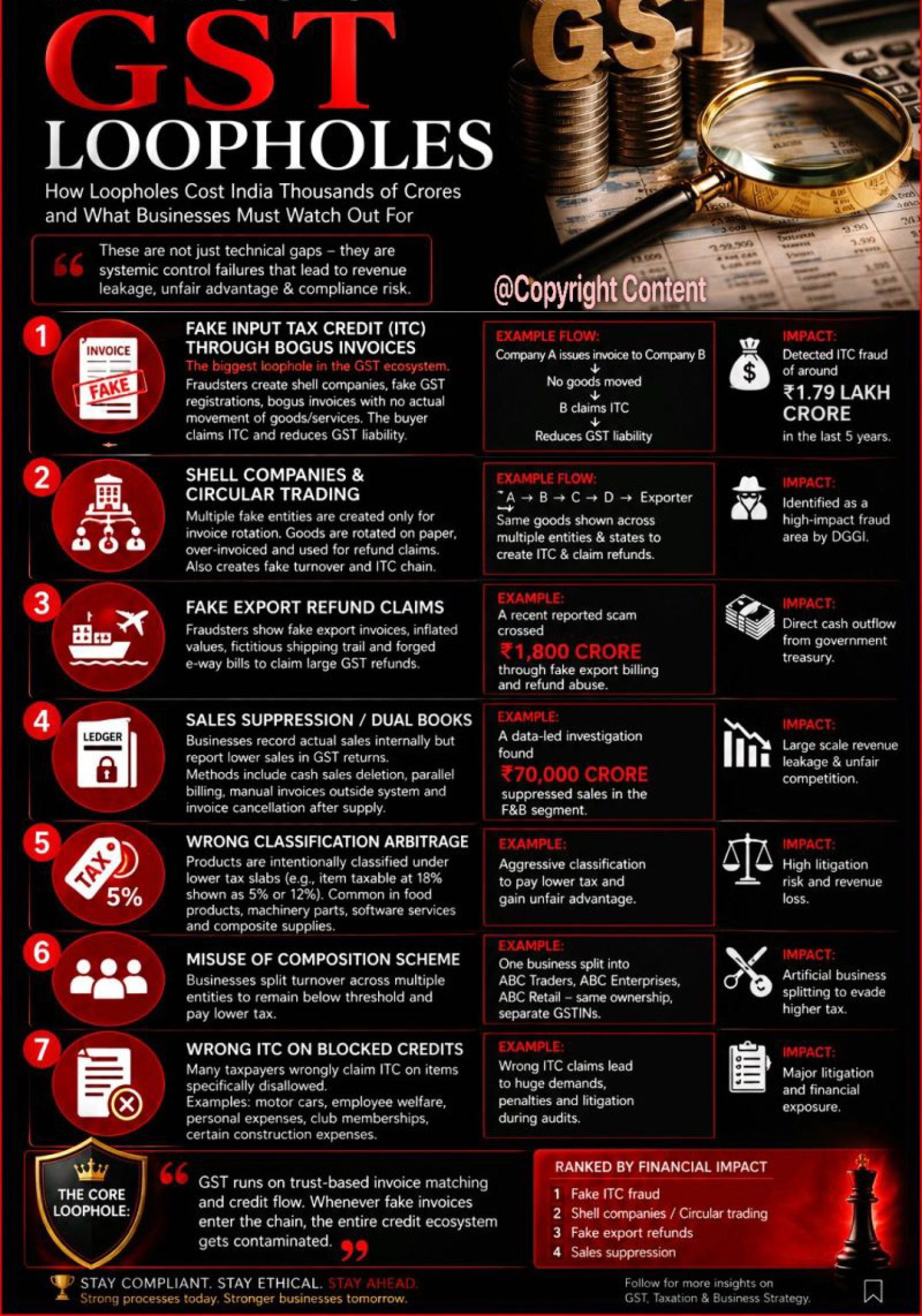
Goods & Services Tax fraud largely revolves around fake Input Tax Credit, fictitious entities, refund abuse & turnover suppression, while classification & Input Tax Credit eligibility continue to drive interpretational disputes & litigation. Challenges faced to overcome fake invoicing under GST are short‑lived shell entities and dummy directors, weak inter‑agency data sharing, and the risk of hardship to genuine taxpayers due to over‑blocking and scrutiny. This blog highlights seven major loopholes & misuse patterns under Goods & Services. Tax, explaining how revenue leakage & fraud commonly occur:
Fake Input Tax Credit via Bogus Invoices:
- Fake invoicing is used for bogus input tax credit claims without real transactions, circular trading among shell companies to create artificial input tax credit chains, sales suppression to evade goods & services tax on actual supplies, and fake export claims to wrongfully obtain goods & services tax refunds.
- Examines fake invoicing under the GST regime as a serious and systemic tax fraud involving the issuance of invoices without the actual supply of goods or services to fraudulently claim Input Tax Credit. This malpractice has caused large-scale revenue losses, distorted competition, and weakened trust in India’s GST framework.
- The largest Goods & Services Tax fraud channel. Shell entities issue invoices without actual supply, allowing buyers to wrongfully claim Input Tax Credit. Authorities have detected INR 1.79 lakh crore of such fraud in recent years. Investigations by Directorate General of Goods & Services Tax Intelligence have revealed fraudulent Input Tax Credit claims worth tens of thousands of crores, often involving complex networks of dummy entities.
Shell Companies & Circular Trading: Networks of fake entities rotate invoices without real movement of goods to create artificial turnover, build input tax credit chains & claim refunds—identified by the Directorate General of Goods & Services Tax Intelligence as a high‑impact fraud.
Fake Export Refund Claims: Since exports are zero‑rated, fraudsters show fictitious exports with inflated values & forged documentation to obtain goods & services tax refunds. Recent scams have crossed INR 1,800 crore, directly draining government funds.
Sales Suppression / Dual Books: Common in retail & restaurants. Actual sales are hidden using cash deletions, parallel systems, or off‑record billing. Data analytics have reportedly uncovered INR 70,000 crores of suppressed sales in the food & beverage sector.
Wrong Classification Arbitrage: Products/services are deliberately classified under lower goods & services tax slabs. Often falls in a grey area of aggressive tax planning rather than outright fraud & leads to prolonged litigation (e.g., food & composite supply disputes).
Misuse of Composition Scheme: Businesses split operations into multiple entities to stay below turnover thresholds & pay lower composition tax, violating the substance‑over‑form principle.
Wrong Input Tax Credit on Blocked Credits: Input Tax Credit is wrongly claimed on items expressly disallowed under Goods & Services Tax (cars, employee perks, club memberships, and certain construction costs), making this a major audit & litigation hotspot.
GST Loopholes & Fraud Areas controlled by Legal Framework and Penal Provisions
GST law provides a strong penal and criminal framework:
- Section 122, Central Goods and Services Tax Act, 2017: Civil penalty of 100% of tax evaded or INR 10,000 (whichever is higher) for issuing fake invoices or availing ineligible input tax credit.
- Under Section 132, Central Goods and Services Tax Act, 2017: Criminal liability with imprisonment ranging from 1 to 5 years depending on the fraud amount; cases above INR 5 crore are cognizable & non bailable.
- Rule 86A, Central Goods and Services Tax Rules: Allows blocking of input tax credit in the electronic credit ledger where fraud is suspected, acting as an immediate preventive tool.
Penal Provisions to handle for GST loopholes/fraud areas controlled
|
Nature of Default |
Consequence |
|---|---|
|
|
|
|
|
|
|
|
|
|
Anti Money Laundering Measures (PMLA)
- Large Goods & Services Tax fraud invoicing cases are increasingly prosecuted under the Prevention of Money Laundering Act: Fake invoicing is treated as a predicate offense. Attachment of properties and freezing of bank accounts permitted. Enhanced punishment of up to 7 years imprisonment. This elevates GST fraud from tax issues to serious financial crimes.
Technology Driven Enforcement:
- GSTN analytics and AI tools identify abnormal ITC patterns; E‑Waybill system ensures linkage between invoicing and actual goods movement; and Real‑time monitoring helps curb invoice‑only transactions
Enforcement Actions and Judicial Support
- Directorate General of Goods & Services Tax Intelligence crackdowns (INR 55,000 crore detection in recent years) involving arrests, registration cancellations, and asset seizures
- • The Supreme Court and High Courts have upheld strict action, recognizing fake invoicing as financial fraud, not mere tax non‑compliance, while also stressing due process.
Rajput Jain and Associates' recommendations in relation to above act
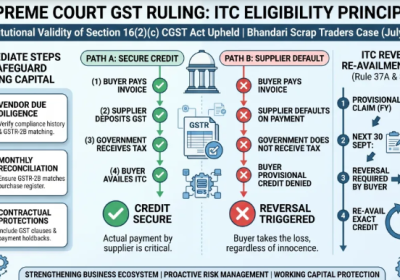
Goods & Services Tax fraud is not merely a tax default but a financial crime with multi-law exposure. Practical Red Flags: Compliance Risk Indicators like Mismatch between GSTR-1, GSTR-3B, and GSTR-2B; High ITC with low output liability, Repeated amendments or reversals, vendor non-compliance (inactive GSTINs), and unusual transaction patterns (round-tripping). Businesses must treat goods & services. Tax compliance as a governance and risk management function, not just a reporting obligation. To mitigate exposure Perform vendor due diligence (GSTIN validation, filing status) and reconcile input tax credit with GSTR-2B on a monthly basis. Maintain robust documentation (invoice, e-way bill, delivery proof); avoid aggressive tax positions on classification/valuation; and implement internal goods & services. Tax audits and controls: we also have recommendations for following action against the Goods & Services Tax loopholes/fraud areas. Advanced AI‑based fraud detection
- Integrated data sharing among Goods & Services Tax, ED, FIU, and banks
- Stricter Goods & Services Tax registration KYC with physical verification for high risk cases
- Stronger penalties for repeat offenders
- Taxpayer education and compliance support to reduce genuine errors
Conclusion
Fake invoicing is one of the most damaging goods & services tax frauds, warranting a combination of strong legal action, AML enforcement, technology upgrades, and systemic coordination. Sustained reform and responsible taxpayer participation are essential to protect the integrity of India’s Goods & Services Tax ecosystem and ensure a fair, compliant business environment. The following are common Goods & services: Tax fraud typologies in India:
|
Type of Fraud |
Description |
Compliance Risk |
|---|---|---|
|
Fake Invoicing |
Issuing invoices without actual supply |
Wrongful Input Tax Credit claims |
|
Circular Trading |
Artificial turnover inflation across entities |
Input Tax Credit fraud and tax evasion |
|
Input Tax Credit Fraud |
Claiming Input Tax Credit on ineligible/non-existent purchases |
High litigation exposure |
|
Tax Evasion |
Suppression or under-reporting of sales |
Direct revenue loss |
|
Undervaluation |
Declaring lower transaction values |
Reduced Goods & Services Tax liability |
|
Bogus Registration |
Fake Goods & Services Tax registrations for fraud |
Registration cancellation + prosecution |
|
Misclassification |
Incorrect HSN/SAC to reduce tax rate |
Demand + penalty |
|
Export Fraud |
Fake export claims for refunds |
Refund clawback + prosecution |
|
E-way Bill Fraud |
Manipulating movement documentation |
Movement verification risk |
|
Non-filing of Returns |
Avoiding tax liability reporting |
Late fees + best judgment assessment |