Table of Contents
- New Draft Income Tax Rules, 2026 – Objective, Areas, Highlights,
- Objective Of The New Draft Income Tax Rules, 2026 :
- Focus Areas Of Reform Via Implemented The New Draft Income Tax Rules, 2026
- What Survives Under The New Tax Regime (2026 Framework)?
- Renaming Of Income Tax Forms Under The Income Tax Act, 2025
- Final Takeaway
New Draft Income Tax Rules, 2026 – Objective, Areas, Highlights,
The Central Board of Direct Taxes has proposed significant reforms under the Draft Income Tax Rules, 2026, to simplify compliance, enhance transparency, and modernize tax administration.
Objective of the New Draft Income Tax Rules, 2026 :
The proposed changes aim to simplify complex tax provisions, reduce paperwork and procedural burden, promote digital compliance and automation, strengthen reporting of high-value transactions, and enhance transparency in financial dealings. This marks a significant step towards a more streamlined, technology-driven tax framework. Increased use of pre-filled income tax returns and greater integration of digital reporting systems.
Focus Areas of Reform via implemented the New Draft Income Tax Rules, 2026
The Draft Income Tax Rules, 2026, emphasize the monitoring of high-value cash and property transactions Rationalization of allowances and perquisites, expansion of metro cities for House Rent Allowance purposes, mandatory reporting for crypto asset transactions, and recognition of digital payment modes including Central Bank Digital Currency.
Major Structural Reform due to new draft income tax rules, 2026: simplification drive rules reduced from 511 to 333, Forms reduced from 399 to 190, nearly a 50% reduction in paperwork, greater use of pre-filled returns, digital compliance systems, and automated reporting.
These New Draft Income Tax Rules, 2026, reflect a shift toward faceless, technology-driven tax administration. Key Highlights of New Draft Income Tax Rules, 2026, are as under
PAN Reporting Thresholds – Expanded Compliance
- Cash Transactions : PAN is mandatory for cash deposits or withdrawals aggregating to INR 10 lakh or more in a financial year.
- Motor Vehicle Purchases: PAN is required for the purchase of motor vehicles exceeding INR 5 lakh, including two-wheelers.
- Property Transactions: PAN is mandatory for transactions above INR 20 lakh (earlier INR 10 lakh). Covers: Purchase, Sale, Gift. Joint Development Agreements (JDA)
- PAN for High-Value Lifestyle & Event Payments : PAN quoting is required for hotel & restaurant bills exceeding INR 1 lakh, convention centers/banquet halls, and event management service providers, and it applies when payment exceeds INR 1 lakh. This move targets tracking of high-value personal expenditures.
PAN Quoting Requirements – Revised Thresholds
|
S. No. |
Nature of Transaction |
Existing Limit |
Draft Rules 2026 Limit |
|
1 |
Sale/purchase of motor vehicle |
PAN required for all vehicles except two‑wheelers |
PAN required for transactions over INR 5 lakh (includes motorcycles; excludes tractors) |
|
2 |
Cash payment to hotel/restaurant |
> INR 50,000 at one time |
> INR 1,00,000 |
|
3 |
Life insurance premium |
> INR 50,000 per year |
Replaced with PAN at commencement of account‑based relationship |
|
4 |
Immovable property transaction |
> INR 10 lakh |
> INR 20 lakh |
|
5 |
Cash withdrawals (bank/post office) |
≥ INR 20 lakh per FY |
≥ INR 10 lakh per FY |
Allowances & Perquisites – Rationalisation
- Free Meals Provided by Employer: Tax-free perquisite value fixed at INR 200 per meal, Applies to food & non-alcoholic beverages
- Company Car Allowance (Monthly Perquisite Value): INR 8,000 – Engine capacity below 1.6L, INR 10,000 – Engine capacity above 1.6L and includes driver cost.
- House Rent Allowance – Expanded Metro Definition: The list of Category 1 metro cities has been expanded. Previously Included: Delhi, Mumbai, Kolkata, Chennai, and Newly Added: Bengaluru, Pune, Ahmedabad, and Hyderabad. This may increase House Rent Allowance exemption eligibility for salaried individuals in these cities.
Allowances & Perquisite Valuation – Old vs New (2026 Draft Rules)
Revised Exemptions and Valuation
|
Item |
BEFORE (Old Rules) |
AFTER (Draft Rules 2026) |
|
Children Education Allowance |
INR 100 per month per child |
INR 3,000 per month per child |
|
Hostel Allowance |
INR 300 per month per child |
INR 9,000 per month per child |
|
Free Meals |
INR 50 per meal |
INR 200 per meal |
|
Gifts (Non cash) |
INR 5,000 per year |
INR 15,000 per year |
|
Car Lease Engine < 1.6L |
INR 1,800 (Perquisite) + INR 900 (Driver) |
INR 5,000 (Perquisite) + INR 3,000 (Driver) |
|
Car Lease Engine > 1.6L |
INR 2,400 (Perquisite) + INR 900 (Driver) |
INR 7,000 (Perquisite) + INR 3,000 (Driver) |
|
Overseas Medical Treatment |
Tax‑free only if income < INR 2 lakh |
Tax-free if income < INR 8 lakh |
Other Important Changes
|
Item |
BEFORE (Old Rules) |
AFTER (Draft Rules 2026) |
|
Property SFT Reporting Limit |
INR 30 lakh |
INR 45 lakh |
|
Books for Professionals |
Manual books |
Mandatory digital books |
|
CBDC (e‑Rupee) |
Not recognised |
Recognized as a valid electronic mode of payment |
Crypto & Digital Asset Reporting
Crypto Exchanges
- Mandatory reporting obligations for crypto-asset service providers.
- Transaction data to be shared with the Income Tax Department.
- Increased surveillance on digital asset transactions.
Central Bank Digital Currency (CBDC)
- Central Bank Digital Currency is recognized as an accepted electronic payment mode.
- Covers India’s digital rupee issued by RBI.
What Survives Under the New Tax Regime (2026 Framework)?
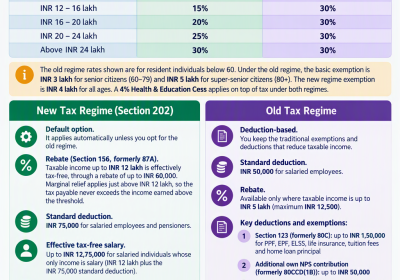
- The New Regime continues to offer Lower slab rates, Minimal exemptions, Limited deductions, and Standard deduction (as notified earlier) and Simplified compliance
- Best suited for Individuals with fewer deductions, Young professionals, and Taxpayers not claiming HRA, home loan interest, 80C, etc.
What Strengthens the Old Tax Regime in 2026?
With the Draft 2026 Rules rationalising allowances and expanding exemption limits, the Old Regime may become attractive again for a section of salaried taxpayers. Key Factors That Could Benefit Old Regime:
- Increased Allowance Exemptions. Revised perquisite valuation for company cars, free meal exemption threshold fixed, and expanded HRA metro classification.
- Expanded metro cities for HRA: Delhi, Mumbai, Kolkata, Chennai, Bengaluru, Pune, Ahmedabad, and Hyderabad. This means higher HRA exemption eligibility for many salaried employees.
- Deductions That Continue Only in Old Regime : Section 80C investments (PF, LIC, ELSS, etc.), home loan interest (Section 24), medical insurance (Section 80D), education loan interest (Section 80E), LTA, HRA exemptions, and various salary structure benefits.
When Can the Old Regime Become More Beneficial in 2026?
If taxpayers already claim multiple deductions, taxpayers live in a newly classified metro city, taxpayers receive structured allowances, taxpayers have a home loan and taxpayers' employer provides tax-efficient perquisites. Then the increased exemption limits may reduce taxpayers' taxable income enough to make the old regime more attractive.
Practical Comparison Logic
|
Situation |
Likely Better Regime |
|---|---|
|
No investments, no HRA, no home loan |
New Regime |
|
High 80C + HRA + Home Loan |
Old Regime |
|
Structured salary with allowances |
Old Regime |
|
Simple salary, no deductions |
New Regime |
Renaming of Income Tax Forms Under the Income Tax Act, 2025
The Income-tax Act, 2025 will come into effect from 1 April 2026, along with the Draft Income-tax Rules, 2026. As part of this transition, several commonly used income tax forms—including Form 26AS, Form 16, Form 13, and others will be renumbered and restructured under the new legislative framework.
Over the years, forms such as Form 26AS (Tax Credit Statement) and Form 16 (TDS Certificate for Salary) have become widely recognized and routinely referenced by salaried employees, pensioners, senior citizens, tax professionals, and financial institutions. However, under the new Act, statutory forms have been systematically reorganized to align with the revised structure and drafting style of the legislation.
Although these changes are largely procedural and structural in nature, the shift to new form numbers may cause some initial confusion during the early phase of rollout, particularly among individual taxpayers and small businesses accustomed to the existing nomenclature.
Taxpayers and professionals are advised to Familiarize themselves with the revised form numbering system, update internal documentation and compliance checklists, and exercise caution during the initial months of implementation to avoid filing errors.
The renaming does not alter the fundamental purpose of these forms but reflects the broader modernization and consolidation approach adopted under the new income tax regime effective from FY 2026–27.
Final Takeaway
The New Regime remains simplified and attractive for low-deduction taxpayers. However, with enhanced allowance exemptions and expanded HRA benefits under the 2026 framework, the Old Regime could regain relevance for salaried employees with structured tax planning. Practical Impact of New Draft Income Tax Rules, 2026 for Taxpayers & Professionals: Increased transaction tracking, Higher PAN compliance in lifestyle spending, Better HRA benefits for new metro cities, Stronger crypto monitoring and Simplified rule structure