Table of Contents
FCRA Update – Foreign Contribution (Regulation) Amendment Rules, 2026
The Ministry of Home Affairs (MHA) has notified the Foreign Contribution (Regulation) Amendment Rules, 2026 on 22 June 2026, bringing significant changes to the compliance framework for NGOs and other organizations receiving foreign contributions. The amendments became effective immediately upon publication in the Official Gazette.
The key objective of the amendments is to shift FCRA regulation from a general registration-based system to a purpose-specific and geography-specific framework. Under the new rules, organizations must clearly specify the approved purposes for which foreign contributions will be utilized and the States/Union Territories where such activities will be undertaken. Existing FCRA-registered entities are required to align their registrations with this new framework through prescribed filings.
Major Changes made by MHA in Foreign Contribution (Regulation) Amendment Rules, 2026
1. Definition of “Key Functionary” Introduced By Ministry of Home Affairs
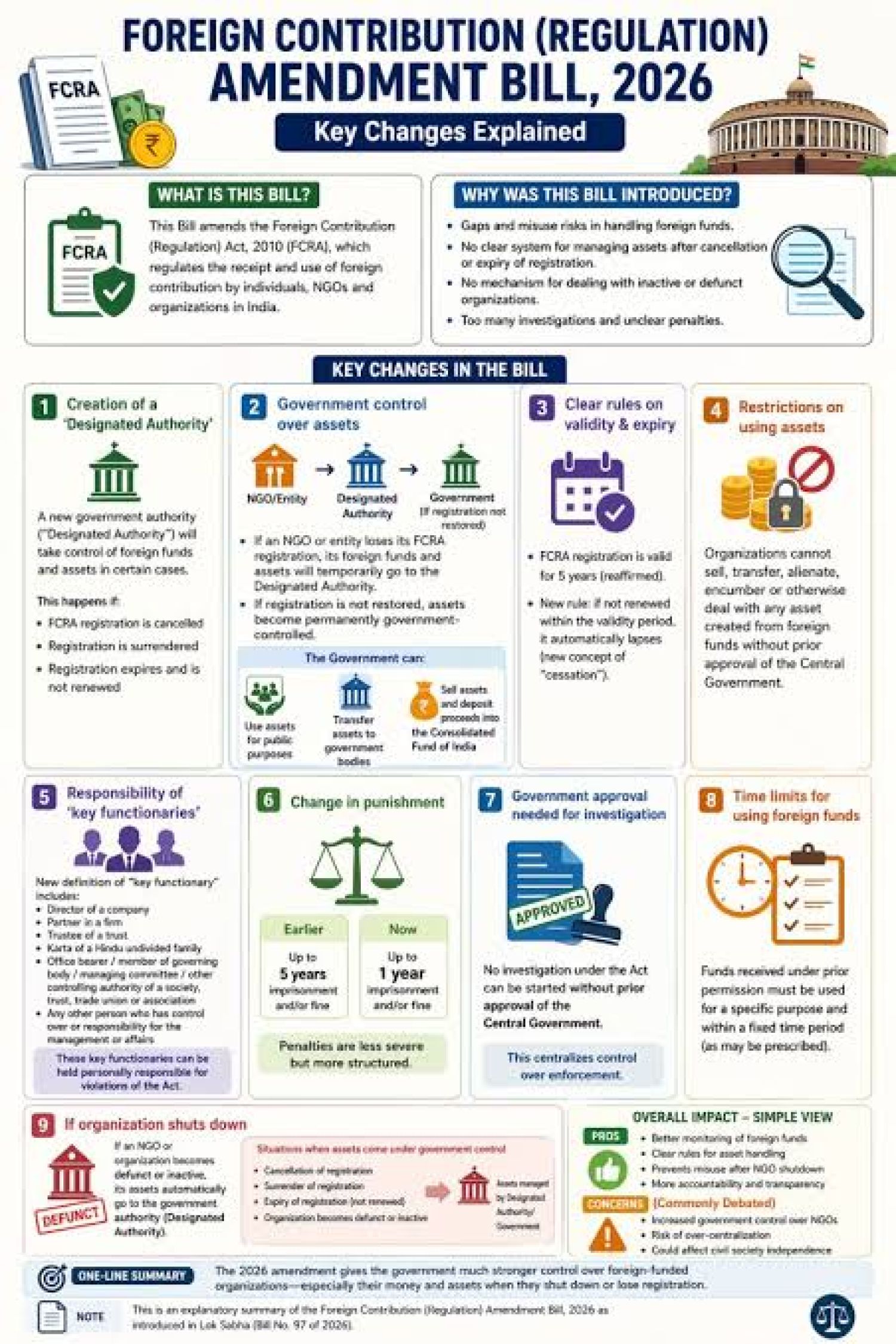
A new standardized term, "Key Functionary," now covers directors of companies, partners of firms, trustees of trusts, Karta of Hindu Undivided Family governing body/managing committee members, and Any person exercising control over management or affairs of the organization. This expands accountability and disclosure requirements to a wider set of office bearers.
2. Purpose-Based & Geographic Registration
FCRA registration certificates will now specifically mention Approved Purpose(s) for utilization of foreign contribution and Approved State(s)/Union Territory where activities can be carried out. New applicants for FCRA registration certificates must select purposes only from the prescribed schedule appended to the rules.
3. Action Required for Existing FCRA-Registered NGOs
All existing FCRA-registered entities must file Form FC-6F within one year (i.e., by 21 June 2027) to declare Approved purpose categories, States/Union Territories of operation. In case of NGO failure, alignment of registration with the new framework may affect future compliance and renewal processes.
4. Fee revisions were introduced by MHA beyond the base registration scope
The Ministry of Home Affairs has changed the additional fees. They will apply for expanded operational scope i.e. INR 300 for each additional state/union territory and also INR 300 for each additional purpose category. These fees apply beyond the base registration scope under the FCRA.
5. Second Installment under Prior Permission
A new FCRA Form FC-3BB has been introduced for the release of second/subsequent installments under the Prior Permission route. The Ministry of Home Affairs has introduced the conditions for the second installment under prior permission, including at least 75% utilization of the previous installment and submission of a chartered accountant certificate and also verification through a field inquiry under the FCRA new regulations. Only after satisfying these conditions can further funds be released.
6. Minimum Activity Threshold for Renewal/Review: least INR 10 lakh of foreign contribution
FCRA-registered entities have required the new activity in NGOs for renewal and review of non-governmental organizations. This is essential for evaluating renewal, cancellation, or compliance status, an organization will generally be considered to have undertaken reasonable activity only if it has utilized at least INR 10 lakh of foreign contribution during the preceding 2 FY.
7. Enhanced FC-4 Annual Return Requirements
The FCRA-registered entities are required to file an annual return in FCRA Form FC-4, which now requires a detailed activity report, a mandatory unique document identification number on the CA certificate, and disclosure of official websites and social media accounts with information regarding publications and communication activities. These changes strengthen transparency and reporting obligations.
8. Foreign Nationals as Key Functionaries Not eligible:
The FCRA dept. also has a key concern on the reporting of associations having foreign nationals (other than eligible persons of Indian origin/overseas citizenship of India as may be permitted) as key functionaries will ordinarily not be considered eligible for registration or prior permission unless specifically permitted by the Central Govt.
9. New Schedule of Approved Activities
The Ministry of Home Affairs has classified activities for main categories. The detailed schedule has been introduced, classifying activities into five broad categories:
|
Category |
Number of Activities |
|
Religious |
16 |
|
Cultural |
18 |
|
Economic |
19 |
|
Educational |
22 |
|
Social |
30 |
NGOs must map their projects and activities to these approved purpose categories while seeking registration or updating their registration.
10. Ministry of Home Affairs makes the change in FCRA due to the following Immediate impact Action Points for non-governmental organizations.
- Non-Governmental Organization Must Review governing body structure and identify all “Key Functionaries”
- Map all ongoing projects to the new purpose categories
- Non-Governmental Organization Must Identify States/Union Territories Where Foreign Contribution-Funded Activities Are Undertaken.
- Prepare for filing Form FC-6F before 21 June 2027.
- Non-Governmental Organizations have to update systems for enhanced FCRA FORM FC-4 disclosures, including social media reporting and Unique Document Identification Number disclosure from the Chartered Accountant certificate issued.
- NGO has to ensure foreign contributions are utilized strictly for approved purposes and locations.
In Summary
Overall, the Foreign Contribution (Regulation) Amendment Rules, 2026 significantly increase governance, disclosure, accountability, and monitoring requirements for FCRA-registered organizations, requiring NGOs to strengthen their compliance and reporting mechanisms
The amendments also strengthen governance and transparency by introducing the concept of a "key functionary," expanding reporting obligations, mandating detailed activity disclosures in annual returns, requiring UDIN-based CA certification, and imposing additional conditions for the release of subsequent installments under prior permission cases.
Further, NGOs must demonstrate a minimum level of foreign contribution utilization for renewal-related evaluations, while restrictions have been tightened regarding foreign nationals serving as key functionaries. A detailed schedule of approved activities has also been introduced to classify permissible purposes under religious, cultural, economic, educational, and social categories.