Table of Contents
- Availability Of Input Tax Credit (itc) To A Business Traveler On Hotel Accommodation Services Taxed At The Concessional Gst Rate Of 5%
- What Section 16 Of The Cgst Act Provides:
- Key Blocked Credit Rule—section 17(5)(b)(i) Of Cgst Act, 2017—blocked Credit
- Gst Rate Applicable On Hotel Accommodation
- Then Why Is There A Dispute Regarding Hotel Gst At 5%?
- Judicial Support For Broad Interpretation Of Itc
- Departmental/industry View
- Gst On Hotel Rooms In India:
- Questions Raised Before The Authority
- Relevant Legal Provisions Examined
- 1. Section 16 Of Cgst Act, 2017 – Eligibility For Itc
- 2. Section 17(5)(b)(i) Of Cgst Act, 2017 – Blocked Credit
- Practical Position For Professional Opinion On It
- Conclusion: As Of 1 August 2026:
- Input Tax Credit (itc) Position At A Glance
Availability of Input Tax Credit (ITC) to a Business Traveler on Hotel Accommodation Services Taxed at the Concessional GST Rate of 5%
1. Background
Whether a registered person (business traveller) is entitled to claim Input Tax Credit (ITC) under the Central Goods and Services Tax Act, 2017 ("CGST Act") on GST charged on hotel accommodation used for business purposes where the hotel has charged GST at the concessional rate of 5% under Notification No. 11/2017–Central Tax (Rate), as amended?
The controversy arises because the 5% GST rate for hotel accommodation is subject to a condition that the hotel (supplier) cannot avail ITC on its inputs/input services, but the notification does not expressly state that the recipient's ITC is blocked.
Business travelers can claim ITC only when GST is charged at 18% and subject to fulfillment of conditions under Section 16 of the CGST Act. is not expressly stated in Sections 16 & 17 of the CGST Act but is derived from a combined reading of the GST rate notification for hotel accommodation and the ITC provisions.
Businesses incur hotel accommodation expenses during official travel undertaken by employees for Client meetings, business development, training, conferences & Official assignments. The hotel supplier issued GST invoices charging GST. The question is whether the GST component paid by the business recipient can be claimed as ITC.
Relevant GST Provisions - Section 16(1) of the CGST Act, 2017
What Section 16 of the CGST Act Provides:
The reference to Section 16 of the CGST Act and the GST rate notification relates to GST Input Tax Credit. Section 16 of the CGST Act provides the core rules for eligibility and conditions for claiming Input Tax Credit Section 16(1) states:
*Section 16. Eligibility and conditions for taking input tax credit.-
(1) Every registered person shall, subject to such conditions and restrictions as may be prescribed and in the manner specified in section 49, be entitled to take credit of input tax charged on any supply of goods or services or both to him which are used or intended to be used in the course or furtherance of his business and the said amount shall be credited to the electronic credit ledger of such person.
(2) Notwithstanding anything contained in this section, no registered person shall be entitled to the credit of any input tax in respect of any supply of goods or services or both to him unless,-
(a) he is in possession of a tax invoice or debit note issued by a supplier registered under this Act, or such other tax paying documents as may be prescribed;
(aa) the details of the invoice or debit note referred to in clause (a) has been furnished by the supplier in the statement of outward supplies and such details have been communicated to the recipient of such invoice or debit note in the manner specified under section 37;]
(b) he has received the goods or services or both.
Explanation.- For the purposes of this clause, it shall be deemed that the registered person has received the goods or, as the case may be, services-
(i) where the goods are delivered by the supplier to a recipient or any other person on the direction of such registered person, whether acting as an agent or otherwise, before or during movement of goods, either by way of transfer of documents of title to goods or otherwise;
(ii) where the services are provided by the supplier to any person on the direction of and on account of such registered person;]
ba) the details of input tax credit in respect of the said supply communicated to such registered person under section 38 has not been restricted;]
(c) subject to the provisions of 4[section 41 ], the tax charged in respect of such supply has been actually paid to the Government, either in cash or through utilisation of input tax credit admissible in respect of the said supply; and
(d) he has furnished the return under section 39:
Provided that where the goods against an invoice are received in lots or instalments, the registered person shall be entitled to take credit upon receipt of the last lot or instalment:
Provided further that where a recipient fails to pay to the supplier of goods or services or both, other than the supplies on which tax is payable on reverse charge basis, the amount towards the value of supply along with tax payable thereon within a period of one hundred and eighty days from the date of issue of invoice by the supplier, an amount equal to the input tax credit availed by the recipient shall be [paid by him along with interest payable under section 50], in such manner as may be prescribed:
Provided also that the recipient shall be entitled to avail of the credit of input tax on payment made by him 10[to the supplier] of the amount towards the value of supply of goods or services or both along with tax payable thereon.
(3) Where the registered person has claimed depreciation on the tax component of the cost of capital goods and plant and machinery under the provisions of the Income tax Act, 1961 (43 of 1961), the input tax credit on the said tax component shall not be allowed.
(4) A registered person shall not be entitled to take input tax credit in respect of any invoice or debit note for supply of goods or services or both after the 6[thirtieth day of November] following the end of financial year to which such invoice or debit note pertains or furnishing of the relevant annual return, whichever is earlier.
(Provided that the registered person shall be entitled to take input tax credit after the due date of furnishing of the return under section 39 for the month of September, 2018 till the due date of furnishing of the return under the said section for the month of March, 2019 in respect of any invoice or invoice relating to such debit note for supply of goods or services or both made during the financial year 2017-18, the details of which have been uploaded by the supplier under sub-section (1) of section 37 till the due date for furnishing the details under sub-section (1) of said section for the month of March, 2019.]
(5) Notwithstanding anything contained in sub-section (4), in respect of an invoice or debit note for supply of goods or services or both pertaining to the Financial Years 2017-18, 2018-19, 2019-20 and 2020-21, the registered person shall be entitled to take input tax credit in any return under section 39 which is filed up to the thirtieth day of November, 2021.
(6) Where registration of a registered person is cancelled under section 29 and subsequently the cancellation of registration is revoked by any order, either under section 30 or pursuant to any order made by the Appellate Authority or the Appellate Tribunal or court and where availment of input tax credit in respect of an invoice or debit note was not restricted under sub-section (4) on the date of order of cancellation of registration, the said person shall be entitled to take the input tax credit in respect of such invoice or debit note for supply of goods or services or both, in a return under section 39,–
(i) filed up to thirtieth day of November following the financial year to which such invoice or debit note pertains or furnishing of the relevant annual return, whichever is earlier; or
(ii) for the period from the date of cancellation of registration or the effective date of cancellation of registration, as the case may be, till the date of order of revocation of cancellation of registration, where such return is filed within thirty days from the date of order of revocation of cancellation of registration, whichever is later.] Enforced w.e.f. 1st July, 2017
For details, mention the section in the link here under CBIC Tax Information Portal https://taxinformation.cbic.gov.in/
Key Blocked Credit Rule—Section 17(5)(b)(i) of CGST Act, 2017—Blocked Credit
- GST compliance must take care via reviewing whether the inward supplies were covered under blocked credit provisions. Section 17(5)(b)(i) restricts ITC in respect of Food and beverages; Outdoor catering; Similar services, except where: Such inward supplies are used for making an outward taxable supply of the same category; or Such inward supplies form part of a taxable composite or mixed supply.
- ITC on "renting or accommodation" services is blocked for most recipients. This includes hotel stays for - Employee business travel, Official meetings, Client entertainment, Conferences. Official purpose or business use alone DOES NOT unlock ITC – that's a common myth! The law is strict: ITC is only allowed if the inward hotel supply is used to make an outward taxable supply of the same category (i.e., you are resupplying hotel accommodation as a taxable service).
- Real-life example: - A software company books a INR 10,000/night room for an employee attending a client meeting → 18% GST paid, but ITC blocked under 17(5)(b)(i). Treat it as a cost/expense. A tour operator books the same room to include in a taxable tour package → ITC allowed (exception applies).
- GST is determined based on the location of the immovable property, not merely on the GST registration state of the tenant/ hotel accommodation. Under Section 12(3) of the IGST Act, the place of supply for renting of immovable property is the location of the property. Section 12(3) of the IGST Act, 2017 is a special place-of-supply provision that overrides the general rule and applies to services directly related to an immovable property. The place of supply is the location of the immovable property. Conditions for applicability of Section 12(3): The following conditions must be satisfied:
- Supplier and recipient are both located in India. Section 12 applies only in such cases.
- The service must be directly related to immovable property. Examples include:
- Renting or leasing of land, building, shop, office, warehouse, factory, etc.
- Services of architects, engineers, surveyors, interior decorators.
- Estate agent services.
- Property management services.
- Construction-related coordination services.
- The property must be identifiable and linked to the service provided. The service should have a direct nexus with a specific, immovable property.
Effect of Section 12(3): Rule of the place of supply = location of the immovable property.
Properties situated in more than one State: If the immovable property is located in more than one State/UT, the service is treated as supplied in each State/UT in proportion to the value attributable to each location.
Renting and GST Registration of Tenant: A common misconception is that GST should be charged based on the tenant's GST registration state. For renting immovable property/, the tenant's GST registration state is generally not relevant for determining the place of supply. The decisive factor is the location of the property.
Practical takeaway: If your commercial property is in the same state where you are registered, you will normally charge CGST + SGST, even if the tenant is registered in another state. IGST on GST portal on hotel accommodation are not allowed by GST dept.
Every registered person shall be entitled to take credit of input tax charged on any supply of goods or services or both which are used or intended to be used in the course or furtherance of business. It lets registered businesses reduce their final tax liability by the tax they already paid on business purchases. Therefore, hotel accommodation utilized for business purposes is generally eligible for ITC unless specifically restricted. Key Eligibility and Conditions for ITC.
- Business Use: Goods or services must be used for business purposes. Section 16 allows a registered person to avail themselves of ITC on goods or services used in the course or furtherance of business, subject to prescribed conditions. Also take care the Blocked Credit Rule - Section 17(5)(b)(i) of CGST Act, 2017 – Blocked Credit i.e outward taxable supply of the same category.
- Tax Documents: GST taxpayer must hold a valid tax invoice or debit note.
- Actual Receipt: GST taxpayer must have received the goods or services.
- Tax Paid: The supplier must have paid the tax collected to the government.
- Return Filing: GST taxpayer must file your regular GST returns.
We should note Important Time Limits and Rules for taking GST input tax credit:
- Time Deadline: ITC for any financial year cannot be claimed after November 30 of the next financial year, or the date of filing the annual return, whichever is earlier.
- 180-Day Payment Rule: GST taxpayer must pay the supplier the invoice value plus tax within 180 days, or taxpayer must reverse the credit.
- Depreciation Restriction: GST taxpayer cannot claim ITC on the tax portion if GST taxpayer already claimed depreciation on it under the Income Tax Act.
- Section 16(4)-time limit exceptions and How the 180-day reversal rule works practically
Post-56th GST Council changes effective Sept 22, 2025
Current GST Rates on Hotel Room Accommodation (per unit per day – actual value charged, declared tariff concept removed for fairness)
- Up to INR 1,000 per night → Nil / Exempt (0% GST)
- INR 1,001 to INR 7,500 per night → 5% GST (without ITC for the hotel)
- Above INR 7,500 per night → 18% GST (with full ITC available to the hotel)
This slab reduction from 12% to 5% for mid-range rooms (up to INR 7,500) was a big relief for travelers, making stays cheaper by up to ~7% (max INR 525/room/night), but it comes with no ITC in the lower slabs!
GST RATE APPLICABLE ON HOTEL ACCOMMODATION
GST Notification No. 11/2017-Central Tax (Rate) dated 28.06.2017 (as amended): Rate of GST applicable on supply of services. Hotel accommodation services are classified under: Heading 9963 – Accommodation, food and beverage services : Official notification source: The rate schedule under Heading 9963 provides different GST rates based on value of accommodation and conditions attached. https://tgct.gov.in/tgportal/Docs/Notifications/TGST/Updated%20TGST%20Rates%2C%202017%2011-2017-CT%28R%29.pdf?utm_source=chatgpt.com
What the Notification No. 11/2017-Central Tax (Rate) says that. The amended Notification No. 11/2017-Central Tax (Rate) provides that hotel accommodation below the prescribed threshold is taxable at 5% GST, subject to the condition that ITC on goods and services used in supplying such accommodation has not been taken. The notification also contains a general explanation regarding rates that are subject to a "no ITC" condition. It states where such a condition applies:
- ITC on goods or services used exclusively for providing the concessional service cannot be taken; and
- If common inputs/input services are used for both eligible and non-eligible supplies, proportionate reversal is required under Section 17(2) of the CGST Act.
Then Why Is There a Dispute Regarding Hotel GST at 5%?
- The dispute arises from Notification No. 11/2017-Central Tax (Rate) as amended. For hotel accommodation below INR 7,500 per unit per day, GST is charged at 5% subject to the condition that ITC on inputs and input services used for providing such accommodation has not been taken by the hotel.
- The dispute arises because the 5% GST rate for hotel accommodation is not an unconditional concessional rate. It comes with a specific restriction on Input Tax Credit (ITC), and there has been disagreement on how widely that restriction should be interpreted.
For hotel accommodation (Heading 9963):
|
Value of accommodation per unit per day |
GST Rate |
ITC Position |
|
Up to INR 1,000 per night |
0% |
Nil / Exempt (0% GST)
|
|
Below INR 7,500 |
5% |
Subject to condition that credit of input taxes used in supplying the service has not been taken |
|
INR 7,500 and above |
18% |
ITC available (with full ITC available to the hotel Bill subject to section 16 and Section 17(5)(b)(i) of CGST Act, 2017) |
Notes: The 5% rate is a concessional rate linked with a "without ITC" condition applicable to the supplier providing the accommodation service.
Core Legal Controversy
The notification language states: "Credit of input tax charged on goods and services used in supplying the service has not been taken." This restriction is imposed on the hotel supplier, not on the recipient (business traveller). Hence an argument exists that:
- Section 16 permits ITC to the recipient.
- The notification only restricts ITC of the hotel.
- There is no express provision in Section 17(5) blocking ITC on business hotel accommodation.
Judicial Support for Broad Interpretation of ITC
Safari Retreats Private Limited v. Chief Commissioner of CGST:
Safari Retreats Private Limited v. Chief Commissioner of CGST: (2019) 25 GSTL 341 (Orissa HC), affirmed substantially by Supreme Court principles on ITC interpretation.
- The Court observed that ITC is a fundamental feature of GST and should not be denied unless specifically restricted by statute.
- This decision is often cited to support a liberal interpretation of ITC provisions. However, it does not deal specifically with hotel accommodation at 5%.
Mohit Minerals Pvt. Ltd. v. Union of India (2022 SCC OnLine SC 657)
The Supreme Court emphasized that GST is intended to avoid cascading of taxes and preserve seamless credit where the law permits. Again, the case is not on hotel accommodation but supports the principle that restrictions on ITC should flow from clear statutory authority.
GST Departmental FAQ /Industry Point of View on this matter:
The GST Council FAQ clarifies that hotel accommodation services up to the prescribed threshold are taxable at 5% without ITC, and suppliers of such services cannot avail ITC.
The GST Council, in its FAQs on Hotel Accommodation Services (stated in Question No 6 & 7), has clarified that “Suppliers of hotel accommodation service where the value of a unit of accommodation is less than or equal to Rs 7500/- per unit per day, shall have to charge GST at 5% without ITC on such units. It is a mandatory rate prescribed for such services, and the option to pay GST at the rate of 18% with ITC is not available for such units.
The hotels supplying units of accommodation, which have value less than or equal to Rs 7500/- per unit per day, shall not be able to avail ITC on such units, as the GST rate prescribed for such supplies is 5% without ITC.”
The concessional rate of 5% is accompanied by a condition that ITC is not available. Therefore: Supplier cannot avail ITC relating to such supply; ITC chain is broken. GST Council clarification: Hotels supplying accommodation units up to the prescribed threshold shall not be able to avail ITC as the GST rate prescribed is 5% without ITC. For details reference you may refer to the following link GST council FAQ on hotel
Departmental/Industry View
Despite the above arguments, the prevailing industry understanding is:
- Accommodation taxed at 18% clearly allows ITC to the recipient, subject to Section 16 & also take care the Blocked Credit Rule - Section 17(5)(b)(i) of CGST Act, 2017 – Blocked Credit i.e outward taxable supply of the same category.
- Accommodation taxed at 5% (without ITC) is generally treated as a non-creditable category in practice.
- Most taxpayers avoid taking credit on hotel invoices bearing concessional GST due to litigation risk and absence of a specific CBIC clarification supporting recipient ITC.
- Hotel Accommodation taxable at 18% : Where hotel accommodation falls under the 18% category: Supplier charges normal GST; ITC mechanism continues; and Recipient may claim ITC subject to Section 16 compliance with Section 17(5)(b)(i) of CGST Act, 2017.
But GST-registered of company must be in the same state where Hotel is available, then GST input can be taken. Despite the above arguments, the prevailing industry understanding is:
- Accommodation taxed at 18% clearly allows ITC to the recipient, subject to Section 16.with Also take care the Blocked Credit Rule - Section 17(5)(b)(i) of CGST Act, 2017
- Accommodation taxed at 5% (without ITC) is generally treated as a non-creditable category in practice.
- Industry practices - most taxpayers avoid taking credit on hotel invoices bearing concessional GST due to litigation risk and absence of a specific CBIC clarification supporting recipient ITC.
GST on Hotel Rooms in India:
The government generally treats:
- Lower-priced accommodation as a mass-market service and taxes it at a lower rate (5%).
- Higher-priced accommodation as a premium service and taxes it at a higher rate (18%).
The statement means that the GST rate on hotel accommodation depends on the room tariff charged per night.
COMPARATIVE TABLE
|
Particulars |
Room Tariff up to INR 7,500 |
Room Tariff above INR 7,500 |
|
GST Rate |
5% |
18% |
|
ITC to Hotel |
Not Available |
Available (Section 17(5)(b)(i) of CGST Act, 2017) |
|
ITC condition |
Without ITC |
With ITC |
|
Tax Burden on Guest |
Lower |
Higher |
|
Suitable Category |
Budget/Mid-range Hotels |
Premium/Luxury Hotels |
|
Supplier ITC |
Not available |
Available (Section 17(5)(b)(i) of CGST Act, 2017) |
|
Recipient ITC |
Generally unavailable |
Available subject to Section 16 & Section 17(5)(b)(i) of CGST Act, 2017 |
|
Business purpose required |
Yes |
Yes |
In summary: Hotel rooms costing up to INR 7,500 per night attract GST at 5% without ITC to the hotel, while rooms costing more than INR 7,500 attract GST at 18% with ITC benefits also take care the Blocked Credit Rule - Section 17(5)(b)(i) of CGST Act, 2017 – Blocked Credit i.e outward taxable supply of the same category. This distinction affects both the guest's bill and the hotel's ability to recover GST paid for its business expenses.
1. Hotel Room with tariff up to INR 7,500 per night (GST @ 5%)
Example: Room Tariff: INR 5,000, GST @ 5%: INR 250, Total Bill: INR 5,250. Although GST is charged, the accommodation falls under the lower GST category where the hotel itself is not eligible for ITC. For businesses, GST credit entitlement should always be evaluated based on the applicable law and invoice details.
- GST Rate: 5%
- Input Tax Credit (ITC): Not available to the hotel
- In this case: The customer pays INR 250 as GST. The hotel cannot claim credit for GST paid on its business purchases such as furniture, laundry services, housekeeping supplies, maintenance contracts, etc.
- The practical consequence is Lower GST is paid upfront. The tax component is only INR 250. And Depending on the applicable GST provisions and eligibility conditions with also take care the Blocked Credit Rule, businesses may have limited scope to recover the benefit compared with accommodation charged at 18%.
2. : Hotel Room Above with tariff above INR 7,500 per night (GST @ 18%)
If the traveler is staying for official business and the company is GST-registered in the same state where Hotel is available, then. The company pays INR 11,800. The GST component of INR 1,800 can generally be claimed as Input Tax Credit (ITC), subject to Section 16 conditions. Effective accommodation cost to the company becomes INR 10,000 (after availing ITC).
- GST Rate: 18%
- Input Tax Credit (ITC): Available subject to take care the Blocked Credit Rule - Section 17(5)(b)(i) of CGST Act, 2017 – Blocked Credit i.e outward taxable supply of the same category
- In this case The customer pays INR 1,800 as GST. The hotel can claim ITC on GST paid on eligible business expenses and use that credit to offset its GST liability.
- The GST does not become a cost because it can be offset against the company's GST liability.
Comparison from a Business Perspective
|
Particulars |
Budget Hotel |
Premium Hotel |
|
Room Rent |
INR 5,000 |
INR 10,000 |
|
GST Rate |
5% |
18% |
|
GST Paid |
INR 250 |
INR 1,800 |
|
Total Bill |
INR 5,250 |
INR 11,800 |
|
ITC Opportunity |
Limited/depends on eligibility |
Generally available subject to GST conditions section 16 and Section 17(5)(b)(i). |
|
Effective Tax Benefit |
Lower |
Higher |
Conditions for Claiming ITC by a Business:
A company can claim ITC on hotel expenses only if The accommodation is used for business purposes. The hotel issues a valid GST tax invoice. The company's GSTIN No must is correctly mentioned and registered in the same state in which hotel is available for state. The supplier has reported the invoice in GST returns. and All conditions under Section 16 & Blocked Credit Rule - Section 17(5)(b)(i) of the CGST Act are satisfied.
Impact on Business Travelers
Hotel accommodation used during official business travel has a business nexus, provided all statutory conditions are fulfilled. Section 16(2) Conditions The recipient must ensure:
|
Condition |
Requirement |
|---|---|
|
Tax Invoice |
Available from hotel supplier |
|
Receipt of service |
Hotel accommodation actually received |
|
Tax payment |
Supplier has discharged GST liability |
|
Return compliance |
Conditions under GST law satisfied |
So Business travelers can usually claim GST paid on hotel accommodation as ITC only when:
- GST has been charged on the invoice.
- The expense is for business purposes.
- GST registration is made by company in the same state where Hotel is available in jurisdiction of GST.
- A valid tax invoice is available.
- Conditions under Section 16 & 16 & Blocked Credit Rule - Section 17(5)(b)(i) of the CGST Act are satisfied.
Practically: If a hotel charges 18% GST, a registered business may be able to claim ITC (subject to eligibility). If GST is charged under a category where ITC is restricted or unavailable, the business may not get the credit benefit. As per GST dept and practical industrial practices 5% GST changeable invoice, ITC is not available in this case, even it is made for business and profession purpose also.
Why the dispute developed
The controversy is generally around the meaning of "inputs and input services used in supplying hotel accommodation" There have been two competing views:
View 1: Restriction applies only to accommodation-related inputs Under this interpretation:
- ITC directly attributable to room accommodation (housekeeping supplies, room amenities, maintenance of guest rooms, etc.) cannot be availed.
- ITC relating to other taxable supplies of the hotel, such as restaurant services, banquet services, laundry, conferences, etc., may still be available, subject to normal GST rules.
- Common credits are apportioned/reversed as per Section 17.
- This view relies heavily on the language in the notification that refers to inputs and services used in supplying such accommodation.
View 2: Restriction applies to the entire hotel establishment
GST Authority/ Revenue authorities in some cases have argued that:
- A hotel opting for or charging accommodation at the concessional 5% rate should not avail ITC on a wider set of common expenses.
- Since many inputs and services support the hotel business as a whole, the credit restriction may extend beyond room-specific expenses.
- This broader interpretation can significantly increase the tax cost for hotels.
Practical issue for hotels
- Hotels frequently have Room accommodation for Restaurant services, Banquet and event services and Spa, gym, or club services.
- Many expenses are common like Electricity, Security, Building maintenance, Management services and AMC contracts.
- The dispute is whether credit on such common expenses must be fully denied or merely apportioned and reversed to the extent attributable to the 5% accommodation service. Legal position emerging from the notification, we can also refere here under Notification No. 11/2017-Central Tax (Rate).
If we read the explanatory clause in the notification, it appears to contemplate apportionment and reversal of common credits, rather than complete denial of all ITC. The explanation specifically states that common credits are to be reversed as though the concessional supply were an exempt supply. Therefore, the stronger technical argument is often that
- Exclusive accommodation-related ITC is not available.
- Common ITC should be proportionately reversed.
- ITC attributable to other taxable supplies should remain eligible.
In one sentence
The condition specifically restricts the hotel's ITC. It is argument that
- Section 16 allows ITC to the recipient.
- Section 17(5) does not specifically block ITC on hotel accommodation used for business.
- The notification restricts the supplier's credit, not the customer's credit.
The dispute exists because the hotel accommodation service is taxed at a concessional 5% GST rate with a "no ITC" condition, and the controversy is whether the restriction applies only to credits attributable to room accommodation or to a much broader pool of hotel expenses and common input services. Hence, a legal argument exists that the business traveller may still claim ITC, although the matter is not conclusively settled.
3. What Does the Income-tax Act Say?
Under the Income-tax Act: Section 37(1) Business expenditure incurred wholly and exclusively for business purposes is allowable as a deduction. Therefore Hotel accommodation expenses incurred for business travel are normally allowable as a business expense. GST paid on hotel bills is also allowable as part of expenditure if ITC is not claimed.
Interaction of GST and Income Tax
|
Particulars |
Income-tax Treatment |
|
ITC available and claimed |
GST portion not allowable as expenditure |
|
ITC not available |
GST becomes part of the cost and deduction can be claimed |
|
Hotel expense for business travel |
Generally allowable u/s 37(1) |
ADVANCE RULINGS / CASE LAW ANALYSIS
- Authority for Advance Ruling in the matter of M/s. Rodec Pharmaceuticals Pvt. Ltd.-
- Authority: Uttar Pradesh Authority for Advance Ruling (UP AAR)
- Advance Ruling No.: UP ADRG-06/2022- Date of Order: 01 July 2022
- Applicant: M/s. Rodec Pharmaceuticals Private Limited
Relevant Provisions:
- Section 16 of the CGST Act, 2017
- Section 17(5)(b)(i) of the CGST Act, 2017
- Section 98 of the CGST Act, 2017
Official GST Council Advance Ruling Database: GST Council – Authority for Advance Ruling (M/s Rodec Pharmaceuticals Pvt. Ltd.)
Official Advance Ruling Order (PDF): M/s Rodec Pharmaceuticals Pvt. Ltd. – UP ADRG-06/2022 PDF
Background / Facts of the Case : M/s. Rodec Pharmaceuticals Pvt. Ltd. is engaged in the business of trading animal health products. The applicant incurred expenditure for:
- Promotional activities;
- Business conferences and meetings;
- Services received from hotels including:
- Accommodation services;
- Food and beverages;
- Food and beverages supplied by outside caterers during business conference meetings.
The applicant received GST invoices from the hotel/service providers and sought clarification regarding the eligibility of Input Tax Credit (ITC) on such inward supplies. The applicant contended that these expenses were incurred in the course and furtherance of business and therefore ITC should be available under Section 16 of the CGST Act, 2017.
https://gstcouncil.gov.in/sites/default/files/AAR/up_aar_06_2022_rodech.pdf?utm_source=chatgpt.com
Questions Raised Before the Authority
The applicant sought an Advance Ruling on the following questions:
Question 1
Whether the GST paid on inputs/input services procured for promotional schemes are eligible for Input Tax Credit under GST law in terms of Section 16 read with Section 17 of the CGST Act, 2017?
Question 2
Whether Input Tax Credit is admissible in respect of GST paid on:
(i) Services provided by hotels including Accommodation; Food and beverages.
(ii) Supply of food and beverages by outside caterers to employees in respect of business conference meetings.
Applicant's Submission
The applicant submitted that:
- The hotel accommodation and food services were used for business conferences and meetings.
- Such expenditure was incurred for business purposes and was directly connected with business activities.
- Since the services were used in the course or furtherance of business, ITC should be available under Section 16 of the CGST Act, 2017.
- The applicant also relied on the argument that these expenses were not personal in nature and were incurred for business promotion.
Relevant Legal Provisions Examined
1. Section 16 of CGST Act, 2017 – Eligibility for ITC
- Section 16 provides that a registered person is entitled to claim ITC on goods and services used or intended to be used in the course or furtherance of business, subject to prescribed conditions.
- The applicant relied on this provision to argue that hotel accommodation expenses incurred for business conferences should qualify for ITC
2. Section 17(5)(b)(i) of CGST Act, 2017 – Blocked Credit
The Authority examined whether the inward supplies were covered under blocked credit provisions.
Section 17(5)(b)(i) restricts ITC in respect of Food and beverages; Outdoor catering; Similar services, except where:
- Such inward supplies are used for making an outward taxable supply of the same category; or
- Such inward supplies form part of a taxable composite or mixed supply.
Findings of the Authority
The UP AAR examined whether the applicant's use of hotel services for business meetings would override the restriction under Section 17(5).
The authority observed the following:
- Although the expenses were related to business activities, the nature of the inward supply must first be examined.
- ITC eligibility under Section 16 is subject to restrictions provided under Section 17(5).
- The applicant was engaged in trading of animal health products and was not engaged in the business of providing hotel, catering or food services.
- Therefore, the exception under Section 17(5)(b)(i) was not applicable.
Final Advance Ruling
The Authority ruled as follows:
Question 1
Is ITC available on input/input services procured for promotional schemes?
Ruling: Answered in the negative.
Question 2
Whether ITC is available on GST paid on hotel services including Accommodation & Food and beverages. & Food and beverages supplied by outside caterers for business conference meetings.
Ruling: Answered in the negative.
- The applicant was not eligible to claim ITC on GST paid for hotel accommodation, food and beverages, and catering services used for business conference meetings.
- Reason for Denial of ITC- The key reasoning given by the Authority was the applicant was not providing outward supplies of hotel accommodation, food or catering services. The inward supplies fell within the restriction under Section 17(5)(b)(i) of the CGST Act, 2017.
- The fact that expenditure was incurred for business purposes does not automatically allow ITC where a specific restriction exists under the CGST Act.
Practical Position for Professional Opinion on it
A balanced professional view would be Section 16 of the CGST Act grants ITC to a registered recipient where services are used in the course or furtherance of business. The concessional 5% GST rate applicable to hotel accommodation is subject to a condition restricting ITC of the hotel supplier and does also expressly block ITC of the recipient. Further, hotel accommodation is covered by the blocked credit provisions of Section 17(5) of the CGST Act. Accordingly, an arguable legal position exists that ITC may be available to a business travel satisfying, and GST registered entity are registered in the same state in which Hotel/ accommodation is registered in India.
As per Section 16 conditions. However, in the absence of any specific CBIC clarification or judicial precedent directly approving such ITC, the issue remains litigious and the conservative industry view is generally to avail ITC only where hotel accommodation is taxed at 18%. and Key Blocked Credit Rule - Section 17(5)(b)(i) of CGST Act, 2017 ITC is only allowed if the inward hotel supply is used to make an outward taxable supply of the same category (i.e., you are resupplying hotel accommodation as a taxable service).
This is legally stronger than the absolute statement that "ITC can be claimed only when GST is charged at 18%." Such a statement reflects prevailing practice rather than an explicit statutory prohibition also taken care the Key Blocked Credit Rule –
Based on a review of the available authorities issued after Notification No. 15/2025, I could not identify any CBIC Circular, High Court judgment, or Supreme Court judgment that directly settles the specific question of whether a business recipient can claim ITC on hotel accommodation taxed at the concessional 5% GST rate. The position is as follows:
|
Authority |
Position |
|
CBIC Circular |
No circular found clarifying that the recipient's ITC is barred merely because the hotel has charged GST at 5%. |
|
Supreme Court |
No judgment found on this precise issue. |
|
High Courts |
No reported High Court judgment deciding recipient ITC on 5% hotel accommodation. The available High Court decisions concern general ITC principles, procedural issues, or fraud-related disputes rather than hotel accommodation taxed at the concessional rate. |
|
Advance Rulings |
No Advance Ruling directly holds that a business traveller cannot claim ITC solely because the hotel charged 5% GST. However, some AAR proceedings concerning hospitality and event-management services discuss the impact of the concessional rate notification in different factual contexts. |
What the law expressly says
The relevant rate notification (Notification No. 11/2017-Central Tax (Rate), as amended including Notification No. 15/2025) prescribes 5% GST for specified accommodation services subject to the condition that the supplier does not avail input tax credit on goods or services used in supplying the accommodation service. The notification does not expressly provide that:
- the recipient shall not be entitled to ITC;
- ITC in the hands of the business traveller stands blocked; or
- Section 16 of the CGST Act is overridden.
Accordingly, the notification is drafted as a condition applicable to the supplier (hotel) rather than the recipient.
Advance Ruling developments
A recent West Bengal AAR matter concerning bundled hotel, conference and catering services analysed the effect of the concessional rate notification. The applicant argued that where a hotel supplies services under the mandatory 5% notification, the supplier cannot pass credit. However, that proceeding involved a different factual matrix (event management/composite supplies) and does not constitute a binding precedent for the issue of a business traveller claiming ITC on a standalone hotel stay.
Another West Bengal AAR application dealing with hotel-related ITC was rejected as not maintainable because proceedings were already pending before the department; consequently, no ruling on the substantive ITC question was given.
If preparing an opinion for FINTUA, it would be prudent to state:
- If a business incurs GST on goods or services used for business purposes, input tax credit can generally be claimed. Four principal conditions under Section 16 must be satisfied Possession of a valid tax invoice. Receipt of goods/services. Tax has been paid to the government by the supplier. And Return under Section 39 has been filed. meaning of business travel i.e Businesses incur hotel accommodation expenses during official travel undertaken by employees for Client meetings, Business development, Training, Conferences & Official assignments.
- There is no express statutory provision under Section 17(5) blocking ITC to the business travelled on hotel accommodation charged at 5%. However Industry practice that No one take ITC on 5% GST invoices goods or services. The restriction in Notification No. 11/2017 is directed primarily towards the supplier of accommodation.
- Therefore, a legally arguable position exists that ITC may be available to the recipient if Section 16 conditions are fulfilled.
- However, there is currently no specific High Court, Supreme Court, CBIC Circular, or Advance Ruling conclusively approving recipient ITC on hotel accommodation taxed at the concessional 5% rate.
- Consequently, availing such ITC would involve litigation risk and should be disclosed as a position based on legal interpretation rather than settled law
Legal assessment: In the absence of an express statutory prohibition, a CBIC clarification, or a binding judicial precedent, there are two competing views:
View 1 – ITC should be available (strict legal interpretation on GST Rates and ITC Rules for Restaurants and Hotels):
- Section 16 grants ITC if statutory conditions are fulfilled.
- Section 17(5) does specifically block business hotel accommodation. However, it is allowable if the inward hotel supply is used to make an outward taxable supply of the same category.
- The rate notification restricts only the supplier's entitlement to ITC. Therefore, the recipient's ITC cannot be denied by implication.
- However, Industry practice generally treats such hotel invoices as creditable if Both services provider and recipient are registered in the same state.
- Hotel services provider and recipient of services are registered in the same state and invoices are issued under CGST and SGST connections with business purpose.
- GST rate applicable for Services must be 18% on taxable billable amount. So, ITC can be taken in this case where 18% GST charge than ITC can be claimed in this regime.
- If GST 18% Rate (With ITC): Applies only to restaurants and hotel accommodations located in "specified premises" where the room rent or unit value exceeds INR 7,500 per night. Only when paying this higher 18% rate can the business claim input tax credit. if the inward hotel supply is used to make an outward taxable supply of the same category.
View 2 – ITC is not available (administrative/practical view on GST Rates and ITC Rules for Restaurants and Hotels):
- The concessional rate is intended to be a "5% without ITC" regime.
- Industry practice generally treats such hotel invoices as non-creditable.
- Some professional commentaries and AAR arguments adopt this interpretation, although it is not founded on an express statutory prohibition. Even Both services provider and recipient are registered in the same state. and they provide services for business purposes.
- 5% Rate (Without ITC): Applies to standalone restaurants, outdoor caterers at non-specified premises, and hotel accommodation or restaurants where the room tariff/value is up to INR 7,500 per unit per day. Businesses opting for or falling under this 5% rate are strictly barred from claiming credit on their input supplies (such as groceries, utilities, or maintenance).
- Blocked Credit for Customers: If you are a business customer or corporate traveler paying a 5% hotel or restaurant bill, you cannot claim ITC on that invoice under Section 17(5) of the CGST Act, regardless of whether it was used for an official
Practical Advice for Businesses Safe & Compliant in 2026):
- Do NOT claim ITC on hotel accommodation invoices unless you're a tour operator/travel agent making onward taxable supply of hotel stays. Wrong claims can lead to notices, interest & penalties!
- Treat GST paid on hotel stays as a business expense (no credit).
- Business travelers can claim ITC only when GST is charged at 18% and subject to fulfilment of conditions under Section 16 of the CGST Act." is not expressly stated in Section 16 of the CGST Act also Blocked Credit Rule - Section 17(5)(b)(i) of CGST Act, 2017 ITC is only allowed if the inward hotel supply is used to make an outward taxable supply of the same category (i.e., you are resupplying hotel accommodation as a taxable service). but is derived from a combined reading of the GST rate notification for hotel accommodation and the ITC provisions.
- Hotels: Carefully reverse proportionate ITC for 5% supplies (under Rules 42/43 if mixed with 18% rooms).
- Always keep invoices, booking proofs, and purpose docs – helpful for audits. Practical Documentation Requirements: For Businesses Claiming ITC: Invoice requirements Company name, Company GSTIN, Hotel GST invoice, GST separately charged along with Supporting documents like: Travel approval, Employee travel itinerary, Business purpose documentation, Expense reimbursement records.
- For luxury stays (>INR 7,500), the hotel enjoys ITC, but you (as guest) usually don't. unless if the inward hotel supply is used to make an outward taxable supply of the same category (i.e., you are resupplying hotel accommodation as a taxable service).
- This is one of the most misunderstood areas in GST – many companies still wrongly claim ITC on business travel hotels and face demands later. Stay cautious
Conclusion: As of 1 August 2026:
My Professional View: From a strict legal interpretation, the stronger argument appears to be:
- Section 16 grants ITC.
- Section 17(5) does not specifically block hotel accommodation used for business supply of the same category
- Notification No. 15/2025 restricts only the supplier's ITC.
- There is currently no express statutory prohibition on the recipient's ITC.
Therefore, there is a reasonable legal basis to contend that recipient ITC should remain available, subject to satisfaction of Section 16 and non-applicability of Section 17(5).
Because there is No CBIC Circular expressly bars recipient ITC on hotel accommodation charged at 5% GST. No Supreme Court judgment has decided the issue. No High Court judgment has directly ruled on this question. No binding Advance Ruling conclusively decides that a business traveler is ineligible for ITC solely because the hotel charged GST at the concessional 5% rate. Accordingly, the issue remains legally debatable, and the entitlement of the recipient must presently be evaluated based on the language of Section 16, Section 17(5), and the specific facts of the case.
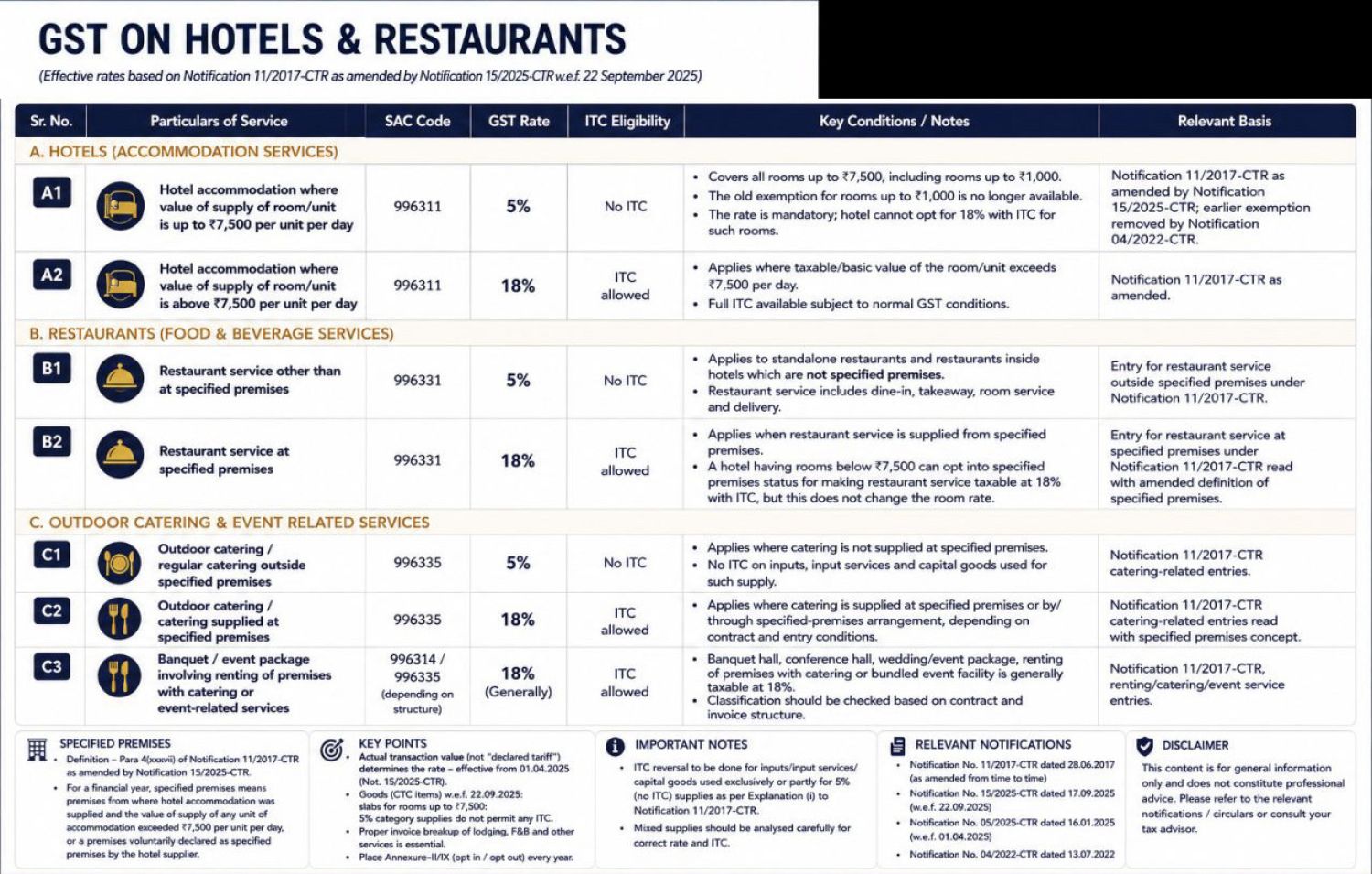
Input Tax Credit (ITC) Position at a Glance
GST on Hotels, Restaurants & Catering - ITC Matrix
|
Service Category |
GST Rate |
ITC to Supplier |
ITC to Business Recipient* |
|
Hotel Accommodation up to INR 7,500 per day |
5% |
Not Available |
Disputed / Generally not availed in practice |
|
Hotel Accommodation above INR 7,500 per day |
18% |
Available |
Subject to Section 16 & Section 17 |
|
Restaurant Service (other than specified premises) |
5% |
Not Available |
Generally blocked |
|
Restaurant Service at Specified Premises |
18% |
Available |
Generally blocked under Section 17(5) unless exception applies |
|
Outdoor Catering (5%) |
5% |
Not Available |
Blocked u/s 17(5) unless exception applies |
|
Outdoor Catering (18%) |
18% |
Available |
Blocked u/s 17(5) unless exception applies |
|
Banquet/Event Package (18%) |
18% |
Available |
Depends on nature of service and use |
Hotel Accommodation ITC - Practical View
|
Particulars |
Room up to INR 7,500 |
Room above INR 7,500 |
|
GST Rate |
5% |
18% |
|
Hotel's ITC |
Not Available |
Available |
|
GST charged on invoice |
Yes |
Yes |
|
Business purpose |
Required |
Required |
|
ITC claim by recipient |
Litigation risk |
Stronger position |
|
Industry practice |
Mostly not claimed |
Claimed where eligible |
Practical Position: ITC may be claimed subject to Section 16 conditions, Valid GST invoice, business purposes, a GSTIN mentioned, supplier compliance, and No restriction under Section 17(5).
Conditions for Claiming ITC
|
Condition |
Requirement |
|
Tax Invoice |
Valid GST invoice available |
|
GSTIN |
Recipient GSTIN mentioned |
|
Receipt of Service |
Hotel accommodation actually received |
|
Business Use |
Used in course or furtherance of business |
|
Tax Payment |
Supplier has deposited GST |
|
GSTR-2B Reflection |
Invoice reflected where applicable |
|
Return Filing |
GST returns filed |
Common Corporate Travel Scenarios
|
Scenario |
ITC Position |
|
Employee stays in hotel for client meeting |
Generally disputed at 5%; stronger at 18% |
|
Employee attends conference |
Similar treatment |
|
Director's business travel |
Similar treatment |
|
Tour operator resupplying hotel stay |
ITC generally available |