Table of Contents

Taxation of Unregistered NPOs: Can Charitable Trusts Be Taxed on Net Income Instead of Gross Receipts?
Introduction
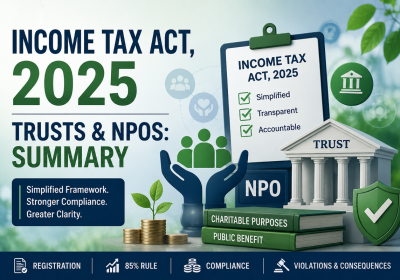
The taxation of charitable and religious organizations has undergone significant changes with the transition from the Income-tax Act, 1961 to the Income-tax Act, 2025. While registered charitable institutions continue to enjoy the benefits of exemption provisions, a major question arises in the case of trusts whose registration has been denied, cancelled, surrendered, or not renewed.
Under this blog, Taxation of Unregistered NPOs, here is we explore an important and evolving issue: whether an unregistered charitable trust should be taxed on its gross receipts or only on its real income (net surplus) after considering expenditure incurred towards its charitable objects. The presentation develops a litigation-support framework for unregistered Non-Profit Organizations (NPOs) while simultaneously emphasizing that registration under Section 12AB (or Section 332 of the Income-tax Act, 2025) remains the most secure and litigation-free route.
Understanding the Core Issue
The primary issue examined is If a charitable trust is not registered under Section 12AB of the Income-tax Act, 1961 or Section 332 of the Income-tax Act, 2025, should tax be levied on the trust's gross receipts or on the net surplus after deducting permissible expenditure?
Traditionally, tax authorities often seek to assess unregistered trusts on gross receipts. However, the presentation argues that once exemption provisions become unavailable, the trust enters the general taxation regime and therefore ordinary computation provisions must be applied. Under general tax principles, income should ordinarily mean real income and not merely gross receipts.
Three Taxation Regimes for Charitable Trusts
This blog explains that charitable institutions may fall into one of three distinct taxation categories.
1. Registered Trust Regime
This is the ideal situation. Under this regime Registration under Section 12AB remains valid, Exemption under Sections 11 to 13 of the Income-tax Act, 1961 is available, Chapter XVII-B benefits under the Income-tax Act, 2025 are available, Income applied towards charitable purposes continues to be exempt. For such entities, taxation issues relating to net income versus gross receipts generally do not arise because the exemption framework itself governs taxation.
2. Compliance Failure Regime
The second category applies where registration remains intact but compliance conditions are violated. Examples include Failure to maintain books of account, Failure to get accounts audited, Failure to file income tax returns and Exceeding the permissible threshold for commercial activities. In such situations, exemption may be denied for a particular year, but registration continues. The Income-tax Act contains special computational provisions to determine taxable income.
3. Unregistered Trust Regime
This category includes Trusts never registered, Registration cancelled, Renewal rejected and Registration surrendered. The blog primarily focuses on this category and argues that such trusts should be governed by ordinary provisions of taxation rather than special exemption provisions.
Important Changes Under the Income-tax Act, 2025
One of the most significant points highlighted is the continuity between Section 57(iii) of the Income-tax Act, 1961 and Section 93 of the Income-tax Act, 2025. The language of both provisions is identical: "Expenditure wholly and exclusively incurred for the purpose of making or earning income is deductible.
Because the legislative language remains unchanged, judicial precedents interpreting Section 57(iii) may continue to be relevant while interpreting Section 93 under the new law.
Major Disadvantages of Remaining Unregistered
The presentation openly acknowledges that registration offers significant benefits unavailable to unregistered trusts.
- Capital Expenditure Not Allowed: Registered trusts can claim application of income when they build schools, construct hospitals, and purchase charitable assets. For unregistered trusts, Section 57(iii) and Section 93 expressly prohibit deduction of capital expenditure. Consequently, major infrastructure spending receives no equivalent tax benefit.
- Loss of Automatic 15% Accumulation: Registered charitable institutions can retain 15% of income without conditions. Unregistered trusts lose this valuable flexibility.
- Loss of Five-Year Accumulation Benefit : Registered institutions can accumulate income for specified future projects over a five-year period. and This planning advantage disappears once registration is lost.
- CSR Ineligibility : Perhaps the most significant practical consequence is loss of CSR funding eligibility. Since CSR regulations generally require valid charitable registration, unregistered entities may lose access to an important source of funding.
Capital expenditure examples include school building, hospital construction, land purchase, ambulance purchase, and permanent infrastructure. Comparative Position
|
Particular |
Registered Trust |
Unregistered Trust |
|
Building Construction |
Treated as Application |
Not Allowed |
|
Land Purchase |
Application |
Not Allowed |
|
Fixed Asset Purchase |
Application |
Not Allowed |
Since Section 57(iii)/93 expressly excludes capital expenditure, there is virtually no sustainable route to claim such deductions. Assessment : Not Available
Net Income Versus Gross Receipts
The central proposition of the presentation is that taxation should be based on real income. According to this blog is Gross receipts do not automatically constitute taxable income, Income implies a gain or surplus and Tax should ideally apply to net income rather than total collections. To support this interpretation, reliance is placed on judicial authorities such as Shaw Wallace, Shoorji Vallabhdas, Godhra Electricity and Hycron India Ltd. These cases reinforce the broader concept that Indian income-tax law generally seeks to tax real income rather than notional or gross receipts.
Voluntary Contributions Under the Income-tax Act, 2025
A noteworthy technical argument discussed in the presentation concerns the treatment of voluntary contributions.
- Under the Income-tax Act, 1961: Section 2(24)(iia) expressly includes voluntary contributions received by charitable trusts within the definition of income.
- Under the Income-tax Act, 2025: Section 2(49)(c) specifically refers to registered NPOs and certain approved entities.
The blog argues that there is no corresponding specific inclusion for voluntary contributions received by unregistered NPOs. Accordingly, an argument may exist that voluntary contributions should be tested under general charging and computation provisions rather than being automatically treated as taxable income. However, the presentation clearly cautions that this position remains litigative and is not yet conclusively settled.
Corpus Donations: Why They Are Considered Non-Taxable
The strongest position discussed in the presentation relates to corpus donations. A corpus donation is a contribution received with a specific direction that it shall form part of the permanent capital of the trust. Common Examples
|
Type of Donation |
Corpus or Revenue |
|
Donation specifically towards Corpus Fund |
Corpus |
|
Donation for building construction |
Corpus |
|
Endowment contribution |
Corpus |
|
General donation without instructions |
Revenue |
Why It Is Not Income
Under the Income Tax Act, 1961, corpus donations are specifically excluded through the proviso to Section 2(24)(iia). Under the Income Tax Act, 2025: The presentation argues that corpus receipts remain capital receipts even for unregistered entities because capital receipts do not become income merely because registration is unavailable. The amount is capital in nature and should not be treated as revenue income. Assessment: Very Strong Position : Documentation Required: Donor letter, corpus direction, governing body resolution, and separate accounting treatment
Section 93 Deduction Strategy
A significant practical argument advanced in the presentation is based on Section 93. The proposition is that charitable expenditure incurred by an unregistered trust may qualify for deduction where it has a sufficient nexus with interest income, dividend income, investment income, and Income arising from property held under trust. If accepted, this approach permits taxation of net surplus rather than gross receipts.
Section 57(iii) Against Donations and Dividends:
This is the most aggressive proposition in the presentation.
Why It Is Controversial: Revenue is likely to argue: Donors contribute because of charitable intentions, not because expenditure was incurred. Therefore: Required nexus under Section 57(iii) may not exist.
Section 11 Surplusage Argument: According to Revenue: Parliament created Section 11 and Section 12AB. specifically to grant exemptions. Allowing deductions through Section 57(iii) to unregistered trusts effectively creates the same benefit without registration.
Comparative Position
|
Particulars |
Investment Income |
Voluntary Donations |
|
Nexus Strength |
Stronger |
Weaker |
|
Judicial Support |
Better |
Limited |
|
Litigation Risk |
Moderate |
High |
|
Practical Success Rate |
Higher |
Lower |
Assessment: Fact-Sensitive and Litigative and Not a settled legal position.
Section 57(iii) / Section 93 Deduction for Investment Income
This is the most important technical argument developed in the presentation.
What Is Being Argued?
An unregistered trust may earn interest income, dividend income, rental income, and investment income. To earn and administer these activities, the trust incurs expenditure towards its charitable functions. If expenditure has sufficient nexus with earning income, deduction may be claimed under Section 57(iii) of the 1961 Act or Section 93 of the 2025 Act.
Judicial Support
|
Case |
Principle |
|
Eastern Investments |
Income need not actually arise if expenditure incurred for earning it |
|
Rajendra Prasad Moody |
Liberal interpretation of Section 57(iii) |
|
Petroleum Sports Board |
Gross receipts taxation not justified |
|
Kandivli Halai Lohana Trust |
Income from trust property retains its character |
Assessment : Reasonably arguable and Not finally settled.
Comparative Mapping: Income-tax Act, 1961 vs Income-tax Act, 2025 for NPOs
|
ITA 1961 |
ITA 2025 |
Subject |
Key Point |
|
Section 57(iii) |
Section 93 |
Deduction of expenditure under Income from Other Sources (IFOS) |
Both provisions are word-for-word identical. Therefore, judicial precedents relating to Section 57(iii), including principles laid down in Eastern Investments, Rajendra Prasad Moody, and Petroleum Sports Board, are expected to remain relevant while interpreting Section 93 under the Income-tax Act, 2025. |
|
Section 2(24) |
Section 2(49) |
Definition of Income |
While both are inclusive definitions of income, a significant distinction exists. Under ITA 2025, voluntary contributions received by an unregistered NPO are not expressly included under Section 2(49)(c), creating a stronger interpretational argument compared to the 1961 Act. |
|
Section 12AB |
Section 332 |
Registration of NPOs |
Registration continues to be the foundation for claiming charitable exemptions. In the absence of registration, the exemption code under Chapter XVII-B does not apply, and income is required to be computed under the general provisions of the Act. |
|
Sections 13(10) & 13(11) |
Section 353 |
Taxation in cases of compliance failures |
Applies where registration remains valid but there are compliance defaults such as non-maintenance of books, non-audit, non-filing of return, or specified commercial activity violations. Registration remains intact, and therefore exit-tax provisions do not get triggered. |
|
Section 115TD |
Section 352 |
Accreted Income Tax (Exit Tax) |
One of the most significant changes under ITA 2025. Cancellation of registration itself can trigger Section 352, potentially leading to tax on accreted income based on fair market value of assets. Immediate legal action against cancellation becomes critical. |
|
Section 161(1A) |
Omitted from Section 304 |
Taxation where trust has business income |
Under the 1961 Act, even a small amount of business income could expose the entire income of certain trusts to Maximum Marginal Rate (MMR). The corresponding provision has not been carried forward in the same manner under ITA 2025, which may provide greater flexibility in appropriate situations. |
|
Section 164(2) Proviso |
Section 307(2) Proviso |
Rate of Tax for Public Charitable Trusts |
The principle remains unchanged. Public charitable trusts are generally taxable at the rate applicable to an Association of Persons (AOP) and not automatically at Maximum Marginal Rate (MMR). This supports the argument that normal AOP rates should apply even where exemption is unavailable. |
Key Takeaways on Income-tax Act, 1961 vs Income-tax Act, 2025 for NPOs
- Section 93 Continues the Legacy of Section 57(iii): Since Section 93 of the Income-tax Act, 2025 is identical to Section 57(iii) of the Income-tax Act, 1961, decades of judicial interpretation continue to hold relevance. This is particularly important for unregistered NPOs seeking deduction of expenditure against income from investments, deposits, and other sources.
- Stronger Position for Unregistered NPOs under ITA 2025: Unlike Section 2(24)(iia) of the 1961 Act, Section 2(49)(c) of the 2025 Act specifically refers to registered NPOs. The omission of unregistered NPOs creates a potential argument that voluntary contributions should not automatically be treated as taxable income without applying the normal computation provisions. However, this remains a litigative issue.
- Section 352 is the Biggest Risk: The transition from Section 115TD to Section 352 marks a major policy change. Under the new law, cancellation of registration itself may trigger accreted income tax, potentially resulting in substantial tax liability based on the market value of trust assets. Accordingly, trusts facing cancellation must immediately challenge such orders.
- AOP Rate Argument Remains Strong: The provisions corresponding to Section 164(2) have largely been retained under Section 307(2). Therefore, the argument that charitable trusts should be taxed at AOP rates and not at the maximum marginal rate continues under both acts.
- Registration Continues to Be the Best Protection: Despite the potential arguments available to unregistered NPOs, both the 1961 Act and the 2025 Act clearly demonstrate that registration under Section 12AB/Section 332 remains the only comprehensive solution for obtaining exemption benefits, accumulation facilities, CSR eligibility, and protection from prolonged litigation.
Judicial Support for the Net Income Theory
The Blog relies heavily on several judicial precedents.
- Petroleum Sports Board v. DDIT : The Delhi High Court held that when Section 11 exemption is unavailable, income must nevertheless be computed under normal provisions. Taxing gross receipts without considering qualifying expenditure is inappropriate.
- Mahakalp Arogya Pratisthan : The Mumbai ITAT allowed deduction of object expenditure under Section 57(iii), strengthening the argument that charitable spending may be relevant even when exemption provisions are not invoked.
- St. Johns Marthoma Syrian Church (2026) : The Mumbai ITAT accepted that Section 57(iii) may be considered even for trusts lacking Section 12AB registration, subject to factual verification.
AOP Rate Versus Maximum Marginal Rate
Another major issue addressed is the applicable rate of tax. We can here make a strong argument that Unregistered charitable trusts should ordinarily be taxed at AOP rates. And the maximum marginal rate (MMR) should not automatically apply.
One of the most important practical issues concerns the applicable rate of tax. The argument relies on Section 164(2), CBDT Circular No. 320, Rose Trust decision and Vindhya Trust decision. This distinction can substantially reduce tax liability for charitable organizations.
Revenue authorities often attempt to levy: Maximum Marginal Rate (MMR) : which may effectively exceed 30% tax, Plus surcharge and Plus cess resulting in a very high tax burden. We can Argues that public charitable trusts are taxable as: Association of Persons (AOP) : and not automatically at MMR. Comparative Impact on AOP Rate Instead of Maximum Marginal Rate
|
Particulars |
AOP Rate |
MMR |
|
Tax Structure |
Slab Based |
Flat Highest Rate |
|
Basic Exemption |
Available |
Not Available |
|
Effective Tax Burden |
Lower |
Much Higher |
|
Trust Friendly |
Yes |
No |
We can relies upon Section 164(2), Section 307(2), CBDT Circular No. 320 and Rose Trust and Vindhya Trust to support the AOP taxation approach. Example: Taxable Income: INR 25,00,000 and Under AOP Provisions: Progressive taxation may apply. Under MMR: Entire income taxed at highest applicable rate. Difference could be several lakhs. Assessment: Strong Position
The Biggest Risk: Section 352 of the Income Tax Act, 2025
We can consider Section 352 to be the most critical concern for charitable institutions. Possible triggers include cancellation of registration, failure to obtain renewal and Modification of charitable objects. The provision may result in taxation of accreted income based on the fair market value of assets less liabilities. The resulting tax exposure can be substantial, especially for trusts holding valuable immovable properties. Consequently, the presentation advises immediate legal challenge against registration cancellation orders.
Section 352: The Biggest Threat Under ITA 2025: Here is repeatedly identifies Section 352 as the most dangerous provision affecting charitable institutions. Triggers
|
Trigger Event |
Section 352 Exposure |
|
Registration Cancellation |
Yes |
|
Renewal Rejected |
Yes |
|
Object Modification |
Yes |
|
Merger / Certain Exit Events |
Yes |
Practical Action Plan for Unregistered Trusts : Here we recommend the following:
- Claims that should generally be made : Treat corpus donations as capital receipts, claim AOP rates wherever legally sustainable, Maintain complete documentation of charitable expenditure Ensure full disclosure in income tax returns. and consider Section 93 deductions where facts support the Nexus requirement.
- Areas requiring caution: Deduction against voluntary contributions remains litigative, Nexus under Section 93 must be demonstrable, TDS compliance is critical and proper supporting records must be maintained.
Practical Implication: here strongly recommends: Appeal against cancellation immediately, File ITAT proceedings without delay, Quantify Section 352 liability., Preserve evidence showing charitable character and Do not allow orders to attain finality.
Conclusion on Taxation of Unregistered NPOs
Taxation of unregistered NPOs classifies the legal positions available to unregistered charitable trusts into four practical categories: Established Positions, Reasonably Arguable Positions, Positions Not Available, and Action Points Requiring Immediate Attention. The significance of this classification is that it helps trustees, chartered accountants, tax consultants, and NPO management distinguish between claims that are legally well-settled and claims that may require litigation support. Comparative Summary Table
|
Position |
Legal Basis |
Assessment |
Litigation Risk |
Recommended Action |
|
Corpus Donations Not Income |
Proviso to Section 2(24)(iia) of ITA 1961; Capital Receipt Principle under ITA 2025 |
Very Strong |
Very Low |
Always claim as capital receipt |
|
AOP Rate instead of MMR |
Section 164(2), Section 307(2), CBDT Circular 320, Rose Trust, Vindhya Trust |
Strong |
Low |
Always claim AOP rate |
|
Section 57(iii)/Section 93 deduction against investment income |
Eastern Investments, Rajendra Prasad Moody, Petroleum Sports Board |
Reasonably Arguable |
Medium |
Claim with full disclosure |
|
Section 57(iii) deduction against donations |
Petroleum Sports Board, IFOS principles, Section 70 set-off |
Arguable |
High |
Evaluate facts carefully |
|
Capital Expenditure deduction |
Expressly prohibited under Section 57(iii)/93 |
Not Available |
Very High |
Do not claim |
|
Section 352 exposure after cancellation |
Section 352 ITA 2025 |
Critical Issue |
Extremely High |
File appeal immediately |
This blog ultimately concludes that while an unregistered charitable trust may have legitimate legal arguments for being taxed on net surplus rather than gross receipts, such positions remain fact-specific and may involve litigation. Corpus donations continue to enjoy strong support as capital receipts. Significant judicial authority supports considering deductions under Section 57(iii)/Section 93 in appropriate circumstances. Further, taxation at AOP rates rather than Maximum Marginal Rate can materially reduce tax exposure.
However, the most important takeaway remains unchanged:
Registration under Section 12AB of the Income-tax Act, 1961 or Section 332 of the Income-tax Act, 2025 is the only complete, secure, and litigation-free solution for charitable organizations. The arguments discussed serve primarily as a legal defence mechanism for unregistered trusts and should not be viewed as a substitute for obtaining or restoring registration.
Final Takeaways
- Established Positions: Corpus donations are capital receipts and AOP taxation instead of the maximum marginal rate.
- Reasonably Arguable Positions: Section 57(iii)/Section 93 deduction against investment income and taxation of net surplus rather than gross receipts.
- High-Risk Positions: Deduction against voluntary donations and broad nexus arguments under Section 93.
- Not Available: Capital expenditure deduction for unregistered trusts.
- Most Critical Action: Any trust facing cancellation, non-renewal, or surrender issues must immediately evaluate exposure under Section 352 and pursue appellate remedies because the potential tax consequences can threaten the very existence of the institution.