Table of Contents
- Taxation Of Npos Under The Income-tax Act, 2025: A Practical Guide For Trusts, Societies And Section 8 Companies
- A New Rulebook For Charities From Tax Year 2026-27
- Who Is An Npo, And What Counts As Charitable Or Religious Purpose?
- Corpus, Application And Accumulation
- Frequently Asked Questions On taxation Of Npos Under The Income-tax Act, 2025
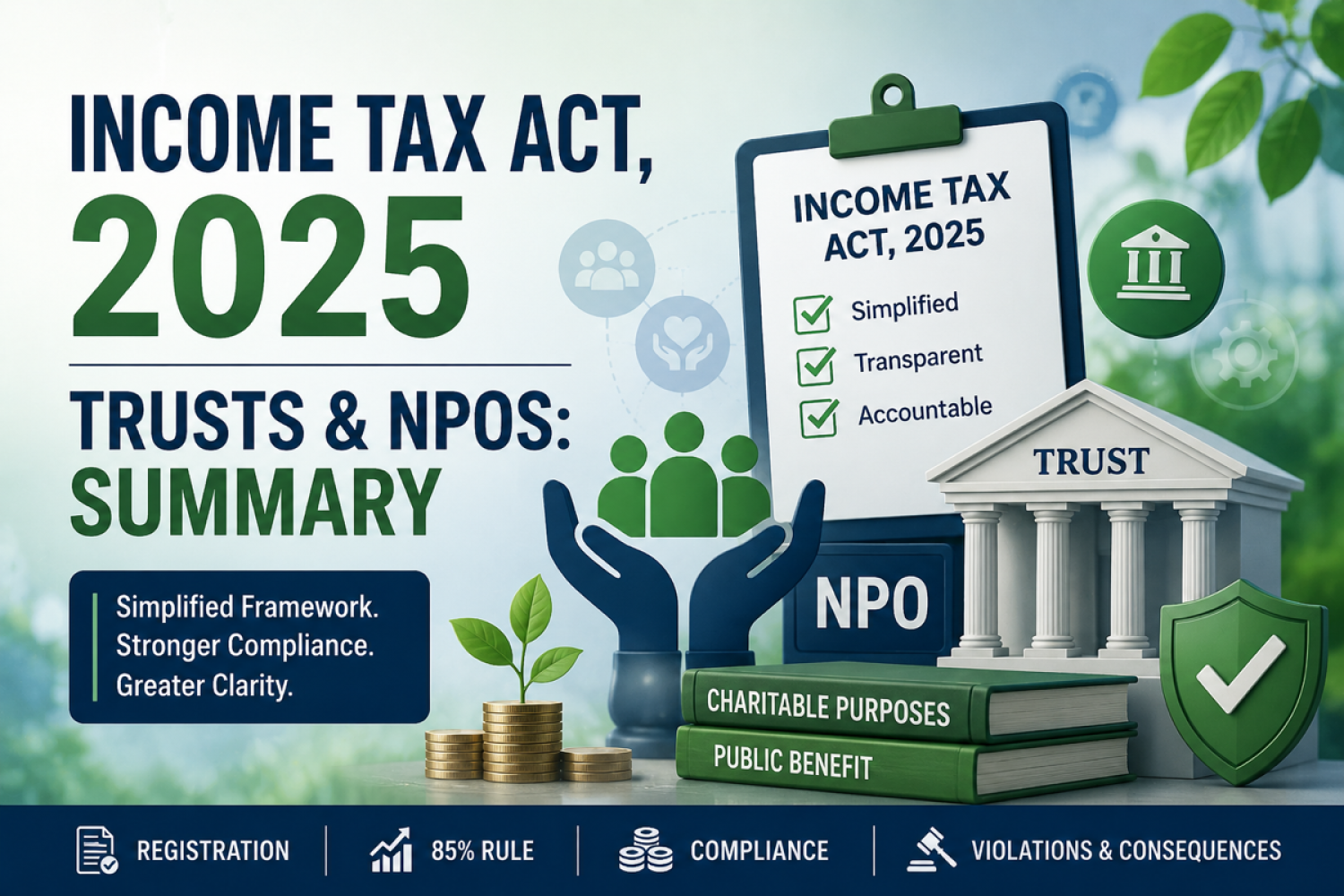
Taxation of NPOs under the Income-tax Act, 2025: A Practical Guide for Trusts, Societies and Section 8 Companies
A new rulebook for charities from Tax Year 2026-27
From Tax Year 2026-27, every charitable and religious trust, society and section 8 company in India is taxed under a new framework in the Income-tax Act, 2025. The familiar sections 11, 12, 12A, 12AB and 13 of the 1961 Act have been rewritten, renumbered and gathered into one place.
The new Act calls all of these bodies by one name: a non-profit organisation (NPO). Almost all the rules sit in Part B of Chapter XVII, sections 332 to 355, read with the Schedules and Rules 181 to 190. Many old provisos and explanations now appear as sub-sections.
The core logic will feel familiar: apply 85% of income, accumulate the rest within limits, keep proper books and get audited. But the vocabulary is new, the forms are renumbered, and several items now fall into a 30% tax bucket. This guide from Rajput Jain & Associates walks trustees, CFOs and accountants through what has changed and what to do about it.
Who is an NPO, and what counts as charitable or religious purpose?
To claim exemption, an NPO must be registered under the 1961 Act or the new Act. The exceptions are entities listed in Schedule VII: PM and CM relief funds, PM CARES, Swachh Bharat Kosh, the Clean Ganga Fund and similar funds (Sr. 10–16), and certain universities, educational institutions and hospitals (Sr. 17–19).
Charitable purpose: section 2(23)
Section 2(23), which corresponds to the old section 2(15), defines charitable purpose inclusively. It covers seven limbs:
- Relief of the poor
- Education
- Yoga
- Medical relief
- Preservation of environment, including watersheds, forests and wildlife
- Preservation of monuments, places or objects of artistic or historic interest
- Advancement of any other object of general public utility (GPU)
The test is selflessness. In CIT v. Ahmadabad Rana Caste Association (1983) 140 ITR 1 (SC), the Supreme Court held that a purpose must benefit the community, or a section of it, rather than an individual or a group of individuals.
Religious purpose
Neither Act defines religious purpose. It is understood as the advancement, support or propagation of a religion and its tenets. Exemption is available only to public religious trusts. Applying income for private religious purposes that do not benefit the public is a specified violation under section 351(c).
How an NPO is taxed: three buckets, two rates
Under section 334, an NPO's tax is the total of two amounts:
|
Income bucket |
What it is |
Rate |
|
Specified income |
Items listed in section 337 |
30% flat |
|
Taxable regular income |
Regular income not applied or accumulated within the 85% rule |
Normal rates |
|
Residual income |
Total income, before Part B benefits, minus regular and specified income (s.355(j)) |
Normal rates |
Section 334(2) gives Part B overriding effect over the rest of the Act, except sections 96 to 98. These correspond to the old sections 60 to 63 on transfers of income without the asset and on revocable transfers.
A ruling worth noting. In WP(L) No. 7587 (order dated 9 March 2026), the Bombay High Court held that the lack of an express irrevocability or dissolution clause cannot by itself justify refusing or cancelling registration under section 12AB. A public charitable trust is treated as irrevocable unless a power of revocation is expressly reserved, and the Commissioner cannot impose conditions the statute does not provide for.
Regular income (section 335)
Regular income has five parts:
- Income from the charitable or religious activity for which the NPO is registered
- Income from property, deposits or investments held wholly for charitable or religious purposes
- Income from property held partly for such purposes (only for NPOs formed before 1 April 1962)
- Voluntary contributions received
- Gains from permitted commercial activity under sections 344 to 346, computed under Rule 182
The 85% test (section 336)
If the NPO applies or accumulates 85% or more of its regular income, its taxable regular income is nil. If it falls short, only the shortfall is taxed: 85% of regular income, less what was applied and accumulated.
Example: regular income is ₹100 lakh and ₹70 lakh is applied, with nothing accumulated. Taxable regular income is ₹85 lakh minus ₹70 lakh, or ₹15 lakh, unless the NPO opts for deemed application (explained below).
Specified income: the 30% bucket (section 337)
Section 337 lists 13 items that are taxed at a flat 30%, each in a fixed tax year. This is where most compliance risk now sits.
|
# |
Specified income |
Taxed in |
|
1 |
Anonymous donations above the higher of INR 1 lakh or 5% of total donations |
Year of receipt |
|
2 |
Income applied for the benefit of a related person |
Year of application |
|
3 |
Income applied outside India in breach of s.338(a) |
Year of application |
|
4 |
Investment or deposit outside the modes permitted by s.350 |
Year of investment |
|
5 |
Deemed corpus donation where a s.340 condition is breached |
Year of breach |
|
6 |
Accumulated income used for other than its stated purpose |
Year so applied |
|
7 |
Accumulated income that ceases to be set apart |
Year it ceases |
|
8 |
Accumulated income not applied within the accumulation period |
Last year of the period |
|
9 |
Accumulated income credited or paid to another registered NPO |
Year so paid |
|
10 |
Income applied outside the registered objects (also a specified violation under s.351) |
Year so applied |
|
11 |
Business undertaking income determined by the AO above the books (s.344) |
Year it relates to |
|
12 |
FMV of assets not held in Schedule XVI modes 1–30 beyond one year after the year of acquisition |
Year after that window |
|
13 |
Deemed application under s.341(5) not actually applied in time |
Year set by s.341(6) |
On item 1, an anonymous donation is one where the NPO does not record the donor's name, address and other prescribed particulars. NPOs set up wholly for religious purposes are outside this item. So are NPOs set up wholly for charitable and religious purposes, except for anonymous donations earmarked for a university, educational institution, hospital or medical institution they run.
Benefits to related persons
Rule 183 lists the benefits that make item 2 apply. They include lending without adequate security or interest, letting property without adequate rent, paying excessive salary, providing goods or services without adequate payment, buying assets above or selling them below adequate value, diverting income or property worth more than ₹1,000, and investing in a concern in which a related person has a substantial interest (20% or more).
Under section 355(h), related persons include:
- The author or founder
- Anyone who contributes more than ₹1 lakh in the tax year, or more than ₹10 lakh in total
- HUF members, where the founder or such contributor is an HUF
- Trustees and managers
- Relatives of the founder, HUF members and trustees
- Concerns in which any of these persons has a substantial interest
The penalty under section 445 (old section 271AAE) is steep: 100% of the amount applied for a first violation, and 200% if it is noticed again in a later year.
Corpus, application and accumulation
What stays out of regular income (sections 338 to 340)
- Income applied outside India, where the CBDT so directs by general or special order. This is available only to NPOs created before 1 April 1952, or to later charitable NPOs whose work promotes international welfare in which India is interested.
- Corpus donations (s.339): donations given with a specific direction that they form part of corpus, and invested in s.350 modes kept specifically for the corpus.
- Deemed corpus (s.340): at the NPO's option, donations to renovate or repair a notified temple, mosque, gurudwara, church or other place. The funds must be kept separately identifiable, used only for that purpose, invested under s.350, and not donated onward.
What counts as application (section 341)
|
Allowed as application |
Not allowed as application |
|
Amounts actually paid in India for registered purposes |
Provisions or unpaid amounts |
|
85% of donations to other registered NPOs |
Corpus donations to other NPOs |
|
Re-investment into corpus within 5 years, where the original spending was after 31 March 2021 with no violation |
Spending out of corpus, loans, accumulated, deemed accumulated or specified income |
|
Repayment of loans within 5 years, on the same conditions |
Depreciation on assets whose cost was already claimed as application |
|
Deemed application under s.341(5) |
Set-off of an earlier year's excess application |
Two business-income rules now apply to application:
- If TDS is not deducted and paid, 30% of the amount is disallowed (s.35(b)(i)).
- Cash payments above ₹10,000 (₹35,000 to transporters) are fully disallowed (s.36(4) to (7)).
Deemed application
If less than 85% is applied, the NPO may treat the shortfall as deemed application. It must then spend the amount in the year of receipt or the next year, where income was not received in time, or in the next year otherwise. The option is exercised in Form 108 (old Form 9A) by the return due date.
Capital gains on reinvestment
Where an asset held wholly for charitable or religious purposes is sold and the whole net consideration is reinvested in a new asset, the entire gain counts as application. If only part is reinvested, the application is the amount reinvested minus the cost of the asset sold. For assets held partly for such purposes, the proportionate share applies. CBDT Instruction No. 883 (24 September 1975) treats a bank fixed deposit of 6 months or more as utilisation for this purpose.
Accumulation (sections 342 and 343)
- Accumulation: an NPO may set income aside for up to 5 years by filing Form 109 (old Form 10) by the return due date, stating the purpose and period. Time lost to a court order or injunction is excluded. To change the purpose, it applies in Form 110, and the AO passes an order in Form 111.
- Deemed accumulation: income left after application and accumulation, up to 15% of regular income, is treated as accumulated automatically. If invested, it must be in s.350 modes.
- Accumulated income paid to another NPO is not application, except on dissolution with the AO's approval.
Commercial activities: tighter, clearer limits
Under section 355(e), a commercial activity is any trade, commerce or business, or any service to a business, carried on for a cess, fee or other consideration. How the income is used or kept makes no difference.
|
NPO type |
Rule |
Section |
|
Any NPO holding a business undertaking |
The AO may determine the undertaking's income; any excess over the books is specified income taxed at 30% |
344 |
|
NPOs under the first six limbs (poor, education, yoga, medical, environment, monuments) |
Commercial activity only if incidental to the objects, with separate books |
345 |
|
General public utility NPOs |
Only in the course of actually carrying out GPU objects, with commercial receipts within 20% of total receipts and separate books |
346 |
Under Rule 182, gains are computed as if the activity were a separate entity, with separate books, under the business income rules in Part D of Chapter IV. Permitted commercial income is part of regular income.
The law does not define "incidental", which remains an open question. Non-incidental business by a first-six-limb NPO may lead to cancellation under section 351. A GPU NPO that breaches section 346 loses the exemption for that year under section 353.
Compliances, permitted investments and the cost of default
These duties apply when the NPO's total income, before Part B benefits, exceeds the basic exemption limit.
|
Duty |
Requirement |
Section / rule |
Old reference |
|
Books of account |
Maintain books and documents as prescribed |
s.347, Rule 187 |
s.12A(1)(b)(i), Rule 17AA |
|
Audit |
Audit by an accountant; report in Form 112 one month before the return due date |
s.348, Rule 188 |
s.12A(1)(b)(ii), Rule 17B |
|
Return of income |
File under s.263(1)(a)(iii), on time or as a belated return |
s.349 |
s.12A(1)(ba), 139(4A) |
|
Investments |
Hold funds only in Schedule XVI modes |
s.350 |
s.11(5), Rule 17C |
Schedule XVI permits investments such as post office savings, deposits with scheduled and co-operative banks, Central and State Government securities, UTI units, immovable property, public sector company shares, deposits with housing and development authorities, specified mutual funds, Sovereign Gold Bond stock certificates and PowerGrid InvIT units.
Section 353: what happens if you default
An NPO that fails to maintain books, get its accounts audited or file its return, or a GPU NPO that breaches section 346, loses the exemption for that year. Its regular income, less only eligible expenditure, becomes taxable regular income. Specified and residual income are taxed as well.
Eligible expenditure is narrow: revenue expenditure in India for the NPO's objects that does not come from corpus held at the previous year-end or from loans, is not a donation, and meets the cash-payment and TDS rules. Depreciation on assets already claimed as application is not allowed, and no other set-off is permitted. The source note also flags an open question on whether section 353(2) taxes income applied abroad with CBDT approval and corpus donations.
Institutions exempt without registration (Schedule VII)
|
Sr. |
Eligible institution |
Key conditions |
Old reference |
|
17 |
University or educational institution wholly or substantially funded by Government |
Exists solely for education, not profit; Government grant above 50% of total receipts (Rule 287) |
s.10(23C)(iiiab) |
|
18 |
Hospital or medical institution wholly or substantially funded by Government |
Solely philanthropic, not for profit; Government grant above 50% of total receipts |
s.10(23C)(iiiac) |
|
19 |
University, educational institution, hospital or medical institution |
Not for profit; aggregate annual receipts up to ₹5 crore; anonymous donations taxed as under s.337 |
s.10(23C)(iiiad), (iiiae) |
These institutions do not need registration, but must file a return if their income exceeds the exemption limit. In the source note's view, the section 348 audit does not apply to them.
Computation format: Tax Year 2026-27 onwards
|
Particulars |
Amount |
|
Regular income (s.335): activity income, property and investment income, voluntary contributions, permitted commercial gains |
xxx |
|
Less: application (s.341): amounts spent in India, 85% of donations to other NPOs, corpus re-invested, loans repaid |
(xxx) |
|
Add: disallowances: 30% for TDS default; cash payments above ₹10,000 / ₹35,000 |
xxx |
|
Less: deemed application (s.341(5)) |
(xxx) |
|
Less: accumulation (s.342) and deemed accumulation up to 15% (s.343) |
(xxx) |
|
Taxable regular income, at normal rates |
xxx |
|
Residual income (s.355(j)), at normal rates |
xxx |
|
Specified income (s.337), at 30% |
xxx |
Capital gains and income applied outside India do not form part of regular income and are computed separately.
Action checklist for trustees and management
- Confirm your registration is valid and note which section it was granted under.
- Update internal manuals and accounting heads to the new section and form numbers (Forms 108, 109, 110 and 112).
- Record every donor's name, address and prescribed details, to limit 30% tax on anonymous donations.
- Map all related persons and review salaries, rents, loans and purchases with them for adequacy.
- Check that all funds sit in Schedule XVI modes, and convert any other assets within the one-year window.
- Track 85% application monthly and decide early on Form 108 (deemed application) or Form 109 (accumulation).
- Keep separate books for any commercial activity; GPU NPOs should monitor the 20% receipts limit.
- Diarise the audit report deadline, one month before the return due date.
Frequently asked questions on Taxation of NPOs under the Income-tax Act, 2025
Does an NPO registered under the 1961 Act need to register again?
No fresh registration is needed simply because the law changed. Registration under section 12A, 12AA, 12AB or 10(23C) of the 1961 Act counts as registration under the new Act's definition of "specified provision".
What tax rate applies to specified income?
A flat 30% under section 334(1)(a), in the tax year that section 337 fixes for each item.
Is 15% of income automatically safe?
Yes, within limits. Under section 343, up to 15% of regular income left unapplied is deemed accumulated. If invested, it must be held in Schedule XVI modes.
Which form replaces Form 10B/10BB for audit?
Form 112, filed under Rule 188 one month before the return due date.
Can a GPU trust run a commercial activity?
Yes, if it is carried on while actually pursuing GPU objects, commercial receipts stay within 20% of total receipts, and separate books are kept.
How Rajput Jain & Associates can help
Rajput Jain & Associates is a peer-reviewed firm of Chartered Accountants (ICAI FRN 015341C) with offices in New Delhi, Noida, Mumbai, Varanasi and Faridkot. We help NPOs with:
- Registration, renewal and approvals
- Audit and Form 112 reporting
- Application and accumulation planning (Forms 108 and 109)
- Related-person and investment compliance reviews
- Representation before tax authorities
Talk to our team: P-6/90 (2F), Connaught Circus, Connaught Place, New Delhi – 110001 · +91 98113 22785 · 011-4352-0194 · info@carajput.com · www.carajput.com Disclaimer: This article is for general information only and is not professional advice. Provisions are summarised and section references are indicative; please consult the Act and Rules, or a professional, before acting.