Table of Contents
- Due Diligence By Insolvency Professionals To Identify And Prevent Misuse Of The Ibc Framework
- Key Red Flags Requiring Attention During due Diligence By Ips To Identify & Prevent Misuse Of The Ibc System
- Indicators Require Contextual Assessment
- Further Enquiry And Appropriate Action
- Implications For Insolvency Professionals
Due Diligence by Insolvency Professionals to Identify and Prevent Misuse of the IBC Framework
The Insolvency and Bankruptcy Board of India (IBBI), based on information received from law enforcement and regulatory authorities, has highlighted concerns regarding the potential misuse of the Insolvency and Bankruptcy Code, 2016 (IBC). In certain cases, insolvency proceedings may be initiated or conducted for objectives unrelated to genuine insolvency resolution or liquidation, such as reducing tax liabilities, facilitating corporate restructuring without appropriate regulatory oversight, avoiding investigations or statutory penalties, or safeguarding and monetising assets through the insolvency mechanism.
In view of these concerns, Insolvency Professionals (IPs) are expected to exercise heightened vigilance and conduct appropriate due diligence throughout the Corporate Insolvency Resolution Process (CIRP) and liquidation proceedings.
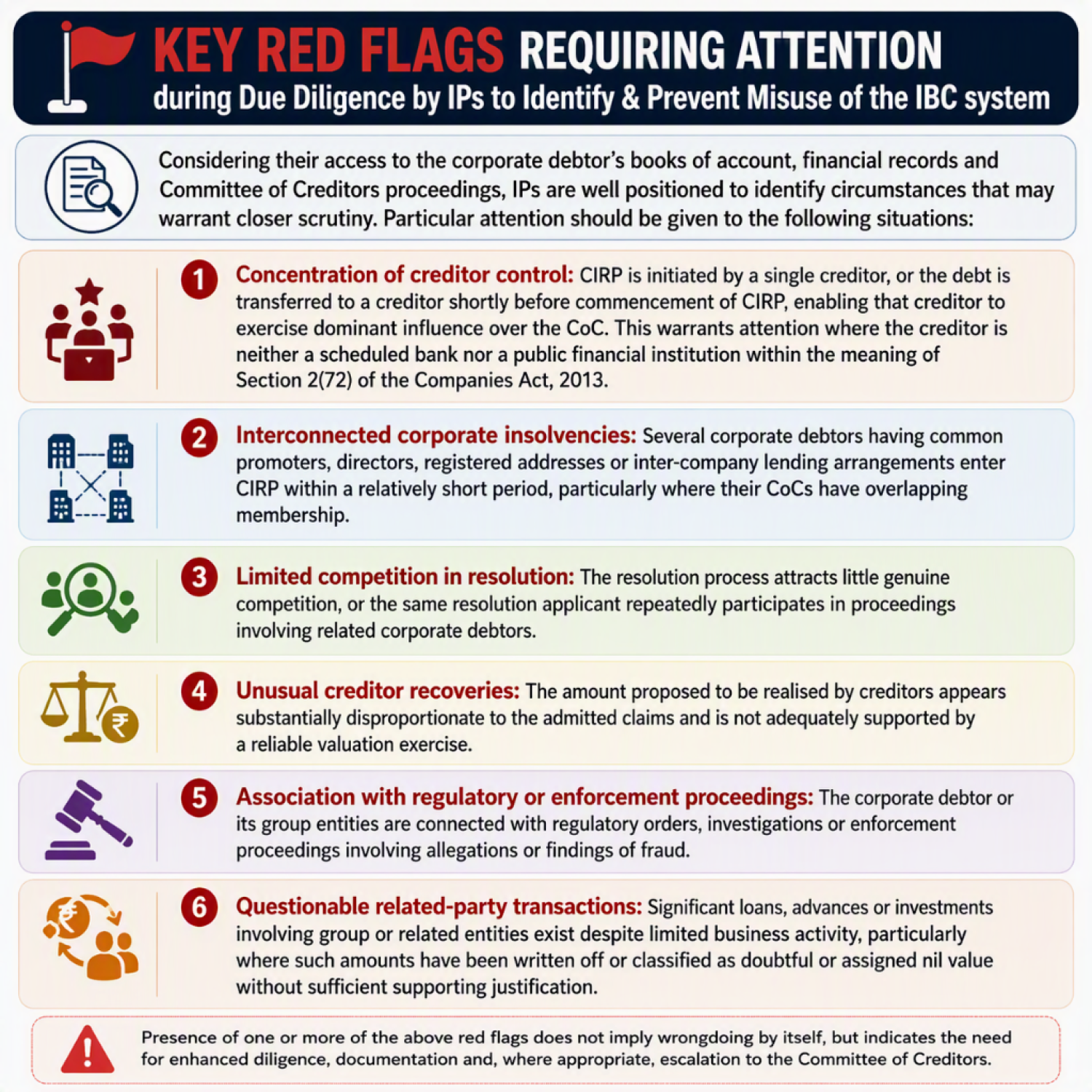
Key Red Flags Requiring Attention during Due Diligence by IPs to Identify & Prevent Misuse of the IBC system
Considering their access to the corporate debtor’s books of account, financial records and Committee of Creditors proceedings, IPs are well positioned to identify circumstances that may warrant closer scrutiny. Particular attention should be given to the following situations:
- Concentration of creditor control: CIRP is initiated by a single creditor, or the debt is transferred to a creditor shortly before commencement of CIRP, enabling that creditor to exercise dominant influence over the CoC. This warrants attention where the creditor is neither a scheduled bank nor a public financial institution within the meaning of Section 2(72) of the Companies Act, 2013.
- Interconnected corporate insolvencies: Several corporate debtors having common promoters, directors, registered addresses or inter-company lending arrangements enter CIRP within a relatively short period, particularly where their CoCs have overlapping membership.
- Limited competition in resolution: The resolution process attracts little genuine competition, or the same resolution applicant repeatedly participates in proceedings involving related corporate debtors.
- Unusual creditor recoveries: The amount proposed to be realised by creditors appears substantially disproportionate to the admitted claims and is not adequately supported by a reliable valuation exercise.
- Association with regulatory or enforcement proceedings: The corporate debtor or its group entities are connected with regulatory orders, investigations or enforcement proceedings involving allegations or findings of fraud.
- Questionable related-party transactions: Significant loans, advances or investments involving group or related entities exist despite limited business activity, particularly where such amounts have been written off or classified as doubtful or assigned nil value without sufficient supporting justification.
Indicators Require Contextual Assessment
The above circumstances are indicative rather than exhaustive. Their occurrence does not, by itself, establish that the insolvency framework has been misused. Similar features may be present in legitimate insolvency cases or arise from ordinary commercial transactions.
Accordingly, an IP should evaluate each warning sign in the context of the corporate debtor’s financial position, transaction history, available documentation and the overall circumstances of the insolvency proceedings. The objective is to distinguish genuine commercial distress from situations in which the process may be directed towards fraudulent or malicious purposes.
Further Enquiry and Appropriate Action
Whenever an IP identifies one or more of these indicators, or encounters other comparable circumstances, appropriate further examination should be undertaken using the records and information available in the ordinary course of CIRP or liquidation.
The assessment should consider whether the circumstances, viewed collectively, reasonably indicate that the proceedings may be serving an objective other than the legitimate resolution of insolvency or liquidation of the corporate debtor.
Where the IP forms a view on reasonable grounds that the process may be serving a fraudulent or malicious purpose, an application must be filed before the Adjudicating Authority (AA). The application should present the relevant facts, identify the warning signs observed, specify the supporting documents or other material relied upon, explain the basis for the IP’s assessment, and seek appropriate directions under the IBC.
Implications for Insolvency Professionals
- This guidance underscores the responsibility of Insolvency Professionals to maintain the integrity and credibility of the insolvency framework. Their role extends beyond the procedural administration of CIRP and liquidation to include vigilance against potential attempts to exploit these mechanisms for unrelated or improper objectives.
- A documented, evidence-based and context-sensitive approach to due diligence can help identify suspicious patterns at an early stage, support appropriate intervention by the Adjudicating Authority and protect the objectives of the IBC. The guidance is intended to ensure that insolvency proceedings remain aligned with their statutory purpose rather than being used as a means to circumvent other legal or regulatory obligations.
Legal reference: IBBI circular concerning due diligence by insolvency professionals regarding potential misuse of the IBC framework, issued under Section 196 of the Insolvency and Bankruptcy Code, 2016.