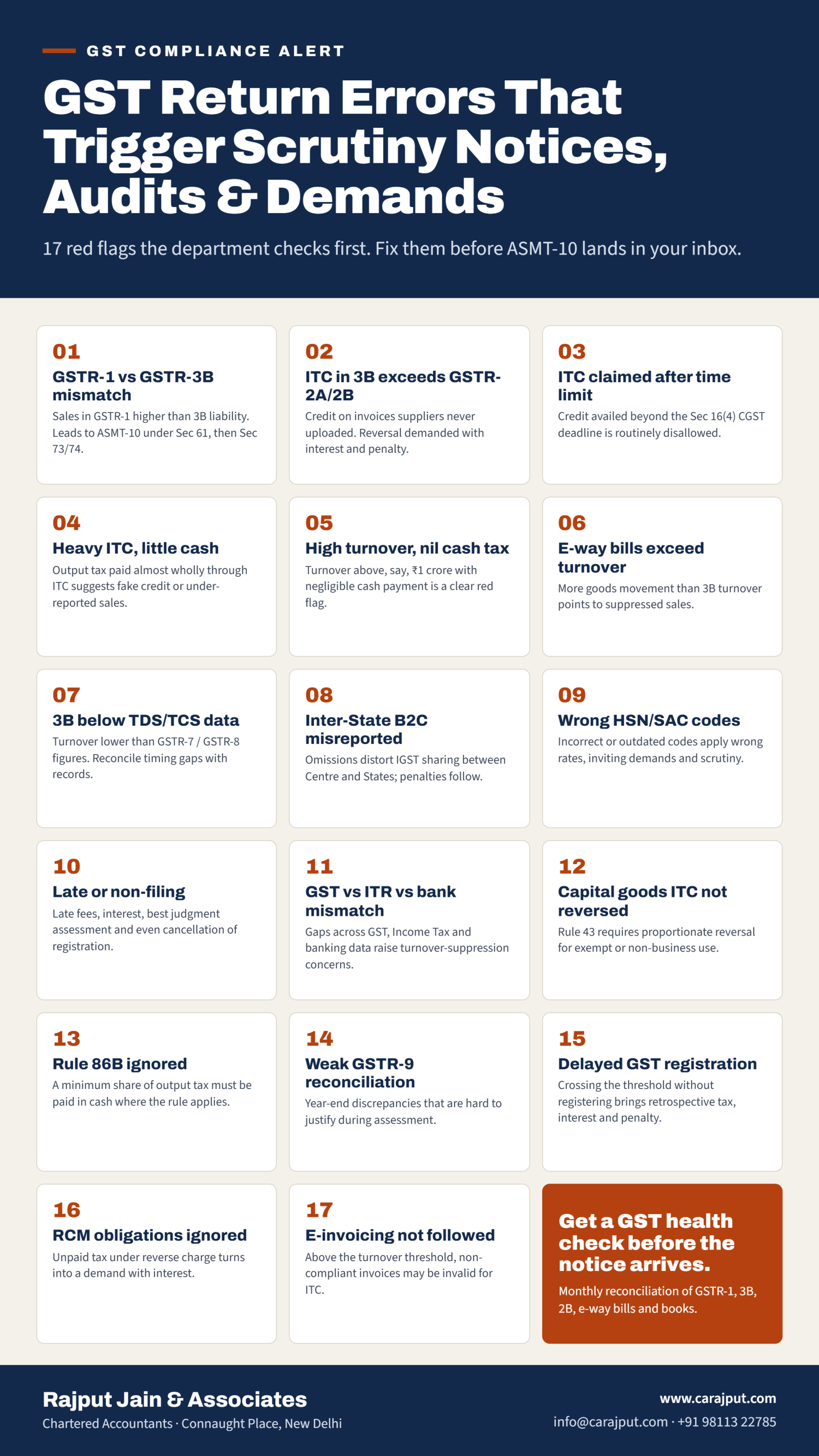
GST Return Errors That Commonly Lead to Scrutiny Notices, Audits and Demands
Small errors in Goods and Services tax returns rarely stay small. Figures that don't match across returns, or Input tax credit claimed without the right support, are now picked up quickly by the department's data analytics. They can lead to scrutiny notices in Form ASMT-10, departmental audits, and demand proceedings with interest and penalty. Most of these problems can be prevented through regular reconciliation.
Below are the errors we see most often in practice, and why each one draws the department's attention.
GSTR-1 and GSTR-3B Do Not Match
When outward supplies in GSTR-1 are higher than the liability declared in GSTR-3B, the department reads it as tax that was charged but not fully paid. This is one of the most common grounds for scrutiny under Section 61, and it often leads to proceedings u/s 73 or 74. Mismatch between GSTR-1 and GSTR-3B arising from differences in reported sales and tax payments, which commonly triggers ASMT-10 scrutiny notices
Input tax credit in GSTR-3B Exceeds GSTR-2A/2B
ITC claimed in GSTR-3B that is higher than what appears in GSTR-2A/2B points to credit taken on invoices the supplier never uploaded, or to excess or ineligible credit. The department may treat it as wrongful availment and seek recovery with interest and penalty. Claiming ITC without reconciling GSTR-2B, resulting in credit being claimed on invoices not reflected by suppliers, leading to ITC reversal demands along with interest.
Input tax credit claimed After the Time Limit
Section 16(4) of the Center Goods and Services Tax Act sets a deadline for availing Input tax credit. Credit claimed after that date is a routine scrutiny check and is usually disallowed in assessment.
Heavy Input tax credit Use and Very Little Cash Payment
A business that pays almost all of its output tax through input tax credit, with very little in cash, can raise suspicion of fake credit or under-reported sales. Such cases are frequently selected for scrutiny.
High Turnover with Nil or Negligible Cash Tax
Reporting large turnover (say, above INR1 crore) while paying little or no tax in cash is a clear red flag. It suggests the tax liability may not be properly discharged.
E-Way Bill Data Exceeds Reported Turnover
If e-way bills show far more movement of goods than the turnover reported in GSTR-3B, the department may suspect suppressed or under-reported sales.
GSTR-3B Turnover Lower Than TDS/TCS Data
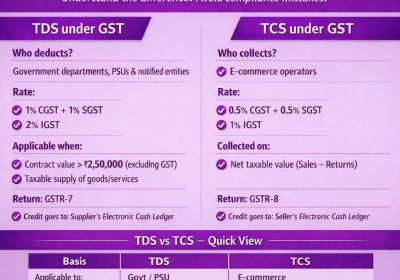
Turnover in GSTR-3B that is lower than the amounts reported by deductors in GSTR-7 or by e-commerce operators in GSTR-8 suggests under-reporting of taxable supplies. Some differences are only timing gaps, but they must be reconciled and explained with records.
Inter-State B2C Supplies Not Reported Correctly
Inter-State B2C supplies left out of the relevant tables of GSTR-1 and GSTR-3B affect how Integrated Goods and Services Tax is shared between the Centre and the States. The omission can attract penalties and compliance action. Using incorrect or outdated HSN/SAC codes, which may cause application of wrong GST rates and result in tax demands and further scrutiny.
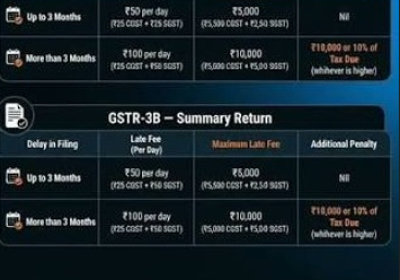
Late Filing or Non-Filing of Returns
Repeated delays in filing GSTR-1 and GSTR-3B, or failing to file them at all, bring late fees and interest. They can also lead to scrutiny, best judgment assessment, penalties and, in serious cases, cancellation of registration. Mismatch of data across GST, Income Tax, and banking records, which can raise concerns regarding turnover suppression or reporting inaccuracies.
Input tax credit on Capital Goods Not Reversed
Under Rule 43, input tax credit on capital goods used for exempt supplies or non-business purposes must be reversed proportionately. If it is not reversed, the result is excess credit and objections in audit or scrutiny.
Rule 86B Not Followed
Where Rule 86B applies, a minimum part of the output tax must be paid in cash. Continuing to pay almost the entire liability through input tax credit despite the rule is a common trigger for scrutiny.
Other
- Inadequate reconciliation while filing GSTR-9 (Annual Return), causing year-end discrepancies that are often difficult to justify during assessments.
- Delayed GST registration after crossing the registration threshold, exposing businesses to retrospective tax liabilities, interest, and penalties.
- Ignoring Reverse Charge Mechanism (RCM) obligations, where the recipient is responsible for paying GST, leading to unpaid tax demands and interest.
- Failure to comply with mandatory e-invoicing requirements after crossing the prescribed turnover threshold, potentially rendering invoices invalid for ITC purposes.
The best protection against Goods and Services tax notices is regular reconciliation. Match GSTR-1, GSTR-3B, GSTR-2A/2B, e-way bills, TDS/TCS data and your books, and correct differences before the department finds them. A little proactive compliance now can save a great deal of time, cost and litigation later.
How Rajput Jain & Associates Can Help
Rajput Jain & Associates supports businesses with Goods and Services tax reconciliations and compliance health checks, Replies to ASMT-10 scrutiny notices and show cause notices, representation in GST audits, Litigation at all levels and Our aim is to find and fix errors before they turn into costly disputes. +91-98-11-322-785 email info@carajput.com | www.carajput.com Save and share this with anyone in your team who handles Goods and Services tax return filing.