Table of Contents
- Why Ibbi Issued It
- Processes Covered
- How The Guidelines Are Organised
- Part I(a): Documentation The Valuer Must Keep
- Part I(b): Minimum Contents Of Every Valuation Report
- Part I(c): Valuing Receivables
- Part I(d): Duties Towards The Coordinating Valuer
- Part Ii: Common Structure Of Asset-specific Reports
- Part Ii: What Differs For Each Asset Class
- Part Iii: The Coordinating Valuer – Purpose And Appointment
- Part Iii: Role, Scope And The Fair Value Formula
- Part Iii: Coordinating Valuation Report And Responsibilities
- Practical Checklist
- Conclusion
IBBI Valuation Guidelines under IBC, 2026: Complete Explained Guide
From 15 June 2026, every registered valuer working under the Insolvency and Bankruptcy Code, 2016 must prepare reports and keep working papers in the format IBBI has now prescribed. The rules come from IBBI Circular No. IBBI/RV/103/2026, which also creates a Coordinating Valuer to arrive at a single fair value for the whole corporate debtor.
|
Item |
Detail |
|---|---|
|
Circular |
IBBI/RV/103/2026, dated 15 June 2026 |
|
Effective |
From the date of issue, for all valuations under the Code carried out after that date |
|
Addressed to |
Registered valuers, RV entities, RV organisations, insolvency professionals, IP entities and IP agencies |
|
Legal power |
Section 196 of the Code and the regulations made under it |
|
Annexure |
Guidelines for Conducting Valuation under the IBC, 2016 (31 pages) |
Why IBBI issued it
Valuation drives almost every decision in an insolvency process, from assessing resolution plans to fixing reserve prices in liquidation. IBBI's view is that reports must be complete, well documented and reasoned, so that values are consistent, comparable and trusted. Reliable valuation is treated as essential to the Code's goal of maximising value.
Processes covered
Several regulations already said that a registered valuer must report and document in the format IBBI notifies by circular. This circular supplies that format for:
- Regulation 35(1A), CIRP Regulations, 2016;
- Regulation 35(8), Liquidation Process Regulations, 2016;
- Regulation 3(1)(b), Voluntary Liquidation Process Regulations, 2017;
- Regulation 39(1A), Pre-packaged Insolvency Resolution Process Regulations, 2021;
- Regulation 30(5), Bankruptcy Process for Personal Guarantors to Corporate Debtors Regulations, 2019.
How the guidelines are organised
|
Part |
What it covers |
|---|---|
|
Part I – General content |
Documentation, minimum report contents, receivables valuation, duties towards the Coordinating Valuer |
|
Part II – Asset-specific formats |
Separate report templates for land & building, plant & machinery, and securities or financial assets |
|
Part III – Coordinating Valuer |
How the fair value of the corporate debtor as a whole is determined |
Part I(a): Documentation the valuer must keep
The valuer's file must be complete enough that an outsider can see what was valued, what work was done and why the final number was reached. The guidelines treat documentation as the full written record of the assignment, not just the final report.
The file should contain at least:
- correspondence and communications with the client;
- working papers and the supporting material behind each conclusion;
- other valuation methods that were considered, and why they were or were not used;
- extra data and inputs that were examined;
- risks and possible biases noticed, and how they were dealt with;
- the points where professional judgement was applied;
- the quality-control checks carried out on the valuation.
In every case, the record must show the steps followed and how the valuer spotted, weighed and controlled valuation risk.
What this means in practice: a report backed by a thin file will not satisfy the guidelines. Valuers should expect their working papers, and not only their reports, to be examined in inspections or disputes.
Part I(b): Minimum contents of every valuation report
Every report under the Code must cover 23 items. They are grouped below by theme; the numbers follow the order in the guidelines.
|
Theme |
Items to include |
|---|---|
|
Engagement |
(i) Purpose and scope; (v) client or appointing authority and other intended users; (vi) intended use |
|
Valuer and independence |
(ii) valuer name and registration number; (iii) any other experts involved; (iv) any interest or conflict of the valuer |
|
Asset |
(vii) assets and/or liabilities valued; (viii) background and relevant facts about the asset |
|
Identification |
(ix) currency and units of measurement; (x) Valuation Report Identification Number (VRIN) |
|
Method |
(xii) basis and premise of value; (xiii) valuation standards followed; (xiv) approaches, methods or models used; (xv) discounts and premiums applied |
|
Evidence |
(xi) sources of information; (xvi) sources and choice of key data and inputs; (xvii) inspections and investigations done; (xxi) findings of other experts |
|
Risk factors |
(xviii) sustainability and functional factors; (xix) significant or special assumptions and limiting conditions |
|
Outcome |
(xx) reasons for leaving out any asset or giving it nil value; (xxii) value and the reasoning behind it |
|
Disclaimers |
(xxiii) caveats, limitations and disclaimers under IBBI's 2020 guidelines on their use, as amended |
Two items deserve special attention. The VRIN gives every report a traceable identity. Item (xx) means an asset cannot be quietly dropped or valued at zero; the report must say why.
Part I(c): Valuing receivables
Receivables are often the most overstated asset in a stressed company's books, so the guidelines list what a valuer must test before putting a value on them.
|
Parameter |
What the valuer examines |
|---|---|
|
Nature |
Whether the amount is a trade receivable, loan, advance or tax-related asset, including carried-forward losses |
|
Credit risk and related parties |
The debtor's financial health and solvency (defaulting, in litigation, insolvent), any external credit rating, and whether the debtor is a related party |
|
Ageing |
How long each amount has been outstanding, in buckets such as under 3 months, under 6 months and 6–12 months |
|
Enforceability and documents |
Secured or unsecured, disputed or undisputed, and whether contracts, invoices, acknowledgements of debt and KYC of the debtors exist |
|
Recovery track record |
Past recovery from similar receivables, customers or sectors, including legal and administrative cost and the time taken |
|
Economy and industry |
Default trends in the debtor's sector and wider economic conditions affecting recovery |
|
Others |
Any further factor the valuer considers relevant |
Example: a corporate debtor shows ₹10 crore owed by a group company that has itself stopped paying lenders, with no signed acknowledgement of debt. Under these parameters, the related-party status, the debtor's default, the age of the balance and the missing documents must all be weighed, and a sharp discount, or even nil value with reasons, may be justified.
Part I(d): Duties towards the Coordinating Valuer
Asset-class valuers must actively support the Coordinating Valuer, since the final fair value of the company depends on their inputs. Each registered valuer must:
- cooperate fully, sharing data, inputs and explanations on time;
- follow the Code, its regulations, the Companies (Registered Valuers and Valuation) Rules, 2017 and the applicable valuation standards;
- hand over inputs and documents within the agreed time;
- ensure that everything shared is accurate and complete, with no material misstatement or omission;
- keep working papers that support every input and analysis given to the Coordinating Valuer;
- answer any further query or request for information from the Coordinating Valuer promptly.
Part II: Common structure of asset-specific reports
IBBI has given three report templates, one each for land & building, plant & machinery, and securities or financial assets. All three share the same skeleton: an executive summary followed by sections (a) to (v).
Executive summary
Each report opens with a one-page table containing:
- the appointing insolvency professional (IRP, RP, liquidator or bankruptcy trustee) and their registration number;
- corporate debtor details: name, business profile, CIN or LLP number, LEI if any, registered and principal office, date of incorporation;
- purpose of valuation, asset class, short description of the asset and scope of work;
- insolvency or liquidation commencement date, valuation date, inspection date and report date;
- fair value and liquidation value in INR crore;
- valuer's name, registration number, date of appointment, certificate of practice status on that date, and the VRIN generated on IBBI's website.
Sections (a) to (v)
|
Section |
What it must say |
|---|---|
|
(a) Purpose and scope |
That the report estimates fair and/or liquidation value under the Code, and the scope agreed in the appointment letter |
|
(b) Valuer details |
Name, registration number and asset class; the VRIN must appear in the footer, left side, on every page |
|
(c) Other experts |
Name, qualifications and role of any expert whose work was used |
|
(d) Interest or conflict |
Any personal, financial or professional interest, as required by the 2017 Valuation Rules |
|
(e) Client and users |
The appointing IP and other intended users such as creditors |
|
(f) Intended use |
Valuation as required under the Code and its regulations |
|
(g)–(h) Asset details and background |
Asset-specific particulars (see next section) |
|
(i) Currency and units |
Normally INR; any other currency needs reasons, the exchange rate, its date and its source; units of measurement stated |
|
(j) Sources of information |
Documents and enquiries relied on |
|
(k) Basis and premise of value |
Fair value and liquidation value as the basis, and the premise chosen for each asset type, with reasons, in a set table |
|
(l) Standards followed |
A clear statement that IBBI-notified valuation standards were followed, naming the specific standards and paragraphs |
|
(m) Approaches and methods |
Market, income and cost approaches each described, with why each was used or rejected, the method chosen, and a note of meetings with the CoC explaining the methodology under Regulation 35(1)(b) of the CIRP Regulations |
|
(n) Discounts and premiums |
Every adjustment with its reasoning |
|
(o) Data and inputs |
Data sources, with reasons for relying on them |
|
(p) Inspections |
Site visits, verification and observations |
|
(q) Sustainability and functional factors |
Environmental, social, governance and usage factors that affect value |
|
(r) Assumptions and limiting conditions |
Key assumptions, including the effect of any pending litigation |
|
(s) Value and rationale |
Fair value, liquidation value, book value and, where the cost approach is used, replacement cost, with reasoning |
|
(t) Caveats |
As per IBBI's 2020 guidelines on caveats, limitations and disclaimers |
|
(u) Summary of conclusions |
Rights identified, approach and method, data available and final working |
|
(v) Annexures |
Appointment letter, engagement terms, photographs, documents, data extracts, CoC meeting minutes and any expert's engagement letter |
Three notes apply to all templates. The format is a minimum, and more items may be added for a particular asset. Where a parameter does not apply or data is missing, the report must say so and give reasons. The VRIN must be on every page.
Part II: What differs for each asset class
The skeleton is the same, but the details the valuer must capture change with the asset.
|
Requirement |
Land & building |
Plant & machinery |
Securities or financial assets |
|---|---|---|---|
|
Asset particulars (g) |
Area, address, revenue survey, circle rate, GPS coordinates, owner or lessee, title and lease status, title deed number, possession, current use, boundaries, land features such as access, shape, topography, frontage-to-depth ratio |
Location, owner or lessee, asset number, make, name, installed and operating capacity, year of manufacture and purchase, country of origin, date put to use, quantity, units |
Type and class of asset including intangibles, quantity, ownership, issuer, rights, marketability, agreements, financial metrics, regulatory compliance |
|
Background (h) |
Ownership history, mutation, permitted use, encumbrances, RERA and zoning approvals, development potential |
Ownership history, legal status, encumbrances, usage, approvals |
Issuer details, face value and rights, pledges, trading history and liquidity, loans and advances given, intangibles, inventories, receivables with ageing and KYC |
|
Sources of information (j) |
Title papers, approvals, building and layout plans, list of structures with built-up area, registry and real-estate data, local brokers |
Financial statements, fixed asset register, machinery list, maintenance records, purchase papers, comparables, manufacturers and dealers, cost indices |
Financial statements and notes, projections, cash and bank, shareholding, ITRs, TDS, GST ledgers, owners' compensation, industry reports, discussions with management and the RP |
|
Data and inputs (o) |
Neighbourhood study, Sub-Registrar sale data, market survey, property portals, approved FAR and scope for higher FAR |
Market quotes, manufacturer data, portals, fixed asset register, legal, physical and technological factors |
Industry reports, financial databases, listed comparables, forecasts, capital market and M&A data, key customers and suppliers |
|
Inspection (p) |
Site visit, measurement, photographs, condition, local enquiries on access and saleability |
Physical check against the asset register, condition, wear and obsolescence, layout, raw material and labour availability, photographs |
Site visit if relevant, management interviews, contract review, industry observations |
|
Sustainability factors (q) |
Environment, connectivity and social infrastructure, RERA and zoning compliance, right to sell or develop, age and remaining life, demand and supply, alternative use |
Pollution control, boiler, factory and fire approvals, sensitive zones, legal compliance, supplier category, imported or indigenous |
ESG, stakeholder impact, promoter integrity and board strength, key customers and contracts, business risks and outlook, legal rights over intangibles |
|
Typical assumptions (r) |
Title subject to legal opinion, soil suitable for construction, no unknown encumbrances, marketability under current conditions |
Clear title, condition as seen on inspection, usable as it stands unless repairs are needed |
Reliance on management representations, no undisclosed contingent liabilities |
|
Key annexures (v) |
Site photos, layout maps, title documents |
Machine specifications and registers, calculation sheets |
Comparable company analysis, financial extracts, computation sheets |
For all three classes, pending litigation and its effect on value must be addressed under the assumptions section.
Part III: The Coordinating Valuer – purpose and appointment
Part III introduces one valuer who pulls the three asset-class reports together and arrives at the fair value of the corporate debtor as a working business. This fair value is the one required under the CIRP Regulations and the PPIRP Regulations. Part III is to be read with Parts I and II.
Objectives
- make valuation outcomes under the Code more consistent and reliable;
- bring the three asset-class valuations together in a coherent way;
- capture total value, including synergies and both tangible and intangible assets;
- help the Committee of Creditors decide on the basis of a full picture of the company;
- build confidence and transparency in the valuation process.
Independence
The Coordinating Valuer is held to the same eligibility, independence and disclosure rules as any registered valuer under the Code, its regulations and the 2017 Valuation Rules. Any conflict or threat to objectivity must be disclosed to the insolvency professional as soon as it is known. The work must be done with due care, competence and in line with the applicable standards.
Designation
The insolvency professional, in consultation with the CoC, picks the Coordinating Valuer from the registered valuers already appointed for the set of asset classes. The designation should be made early, so that coordination is effective from the start.
Engagement letter
The IP issues a written engagement letter that must set out at least:
- the purpose of the assignment;
- the extent of coordination and review;
- reporting obligations;
- the timeline;
- access to the information and documents needed;
- confidentiality of the valuation;
- any limitations or special assumptions.
Part III: Role, scope and the fair value formula
The Coordinating Valuer's fair value is meant to reflect the business as a whole, not merely the sum of its parts.
How the work flows
- Valuers for each asset class (land & building, plant & machinery, securities or financial assets) determine fair value and liquidation value for their own class.
- Their reports, submitted as a set, go to the Coordinating Valuer.
- The Coordinating Valuer reviews the methods and assumptions used in each report.
- The Coordinating Valuer combines the asset-class values, identifies synergies and estimates the fair value of the corporate debtor.
What must be considered
In arriving at the integrated value, the Coordinating Valuer should look at:
- the operating business of the corporate debtor;
- expected future cash flows;
- the industry outlook and the wider economy;
- synergies from running the assets together;
- the tangible and intangible assets of the business.
The Coordinating Valuer must also judge whether a market participant would actually pay for those synergies.
Intangible assets
The Coordinating Valuer must assess intangibles that can materially affect value, such as brand, trademarks and copyrights, patents and proprietary technology, licences and approvals, customer relationships and contracts, distribution networks, and goodwill. The basis for identifying, recognising and valuing each intangible must be documented.
Indicative formula
IBBI gives the following representation of the fair value of the corporate debtor:
FV_{CD} = sum V_{RV} + S
Here FV(CD) is the fair value of the corporate debtor, ΣV(RV) is the total of the values of the individual asset classes found by the registered valuers, and S is the synergy adjustment. S captures the extra value that comes from running tangible and intangible assets together, including operating efficiencies, market position and future earning potential.
Example: land & building is valued at ₹60 crore, plant & machinery at ₹25 crore and securities or financial assets at ₹15 crore, a total of ₹100 crore. If the Coordinating Valuer assesses that the running plant, its licences and customer contracts add ₹20 crore of value as a going concern, the fair value of the corporate debtor would be ₹120 crore. These figures are only illustrative.
Part III: Coordinating Valuation Report and responsibilities
The Coordinating Valuer issues a separate Coordinating Valuation Report, which must meet the Part I(b) minimum contents and also explain how the integrated fair value was reached.
Contents of the report
- background, purpose and scope of the valuation;
- the registered valuers whose reports were used;
- methods applied and key assumptions;
- assessment of total value and business synergies;
- treatment of tangible and intangible assets;
- the basis and method used to combine the individual reports;
- main information, data sources and documents relied on;
- the final fair value of the corporate debtor.
Where special assumptions are used, their nature and effect on the value must be clearly explained.
Other obligations
|
Area |
Requirement |
|---|---|
|
Documentation and records |
Keep records as required by Part I(a), and preserve them as law and professional rules require |
|
Professional responsibility |
Use independent judgement, act with integrity and diligence, keep the process confidential, and own the conclusions in the report |
|
Standards |
Follow the valuation standards notified by IBBI |
|
Communication |
Write a clear report for the intended users, and meet the CoC to explain the methodology before computing the estimates |
|
Timelines |
Aim to finish within the time in the engagement letter or the regulations |
The framework is a minimum. Extra sections may be added where a case is complex or raises specific issues.
Annexure A: executive summary of the coordinating report
|
Field |
What to enter |
|---|---|
|
Client |
Appointing IP (IRP, RP or liquidator) and registration number |
|
Corporate debtor |
Name, CIN or LLP number, LEI, registered office, principal place of business, business profile |
|
Purpose |
Fair value of the corporate debtor under the Code |
|
Key dates |
ICD or LCD, valuation date, inspection date(s), report date |
|
Each asset-class valuer |
Name, registration number, appointment date, CoP status, VRIN and date of report |
|
Values |
Fair value of land & building, plant & machinery and securities or financial assets; synergy adjustment; final integrated fair value |
|
Coordinating Valuer |
Name, registration number, RV entity if any, and VRIN of the coordinating report |
Practical checklist
For registered valuers
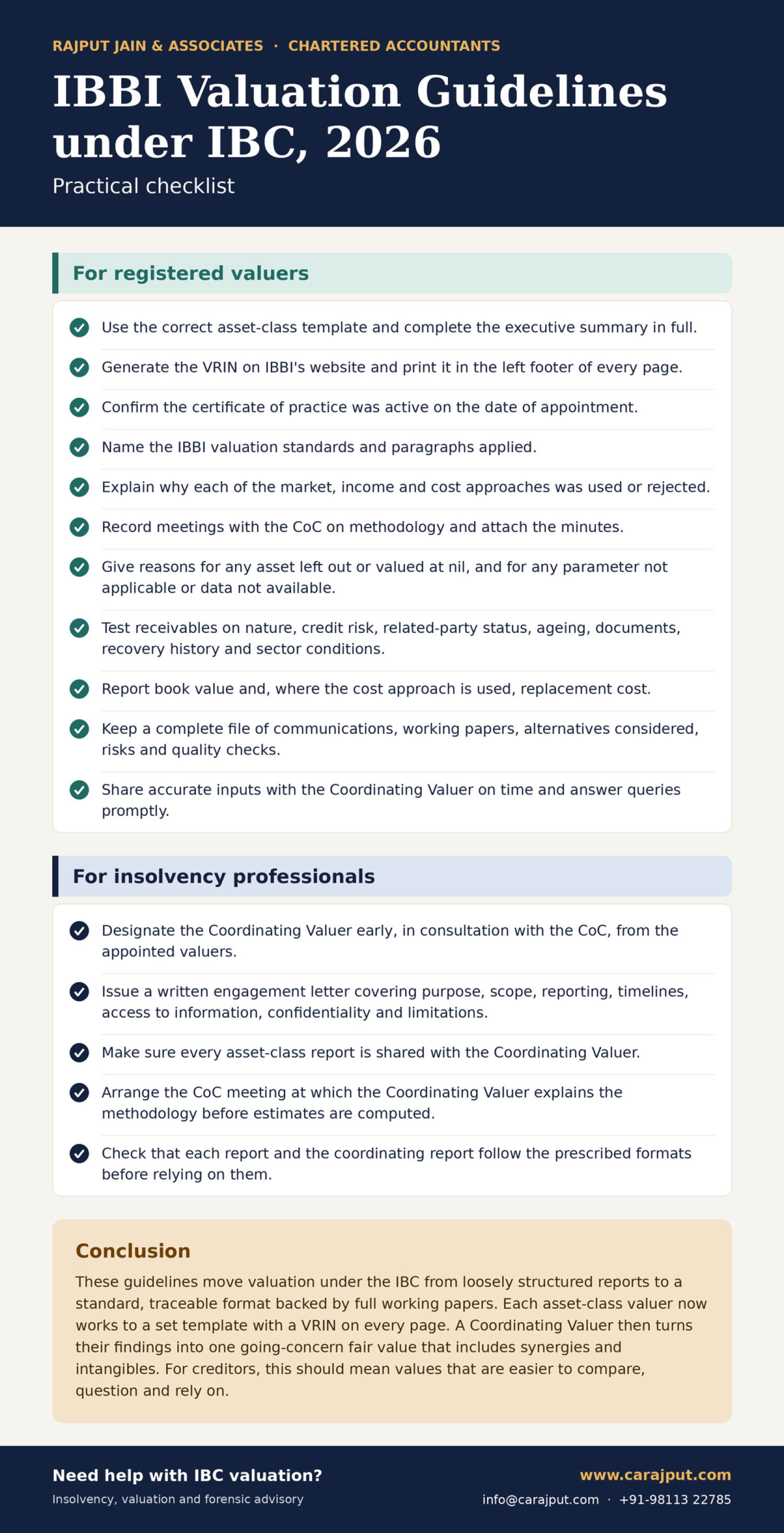
- Use the correct asset-class template and complete the executive summary in full.
- Generate the VRIN on IBBI's website and print it in the left footer of every page.
- Confirm the certificate of practice was active on the date of appointment.
- Name the IBBI valuation standards and paragraphs applied.
- Explain why each of the market, income and cost approaches was used or rejected.
- Record meetings with the CoC on methodology and attach the minutes.
- Give reasons for any asset left out or valued at nil, and for any parameter not applicable or data not available.
- Test receivables on nature, credit risk, related-party status, ageing, documents, recovery history and sector conditions.
- Report book value and, where the cost approach is used, replacement cost.
- Keep a complete file of communications, working papers, alternatives considered, risks and quality checks.
- Share accurate inputs with the Coordinating Valuer on time and answer queries promptly.
For insolvency professionals
- Designate the Coordinating Valuer early, in consultation with the CoC, from the appointed valuers.
- Issue a written engagement letter covering purpose, scope, reporting, timelines, access to information, confidentiality and limitations.
- Make sure every asset-class report is shared with the Coordinating Valuer.
- Arrange the CoC meeting at which the Coordinating Valuer explains the methodology before estimates are computed.
- Check that each report and the coordinating report follow the prescribed formats before relying on them.
Conclusion
These guidelines move valuation under the IBC from loosely structured reports to a standard, traceable format backed by full working papers. Each asset-class valuer now works to a set template with a VRIN on every page. A Coordinating Valuer then turns their findings into one going-concern fair value that includes synergies and intangibles. For creditors, this should mean values that are easier to compare, question and rely on.
Need support on IBC valuations? Rajput Jain & Associates, Chartered Accountants, assists insolvency professionals, creditors and corporate debtors on IBC compliance, valuation coordination and forensic review. Write to info@carajput.com, call +91 98113 22785, or visit www.carajput.com.