Table of Contents
- Overview Of ibbi Fifth Amendment 2026: Liquidator Can Now Modify The List Of Stakeholders
- Why The List Of Stakeholders Matters
- Old Position Vs New Regulation 31(3)
- Key Highlights Of ibbi Fifth Amendment 2026: Liquidator Can Now Modify The List Of Stakeholders
- Practical Illustrations Of ibbi Fifth Amendment 2026
- Who Benefits Of ibbi Fifth Amendment 2026
- Compliance Checklist For Liquidators
- Conclusion
Overview of IBBI Fifth Amendment 2026: Liquidator Can Now Modify the List of Stakeholders
A liquidator can now correct any entry in the List of Stakeholders when fresh information supports it, provided the Adjudicating Authority is told within 30 days. This is the core of the IBBI (Liquidation Process) (Fifth Amendment) Regulations, 2026, notified on 22 September 2026 and effective from the date of publication in the Official Gazette.
The amendment rewrites Regulation 31. It replaces the old sub-regulations (3) and (4) with a single, simpler rule. For liquidators, creditors and the NCLT, this changes how the stakeholder list is maintained during a liquidation.
Why the List of Stakeholders matters
The List of Stakeholders is the liquidator's master record of every creditor and stakeholder with a right to share in the liquidation estate. Almost every later step in the process relies on it:
- the amount each stakeholder receives when proceeds are distributed;
- which claims stand recognised, and at what value;
- voting entitlements, where the process calls for a vote;
- the audit trail that keeps the liquidation open to scrutiny.
An error or omission in this list can therefore cost a creditor real money. Keeping it accurate is central to a fair liquidation.
Old position vs new Regulation 31(3)
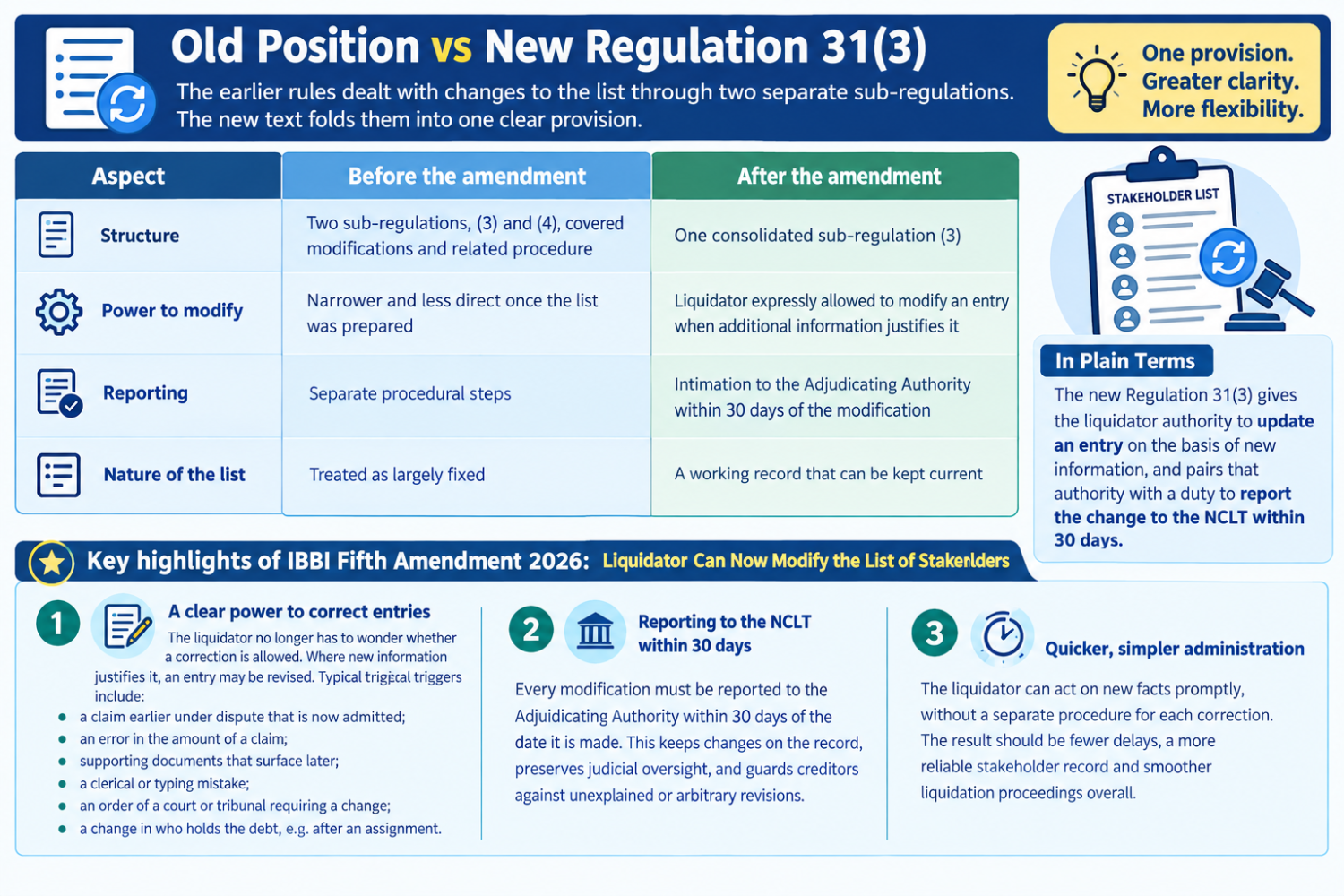
The earlier rules dealt with changes to the list through two separate sub-regulations. The new text folds them into one clear provision.
|
Aspect |
Before the amendment |
After the amendment |
|---|---|---|
|
Structure |
Two sub-regulations, (3) and (4), covered modifications and related procedure |
One consolidated sub-regulation (3) |
|
Power to modify |
Narrower and less direct once the list was prepared |
Liquidator expressly allowed to modify an entry when additional information justifies it |
|
Reporting |
Separate procedural steps |
Intimation to the Adjudicating Authority within 30 days of the modification |
|
Nature of the list |
Treated as largely fixed |
A working record that can be kept current |
In plain terms, the new Regulation 31(3) gives the liquidator authority to update an entry on the basis of new information, and pairs that authority with a duty to report the change to the NCLT within 30 days.
Key highlights of IBBI Fifth Amendment 2026: Liquidator Can Now Modify the List of Stakeholders
1. A clear power to correct entries
The liquidator no longer has to wonder whether a correction is allowed. Where new information justifies it, an entry may be revised. Typical triggers include:
- a claim earlier under dispute that is now admitted;
- an error in the amount of a claim;
- supporting documents that surface later;
- a clerical or typing mistake;
- an order of a court or tribunal requiring a change;
- a change in who holds the debt, for example after an assignment.
2. Reporting to the NCLT within 30 days
Every modification must be reported to the Adjudicating Authority within 30 days of the date it is made. This keeps changes on the record, preserves judicial oversight, and guards creditors against unexplained or arbitrary revisions.
3. Quicker, simpler administration
The liquidator can act on new facts promptly, without a separate procedure for each correction. The result should be fewer delays, a more reliable stakeholder record and smoother liquidation proceedings overall.
Practical illustrations of IBBI Fifth Amendment 2026
The three situations below show how the amended rule works in day-to-day liquidation practice.
|
Situation |
What comes to light |
What the liquidator does |
|---|---|---|
|
Additional claim proof |
A creditor's admitted claim stands at ₹5 crore; later documents support a further ₹1 crore |
Raises the entry to ₹6 crore and reports the change to the NCLT within 30 days |
|
Duplicate entry |
After the list is published, the same operational creditor is found listed twice because of a clerical slip |
Removes the duplicate, updates the list and informs the NCLT within 30 days |
|
Assignment of debt |
After the list is prepared, Bank A assigns its debt to an Asset Reconstruction Company |
Substitutes the ARC's details for Bank A's and notifies the NCLT within 30 days |
Who benefits of IBBI Fifth Amendment 2026
The amendment balances flexibility for the liquidator with accountability to the tribunal, and each party gains something from it.
|
Stakeholder |
What changes for them |
|---|---|
|
Liquidators |
Statutory backing to correct records, less doubt about the scope of their powers, easier compliance |
|
Creditors |
A list that reflects their true claims, stronger protection of their economic interest, more visibility into changes |
|
Adjudicating Authority (NCLT) |
Prompt notice of every modification and a clearer view of how the liquidation is progressing |
Compliance checklist for liquidators
- Record the new information that justifies the change and keep the supporting documents on file.
- Note the exact date on which the entry is modified; the 30-day window runs from this date.
- Update the List of Stakeholders and retain the earlier version for the audit trail.
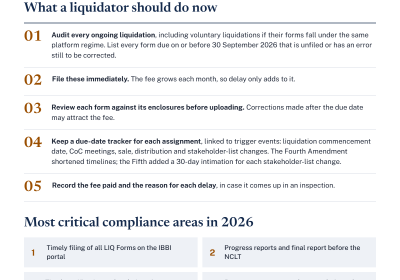
- File the intimation with the Adjudicating Authority within 30 days of the modification.
- Keep a modification register showing each change, its reason and the date of intimation.
Conclusion
The Fifth Amendment is a narrow change with wide practical effect. Liquidators may now update the List of Stakeholders whenever new information warrants it, but every change must reach the NCLT within 30 days. The outcome is a stakeholder record that is both accurate and accountable, and a liquidation process that runs more smoothly under the IBC.
Need help with liquidation compliance? Rajput Jain & Associates, Chartered Accountants, advises Insolvency Professionals, creditors and corporate debtors on IBC and liquidation matters. Write to info@carajput.com, call +91 98113 22785, or visit www.carajput.com.