Table of Contents
- How Ai Is Transforming In Tax Compliance In India
- Key Highlights Of How Artificial Intelligence Is Transforming Tax Compliance In India
- Future Of Ai In Tax Administration: What Lies Ahead For India
- Emerging Technologies To Watch:
- Persistent Significance In Tax Functions:
- Major Ai Implementations In India - Ai & The Future Of Tax Administration.
- Ai Is Reshaping The Enforcement, Administration, And Taxpayer Experience In India’s Huge And Complex Tax Ecosystem
- Perceived Benefits Of Ai Is Transforming In Tax Compliance
- Implementation Challenges Of Ai Is Transforming In Tax Compliance
- How India Compares Globally
- At-a-glance: Critical Takeaways
How AI Is Transforming in Tax Compliance in India
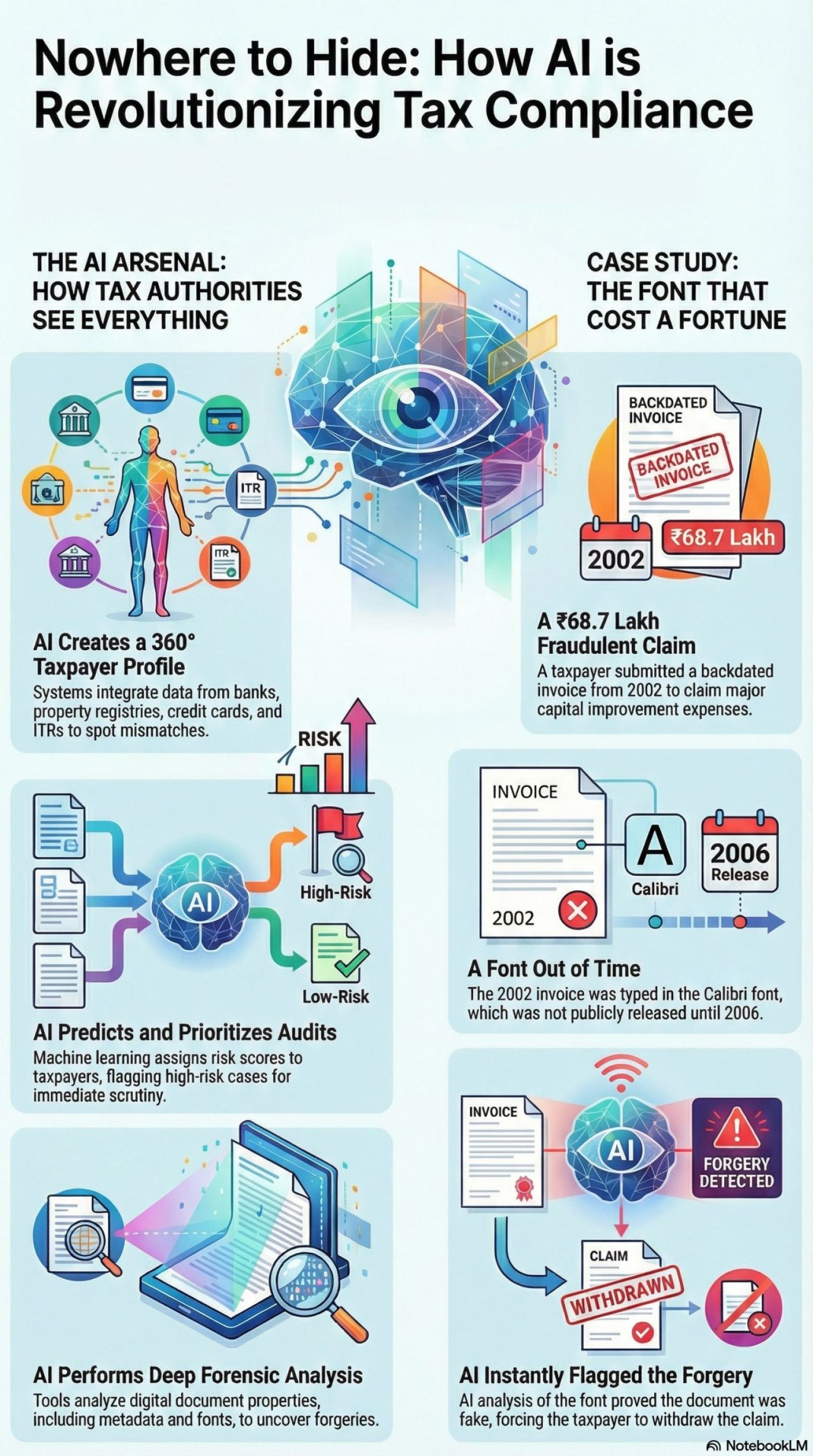
India's tax administration is fast changing due to artificial intelligence, and this change is far more profound than most people know. Across the nation, artificial intelligence is enhancing taxpayer experience, decreasing evasion, and updating compliance. In India, artificial intelligence is revolutionizing tax administration and compliance. It describes how India's tax systems have changed over time, as well as the impact, difficulties, global comparisons, and future policy recommendations of present AI implementations.
Over 1.4 billion people and enormous transaction records are managed by India's tax network. Long-standing issues including taxpayer service efficiency, compliance monitoring, and evasion detection are being resolved by AI. Large-scale AI projects like Project Insight and GST Analytics have already been started by the government (CBDT, CBIC). The insights assist professionals, firms, and policymakers in getting ready for a tax climate that is more automated, data-driven, and risk-based.
Key Highlights of How Artificial Intelligence Is Transforming Tax Compliance in India
- Project Insight (Income Tax): Millions of possible evaders have already been found thanks to AI-powered profiling, predictive analytics, and non-filer detection, which has greatly increased revenue.
- Artificial Intelligence in GST: More accurate detection of fraud rings and circular trade is made possible by advanced invoice-matching, risk scoring, and network analysis.
- Smarter Taxpayer Services: By answering thousands of questions every day, chatbots like AskIT and GSTBOT have improved accessibility and user-friendliness.
- Better Governance Through Behavioral Insights: One-time filing rates and voluntary compliance are increasing thanks to AI-driven nudges and tailored communications.
- Issues That Still Need Work: The biggest obstacles to the widespread use of AI are still data quality, legacy system integration, technological capability constraints, and privacy concerns.
- Global Inspiration: In terms of data governance and transparent AI decision-making, nations like Brazil, Singapore, and the UK provide India with useful models.
- The Changing Role of Company Secretaries: AI is automating repetitive jobs, freeing up CS experts to concentrate on complicated tax interpretation, governance, and strategic advice areas where human judgment is still indispensable.
Future of AI in Tax Administration: What Lies Ahead for India
India is getting ready for the next stage of intelligent, data-driven tax administration as AI continues to transform tax systems throughout the world. Prospective Paths & Suggestions:
- Unified Data Governance Framework: To guarantee uniformity, correctness, and smooth integration among tax departments, India needs a unified, high-quality data ecosystem.
- Increasing AI Capacity Within Tax Departments: Long-term success will depend on developing specialist AI teams, improving technical capabilities, and encouraging cooperation with academic institutions and tech partners.
- Ethical & Responsible AI: India has to set up transparent algorithms, formal appeal procedures, and frequent audits for bias and accuracy in order to preserve justice and confidence in AI-driven tax administration.
Emerging Technologies to Watch:
India is getting ready for the next stage of intelligent, data-driven tax administration as AI continues to transform tax systems throughout the world. Prospective Paths & Suggestions:
- Unified Data Governance Framework: To guarantee uniformity, correctness, and smooth integration among tax departments, India needs a unified, high-quality data ecosystem.
- Increasing AI Capacity Within Tax Departments: Long-term success will depend on developing specialist AI teams, improving technical capabilities, and encouraging cooperation with academic institutions and tech partners.
- Human Judgment Still Matters : While AI boosts efficiency, the advisory responsibilities of a Professional interpretation, strategic decision-making, judgment — remain uniquely human and irreplaceable.
- Ethical & Responsible AI: India has to set up transparent algorithms, formal appeal procedures, and frequent audits for bias and accuracy in order to preserve justice and confidence in AI-driven tax administration.
Persistent Significance in Tax Functions:
Professionals are still essential to TDS compliance, filing and attestation requirements, tax representation, corporate transaction structuring, and tax strategy. AI-powered, data-driven, and governance-focused, the future of Indian tax administration will be supported by qualified experts who blend technology and good judgment. In order to connect intelligent automation with moral and efficient corporate governance, company secretaries will be essential.
Major AI Implementations in India - AI & the Future of Tax Administration.
Evolution of Indian Tax Administration: From manual, paper-based procedures to one of the biggest digital tax ecosystems in the world, India's tax system has experienced a significant transition. Key milestones that shaped this journey include:
- PAN adoption – creating a unified taxpayer identity
- E‑filing systems – enabling digital return filing
- Tax Information Network (TIN) – strengthening data collection
- Project Insight (2017) – AI-driven analytics for direct taxes
- GSTN (2017) – one of the largest indirect tax platforms globally
These reforms laid the foundation for AI-driven compliance and smarter enforcement.
AI is reshaping the enforcement, administration, and taxpayer experience in India’s huge and complex tax ecosystem
- Direct Tax AI Platform : Uses machine learning, 360° profiling, and predictive audit selection. Identified 2.4 million non-filers and boosted collections by ₹14,000 crore in first three years.
- GST AI Analytics : Invoice-matching algorithms, risk-scoring models, network analysis for detecting fraud rings/circular trading, and increased compliance in high-risk sectors by 12%.
Perceived Benefits of AI Is Transforming in Tax Compliance
- Better detection of evasion (86%)
- Efficient resource allocation (73%)
- Reduced compliance burden (67%)
- Improved taxpayer service (60%)
Implementation Challenges of AI Is Transforming in Tax Compliance
- Poor data quality across systems (80%)
- Limited AI/tech skills in departments (73%)
- Legacy IT integration issues (67%)
- Privacy and transparency concerns (53%)
How India Compares Globally
India’s AI adoption in tax administration is now benchmarked against some of the world’s most advanced systems:
- Brazil’s SISAM—Machine learning–based audit selection with a 30% higher audit yield
- Singapore’s IRAS – AI-backed taxpayer scoring leading to 25% reduction in compliance costs
- UK’s Connect System—Integrates data from 30+ sources, delivering £3 billion in additional annual revenue
These models demonstrate worldwide how integrated data and sophisticated analytics may boost compliance effectiveness. To fully unlock AI’s potential in tax administration, the most successful global systems show the importance of:
- Integrated data governance—cleaner, connected, and high-quality data
- Balanced focus—stronger enforcement and better taxpayer service
- Transparency in AI decisions—clear logic, auditability, and fairness
- Collaborative development—government, technology partners, and academia working together
The Road Ahead : India is positioned to create one of the most sophisticated and just tax systems in the world thanks to upcoming technologies like blockchain, federated learning, and powerful natural language processing. Strong data governance, moral protection, and ongoing capacity building must now be the main priorities.
At-a-Glance: Critical Takeaways
|
Topic |
Key Point |
|
Document Purpose |
Analyze how AI is transforming tax compliance in India |
|
Most Important Systems |
Project Insight, GST Analytics, AskIT, GSTBOT |
|
Why It Matters |
AI enhances compliance, reduces fraud, boosts revenue, and improves taxpayer services |
|
Biggest Challenges |
Data quality, talent shortage, legacy systems, privacy concerns |
|
Global Insights |
India can learn from Brazil, Singapore, and the UK |
|
Future Focus |
Data governance, ethical AI, blockchain, federated learning |
|
Role of professional |
Evolving toward tech-enabled strategic advisors |