Table of Contents

CBDT issued FAQs on the Income Tax Bill, 2025, & key highlights and major changes:
The CBDT FAQs are designed to explain and interpret provisions of the Income Tax Bill, 2025, especially where language/definitions are simplified, changes affect recurring compliance, procedural aspects are clarified, and ambiguities that historically caused disputes are removed. These FAQs are issued to help taxpayers, tax professionals, and administrators understand the intent, application, and transition from the Income-tax Act, 1961 to the new statutory framework.
The FAQs specifically address how readers should interpret definitions placed in one section rather than many, formulaic computation rules, rules previously explained by footnotes/provisos, and legacy exemptions embedded as standalone clauses, ensuring no change in underlying tax policy but improving interpretability. This ensures tax professionals can map old Act sections to new Bill clauses without loss of meaning.
FAQs frequently emphasize that the intent is simplification and certainty, not new tax impositions. The authoritative FAQs are published on the Income Tax Department website under the Income Tax Bill, 2025 section, with PDFs covering general FAQs and topic-specific clarifications.
Introduction of “Tax Year”
- Replaces “Previous Year” and “Assessment Year” from the 1961 Act.
- Purpose: Aligns with international practice and removes confusion.
- Impact: All assessments and rates will now relate to the tax year (e.g., Tax Year 2026-27).
- Simplification of Definitions : All definitions are consolidated in Section 2. and redundant repetitions are removed (e.g., “Senior Citizen” now appears only once).
No Major Policy Changes-Structural Simplification & Language Changes
- Most changes are structural and language simplifications. Existing rights and duties of taxpayers remain intact.
- The transition is expected to be seamless. Multiple scattered definitions under the old law (e.g., senior citizen) are consolidated into a unified definitions section. This reduces repetition and confusion.
- Several sections from the old Act dealing with similar matters are consolidated or placed in tabular formats for ease of understanding, e.g., assessment and limitation procedures.
- Frequent explanatory provisos in the 1961 law are recast as standalone sub-sections or clauses to improve readability. The Bill does not introduce new tax rates or radically alter tax policy; rather it simplifies the wording and structure of existing law for predictability and fewer disputes. The Bill seeks to retain the substantive tax concepts of the 1961 Act (residence, scope of total income, income heads), but presents them in clear and consolidated formats.
Exemptions (Section 10)
- Previously 140 clauses, now reorganized into 6 schedules by category.
- Word count reduced: from ~30,000 to ~13,500.
- 90 explanations and 134 provisos removed for clarity.
Non-Profit Organisations
- All provisions consolidated under Part XVII-B.
- Common term introduced: “Registered Non-Profit Organization.”
- Word count reduced from 12,800 to 7,600.
- Simplified registration and compliance; redundant provisions removed.
Salary & House Property
- Language simplified; technical jargon minimized.
- Word count reduced significantly (e.g., Salaries: 4,401 → 3,420 words).
- Provisions consolidated for easy self-compliance.
Profits & Gains of Business/Profession
- Sections reduced from 65 to 41.
- Similar provisions merged; formula-based explanations added.
- Presumptive taxation for residents & non-residents consolidated into single sections.
Clubbing & Deeming Provisions
- Language simplified; formulas introduced for clarity.
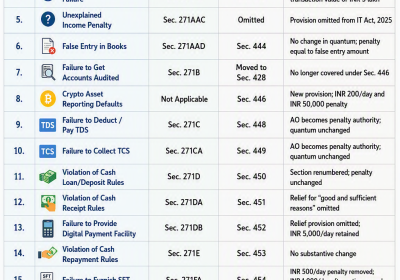
- Section 68 renamed from “Cash Credits” to “Unexplained Credits”.
TDS/TCS
- Sections reduced from 69 to 13.
- All rates and thresholds remain the same but are presented in tabular format.
- Separate tables for residents, non-residents, and general cases.
- Many obsolete, repetitive, or redundant sections from the 1961 Act have been removed, shrinking the law’s size and complexity. & Related provisions (e.g., various facets of TDS/TCS or set-off and carry-forward of losses) are now under consolidated chapters for easier navigation.
Advance Tax, Refund & Interest
- Formula-based computation introduced for interest and advance tax.
- Clear start and end dates for interest calculation provided in tables.
Virtual Digital Assets (VDA) & Modern Economy :
- Clarifications include how certain digital and electronic assets fit into income-tax definitions , aligning with amendments already introduced under the Finance Act, 2025.
Assessment, Return Filing & Compliance Reforms
- Return filing obligations consolidated in one section. Due dates remain same but shown in tabular format.
- Faceless / Digital Emphasis: Assessment procedures, previously spread across multiple sections, are streamlined to support faceless and digital processes with reduced on-site notices and clearer timelines.
- Limitation Period / Reassessment: Limitation provisions for assessment and reassessment are recast for clarity rather than changing substantive rights.
- Faceless Assessment Redesignated: Faceless assessment procedure simplified. Provisions that previously referred to “faceless assessment” have been simplified and reorganized into main procedural sections with better readability.
Longer window for filing updated returns (extended to 48 months from the end of the relevant year). These timelines are mainly transitional adjustments under the new Bill structure but align with policy changes already enacted for AY 2025-26.
‘Cash Credits’ / ‘Unexplained Credits’ Terminology CBDT FAQs clarify that the old Section 68 ‘cash credits’ has been renamed ‘unexplained credits’ to reflect actual tax intent; this does not change the substantive nature of the tax provision.
You may also Review following blogs.