Table of Contents
Major Compliance Relief for Growing Businesses
The Ministry of Corporate Affairs has taken a significant step towards ease of doing business by expanding the definition of a "small company" under the Companies Act, 2013. This revision is expected to bring thousands of growing companies within the ambit of small company benefits, enabling them to enjoy reduced compliance obligations, lower administrative costs, and simplified governance requirements.
For entrepreneurs, startups, family-owned businesses, and emerging enterprises, this move marks a welcome shift towards a more business-friendly regulatory framework.
Understanding the Revised Definition
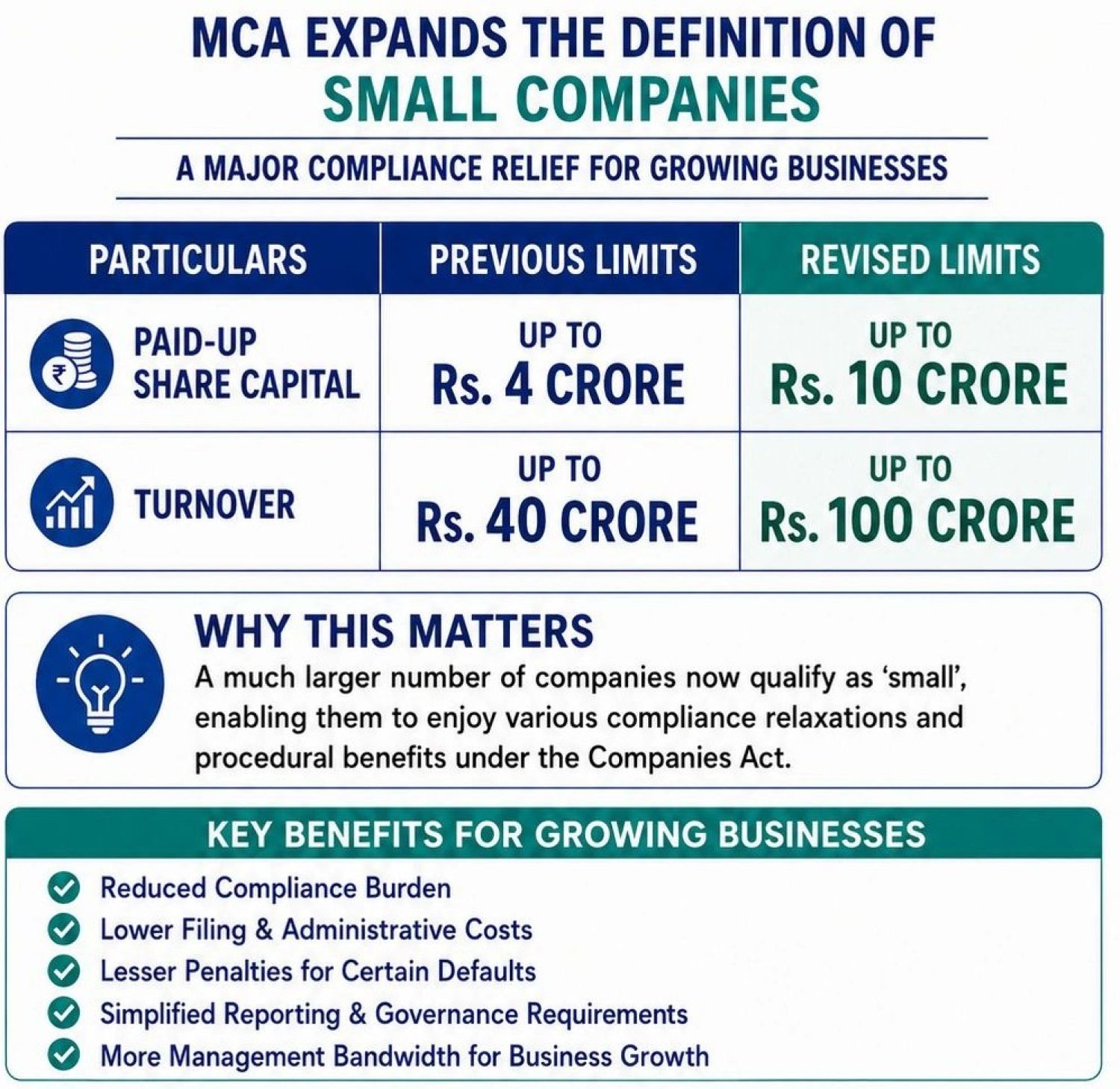
Under the revised criteria, a company will qualify as a Small Company if it satisfies the following conditions:
|
Particulars |
Earlier Limit |
Revised Limit |
|
Paid-up Share Capital |
Up to INR 4 Crore |
Up to INR 10 Crore |
|
Turnover |
Up to INR 40 Crore |
Up to INR 100 Crore |
A company must satisfy both conditions to qualify as a small company, subject to exclusions specified under the Companies Act.
Why Has MCA Increased the Limits?
- Over the last few years, businesses have witnessed substantial growth due to inflation, economic expansion, digitalization, and increased access to funding. Many companies that were relatively small in terms of operations had crossed the earlier thresholds and, consequently, lost the benefits available to small companies.
- Recognizing this challenge, MCA has revised the limits to ensure that genuinely growing businesses are not subjected to disproportionate compliance requirements merely because of an increase in turnover or capital base.
- The objective is clear: promote ease of doing business, encourage entrepreneurship, reduce compliance costs, allow management to focus on growth rather than paperwork, and improve India's business ecosystem.
Key Benefits Available to Small Companies
The revised definition opens the door for numerous compliance relaxations under the Companies Act, 2013.
1. Reduced Compliance Burden
Small companies enjoy various exemptions and simplified procedures compared to larger companies. This means fewer regulatory filings, relaxed procedural requirements, simplified board processes, and reduced documentation requirements. For many growing businesses, this translates into substantial savings in time and professional costs.
2. Simplified Annual Filing Requirements
Small companies generally have simplified reporting and filing obligations compared to larger entities. Benefits include simplified annual return formats, reduced disclosures, and easier secretarial compliance. This reduces both internal administrative efforts and external professional fees.
3. Lesser Penalties for Certain Defaults
One of the most attractive advantages is the concept of "lesser penalties." Under Section 446B of the Companies Act, small companies are eligible for reduced penalties for specific compliance defaults. This can significantly reduce the financial impact of inadvertent procedural lapses and compliance delays.
4. Simplified Board Governance:
Small companies enjoy certain governance relaxations, including fewer board meeting requirements, simplified record-keeping, and reduced procedural formalities. This is particularly beneficial for closely held companies where management is directly involved in daily operations.
5. Reduced Audit and Reporting Complexity
- Although statutory audit requirements continue to apply, the overall compliance ecosystem becomes considerably lighter.
- Management teams can focus more on business development, expansion strategies, customer acquisition, and fundraising. instead of spending excessive time managing regulatory obligations.
6. Lower Compliance Costs
Every compliance requirement involves costs: professional fees, internal compliance staff, documentation expenses, and filing charges. By reducing procedural requirements, MCA's revised definition can significantly lower the annual compliance budget of many companies.
Which Companies Can Benefit?
The revised limits are expected to benefit the following:
- Startups: Many startups raise capital quickly and cross the earlier INR 4 crore paid-up capital threshold despite not having large-scale operations. Under the revised regime, such companies can continue enjoying small company benefits for a longer period.
- Family-Owned Businesses: Traditional businesses experiencing steady growth can remain within the small company framework while expanding operations.
- MSMEs: Micro, Small, and Medium Enterprises undertaking expansion projects and increasing turnover can continue receiving regulatory relief.
- Emerging Enterprises: Companies in sectors such as Technology, E-commerce, Manufacturing, Professional Services, and Healthcare are likely to be major beneficiaries of the revision.
Who Are Still Excluded?
- Despite the revised thresholds, certain entities cannot be classified as small companies, including Public Companies, holding companies, subsidiary companies, companies registered under Section 8, and companies governed by special acts. These exclusions continue irrespective of the capital or turnover criteria.
Practical Impact on Businesses:
- Consider a private company with paid-up capital of INR 7 crore and annual turnover of INR 80 crore. Earlier, this company would not qualify as a small company because it exceeded both prescribed limits.
- Under the revised definition, the same company now qualifies as a small company (subject to other eligibility conditions), allowing it to enjoy various compliance exemptions and procedural relaxations.
- This demonstrates how the revised framework directly supports growing businesses that have outgrown the earlier thresholds but are still far from large corporate status.
A Welcome Step Towards Ease of Doing Business
- The revision of small company thresholds reflects the government's continued commitment to fostering entrepreneurship and supporting business growth. By increasing the paid-up capital limit from INR 4 crore to INR 10 crore and the turnover limit from INR 40 crore to INR 100 crore
- the MCA has substantially widened the pool of companies eligible for compliance benefits. This move will help businesses Reduce compliance burden, Lower administrative costs, Enjoy simplified governance requirements. Benefit from lesser penalties for certain defaults and Focus more on business growth and value creation
Conclusion
- The expansion of the small company definition is more than just a numerical revision—it is a policy initiative aimed at empowering India's growing businesses. As companies scale operations, increase investments, and enter new markets, regulatory compliance should facilitate growth rather than impede it.
- For thousands of private companies across India, the revised thresholds provide a valuable opportunity to reduce compliance costs, enhance operational efficiency, and devote greater attention to innovation and expansion