Table of Contents
- Liquidator's Compliance Under Ibc Underwent Changes In 2026.
- 1. Liquidator's Compliance Under Ibc filings With Ibbi
- 2. Filings Before The Adjudicating Authority (nclt)
- 3. Public Announcement And Verification Of Claims
- 4. Committee Of Creditors Related Requirements Under liquidation
- 5. Statutory And Tax Compliance Outside The Ibc Framework
- Key Compliance Checklist For Liquidators (2026)
- Practical Takeaway Under liquidation
Liquidator's compliance under IBC underwent changes in 2026.
The compliance framework for liquidators has undergone substantial changes during 2026. The most significant amendments were introduced through the Insolvency and Bankruptcy Board of India (Liquidation Process) (Fourth Amendment) Regulations, 2026, notified on 1 June 2026 and brought into force from 3 June 2026 through publication in the Official Gazette. A further set of amendments became effective in September 2026. Given these developments, liquidators should review their compliance processes against the latest regulatory framework rather than relying on older checklists.
1. Liquidator's compliance under IBC filings with IBBI
One of the most important compliance requirements is the filing of prescribed forms on the IBBI electronic platform. Under the revised Regulation 47B(1), liquidators are required to submit the applicable LIQ forms together with supporting documents within the timelines prescribed for each form.
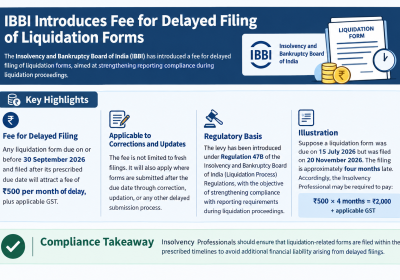
The Board has also introduced consequences for delayed filings. For liquidation forms due on or before 30 September 2026, a fee of ₹500 plus applicable GST per form per calendar month of delay is payable where filings are not made within the specified timeline.
2. Filings before the Adjudicating Authority (NCLT)
The reporting structure before the Adjudicating Authority has been streamlined. Liquidators are generally required to file periodic progress reports and the final report with the NCLT. Information that was earlier submitted through multiple standalone filings is now largely incorporated into the progress reporting framework.
Some event-driven filings with NCLT also remain:
|
Event |
Filing / requirement |
|---|---|
|
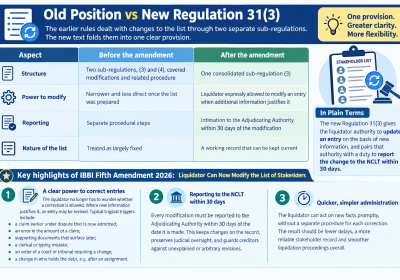
Change to the list of stakeholders |
The liquidator must intimate the Adjudicating Authority within 30 days of each modification (Reg 31(3), effective 22 September 2026). Each change has its own 30-day clock. |
|
Sale to a related party or a process professional |
Prior permission of the Adjudicating Authority is required, even when the sale is by auction. |
|
Compromise or arrangement under Section 230 |
It can be filed only if approved by the requisite majority of creditors under Section 230(6) of CA 2013, and only if creditors would receive more than the liquidation value as on the insolvency commencement date. |
|
Replacement of liquidator |
The CoC files the application, with 66% vote and the proposed liquidator's written consent. |
|
Closure |
Final report, followed by the application for dissolution u/s 54. |
Certain matters, however, continue to require specific applications, approvals, or intimations before the NCLT:
- Any modification in the stakeholder list must be reported within 30 days of such change.
- Sale of assets to a related party or a professional involved in the process requires prior approval of the Adjudicating Authority, even where the asset is sold through auction.
- Any compromise or arrangement under Section 230 of the Companies Act, 2013 must satisfy the prescribed creditor approval requirements and other conditions laid down under law.
- An application for replacement of the liquidator may be filed by the CoC upon obtaining the requisite voting approval and consent of the proposed professional.
- On completion of liquidation, the final report is to be submitted along with the application for dissolution under Section 54 of the Insolvency and Bankruptcy Code.
3. Public Announcement and Verification of Claims
Although a public announcement continues to be mandatory, the treatment of claims has undergone a major change. Claims that were already admitted and verified during the Corporate Insolvency Resolution Process (CIRP) are generally carried into liquidation without fresh verification.
Fresh claims are invited only from stakeholders who did not submit claims during CIRP. Verification timelines have also been compressed:
- Claims received during liquidation are required to be verified within seven days from receipt.
- Claims received during CIRP but pending verification must be examined within seven days from the liquidation commencement date.
These changes are intended to expedite the liquidation process and eliminate duplication of effort.
4. Committee of Creditors Related Requirements under liquidation
The earlier Stakeholders' Consultation Committee framework has been replaced. The Committee of Creditors (CoC) now plays a continuing role during liquidation, subject to the provisions of the amended regulations. Secured creditors who choose to realise their security interest independently under Section 52 are excluded from participation in the CoC for these purposes.
Key responsibilities of the CoC include:
- Determining the liquidator's fee in its first meeting after appointment.
- Providing the necessary approval for private sales where such approval is mandated.
- Considering matters placed before it by the liquidator relating to the liquidation process.
Private sale of assets is generally restricted and can be undertaken only in limited circumstances, such as perishable assets, assets likely to suffer rapid deterioration in value, or where specific permission has been obtained from the Adjudicating Authority.
The liquidator should maintain complete records of meeting notices, minutes, voting results and related communications.
5. Statutory and Tax Compliance Outside the IBC Framework
Apart from insolvency-specific filings, a liquidator must also comply with various statutory obligations under tax and corporate laws.
Income Tax
- The appointment of the liquidator should be notified to the jurisdictional tax authorities in accordance with the applicable provisions of the Income-tax law.
GST
- Intimation of the appointment should be furnished to the GST authorities within the prescribed period.
- GST registrations, returns and related compliances should remain current as long as business operations or asset sales continue.
TDS Compliance
- TDS deductions, deposits and periodic returns must continue wherever applicable.
Registrar of Companies
- The liquidation order should be reported to the Registrar of Companies and MCA records should be updated accordingly.
Corporate Liquidation Account
- Before seeking dissolution, any unclaimed dividends or undistributed sale proceeds must be transferred to the Corporate Liquidation Account in accordance with the regulations.
Books, Registers and Disclosures
- The liquidator is required to maintain all prescribed registers, records and accounts and comply with disclosure requirements mandated by the IBBI from time to time.
6. Revised Timelines
The model timeline under Regulation 47 has been comprehensively revised. The amended framework places greater emphasis on faster completion of liquidation proceedings. Commentary on the amendments indicates a target of completing liquidation within approximately 180 days from the liquidation commencement date, subject to the facts of each case.
Given the number of amendments introduced during 2026, practitioners should avoid relying on older timelines appearing in previous checklists and instead refer to the latest consolidated version of the Liquidation Regulations, incorporating amendments up to September 2026.
Key Compliance Checklist for Liquidators (2026)
IBBI Circular No. IBBI/LIQ/107/2026, dated 24 September 2026, is addressed to all insolvency professionals, IPEs and IPAs. Any liquidation form that was due on or before 30.09.2026 and is submitted after its due date must now carry a fee of INR 500 plus applicable GST for each month of delay. The circular is issued under Section 196 of the IBC and builds on two earlier steps.
- Regulation 47B of the Liquidation Process Regulations. Since January 2026 it has required the liquidator to file the prescribed forms, with enclosures, on IBBI's electronic platform within the timeline set for each form. It also provides for a fee when a form is filed late.
- Circular No. IBBI/LIQ/91/2026, dated 05.01.2026. This introduced the revised liquidation forms and their due dates.
Forms covered. It applies to every form in the revised liquidation set whose due date falls on or before 30 September 2026. like Public Announcement, Verification of Claims, Stakeholder List, LIQ Form Filings on IBBI Portal, Progress Reports to NCLT, CoC Meetings and Minutes, Sale Process Documentation, GST Compliance, Income Tax Compliance, TDS Returns, Bank Account Maintenance, Corporate Liquidation Account Transfer, Final Report, Dissolution Application, That includes forms whose due dates passed months ago and are still pending. If such a form is filed now, the fee applies to the whole period of delay.
the fee applies whether the late submission happens "by correction, updation, or otherwise." Filing on time and then revising after the due date can therefore attract the fee for that revision. The safest approach is to get each form right the first time. Amount. The fee is INR 500 per form per month of delay. With GST at 18%, that is ₹590 per form per month. How the fee adds up. It is charged separately for each form. A liquidator with several overdue forms across several assignments can face a sizeable total.
For practical implementation, every liquidator should maintain a compliance calendar from Day 1 of liquidation because the 2026 amendments have significantly tightened timelines and introduced monetary consequences for defaults in reporting and filing requirements.
Practical takeaway under liquidation
What a liquidator should do now
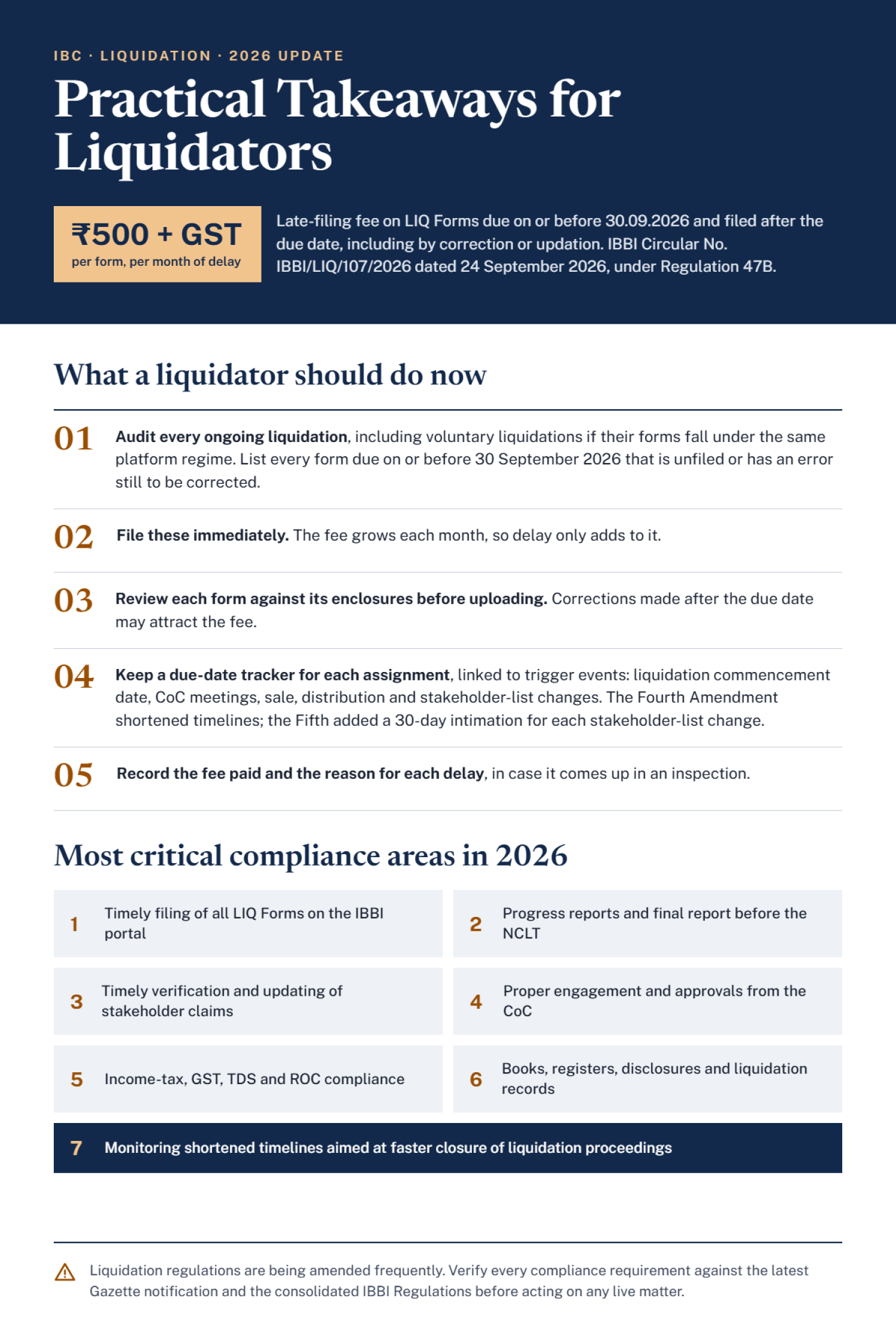
- Go through every ongoing liquidation, voluntary liquidations included if those forms fall under the same platform regime. List every form that was due on or before 30 September 2026 and has not been filed, or has an error still to be corrected.
- File these immediately. The fee grows each month, so delay only adds to it.
- Before uploading, review each form against its enclosures. Corrections made after the due date may attract the fee.
- Keep a tracker of due dates for each assignment, linked to the trigger events: the liquidation commencement date, CoC meetings, sale, distribution, and stakeholder-list changes. This matters more now that the Fourth Amendment has shortened timelines and the Fifth Amendment added a separate 30-day intimation for each stakeholder-list change.
- Keep a record of the fee paid and the reason for each delay, in case it comes up in an inspection.
For a liquidator in 2026, the most critical compliance areas are:
- Timely filing of all LIQ Forms on the IBBI portal.
- Submission of progress reports and final reports before the NCLT.
- Timely verification and updating of stakeholder claims.
- Proper engagement and approvals from the CoC.
- Compliance with Income-tax, GST, TDS and ROC requirements.
- Maintenance of books, registers, disclosures and liquidation records.
- Monitoring shortened timelines aimed at faster closure of liquidation proceedings.
As liquidation regulations are being amended frequently, it is advisable to verify every compliance requirement against the latest Gazette notification and consolidated IBBI Regulations before acting on any live matter.