Table of Contents
GST Late Fee in 2026: Complete Guide to Late Filing Fees Under GST
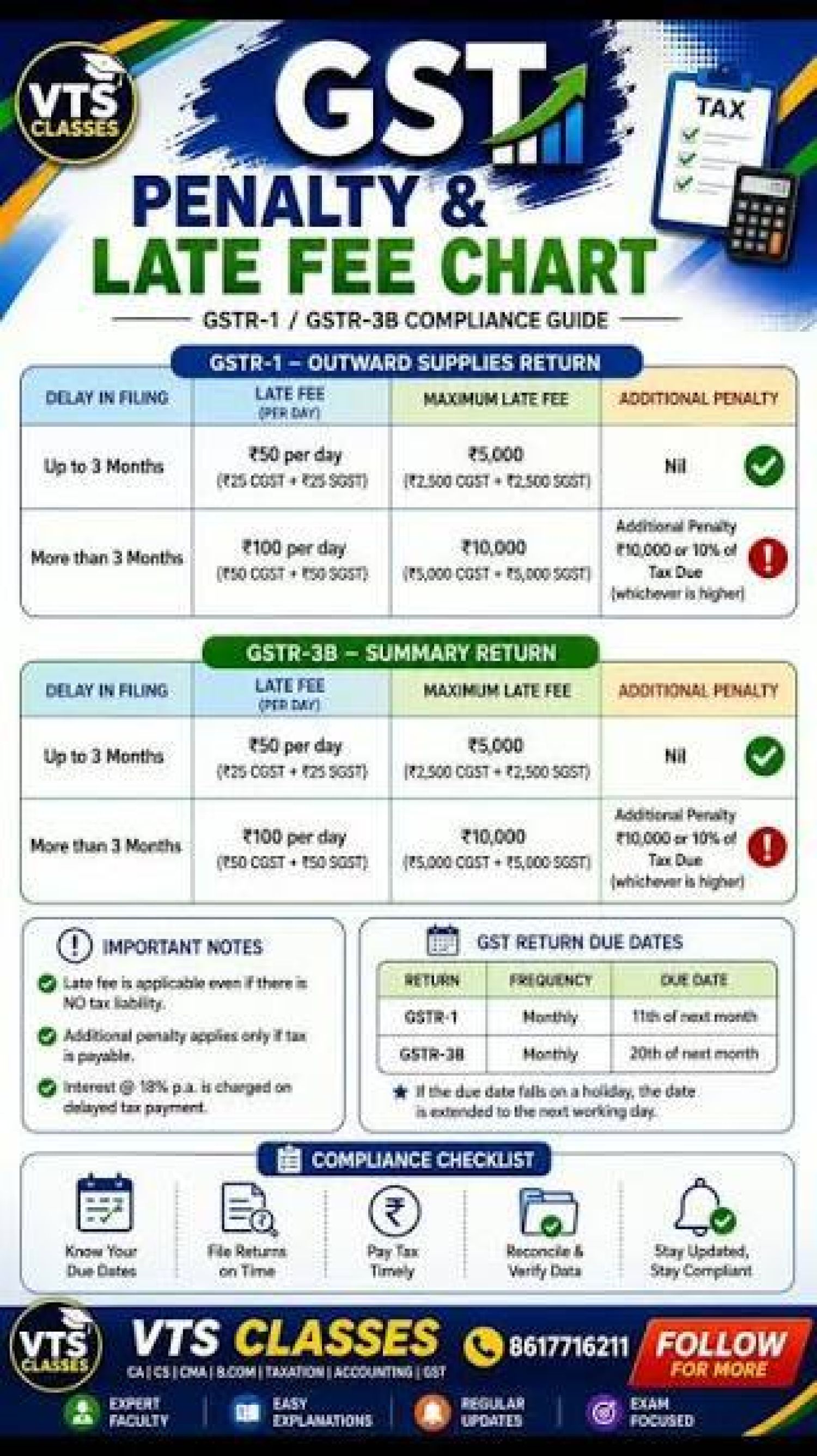
- Timely filing of GST returns is one of the most critical compliance requirements for registered taxpayers. Failure to file GST returns within the prescribed due dates can attract late fees U/s 47 of the Central Goods and Services Tax (CGST) Act, 2017, in addition to interest on delayed payment of tax.
- Over the years, the Government has rationalized late fee provisions for various GST returns to reduce compliance burden, especially for small taxpayers. This article provides a comprehensive overview of the latest GST late fee structure applicable in 2026.
- The late fees mentioned below represent the CGST component only. An equal amount generally becomes payable under the corresponding SGST/UTGST law, effectively doubling the total late fee liability.
Legal Framework for GST Late Fee
- GST late fee is governed by Section 47 of the Central Goods and Services Tax Act, 2017, which prescribes penalties for delayed filing of prescribed GST returns and statements.
- The Government has subsequently amended and rationalized the late fee structure through various notifications to provide relief to taxpayers and align penalties with turnover-based compliance requirements.
A. Late Fee for Regular GST Returns and Statements
1. GSTR-1 for NIL Outward Supplies
Where a taxpayer has no outward supplies during the tax period:
- Late Fee: INR 10 per day (CGST)
- Maximum Late Fee: INR 250 (CGST)
- Applicable for tax periods from June 2021 onwards
This relief significantly benefits inactive or low-volume taxpayers by reducing the compliance burden.
2. GSTR-3B Where Central Tax Liability is NIL
For returns showing nil tax liability:
- Late Fee: INR 10 per day (CGST)
- Maximum Late Fee: INR 250 (CGST)
- Applicable from June 2021 onwards
3. GSTR-1 / GSTR-3B for Taxpayers with AATO up to INR 1.5 Crore
Where returns are not NIL:
- Late Fee: INR 25 per day (CGST)
- Maximum Late Fee: INR 1,000 (CGST)
Applicable for taxpayers whose Aggregate Annual Turnover (AATO) does not exceed INR 1.5 crore.
4. GSTR-1 / GSTR-3B for Taxpayers with AATO Above INR 1.5 Crore up to INR 5 Crore
- Late Fee: INR 25 per day (CGST)
- Maximum Late Fee: INR 2,500 (CGST)
Applicable for tax periods from June 2021 onwards.
5. GSTR-1 / GSTR-3B for Taxpayers with AATO Exceeding INR 5 Crore
- Late Fee: INR 25 per day (CGST)
- Maximum Late Fee: INR 5,000 (CGST)
The statutory ceiling continues to apply for larger taxpayers.
6. Composition Taxpayers Filing Annual GSTR-4 (NIL Liability)
For composition taxpayers having nil central tax payable:
- Late Fee: INR 10 per day (CGST)
- Maximum Late Fee: INR 250 (CGST)
- Applicable from FY 2021-22 onwards
7. Composition Taxpayers Filing Annual GSTR-4 (Tax Payable)
Where tax liability exists:
- Late Fee: INR 25 per day (CGST)
- Maximum Late Fee: INR 1,000 (CGST)
8. TDS Deductors Filing GSTR-7 (Nil TDS)
A major relief has been granted to TDS deductors:
- Late Fee: Nil
- Maximum Late Fee: Nil
This complete waiver applies for months where no TDS is deductible and is effective from 1 November 2024.
9. TDS Deductors Filing GSTR-7 (TDS Liability Exists)
- Late Fee: INR 25 per day (CGST)
- Maximum Late Fee: INR 1,000 (CGST)
10. Input Service Distributor (ISD) – GSTR-6
For delayed filing of GSTR-6:
- Late Fee: INR 25 per day (CGST)
- Maximum Late Fee: INR 5,000 (CGST)
11. Non-Resident Taxable Persons – GSTR-5 (Nil Tax Liability)
- Late Fee: INR 10 per day (CGST)
- Maximum Late Fee: INR 5,000 (CGST)
12. Non-Resident Taxable Persons – GSTR-5 (Tax Liability Exists)
- Late Fee: INR 25 per day (CGST)
- Maximum Late Fee: INR 5,000 (CGST)
13. E-Commerce Operators Collecting TCS – GSTR-8
For delayed filing of GSTR-8:
- Late Fee: INR 100 per day (CGST)
- Maximum Late Fee: INR 5,000 (CGST)
These provisions became applicable from 1 October 2022.
B. Late Fee for Annual and Final Returns
14. GSTR-9 for Taxpayers with Turnover up to INR 5 Crore
- Late Fee: INR 25 per day (CGST)
- Maximum: 0.02% of turnover in the State/UT
Applicable from FY 2022-23 onwards.
15. GSTR-9 for Turnover Above INR 5 Crore up to INR 20 Crore
- Late Fee: INR 50 per day (CGST)
- Maximum: 0.02% of turnover in the State/UT
16. GSTR-9 for Turnover Exceeding INR 20 Crore
- Late Fee: INR 100 per day (CGST)
- Maximum: 0.25% of turnover in the State/UT
This continues to be the statutory rate U/s 47(2) of the CGST Act.
17. Final Return after GST Registration Cancellation (GSTR-10)
Taxpayers whose registration has been cancelled must file GSTR-10 within the prescribed time.
- Late Fee: INR 100 per day (CGST)
- Maximum Late Fee: INR 5,000 (CGST)
Important Legal Clarifications
No Separate Late Fee for GSTR-9C
- There is no independent late fee specifically prescribed for GSTR-9C. Where GSTR-9C is applicable, the annual return filing process is considered complete only when both GSTR-9, and GSTR-9C have been furnished.
- Consequently, the late fee U/s 47(2) of Central Goods and Services Tax Act, 2017 is calculated up to the date on which the complete annual return package is filed.
Reference: Circular No. 246/03/2025-GST dated 30 January 2025.
Expiry of Special GSTR-9C Waiver
- The special waiver granted under Notification No. 08/2025-Central Tax for specified delayed GSTR-9C filings relating to periods up to FY 2022-23 was available only up to 31 March 2025. The benefit has now expired and is no longer available.
GST Late Fee Must Be Paid in Cash
- Taxpayers should note that GST late fees Cannot be paid through the Electronic Credit Ledger; and Must be discharged through the Electronic Cash Ledger. Input Tax Credit (ITC) cannot be utilised for payment of late fees.
Late Fee and Interest Are Different
- Many taxpayers mistakenly assume that payment of interest covers the late filing default. However, the two are separate liabilities.
Late Fee
- Levied U/s 47 of Central Goods and Services Tax Act, 2017
- Applies for delayed filing of returns.
Interest
- Levied U/s 50 of Central Goods and Services Tax Act, 2017
- Applies for delayed payment of tax.
- Even after paying interest, late fee liability may continue to arise if the return is filed after the due date. Generally, interest is payable at 18% per annum on delayed payment of tax, subject to applicable provisions.
Three-Year Restriction on Filing Old Returns
- With effect from December 2025, the GST portal enforces the statutory three-year limitation period for filing returns. As a result Returns pending beyond three years from the original due date may become non-fileable on the GST portal. And Filing such returns may require specific legal relief or permissions where permitted under law. Taxpayers should therefore review pending GST compliances and regularize old defaults before the limitation period expires.
Key Takeaways
- GST late fee generally applies under both CGST and SGST/UTGST, effectively doubling the liability.
- Nil returns enjoy significantly reduced late fees.
- TDS deductors filing Nil GSTR-7 returns now enjoy complete late fee waiver.
- GSTR-9C does not attract a separate late fee, but delayed filing affects GSTR-9 compliance.
- Late fee must be paid in cash and cannot be adjusted against Input Tax Credit.
- Interest and late fee are separate liabilities and may apply simultaneously.
- Returns older than three years may no longer be fileable on the GST portal due to statutory restrictions.
Principal References
- Section 47, Central Goods and Services Tax Act, 2017
- Notification No. 19/2021-Central Tax
- Notification No. 20/2021-Central Tax
- Notification No. 07/2023-Central Tax
- Notification No. 18/2022-Central Tax
- Notification No. 23/2024-Central Tax
- Notification No. 08/2025-Central Tax
- Circular No. 246/03/2025-GST dated 30 January 2025
Disclaimer: This article is intended for general informational purposes. Taxpayers should verify the relevant notifications, return period, turnover category, and any subsequent amendments before calculating GST late fee liability in a specific case.