Table of Contents
Undisclosed Foreign ESOP Dividends under FAST-DS 2026
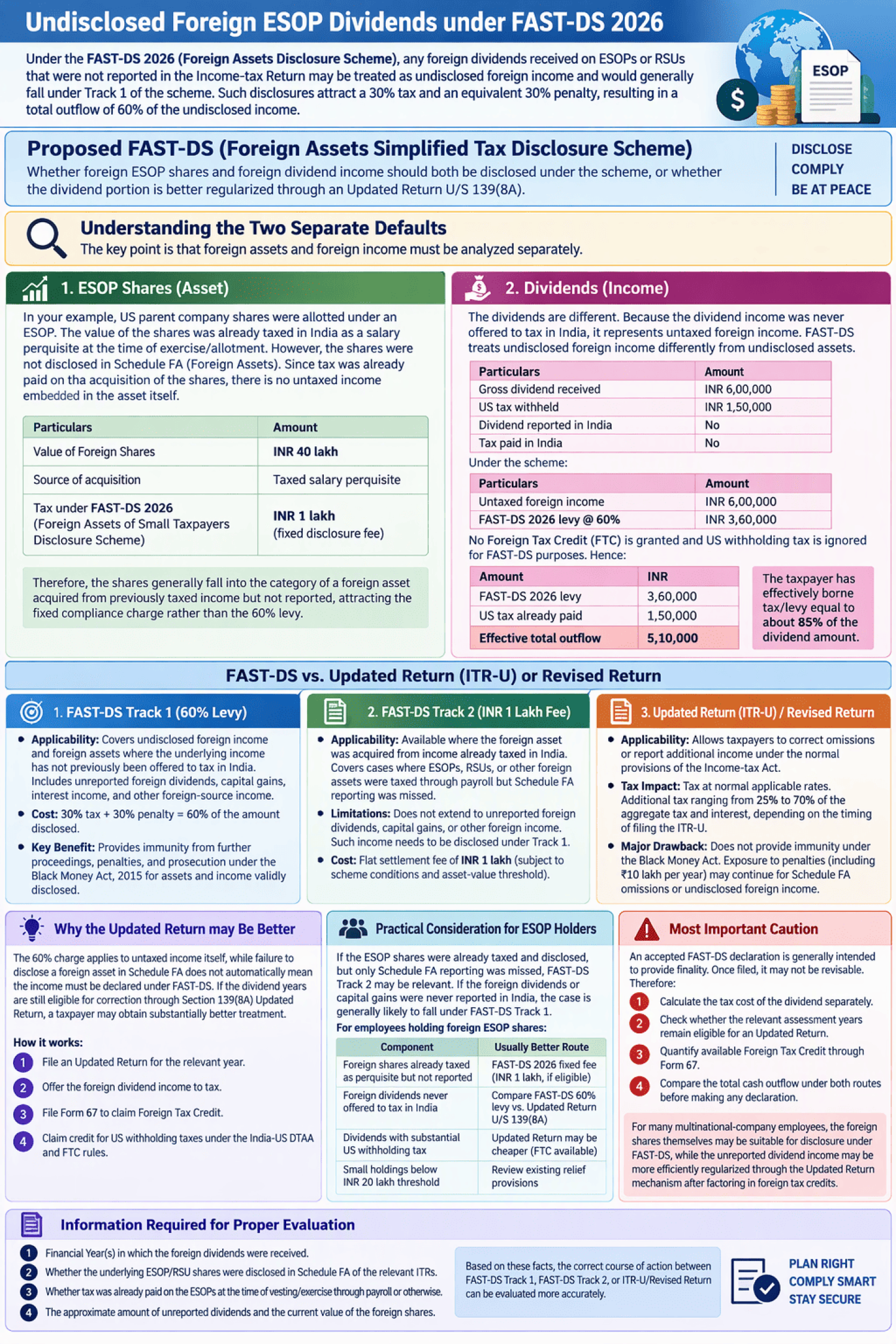
Under the FAST-DS 2026 (Foreign Assets Disclosure Scheme), any foreign dividends received on ESOPs or RSUs that were not reported in the Income-tax Return may be treated as undisclosed foreign income and would generally fall under Track 1 of the scheme. Such disclosures attract a 30% tax and an equivalent 30% penalty, resulting in a total outflow of 60% of the undisclosed income.
Proposed FAST-DS (Foreign Assets Simplified Tax Disclosure Scheme)
Whether foreign ESOP shares and foreign dividend income should both be disclosed under the scheme, or whether the dividend portion is better regularized through an Updated Return U/S 139(8A).
Understanding the Two Separate Defaults
The key point is that foreign assets and foreign income must be analyzed separately.
1. ESOP Shares (Asset)
In your example US parent company shares were allotted under an ESOP. The value of the shares was already taxed in India as a salary perquisite at the time of exercise/allotment. However, the shares were not disclosed in Schedule FA (Foreign Assets). Since tax was already paid on the acquisition of the shares, there is no untaxed income embedded in the asset itself. Under FAST-DS:
|
Particulars |
Amount |
|
Value of Foreign Shares |
INR 40 lakh |
|
Source of acquisition |
Taxed salary perquisite |
|
Tax under Foreign Assets of Small Taxpayers Disclosure Scheme 2026 |
INR 1 lakh (fixed disclosure fee) |
Therefore, the shares generally fall into the category of a foreign asset acquired from previously taxed income but not reported, attracting the fixed compliance charge rather than the 60% levy.
2. Dividends (Income)
The dividends are different. Facts:
|
Particulars |
Amount |
|
Gross dividend received |
INR 6,00,000 |
|
US tax withheld |
INR 1,50,000 |
|
Dividend reported in India |
No |
|
Tax paid in India |
No |
Because the dividend income was never offered to tax in India, it represents untaxed foreign income. FAST-DS reportedly treats undisclosed foreign income differently from undisclosed assets. Under the scheme:
|
Particulars |
Amount |
|
Untaxed foreign income |
INR 6,00,000 |
|
Foreign Assets of Small Taxpayers Disclosure Scheme 2026 levy @ 60% |
INR 3,60,000 |
A significant point is that the example assumes No foreign tax credit (FTC) is granted. And US withholding tax already suffered is ignored for Foreign Assets of Small Taxpayers Disclosure Scheme 2026 purposes. Hence:
|
Amount |
INR |
|
Foreign Assets of Small Taxpayers Disclosure Scheme 2026 levy |
3,60,000 |
|
US tax already paid |
1,50,000 |
|
Effective total outflow |
5,10,000 |
The taxpayer has effectively borne tax/levy equal to about 85% of the dividend amount.
FAST-DS vs. Updated Return (ITR-U) or Revised Return
1. FAST-DS Track 1 (60% Levy)
- Applicability FAST-DS : Covers undisclosed foreign income and foreign assets where the underlying income has not previously been offered to tax in India. Includes unreported foreign dividends, capital gains, interest income, and other foreign-source income.
- Cost under FAST-DS: Tax: 30%, Penalty: 30% and Total liability: 60% of the amount disclosed.
- Key Benefit under FAST-DS: Provides immunity from further proceedings, penalties, and prosecution under the Black Money (Undisclosed Foreign Income and Assets) and Imposition of Tax Act, 2015 for assets and income validly disclosed under the scheme.
2. FAST-DS Track 2 (INR 1 Lakh Settlement Fee)
- Applicability FAST-DS : Available where the foreign asset was acquired from income that had already been taxed in India. Generally covers cases where ESOPs, RSUs, or other foreign assets were properly taxed through payroll or otherwise disclosed, but reporting in Schedule FA was inadvertently missed. Applicable only up to the prescribed asset-value threshold under the scheme.
- Limitations of FAST-DS : Does not extend to unreported foreign dividends, capital gains, or other foreign income and Such income is treated separately and would generally need to be disclosed under Track 1.
- Cost under FAST-DS: Flat settlement fee of INR 1 lakh.
3. Updated Return (ITR-U) / Revised Return
- Applicability FAST-DS : Allows taxpayers to correct omissions or report additional income under the normal provisions of the Income-tax Act.
- Tax Impact of FAST-DS: Tax is payable at normal applicable rates. Additional tax ranging from 25% to 70% of the aggregate tax and interest may apply, depending on the timing of filing the ITR-U.
- Major Drawback under FAST-DS: Filing an Updated Return or Revised Return does not provide immunity under the Black Money Act. If foreign assets or foreign income were omitted from Schedule FA or not disclosed altogether, exposure to Black Money Act proceedings may continue, including the possibility of substantial penalties.
Why the Updated Return may Be Better
The critical observation is The 60% charge applies to untaxed income itself, while failure to disclose a foreign asset in Schedule FA does not automatically mean the income must be declared under FAST-DS. If the dividend years are still eligible for correction through Section 139(8A) Updated Return, a taxpayer may obtain substantially better treatment.
How it works :
The taxpayer Files an Updated Return for the relevant year. Offers the foreign dividend income to tax. Files Form 67 to claim Foreign Tax Credit. And Claims credit for US withholding taxes under the India-US DTAA and FTC rules. Illustrative Comparison Assume:
|
Particulars |
Amount |
|
Dividend income |
INR 6,00,000 |
|
US Tax Withheld |
INR 1,50,000 |
Assume the taxpayer falls in the 30% slab.
Option A: FAST-DS
|
Particulars |
Amount |
|
Dividend income |
INR 6,00,000 |
|
Levy @ 60% |
INR 3,60,000 |
|
FTC Allowed |
Nil |
|
Net cost |
INR 3,60,000 |
|
US tax already suffered |
INR 1,50,000 |
|
Total economic burden |
INR 5,10,000 |
Option B: Updated Return
Illustrative only:
|
Particulars |
Amount |
|
Indian tax @ approx. 30% |
INR 1,80,000 |
|
Less FTC for US tax |
(INR 1,50,000) |
|
Balance tax payable |
INR 30,000 |
Even after including interest and additional tax applicable to an Updated Return, the cost can often be materially lower than a 60% FAST-DS levy. The actual outcome depends on Assessment year involved. Tax slab applicable in that year. Availability and timing requirements for Form 67. FTC eligibility under Rule 128 and the India-US DTAA. Additional tax payable on an Updated Return U/S 140B.
Smaller Holdings Relief
- You also referred to the relief introduced from 1 October 2024. Where aggregate foreign assets (other than immovable property) do not exceed INR 20 lakh, Black Money Act penalty and prosecution relief may be available for specified non-reporting situations.
- This is particularly relevant for Employees holding modest amounts of foreign listed shares. Small RSU/ESOP holders of multinational groups such as Microsoft, Google, Amazon, Meta, Adobe, Oracle, Accenture, etc. Individuals whose primary lapse was Schedule FA reporting rather than tax evasion. However, the relief does not automatically eliminate income-tax liability on foreign income that was never offered to tax.
Practical Takeaway : Practical Consideration for ESOP Holders
- If The ESOP shares were already taxed and disclosed, but only Schedule FA reporting was missed, FAST-DS Track 2 may be relevant. The foreign dividends or capital gains were never reported in India, the case is generally likely to fall under FAST-DS Track 1, attracting the 60% tax-plus-penalty framework. For employees holding foreign ESOP shares:
|
Component |
Usually Better Route |
|
Foreign shares already taxed as perquisite but not reported |
Consider Foreign Assets of Small Taxpayers Disclosure Scheme 2026 fixed asset disclosure fee (INR 1 lakh, if eligible) |
|
Foreign dividends never offered to tax in India |
Compare Foreign Assets of Small Taxpayers Disclosure Scheme 2026 60% levy against Updated Return U/S 139(8A) |
|
Dividends with substantial US withholding tax |
Updated Return may be significantly cheaper because FTC may be available |
|
Small holdings below INR 20 lakh threshold |
Review whether existing relief provisions already reduce Black Money Act exposure |
Most Important Caution
An accepted FAST-DS declaration is generally intended to provide finality. Once filed, it may not be revisable. Therefore:
- Calculate the tax cost of the dividend separately.
- Check whether the relevant assessment years remain eligible for an Updated Return.
- Quantify available Foreign Tax Credit through Form 67.
- Compare the total cash outflow under both routes before making any declaration.
For many multinational-company employees, the foreign shares themselves may be suitable for disclosure under FAST-DS, while the unreported dividend income may be more efficiently regularized through the Updated Return mechanism after factoring in foreign tax credits.
Information Required for Proper Evaluation
- To determine the most appropriate compliance route, provide The Financial Year(s) in which the foreign dividends were received; Whether the underlying ESOP/RSU shares were disclosed in Schedule FA of the relevant Income-tax Returns; Whether tax was already paid on the ESOPs at the time of vesting/exercise through payroll or otherwise; and The approximate amount of unreported dividends and the current value of the foreign shares.
- Based on these facts, the correct course of action between FAST-DS Track 1, FAST-DS Track 2, or ITR-U/Revised Return can be evaluated more accurately.