Table of Contents
- Directors In A Public Limited Company Under The Companies Act, 2013
- Board Composition: Minimum And Maximum Directors
- Consequence Of Falling Below Minimum Strength
- Minimum Number Of Directors In A Public Company :
- Maximum Number Of Directors In A Public Company :
- Why Companies Increase Board Size
- Procedure For Appointment Of More Than 15 Directors
- Key Provisions Relating To Directors In A Public Limited Company
- Board Composition In Listed Companies
- Board Composition Snapshot
- Number Of Directorships : Section 165 : Limits On Directorships
- Major Committees Under Companies Act, 2013
- Forms & Compliances At A Glance
Directors in a Public Limited Company under the Companies Act, 2013
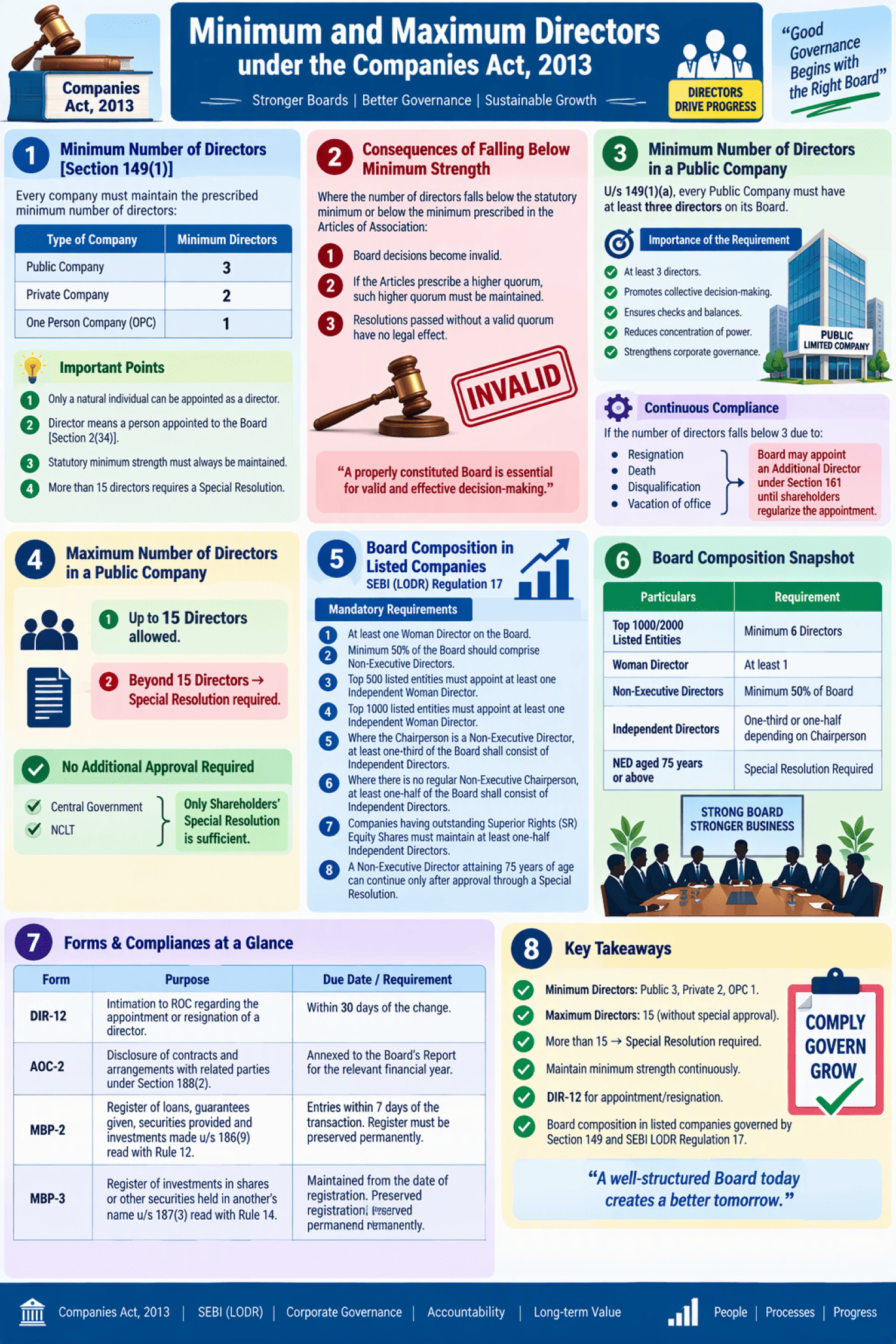
The Companies Act, 2013 lays down a comprehensive framework governing the composition, appointment, qualifications, duties, resignation, removal, and compliance obligations of directors in a public company. These provisions are primarily contained in Sections 149 to 171 of the Act and aim to ensure effective corporate governance, accountability, and board oversight.
Board Composition: Minimum and Maximum Directors
Minimum Number of Directors [Section 149(1)]
Every company must maintain the prescribed minimum number of directors:
|
Type of Company |
Minimum Directors |
|
Public Company |
3 |
|
Private Company |
2 |
|
One Person Company (OPC) |
1 |
Important Points
- Only a natural individual can be appointed as a director.
- A director means a person appointed to the Board of Directors of a company [Section 2(34)].
- The Board must always maintain the statutory minimum number of directors.
- A company can appoint more than 15 directors only by passing a Special Resolution.
Consequence of Falling Below Minimum Strength
Where the number of directors falls below the statutory minimum or below the minimum prescribed in the Articles of Association:
- Board decisions become invalid.
- If the Articles prescribe a higher quorum, such higher quorum must be maintained.
- Resolutions passed without a valid quorum have no legal effect.
Minimum Number of Directors in a Public Company :
U/s 149(1)(a), every Public Company must have at least three directors on its Board. Importance of the Requirement
- Promotes collective decision-making.
- Ensures checks and balances at the Board level.
- Reduces concentration of power in a single individual.
- Strengthens corporate governance practices.
Continuous Compliance :
The minimum requirement must be maintained throughout the company's existence. If the number of directors falls below three due to Resignation, Death, Disqualification and Vacation of office. the company should appoint a replacement director without undue delay. The Board may temporarily appoint an Additional Director under Section 161 until shareholders regularize the appointment.
Maximum Number of Directors in a Public Company :
A Public Company may have up to 15 directors without any special approval.
Appointment Beyond 15 Directors : The company can increase the Board strength beyond 15 directors by passing a Special Resolution in a General Meeting.
No Additional Approval Required
- No approval from the Central Government is required.
- No approval from NCLT is required.
- Shareholders' approval through a Special Resolution is sufficient.
Why Companies Increase Board Size
Companies generally expand their boards due to:
- Business growth and operational expansion.
- Requirement of specialized industry expertise.
- Regulatory or sector-specific requirements.
- Need for greater board diversity and governance oversight.
- Enhanced stakeholder representation.
Procedure for Appointment of More Than 15 Directors
- Step-1: Review the Articles of Association (AOA) : Verify whether the Articles restrict the maximum number of directors. If required, amend the Articles first.
- Step-2: Convene Board Meeting : Pass a Board Resolution Approving the proposal, Calling a General Meeting and Approving the notice and explanatory statement.
- Step-3: Hold General Meeting : Pass a Special Resolution approving an increase in Board strength beyond 15 directors.
- Step-4: File Form MGT-14 : File the Special Resolution with the Registrar of Companies within 30 days of passing the resolution.
- Step-5: Appoint the Additional Directors : After approval, appoint the proposed directors through the prescribed procedure.
- Step-6: File Form DIR-12 : File Form DIR-12 within 30 days of appointment along with supporting documents such as DIR-2 (Consent to Act as Director) and DIR-8 (Declaration of Non-Disqualification)
Quick Revision Table
|
Particulars |
Requirement |
|
Minimum Directors in Public Company |
3 |
|
Maximum Directors without Special Resolution |
15 |
|
More than 15 Directors |
Allowed through Special Resolution |
|
Resident Director |
Minimum 1 |
|
DIN Requirement |
Mandatory for every director |
|
Maximum Directorships |
20 Companies |
|
Maximum Public Company Directorships |
10 Companies |
|
Filing for Appointment/Resignation |
Form DIR-12 |
|
Filing of Special Resolution |
Form MGT-14 |
|
Director Removal |
Ordinary Resolution |
|
Register Maintenance |
Register of Directors & KMPs |
A Public Company must always maintain at least three directors and may appoint more than fifteen directors only by passing a Special Resolution under Section 149(1) of the Companies Act, 2013
Key Provisions Relating to Directors in a Public Limited Company
|
Section |
Subject Matter |
Key Provision |
|
149 |
Board Composition |
Minimum 3 directors and maximum 15 directors. Appointment of more than 15 directors requires a Special Resolution. Listed companies must have a prescribed number of Independent Directors and at least one Resident Director. |
|
150 |
Independent Directors |
Independent Directors are selected from the databank maintained in accordance with prescribed rules. |
|
151 |
Small Shareholders' Director |
Eligible listed companies may appoint one Small Shareholders' Director. |
|
152 |
Appointment of Directors |
Directors are generally appointed by shareholders in a general meeting. Two-thirds of the directors are ordinarily subject to retirement by rotation. |
|
153–159 |
Director Identification Number (DIN) |
No individual can act as a director without obtaining a valid DIN. |
|
160 |
Candidature for Directorship |
Any eligible person may seek appointment as a director by giving the prescribed notice. The deposit requirement does not apply to Independent Directors or candidates recommended by the Board/NRC. |
|
161 |
Board Appointments |
The Board may appoint Additional Directors, Alternate Directors, Nominee Directors, and fill Casual Vacancies. |
|
162 |
Separate Resolution |
Appointment of each director must be approved through a separate resolution. |
|
164 |
Disqualifications |
Certain persons, including insolvents, persons of unsound mind, convicted individuals, and directors of defaulting companies, are disqualified from holding office. |
|
165 |
Limits on Directorships |
A person cannot hold directorship in more than 20 companies, including not more than 10 public companies. |
|
166 |
Duties of Directors |
Directors must act in good faith, exercise due care and diligence, and avoid conflicts of interest. |
|
167 |
Vacation of Office |
Office becomes vacant in specified circumstances such as disqualification or absence from all Board Meetings for a continuous period of 12 months. |
|
168 |
Resignation of Directors |
A director may resign by written notice and the company must file Form DIR-12 with ROC. |
|
169 |
Removal of Directors |
Shareholders may remove a director through an Ordinary Resolution after following due process and providing an opportunity of being heard. |
|
170–171 |
Registers and Inspection |
Companies must maintain a Register of Directors and KMPs, which is open for inspection by members. |
Board Composition in Listed Companies
SEBI (LODR) Regulation 17 : Listed entities are required to maintain an optimum balance between executive and non-executive directors to ensure effective corporate governance.
Mandatory Requirements
- At least one Woman Director on the Board.
- Minimum 50% of the Board should comprise Non-Executive Directors.
- Top 500 listed entities must appoint at least one Independent Woman Director.
- Top 1000 listed entities must appoint at least one Independent Woman Director.
- Where the Chairperson is a Non-Executive Director, at least one-third of the Board shall consist of Independent Directors.
- Where there is no regular Non-Executive Chairperson, at least one-half of the Board shall consist of Independent Directors.
- Companies having outstanding Superior Rights (SR) Equity Shares must maintain at least one-half Independent Directors.
- A Non-Executive Director attaining 75 years of age can continue only after approval through a Special Resolution.
Board Composition Snapshot
|
Particulars |
Requirement |
|
Top 1000/2000 Listed Entities |
Minimum 6 Directors |
|
Woman Director |
At least 1 |
|
Non-Executive Directors |
Minimum 50% of Board |
|
Independent Directors |
One-third or one-half depending on Chairperson |
|
Non-Executive Director aged 75 years or above |
Special Resolution Required |
SEBI's governance framework requires listed entities to maintain a balanced Board with adequate independent oversight, mandatory women representation, and age-related approval requirements for senior non-executive directors.
Number of Directorships : Section 165 : Limits on Directorships
A person cannot hold directorships beyond the following limits:
|
Particulars |
Limit |
|
Total Companies |
20 |
|
Public Companies |
10 |
Important Points
- Alternate Directorships are included in the above limits.
- Private companies that are holding or subsidiary companies of public companies are counted within the 10-public-company limit.
- Directorship in a Dormant Company is excluded while calculating the overall limit of 20 companies.
- Members may prescribe a lower limit through a Special Resolution.
- Section 165 is not applicable to Section 8 Companies.
- Compliance with these limits is the personal responsibility of the director.
Penalty for Violation
- INR 2,000 per day of continuing default.
- Maximum penalty: INR 2,00,000.
Additional Restrictions for Listed Companies
Regulation 17A : Directorship Limits in Listed Entities :
- Maximum 8 listed entity directorships (from 1 April 2019).
- Maximum 7 listed entity directorships (from 1 April 2020).
Independent Director Limits :
- An Independent Director cannot serve on the Board of more than 7 listed entities.
- A Whole-Time Director (WTD) or Managing Director (MD) of a listed entity can act as Independent Director in not more than 3 listed entities.
Important Note : Only companies whose equity shares are listed on a recognized stock exchange are counted.
Committee Membership Limits
Regulation 26 : Membership Restrictions
|
Particulars |
Limit |
|
Committee Memberships |
Maximum 10 |
|
Committee Chairmanships |
Maximum 5 |
Committees Counted : Only the following committees are considered Audit Committee and Stakeholders' Relationship Committee
Companies Counted
- Public Limited Companies (listed or unlisted) are counted.
- Private Companies are excluded.
- Foreign Companies are excluded.
- Section 8 Companies are excluded.
Landmark Case Law
Registrar of Companies v. Karan Kishore Samtani (NCLAT, 2020)
|
Particulars |
Details |
|
Violation |
Section 165(1) read with Section 165(3) |
|
Default Period |
01.04.2015 to 21.02.2016 |
|
Duration |
272 Days |
|
Penalty Applied |
INR 5,000 per day |
|
Total Penalty |
INR 13,60,000 |
|
Amount Already Paid |
INR 50,000 |
|
Balance Payable |
INR 13,10,000 |
The case highlights that directors are personally responsible for ensuring compliance with statutory directorship limits.
Board Committees: Overview
Meaning of Board Committee : A Board Committee is a smaller group of directors constituted by the Board to perform specific functions and provide detailed examination of critical matters.
Objectives
- Improve governance efficiency.
- Enable detailed scrutiny.
- Assist the Board in informed decision-making.
- Save Board time through specialized oversight.
Board's Power to Constitute Committees
The Board may Delegate any of its powers to committees, Prescribe regulations governing committee functioning and Define committee composition and responsibilities. However, ultimate responsibility always remains with the Board of Directors.
Functions of Board Committees
Board Committees primarily perform:
- Governance Functions : Corporate governance oversight and Compliance monitoring.
- Coordination Functions : Coordination among directors, management, auditors, and stakeholders.
- Advisory Functions : Research, Analysis, Recommendations to the Board.
Major Committees under Companies Act, 2013
The Companies Act mandates the constitution of the following committees for specified classes of companies:
- Audit Committee
- Nomination and Remuneration Committee (NRC)
- Stakeholders' Relationship Committee (SRC)
- Corporate Social Responsibility Committee (CSR Committee)
- Additional Committee under SEBI (LODR) : Listed entities are also required to constitute Risk Management Committee (RMC)
Forms & Compliances at a Glance
|
Form |
Purpose |
Due Date / Requirement |
|
DIR-12 |
Intimation to the Registrar of Companies (ROC) regarding the appointment or resignation of a director. This form is also relevant in matters relating to compliance with directorship limits under Section 165. |
Within 30 days from the date of appointment, resignation, or any change in directorship. |
|
AOC-2 |
Disclosure of contracts and arrangements with related parties under Section 188(2). The form provides details of Related Party Transactions (RPTs) requiring disclosure. |
To be annexed to the Board's Report for the relevant financial year. |
|
MBP-2 |
Register of loans granted, guarantees given, securities provided, and investments made u/s 186(9) read with Rule 12. |
Entries must be made chronologically within 7 days of the transaction. The register must be preserved permanently. |
|
MBP-3 |
Register of investments held in the name of another person on behalf of the company under Section 187(3) read with Rule 14. |
Maintained from the date of registration of such investment and preserved permanently. |