Table of Contents
- Valuation For Impairment Testing – A Comprehensive Guide Under Ind As 36
- What Is Impairment Under Ind As 36?
- Importance Of Impairment Testing
- Identifying Indicators Of Impairment
- Measuring Recoverable Amount
- Future Cash Flow Projections
- Discount Rate – The Core Valuation Judgment
- Pre-tax Discount Rate Reflecting Market Assessments Of Time Value And Asset-specific Risks.
- Cash-generating Units (cgus) :
- Recognition And Allocation Of Impairment Loss
- Practical Challenges In India
- Conclusion
Valuation for Impairment Testing – A Comprehensive Guide under Ind AS 36
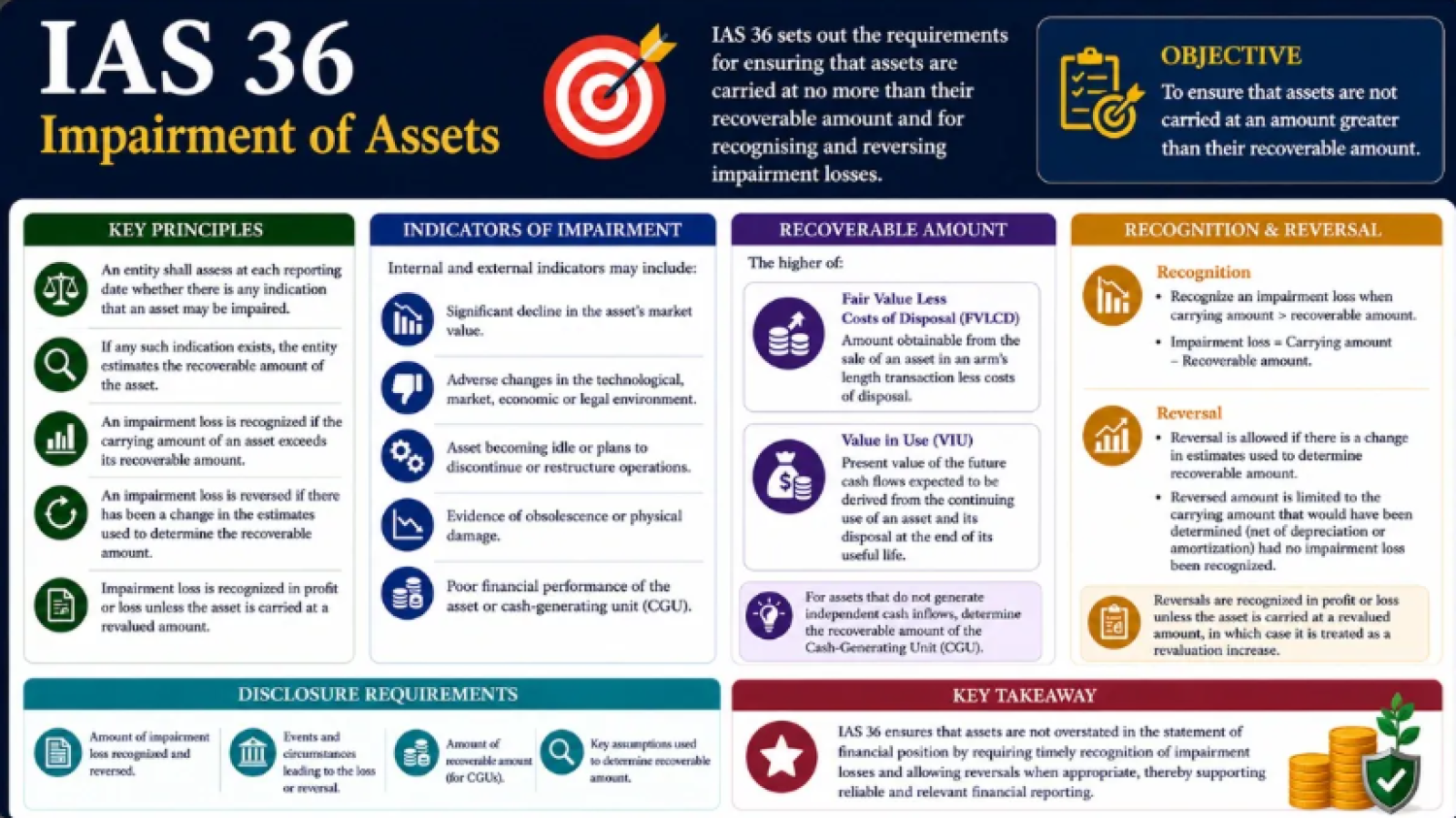
In today’s dynamic business environment, assets may lose value due to market disruptions, technological changes, economic slowdowns, regulatory developments, or operational inefficiencies. Financial reporting standards therefore require entities to ensure that assets are not carried in the books at amounts exceeding their recoverable values. This is where Ind AS 36 – Impairment of Assets assumes critical importance.
Impairment testing is not merely an accounting compliance exercise; it is a strategic valuation process involving financial forecasting, risk assessment, discount rate determination, and cash flow evaluation. Proper impairment assessment enhances transparency, strengthens investor confidence, and ensures fair presentation of financial statements.
What is impairment under Ind AS 36?
An asset is considered impaired when its carrying amount exceeds its recoverable amount. In such cases, the entity must recognize an impairment loss in its financial statements.
The standard defines:
Recoverable Amount = Higher of Fair Value Less Costs of Disposal (FVLCD), or Value in Use (VIU)
Ind AS 36 applies to most non-financial assets, including Property, Plant & Equipment, Intangible Assets, Goodwill, Investments in Subsidiaries, Associates, and Joint Ventures in separate financial statements. However, inventories, financial instruments, deferred tax assets, biological assets, and assets held for sale are excluded from its scope.
Importance of Impairment Testing
- Impairment testing ensures Assets are not overstated, Losses are recognized timely, Financial statements reflect economic reality, Investors receive reliable information and Management reassesses operational performance periodically
- With increasing economic volatility and rapid technological disruptions, impairment testing has become a major area of auditor focus and regulatory scrutiny.
Identifying Indicators of Impairment
Ind AS 36 requires entities to assess at each reporting date whether indicators of impairment exist.
External Indicators
Some important external indicators include
- Significant decline in market value
- Adverse technological or economic changes
- Increase in market interest rates
- Market capitalization lower than net assets
Internal Indicators
Internal indicators may include
- Obsolescence or physical damage
- Poor operating performance
- Idle assets or restructuring plans
- Negative internal cash flow trends
Notably, goodwill and indefinite-life intangible assets must be tested annually, irrespective of impairment indicators.
Measuring Recoverable Amount
1. Fair Value Less Costs of Disposal (FVLCD) : This represents the price obtainable from selling the asset in an orderly transaction between market participants, less disposal costs.
Valuation Approaches under Ind AS 113 : Entities may apply the market approach, cost approach, and income approach. The selection depends on asset nature and data availability.
2. Value in Use (VIU)
Value in Use is the present value of future cash flows expected from the continuing use of an asset or cash-generating unit (CGU). The VIU model typically involves forecasting future cash inflows, estimating operating outflows, determining terminal value and applying an appropriate discount rate. This is often the more complex and judgment-intensive area of impairment testing.
Future Cash Flow Projections
Ind AS 36 prescribes specific principles regarding cash flow estimates.
Cash Flows to Include
Entities should include:
- Cash inflows from continuing use
- Necessary operating outflows
- Disposal proceeds at end of useful life
- Maintenance capital expenditure
Cash Flows to Exclude
The following are specifically prohibited:
- Future uncommitted restructurings
- Financing cash flows
- Income tax cash flows
- Future enhancement expenditures unless already committed
Cash flow projections should generally be based on approved budgets for a maximum period of five years unless a longer period can be justified.
Discount Rate – The Core Valuation Judgment
- Selection of discount rate significantly impacts impairment valuation.
- Ind AS 36 requires use of a:
Pre-tax discount rate reflecting market assessments of time value and asset-specific risks.
- Entities commonly use Weighted Average Cost of Capital (WACC), CAPM methodology and Incremental borrowing rates
- The discount rate must Reflect market participant assumptions, Avoid double counting risks and Remain independent of financing structure
Cash-Generating Units (CGUs) :
Often, individual assets do not generate independent cash flows. In such cases, impairment testing is performed at the CGU level. A CGU is “The smallest identifiable group of assets generating largely independent cash inflows.” Determining CGUs requires considerable judgment and depends on:
- Internal management monitoring
- Operational structure
- Independent revenue generation patterns
Goodwill Impairment
Goodwill arising from business combinations must be allocated to CGUs expected to benefit from acquisition synergies.
Key principles include:
- Mandatory annual impairment testing
- Testing at lowest monitored level
- No reversal of goodwill impairment permitted under Ind AS 36
This prohibition distinguishes Ind AS 36 from earlier Indian GAAP practices.
Recognition and Allocation of Impairment Loss
When impairment arises at CGU level
- Goodwill is reduced first
- Remaining loss is allocated proportionately among CGU assets
However, asset values cannot be reduced below: Fair value less costs of disposal, Value in use and Zero
This ensures impairment allocation remains commercially reasonable.
Reversal of Impairment
Ind AS 36 permits reversal of impairment losses for assets other than goodwill if assumptions underlying prior impairment have changed. However Reversal is capped at original carrying amount adjusted for depreciation and Goodwill impairment reversal is strictly prohibited
Disclosure Requirements
Ind AS 36 contains extensive disclosure obligations aimed at enhancing transparency.
Entities must disclose:
- Amount of impairment losses/reversals
- Events triggering impairment
- Key assumptions used
- Discount rates applied
- Growth assumptions
- Sensitivity analysis for key CGUs
Disclosure quality is increasingly becoming a focus area for auditors and regulators alike.
Practical Challenges in India
Some common practical difficulties faced by companies include Determining reliable cash flow forecasts, Selection of suitable peer-based discount rates, Identifying appropriate CGUs, evaluating long-term growth assumptions, Performing sensitivity analysis and Assessing impairment during economic uncertainty. Accordingly, impairment testing frequently requires collaboration between Finance teams, Valuation specialists, Auditors and Strategic management
Conclusion
Impairment testing under Ind AS 36 is far more than an accounting formality. It is an integrated valuation exercise combining finance, economics, forecasting, and strategic assessment. Robust impairment analysis helps organizations improve governance, enhance reporting credibility, Align asset values with economic realities, and build investor trust.
As businesses continue to face rapid market changes, geopolitical uncertainties, and technological disruptions, effective impairment testing will remain one of the most critical aspects of financial reporting and valuation practice. For professional assistance in impairment valuation, CGU assessment, WACC determination, financial modeling, and Ind AS advisory, connect with Rajput Jain & Associates.