Table of Contents
- Dormant Company Under The Companies Act, 2013 – Detailed Guide And Compliance Requirements
- Who Can Apply For Dormant Status?
- Pre-conditions For Obtaining Dormant Company Status
- Situations Where Dormant Status Cannot Be Granted
- Approvals And Documents Required For Dormant Status Application
- Important Note On Outstanding Loans :
- Minimum Number Of Directors
- Advantages Of Dormant Company Status
- Compliance Requirements For Dormant Companies
- Procedure To Obtain Dormant Status
- Step-wise Procedure For Procedure To Obtain Dormant Status
- Documents Required For Msc-1
- Cases Where Dormant Status Cannot Be Granted
- Dormant Status Granted By Roc On Its Own
- Reactivation Of Dormant Company
- Dormant Company Forms & Compliance At A Glance
- Important Points To Remember Dormant Company & Compliance
- Forms & Compliance Summary
- Compliance Calendar For Dormant Companies
- Conclusion
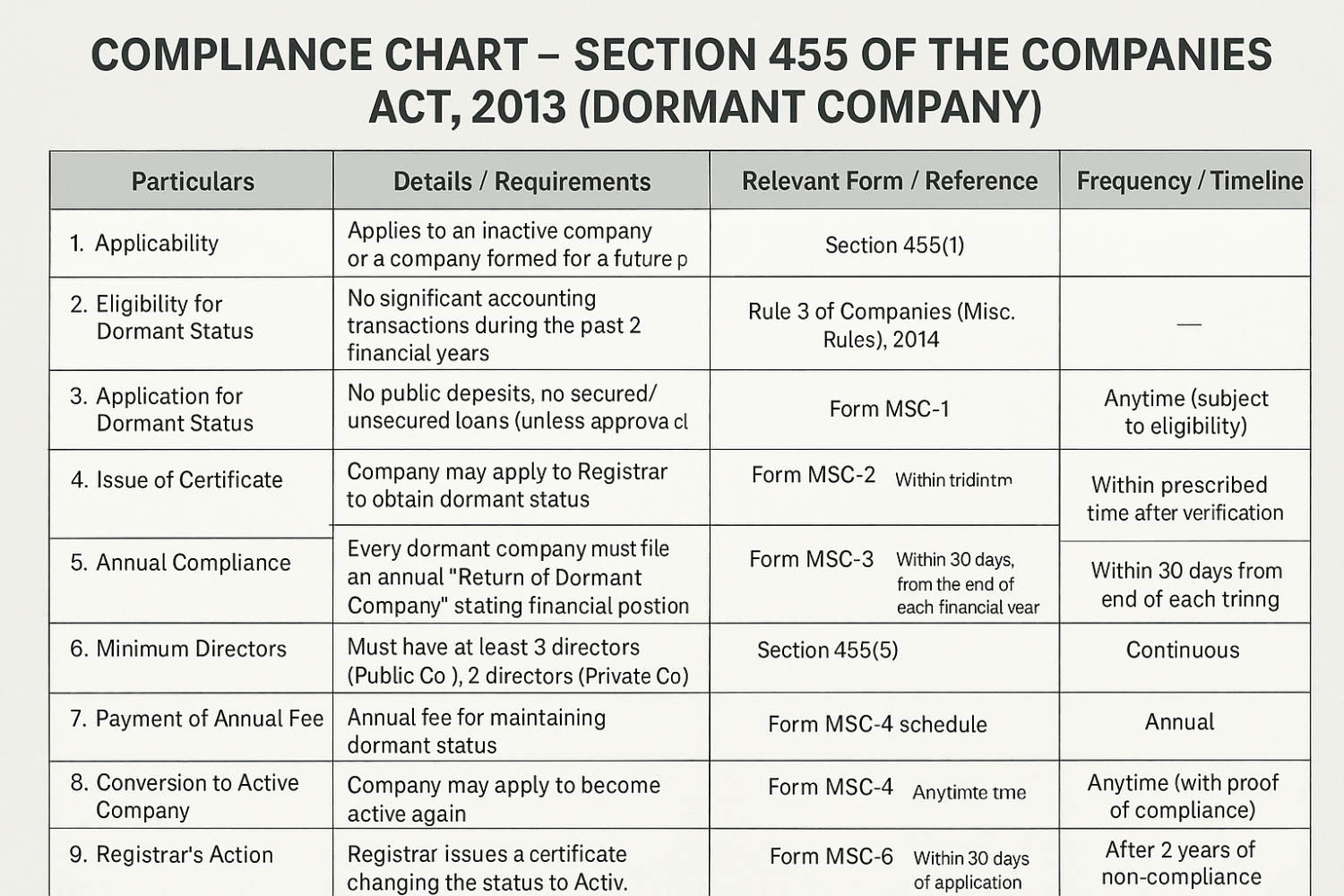
Dormant Company under the Companies Act, 2013 – Detailed Guide and Compliance Requirements
A Dormant Company is a company that is legally registered but is not carrying on any business operations or commercial activities. Instead of closing the company, the promoters may choose to retain its legal existence by obtaining dormant status from the Registrar of Companies (ROC). This concept is governed by Section 455 of the Companies Act, 2013 read with the Companies (Miscellaneous) Rules, 2014.
Meaning of Dormant Company
- A dormant company is an inactive company that has formally applied to the ROC and obtained dormant status.
- Such companies generally remain inactive because they are Created for future projects, Formed to hold assets or intellectual property, Temporarily inactive due to business or market conditions and Preserving a business name for future use.
- Dormant companies are commonly referred to as inactive companies; however, not every inactive company automatically becomes a dormant company unless approval is obtained from the ROC.
Regulatory Framework
The provisions relating to dormant companies are governed by:
- Section 455 of the Companies Act, 2013.
- Companies (Miscellaneous) Rules, 2014.
Who Can Apply for Dormant Status?
A company may apply for dormant status if:
- It is incorporated for a future project.
- It holds an asset or intellectual property.
- It is not carrying out significant business activities.
- It qualifies as an inactive company.
A dormant company can be:
- Private Limited Company
- Public Limited Company
- One Person Company (OPC)
Pre-Conditions for Obtaining Dormant Company Status
Under Rule 3 of the Companies (Miscellaneous) Rules, 2014, the Registrar of Companies (ROC) will not approve an application for dormant status if certain disqualifying conditions exist. A company seeking dormant status must ensure that it is free from litigation, financial defaults, regulatory proceedings, and management disputes before making the application.
Situations Where Dormant Status Cannot Be Granted
A company is not eligible to obtain dormant status if:
- Any inspection, inquiry, or investigation has been ordered, initiated, or is currently being conducted against the company.
- Any prosecution under the Companies Act or any other applicable law has been commenced and remains pending.
- The company has outstanding public deposits or has defaulted in repayment of deposits or interest thereon.
- Any secured or unsecured borrowings remain outstanding. However, in the case of an unsecured loan, the company may apply for dormant status after obtaining the lender's consent.
- There is an ongoing dispute relating to the management or ownership of the company.
- Any statutory dues, taxes, duties, cess, or government levies payable to the Central Government, State Government, or local authorities are unpaid.
- Workmen's dues, employee benefits, or labour-related obligations remain unpaid.
- The company is listed on any recognized stock exchange in India or abroad.
Approvals and Documents Required for Dormant Status Application
Before filing Form MSC-1, the company must obtain necessary approvals and prepare supporting documents to demonstrate eligibility for dormant status.
Corporate Approvals
- Board Resolution approving the proposal to apply for dormant status.
- Special Resolution passed by shareholders in a general meeting, or consent from shareholders holding at least 75% of the voting power in value.
Supporting Documents
- Copy of the Memorandum of Association (MOA) and Articles of Association (AOA).
- Consent or No Objection Certificate from lenders where loans are outstanding and eligible for consideration.
- Statement of Affairs certified by a practicing Chartered Accountant or the company's auditor.
- Latest Financial Statements and Annual Returns filed by the company.
- No Objection Certificate from the concerned regulator where the company is regulated by a specific authority.
- Declaration confirming that there are no outstanding workmen's dues, unpaid taxes, pending inspections, investigations, or prosecutions.
Meaning of Inactive Company
An inactive company refers to a company that:
- Has not carried out business operations during the last two financial years; or
- And Has not entered into significant accounting transactions during the last two financial years; or
- Has failed to file annual returns and financial statements for the last two financial years.
Important Note on Outstanding Loans :
One of the most critical factors considered by ROC while processing a dormant company application is the existence of outstanding borrowings. A company cannot ordinarily obtain dormant status if any secured or unsecured loans remain outstanding.
- Exception for Unsecured Loans: Where the unsecured loan has been provided by Shareholders, or Relatives of directors, the company may still apply for dormant status, provided the lender gives written consent to the proposed dormant status application.
- Position Regarding Secured Debentures: Secured debentures are treated as secured borrowings. Therefore, where such liabilities continue to exist, the company must comply with the relevant requirements and obtain necessary lender concurrence wherever applicable before seeking dormant status.
Significant Accounting Transactions
A transaction is generally considered significant unless it falls under the following exceptions Payment of ROC filing fees, Statutory payments required by law, Allotment of shares for legal compliance and Expenses incurred towards maintenance of office and records. Where only these transactions take place, the company may still qualify as an inactive company and apply for dormant status.
Key Provisions of Section 455
Once the ROC approves the application:
- A Certificate of Dormant Status is issued.
- The company's name is entered into the Register of Dormant Companies maintained by ROC.
- Company must continue to comply with specified dormant company requirements.
- The company may subsequently apply for active status whenever required.
Minimum Number of Directors
|
Company Type |
Minimum Directors |
|
Public Company |
3 |
|
Private Company |
2 |
|
OPC |
1 |
A company can remain dormant for a maximum period of five consecutive financial years, after which the ROC may initiate action to strike off its name.
Judicial Precedent
AVS Enterprises Pvt. Ltd. v. Registrar of Companies, Delhi
The appellate authority held that a company may apply for dormant status by Passing a Special Resolution in a General Meeting, or Obtaining consent from shareholders holding at least 75% of the share value.
Advantages of Dormant Company Status
Dormant company status offers several benefits:
Business Advantages
- Preserves a company name for future projects.
- Protects trademarks and intellectual property.
- Enables holding of valuable assets for future development.
- Creates a corporate identity for future business expansion.
Compliance Advantages
- Reduced compliance burden.
- Simplified annual filing through Form MSC-3.
- No requirement to hold four Board Meetings every year.
- No requirement to conduct Annual General Meetings.
- Rotation of auditors provisions do not apply.
Financial Advantages
- Lower statutory compliance costs.
- No cash flow statement required.
- Easy revival into active status when business starts.
- Avoids costs associated with fresh incorporation.
Compliance Requirements for Dormant Companies
Even though dormant companies enjoy reduced compliances, certain statutory obligations remain mandatory.
- Maintain Minimum Directors: The prescribed minimum number of directors must always be maintained.
- File Returns for Changes: The company must continue filing Return of allotment of shares. and Director appointment or resignation related filings.
- Board Meetings: At least one Board Meeting in every half-year. and Gap between two meetings should not exceed 90 days.
- Annual Return: The company must file ROC Form MSC-3 (Return of Dormant Company) : Certified by a Chartered Accountant in Practice. And Filed within 30 days from the end of every financial year.
- Maximum Dormancy Period: Dormant status can continue only for five consecutive financial years.
Procedure to Obtain Dormant Status
A company may become dormant through:
- Voluntary Application by Company.
- Suo-Motu Action by ROC.
Step-wise Procedure for Procedure to Obtain Dormant Status
- Step-1: Board Meeting: Issue notice under Section 173 and SS-1, Approve proposal for dormant status and Authorize convening of General Meeting.
- Step-2: Obtain Statement of Affairs: Certified by Auditor or Chartered Accountant.
- Step-3: General Meeting: Pass Special Resolution and Obtain consent of 3/4th shareholders in value.
- Step-4: File Form MGT-14: Within 30 days of Special Resolution.
- Step-5: File Form MSC-1: Application for dormant status. And Filed within 30 days of Special Resolution.
- Step-6: ROC Approval: Registrar issues Form MSC-2 granting dormant status.
Documents Required for MSC-1
The following documents are generally required:
- Board Resolution.
- Special Resolution.
- Statement of Affairs.
- Lender's consent (if required).
- Latest financial statements.
- Latest annual return.
- Regulatory NOC (if applicable).
- Certificate relating to taxes and workmen dues.
- Declaration regarding non-pendency of investigation and prosecution.
Cases Where Dormant Status Cannot Be Granted
ROC will not approve dormant status where:
- Investigation, inspection or inquiry is pending.
- Prosecution is pending.
- Public deposits remain unpaid.
- Any secured or unsecured loan remains outstanding.
- Management dispute exists.
- Tax liabilities remain unpaid.
- Employee dues remain outstanding.
- The company is listed on any stock exchange.
Dormant Status Granted by ROC on Its Own
ROC may independently classify a company as dormant if it Has failed to file financial statements for two consecutive financial years. And Has failed to file annual returns for two consecutive financial years.
Reactivation of Dormant Company
A dormant company can return to active status by making an application under Section 455. ROC Forms Involved for Reactivation of Dormant Company
|
Form |
Purpose |
|
MSC-4 |
Application for Active Status |
|
MSC-5 |
Certificate Granting Active Status |
Reactivation Process
- Convene Board Meeting.
- Pass Board Resolution.
- Prepare Form MSC-3.
- File Form MSC-4 with prescribed fee.
- ROC issues Form MSC-5.
Dormant Company Forms & Compliance at a Glance
|
|
Form |
Purpose |
Due Date / Timeline |
||
|
MGT-14 |
Filing of Special Resolution along with Notice and Explanatory Statement for obtaining Dormant Company status. |
Within 30 days from the date of passing the Special Resolution. |
|
||
|
MSC-1 |
Application filed with ROC for obtaining the status of a Dormant Company. |
Within 30 days of passing the Special Resolution. |
|
||
|
MSC-2 |
Certificate issued by ROC granting Dormant Company status. |
Issued upon approval of the application by ROC. |
|
||
|
MSC-3 |
Return of Dormant Company indicating financial position, duly audited by a Chartered Accountant in Practice. |
Within 30 days from the end of each financial year. |
|
||
|
MSC-4 |
Application to ROC for obtaining Active Company status from Dormant status. |
Before completion of 5 consecutive years of dormancy or within 7 days of any contravention affecting dormant status. |
|
||
|
MSC-5 |
Certificate issued by ROC granting Active Company status. |
Issued upon approval of the application by ROC |
|
||
Important Points to Remember Dormant Company & Compliance
- Dormant status is available only subject to prescribed conditions.
- Listed companies cannot obtain dormant status.
- Dormancy cannot exceed 5 consecutive financial years.
- Form MSC-3 must be filed annually.
- At least one Board Meeting every half-year is mandatory.
- ROC can suo-motu declare a company dormant for non-filing of annual returns and financial statements.
Forms & Compliance Summary
|
Form |
Purpose |
Due Date |
|
MGT-14 |
Filing Special Resolution |
Within 30 Days |
|
MSC-1 |
Application for Dormant Status |
Within 30 Days |
|
MSC-2 |
Dormant Status Certificate |
On ROC Approval |
|
MSC-3 |
Return of Dormant Company |
Within 30 Days from FY End |
|
MSC-4 |
Application for Active Status |
Before 5 Years / Within 7 Days of Contravention |
|
MSC-5 |
Active Status Certificate |
On ROC Approval |
Compliance Calendar for Dormant Companies
|
Compliance Requirement |
Details |
|
Minimum Directors |
3 Directors (Public Company), 2 Directors (Private Company), 1 Director (OPC). |
|
Board Meetings |
Minimum one Board Meeting in every half-year. Gap between two meetings should not exceed 90 days. |
|
Annual Filing |
Form MSC-3 to be filed every year. |
|
Cash Flow Statement |
Not required to be attached with annual financial statements. |
|
Rotation of Auditors |
Not applicable to Dormant Companies. |
|
Maximum Dormancy Period |
5 consecutive financial years. |
|
Change in Directors |
Mandatory ROC filing whenever there is any appointment, resignation or change in directors. |
|
Return of Allotment |
Required to be filed whenever securities are allotted |
Before filing Form MSC-1, companies should conduct a complete compliance review to ensure there are No pending ROC proceedings, No unpaid government dues, No outstanding employee dues, No unresolved management disputes, No disqualifying borrowings or financial defaults. Taking corrective action before filing significantly improves the likelihood of obtaining Dormant Company status under Section 455 of the Companies Act, 2013
Conclusion
A Dormant Company under Section 455 of the Companies Act, 2013 provides an excellent option for promoters who wish to preserve a corporate structure without actively carrying on business. It allows businesses to retain their legal identity, assets, intellectual property, and future business opportunities while enjoying substantially reduced compliance obligations. However, companies must continue complying with minimum governance requirements, annual filings, and Board Meeting provisions to retain dormant status successfully. Quick Summary of Dormant Company Process
|
Step |
Form |
|
Pass Special Resolution |
MGT-14 |
|
Apply for Dormant Status |
MSC-1 |
|
ROC Grants Dormant Status |
MSC-2 |
|
Annual Compliance Return |
MSC-3 |
|
Apply for Active Status |
MSC-4 |
|
ROC Grants Active Status |
MSC-5 |
A Dormant Company can retain its status for a maximum period of five consecutive financial years. Failure to comply with the requirements of Section 455 or to reactivate the company before expiry of five years may result in initiation of strike-off proceedings by ROC