Table of Contents
- Distribution Of Profits Under The Companies Act, 2013
- Regulatory Framework Governing Distribution Of Profits
- Meaning Of Profit And Divisible Profit
- Meaning Of Dividend
- Difference Between Interest And Dividend
- Companies Eligible To Pay Dividend
- Types Of Dividend
- Sources From Which Dividend Can Be Paid
- Circumstances Where Dividend Cannot Be Declared
- Declaration Of Dividend Out Of Free Reserves
- Dividend Distribution Policy
- Transfer Of Dividend To Separate Bank Account
- Unpaid Dividend Account
- Investor Education And Protection Fund (iepf)
- Transfer Of Shares To Iepf
- Important Iepf Forms
- Revocation Of Dividend
- Punishment For Failure To Pay Dividend
- Procedure For Payment Of Interim Dividend
- Procedure For Declaration Of Dividend Out Of Reserves
- Key Compliance Deadlines
- Conclusion
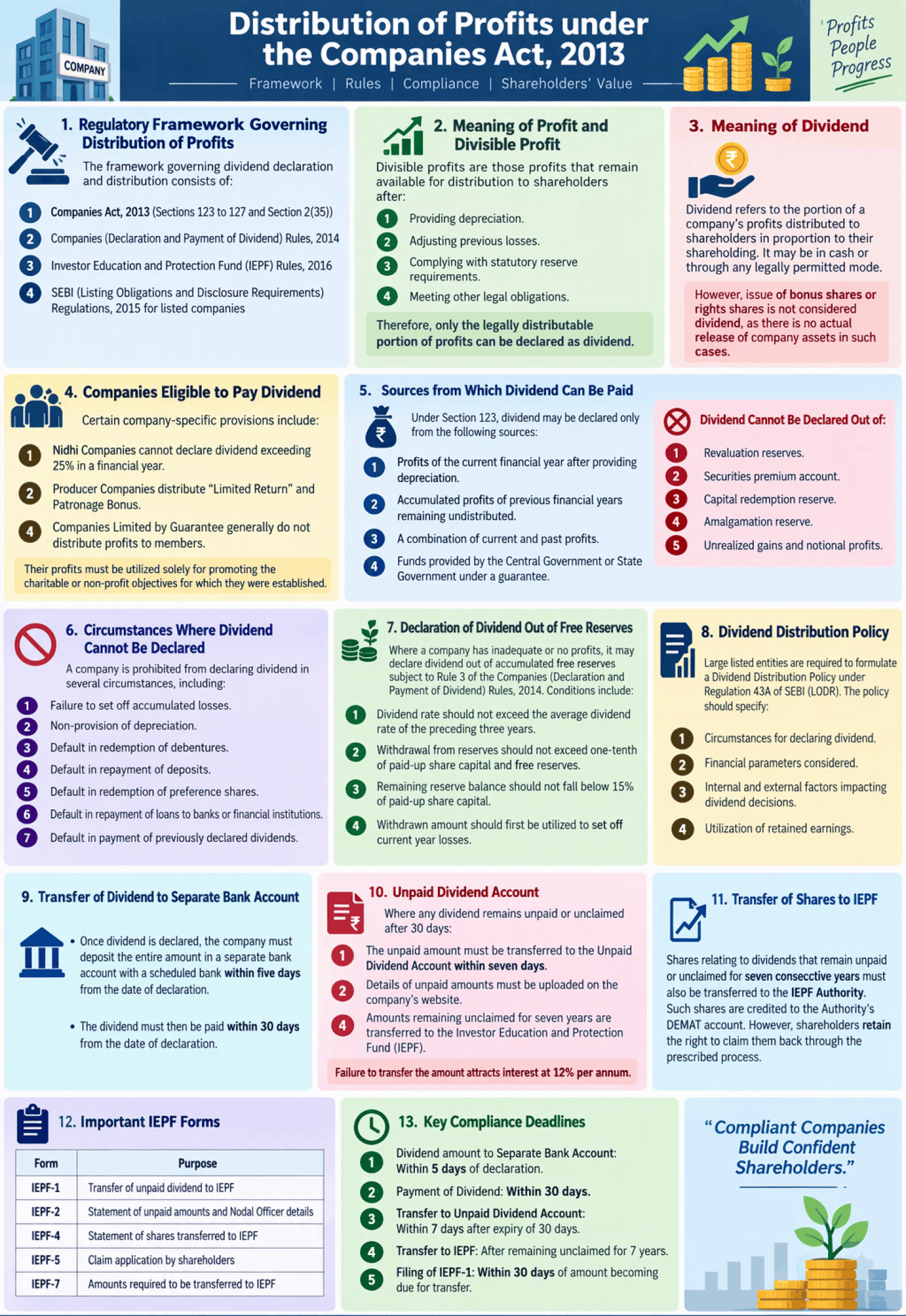
Distribution of Profits under the Companies Act, 2013
The distribution of profits is one of the most important aspects of corporate financial management. While earning profits is a primary objective of a company, the law regulates how and when such profits can be distributed among shareholders. Under the Companies Act, 2013, the provisions relating to dividend and distribution of profits are primarily contained in Sections 123 to 127, along with the Companies (Declaration and Payment of Dividend) Rules, 2014, the IEPF Rules, 2016, and SEBI (LODR) Regulations for listed companies.
Regulatory Framework Governing Distribution of Profits
The framework governing dividend declaration and distribution consists of:
- Companies Act, 2013 (Sections 123 to 127 and Section 2(35))
- Companies (Declaration and Payment of Dividend) Rules, 2014
- Investor Education and Protection Fund (IEPF) Rules, 2016
- SEBI (Listing Obligations and Disclosure Requirements) Regulations, 2015 for listed companies
Meaning of Profit and Divisible Profit
The Companies Act, 2013 does not specifically define the term "profit." In practical terms, profit represents the surplus earned by a company after meeting all business expenses and obligations. The concept of divisible profit is particularly important because not every profit earned by a company can be distributed as dividend.
According to the principles established by judicial precedents, divisible profits are those profits that remain available for distribution to shareholders after:
- Providing depreciation.
- Adjusting previous losses.
- Complying with statutory reserve requirements.
- Meeting other legal obligations.
Therefore, only the legally distributable portion of profits can be declared as dividend.
Meaning of Dividend
The word dividend originates from the Latin term "Dividenda", meaning something to be divided among members. Under Section 2(35) of the Companies Act, 2013, dividend includes interim dividend as well.
Dividend generally refers to the portion of a company's profits distributed to shareholders in proportion to their shareholding. Such distribution may be in cash or through any legally permitted mode. However, issue of bonus shares or rights shares is not considered dividend, as there is no actual release of company assets in such cases.
Difference Between Interest and Dividend
| Particulars | Interest | Dividend |
|---|---|---|
| Nature | Charge against profits | Appropriation of profits |
| Payable To | Creditors and lenders | Shareholders |
| Obligation | Mandatory as per agreement | Depends upon availability of profits |
| Treatment | Expense of business | Distribution of earnings |
| Payability | Payable even in loss situations | Can be paid only from distributable profits |
Interest is a contractual liability, whereas dividend is distributed only after profits are earned and legally declared.
Companies Eligible to Pay Dividend
Generally, every company can declare dividend except companies incorporated under Section 8 of the Companies Act, which are prohibited from distributing profits to members. Their profits must be utilized solely for promoting the charitable or non-profit objectives for which they were established.
Certain company-specific provisions include:
- Nidhi Companies cannot declare dividend exceeding 25% in a financial year.
- Producer Companies distribute "Limited Return" and Patronage Bonus.
- Companies Limited by Guarantee generally do not distribute profits to members.
Types of Dividend
The Companies Act recognizes two major types of dividend:
1. Final Dividend
Final dividend is recommended by the Board of Directors and declared by shareholders at the Annual General Meeting (AGM). The shareholders cannot approve a dividend exceeding the amount recommended by the Board. However, they may declare a lower amount.
2. Interim Dividend
Interim dividend is declared by the Board of Directors between two AGMs and does not require shareholder approval. It may be declared during the financial year or after the end of the financial year but before the AGM.
Sources from Which Dividend Can Be Paid
Under Section 123, dividend may be declared only from the following sources:
- Profits of the current financial year after providing depreciation.
- Accumulated profits of previous financial years remaining undistributed.
- A combination of current and past profits.
- Funds provided by the Central Government or State Government under a guarantee.
Dividend cannot be declared out of:
- Revaluation reserves.
- Securities premium account.
- Capital redemption reserve.
- Amalgamation reserve.
- Unrealized gains and notional profits.
Circumstances Where Dividend Cannot Be Declared
A company is prohibited from declaring dividend in several circumstances, including:
- Failure to set off accumulated losses.
- Non-provision of depreciation.
- Default in redemption of debentures.
- Default in repayment of deposits.
- Default in redemption of preference shares.
- Default in repayment of loans to banks or financial institutions.
- Default in payment of previously declared dividends.
Declaration of Dividend Out of Free Reserves
Where a company has inadequate or no profits in a financial year, it may declare dividend out of accumulated free reserves subject to Rule 3 of the Companies (Declaration and Payment of Dividend) Rules, 2014. Conditions include:
- Dividend rate should not exceed the average dividend rate of the preceding three years.
- Withdrawal from reserves should not exceed one-tenth of paid-up share capital and free reserves.
- Remaining reserve balance should not fall below 15% of paid-up share capital.
- Withdrawn amount should first be utilized to set off current year losses.
Dividend Distribution Policy
Large listed entities are required to formulate a Dividend Distribution Policy under Regulation 43A of SEBI (LODR). The policy should specify:
- Circumstances for declaring dividend.
- Financial parameters considered.
- Internal and external factors impacting dividend decisions.
- Utilization of retained earnings.
Transfer of Dividend to Separate Bank Account
Once dividend is declared, the company must deposit the entire amount in a separate bank account with a scheduled bank within five days from the date of declaration.
The dividend must then be paid within 30 days from the date of declaration.
Unpaid Dividend Account
Where any dividend remains unpaid or unclaimed after 30 days:
- The unpaid amount must be transferred to the Unpaid Dividend Account within seven days.
- Details of unpaid amounts must be uploaded on the company's website.
- Amounts remaining unclaimed for seven years are transferred to the Investor Education and Protection Fund (IEPF).
Failure to transfer the amount attracts interest at 12% per annum.
Investor Education and Protection Fund (IEPF)
The IEPF Authority was established under Section 125 to administer unpaid and unclaimed corporate amounts. Its main functions include:
- Refund of unclaimed dividends.
- Refund of matured deposits and debentures.
- Investor awareness and education.
- Management of transferred shares and investor claims.
Transfer of Shares to IEPF
Shares relating to dividends that remain unpaid or unclaimed for seven consecutive years must also be transferred to the IEPF Authority. Such shares are credited to the Authority's DEMAT account. However, shareholders retain the right to claim them back through the prescribed process.
Important IEPF Forms
| Form | Purpose |
|---|---|
| IEPF-1 | Transfer of unpaid dividend to IEPF |
| IEPF-2 | Statement of unpaid amounts and Nodal Officer details |
| IEPF-4 | Statement of shares transferred to IEPF |
| IEPF-5 | Claim application by shareholders |
| IEPF-7 | Amounts required to be transferred to IEPF |
Revocation of Dividend
Once dividend is declared, it becomes a debt payable by the company to shareholders and cannot be revoked. Shareholders thereafter acquire an enforceable right to receive the dividend.
Punishment for Failure to Pay Dividend
Under Section 127, if a company fails to pay declared dividend within thirty days:
- Director responsible for the default may face imprisonment up to two years.
- Directors may also face daily monetary fines.
- The company must pay simple interest at 18% per annum for the period of default.
Procedure for Payment of Interim Dividend
The Board must:
- Verify authority under Articles of Association.
- Convene Board Meeting.
- Assess profitability and availability of distributable profits.
- Declare interim dividend.
- Deposit amount in separate bank account within five days.
- Distribute dividend within thirty days.
Procedure for Declaration of Dividend Out of Reserves
The company should:
- Pass Board Resolution.
- Ensure compliance with Rule 3.
- Determine free reserves.
- Hold AGM and pass necessary resolution.
- Deposit and distribute dividend within statutory timelines.
Key Compliance Deadlines
- Dividend amount to Separate Bank Account: Within 5 days of declaration.
- Payment of Dividend: Within 30 days.
- Transfer to Unpaid Dividend Account: Within 7 days after expiry of 30 days.
- Transfer to IEPF: After remaining unclaimed for 7 years.
- Filing of IEPF-1: Within 30 days of amount becoming due for transfer.
Judicial Pronouncements on Declaration of Dividend
Raghunandan Neotia v. Swadeshi Cloth Dealers Ltd.
- Principle Established : The Court held that final dividend can be declared only at the Annual General Meeting. The Board merely recommends the dividend and shareholders formally declare it.
- Significance : Board of Directors do not have authority to declare final dividend independently.
Maharani Lalita Rajya Lakshmi v. Indian Motor Co. (Hazaribag) Ltd.
- Principle Established : The Court ruled that shareholders cannot increase the dividend rate beyond what the Board recommends. They may reduce the amount but cannot enhance it.
- Significance : Protects financial discipline and prevents shareholders from forcing excessive dividend payouts.
Tarajan Tea Co. (P) Ltd. v. CIT
- Principle Established: The Court held that dividend becomes a debt against the company only after being declared by shareholders at the AGM. Board recommendation alone does not create a legal liability.
- Significance : A shareholder cannot claim dividend merely because the Board recommended it. The right arises only after formal declaration.
J. Dalmia v. Commissioner of Income Tax
- Principle Established: The Court held that interim dividend may be declared by directors if the Articles of Association authorize them to do so. Shareholder approval is not mandatory.
- Significance : Provides legal backing for Board-controlled declaration of interim dividend.
Steel Co. of Canada Ltd. v. Ramsay
- Principle Established : The Court clarified that dividend need not be declared only once in a year. Directors may declare dividend several times if justified by profits and Articles of Association.
- Significance : Provides flexibility in declaring interim dividends multiple times during a year.
Judicial Pronouncements on Shareholder Entitlement
Chunilal Kuhshaldas Patel v. H.K. Adhyaru
- Principle Established : The Court held that dividend is payable to the person whose name appears in the Register of Members on the record date even if the shares have already been sold and transfer registration is pending.
- Significance : The registered shareholder is entitled to dividend and not the beneficial owner until the transfer is recorded.
Hariprasad v. A.C. Traders (P) Ltd.
- Principle Established: The Court ruled that where shares are transferred on a cum-dividend basis, the transferee is not entitled to any dividend declared before the transfer.
- Significance : Dividend rights are determined by the record date and declaration date.
Rameshwar Lal Sanwarmal v. Commissioner of Income Tax
- Principle Established : Only the person whose name is entered in the register of members can be treated as a shareholder for dividend purposes. A beneficial owner does not automatically acquire dividend rights against the company.
- Significance : Reinforces the importance of registered membership in company records.
Gopal & Sons (HUF) v. CIT
- Principle Established : The Supreme Court held that deemed dividend provisions can apply where payments are made to concerns in which significant shareholders have substantial interest.
- Significance : Important for understanding deemed dividend under Section 2(22)(e) of the Income-tax Act.
Judicial Pronouncements on Revocation and Payment of Dividend
Vazir Sultan Tobacco Co. Ltd. v. Commissioner of Income Tax
- Principle Established : The Supreme Court held that a Board recommendation for dividend does not create any enforceable liability. Liability arises only after shareholders approve and declare the dividend.
- Significance : A Board recommendation can be modified or withdrawn before declaration at the AGM.
Kishinchand Chellaram v. Commissioner of Income Tax
- Principle Established : The Court held that once dividend is declared and credited to shareholders, its character cannot subsequently be changed through another resolution.
- Significance : Declared dividend becomes final and legally enforceable.
Bacha F. Guzdar v. Commissioner of Income Tax
- Principle Established : The right of shareholders to receive dividend arises only after declaration of dividend by the company. Prior to declaration, shareholders have no enforceable claim.
- Significance : This case establishes when the legal right to dividend actually arises.
C.W. Spencer v. ITO
- Principle Established : The Court held that shareholders cannot compel a company to declare dividend through legal proceedings. Declaration of dividend remains a matter of corporate discretion.
- Significance : Even profitable companies cannot be forced by shareholders to declare dividend.
Judicial Pronouncements on Non-Declaration of Dividend
Indowind Energy Ltd. v. ICICI Bank Ltd.
- Principle Established : The Court held that non-declaration of dividend does not amount to oppression, mismanagement, or misconduct by the company.
- Significance : Companies retain discretion to retain earnings for business requirements and growth.
Judicial Pronouncement on IEPF Transfer
Kamala Srinivasan v. Union of India (Madras High Court, 2020)
- Principle Established : The Madras High Court upheld the validity of Section 124(6) and Rules 6 and 7 relating to transfer of unclaimed dividends and shares to the IEPF. The Court held that the provisions are constitutional, reasonable, and in public interest.
- Significance : The judgment confirms that transfer of shares and unclaimed dividends to IEPF after seven years is legally valid and intended to protect investor interests.
Conclusion
The distribution of profits under the Companies Act, 2013 is a highly regulated process aimed at protecting shareholders, creditors, and investors. A company can distribute only legally divisible profits after providing for depreciation, losses, and statutory obligations. Proper compliance with Sections 123 to 127, IEPF provisions, SEBI regulations, and dividend payment procedures is essential to avoid penalties and ensure transparent corporate governance. The most important judicial principles emerging from these cases are:
- Dividend can be paid only from legally divisible profits.
- Board recommendation does not create liability; declaration does.
- Dividend once declared becomes a debt and cannot be revoked.
- Shareholders cannot compel declaration of dividend.
- Registered shareholders, not beneficial owners, are generally entitled to dividend.
- Unclaimed dividends and related shares may be transferred to IEPF after the prescribed period.
- Courts consistently emphasize protection of shareholders while ensuring prudent financial management by companies