Table of Contents
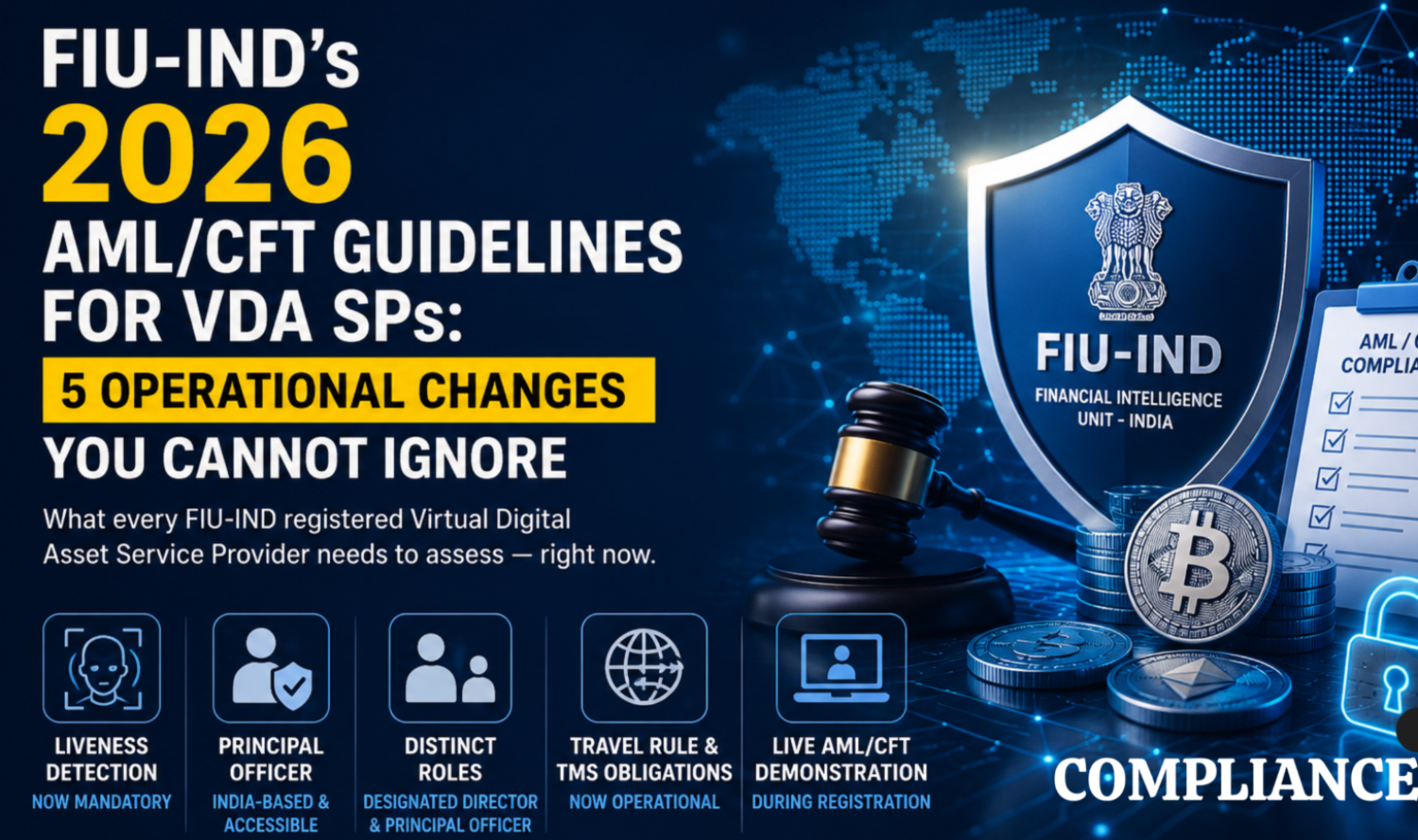
FIU-IND Guidance for Principal Officer (PO) of Virtual Digital Asset Service Providers (VDA SPs)
The "Guidance for Principal Officer (PO) for Virtual Digital Asset Service Providers (VDA SPs) Sector - Minimum Requirements and Qualifications," issued on 25 February 2025 by the Financial Intelligence Unit - India (FIU-IND) under the Ministry of Finance, provides a comprehensive framework for the appointment of Principal Officers by Virtual Digital Asset Service Providers.
This guidance for PO for VDA SPs sector guidance outlines the minimum eligibility criteria, qualifications, roles and responsibilities, and organizational requirements for principal officers to ensure compliance with the provisions of the Prevention of Money Laundering Act (PMLA), 2002, and related regulatory obligations.
Purpose of the Financial Intelligence Unit - India Guidance for PO of VDA SPs
- Financial Intelligence Unit - India recognizes that the Virtual Digital Asset (VDA) sector, including cryptocurrency exchanges, wallet providers, and related service providers, carries higher risks of money laundering (ML), terrorist financing (TF), cross-border financial crime, anonymous transactions, and complex transaction structures.
- Therefore, every VDA service provider registered or seeking registration with the Financial Intelligence Unit - India must appoint a suitably qualified principal officer.
Who is a principal officer?
- Under the PMLA framework, the Principal Officer is the designated senior official responsible for AML (Anti-Money Laundering) compliance, CFT (Combating Financing of Terrorism) compliance, Reporting suspicious transactions to FIU-IND, Monitoring compliance with KYC obligations and Coordinating with law enforcement agencies and regulators
- The principal officer acts as the primary liaison between the Financial Intelligence Unit - India and the reporting entity.
Detailed Requirements Prescribed by Financial Intelligence Unit - India
A. Management Level Officer
The principal officer must be an officer at the management level of the organization.
Practical Meaning
The principal officer should be senior enough to take independent decisions, access management records, escalate issues to the board, and implement AML policies effectively. A junior executive or compliance assistant would generally not qualify.
B. No Conflict of Interest
- The principal officer should exclusively handle responsibilities under Chapter IV of PMLA and should not be actively involved in business operations.
Practical Meaning
- The PO should not simultaneously be Sales Head, Marketing Head, Business Development Head and Revenue Officer. This ensures independent monitoring and reporting of suspicious transactions.
C. Full-Time Engagement
- The principal officer must be engaged exclusively with the VDA SP on a full-time basis and should not hold concurrent employment or engagements elsewhere. The following are implications in this case. Following are not permitted, like a part-time compliance officer, a consultant serving multiple exchanges, an outsourced principal officer arrangement, simultaneous employment with another company, and a financial intelligence unit. India expects a dedicated compliance professional.
D. Sufficient Seniority
- The PO should have sufficient authority within the organizational hierarchy and must be able to discharge responsibilities without undue corporate influence.
- Importance of the Principal Officer should be able to Freeze escalating compliance concerns, reject high-risk customers, report suspicious activities, and escalate directly to senior management without interference from business teams.
E. Experience and Skill Requirements
- The Principal Officer should possess knowledge of AML laws, knowledge of PMLA and rules, relevant experience, and a minimum of 3 years of experience in the field, as specifically required by Financial Intelligence Unit - India.
Suitable Background
- Persons from AML Compliance, Banking Compliance, Financial Crime Compliance, Risk Management, Forensic Audit with Regulatory Compliance, and KYC and Monitoring Functions may generally satisfy the criteria.
F. Knowledge of ML/TF Risks
- The PO must possess a thorough understanding of money laundering risks, terrorist financing risks, sector-specific vulnerabilities, country-level risk factors, and emerging laundering techniques and typologies relevant to virtual digital asset businesses. Basic examples of the principal officer should include understanding risks involving layering through crypto wallets, Mule accounts, cross-border transfers, mixer services, privacy coins, and sanctioned jurisdictions.
G. Participation in Risk Committees
- The Principal Officer should be a permanent invitee to all high-level committees assessing risks relating to products, Services, Delivery channels, customer categories, and geographical exposure to ensure AML risks are evaluated appropriately.
- Practical Requirement: Whenever management considers New crypto products, New wallet services, international expansion, or New client segments, the principal officer must be involved in the risk assessment process.
H. Adequate Resources and Access
- The organization must provide the Principal Officer with competent support staff, access to transaction data, Access to customer records, monitoring tools, and investigation resources to effectively implement AML/CFT controls. Following are the basic compliance expectations: The principal officer should not merely be appointed on paper; adequate infrastructure must support the function.
I. Access to Information for Financial Intelligence Unit—India Requests
- The Principal Officer may require information from different departments to respond to requests from the Financial Intelligence Unit - India, Law Enforcement Agencies (LEAs), and Regulators. The organization should establish internal procedures to ensure timely provision of information. Examples of requests may relate to KYC records, wallet addresses, transaction history, IP logs, and beneficial ownership details.
J. Quarterly AML Reporting to the Board
- The Principal Officer should present a review/status report of the AML/CFT function before Board of Directors, or Board Sub-Committee, preferably every quarter. Board updates may include STR filings, compliance breaches, regulatory inspections, high-risk accounts, AML system effectiveness, and training conducted.
K. Preferably Based in India
- Financial Intelligence Unit - India advises that the Principal Officer should preferably be located in India. Reason of that The principal officer must coordinate with the Financial Intelligence Unit—India, Meet regulatory timelines, interact with enforcement authorities, and support investigations without delays arising from offshore locations.
Key Takeaways for VDA Service Providers
To remain compliant with Financial Intelligence Unit - India requirements, a VDA Service Provider should ensure that its Principal Officer:
- A principal officer is a senior management-level employee and Works exclusively as Principal Officer and the principal officer is employed on a full-time basis. Principal Officer Is preferably located in India
- The Principal Officer Has at least 3 years of relevant AML/compliance experience, he also Understands PMLA and AML/CFT regulations
- Principal officer participates in risk management discussions also has direct access to customer and transaction data.
- The Principal Officer Reports regularly to the Board, Principal Officer also required to coordinates with Financial Intelligence Unit - India & regulators
Impact on Financial Intelligence Unit - India Registration
- For existing and prospective Virtual Digital Asset Service Providers, FIU-IND may scrutinize whether the appointed Principal Officer satisfies these qualifications. A mere nominal appointment without adequate authority, experience, or independence may not meet the expectations outlined in the guidance.
- For firms providing Financial Intelligence Unit-India registration, AML compliance, and VDA advisory services, this guidance makes it clear that the Principal Officer position is intended to be a substantive compliance role rather than a formal designation