Table of Contents
- Gst Registration Mechanisms Comparison: Rule 9, Rule 14a & Rule 14b
- Normal Gst Registration (rule 9)
- Simplified Gst Registration (rule 14a)
- E-commerce Gst Registration (rule 14b)
- Gst Registration Comparison In Normal Registration (rule 9), E-commerce Registration (rule 14b) And Simplified Registration (rule 14a)
- Practical Comparison Of All The Above Three Gst Registrations
- Gst Registration Comparison: Rule 9 Vs Rule 14a Vs Rule 14b
- New Gst Registration Guidelines From 1st Nov 2026 - As Per Circular-no-257-03-2026 (2) And Central-tax-05-gst-27102026
- Major Changes Applicable From 1 November 2026
- Detailed Principal Place Of Business (ppob) Requirements
- Conclusion
GST registration mechanisms Comparison: Rule 9, Rule 14A & Rule 14B
Normal GST Registration (Rule 9)
This is the standard GST registration process applicable to most businesses. Following are Key Features of Normal GST Registration (Rule 9)
- Principal Place of Business (PPOB) is mandatory.
- Physical verification may be conducted based on risk parameters.
- No turnover or tax liability restrictions.
- Suitable for regular businesses operating from fixed premises.
- Registration is approved through the normal officer/system verification process.
Best for of Normal GST Registration (Rule 9) for Manufacturers, Traders, Service providers and Companies operating from fixed business locations
Simplified GST Registration (Rule 14A)
Introduced to make registration easier for small taxpayers. Following are Key Features of Simplified GST Registration (Rule 14A)
- OTP-based Aadhaar authentication.
- Simplified electronic approval process.
- Available only where monthly B2B output tax liability remains within INR 2.50 lakh.
- No separate approval by officer in normal circumstances.
- Withdrawal from this option requires filing GST REG-32.
Benefits of Simplified GST Registration (Rule 14A)
- Faster registration
- Reduced documentation
- Less physical verification
- Easier compliance for small businesses
The INR 2.50 lakh limit refers to monthly B2B GST output tax liability, not turnover. A taxpayer may have turnover much higher than INR 2.50 lakh and still qualify, depending on the applicable GST rate and nature of supplies.
E-Commerce GST Registration (Rule 14B)
A special registration mechanism for sellers supplying goods through E-Commerce Operators (ECOs) such as Amazon, Flipkart, Meesho and Jiomart. Key Features of E-Commerce GST Registration (Rule 14B)
- Seller may obtain registration in another State without a physical place of business there.
- Existing GSTIN in the home State is mandatory.
- ECO warehouse can be used as the Principal Place of Business.
- Consent from the E-Commerce Operator is mandatory.
- Biometric verification is required in the home State if not already completed.
- Same PAN cannot obtain multiple Rule 14B registrations in the same State.
New Rule 14B Registration for E-Commerce Sellers
The most significant change from 1 November 2026 is the introduction of Rule 14B. Under this scheme, a seller can obtain GST registration in another State even without having a physical office there, by using the warehouse of an E-Commerce Operator (ECO) as the Principal Place of Business. Following Eligibility Conditions E-Commerce Sellers
| Condition | Requirement |
|---|---|
| Existing GST Registration | Must already have GST registration in a home State |
| Business Model | Supply of goods through E-Commerce Operators |
| Physical Presence | Not required in destination State |
| Monthly B2B Tax Liability | Not more than INR 2.50 lakh per month |
| ECO Consent | Mandatory |
| Aadhaar Verification | Mandatory |
| Warehouse Usage | ECO warehouse can be declared as PPoB |
Example: A seller registered in Uttar Pradesh can obtain GST registration in Maharashtra using an Amazon or Flipkart warehouse without opening an office in Maharashtra
Major Benefit of E-Commerce GST Registration (Rule 14B)
A seller in Uttar Pradesh can sell goods through an e-commerce warehouse in Maharashtra without maintaining his own office in Maharashtra, subject to Rule 14B conditions.
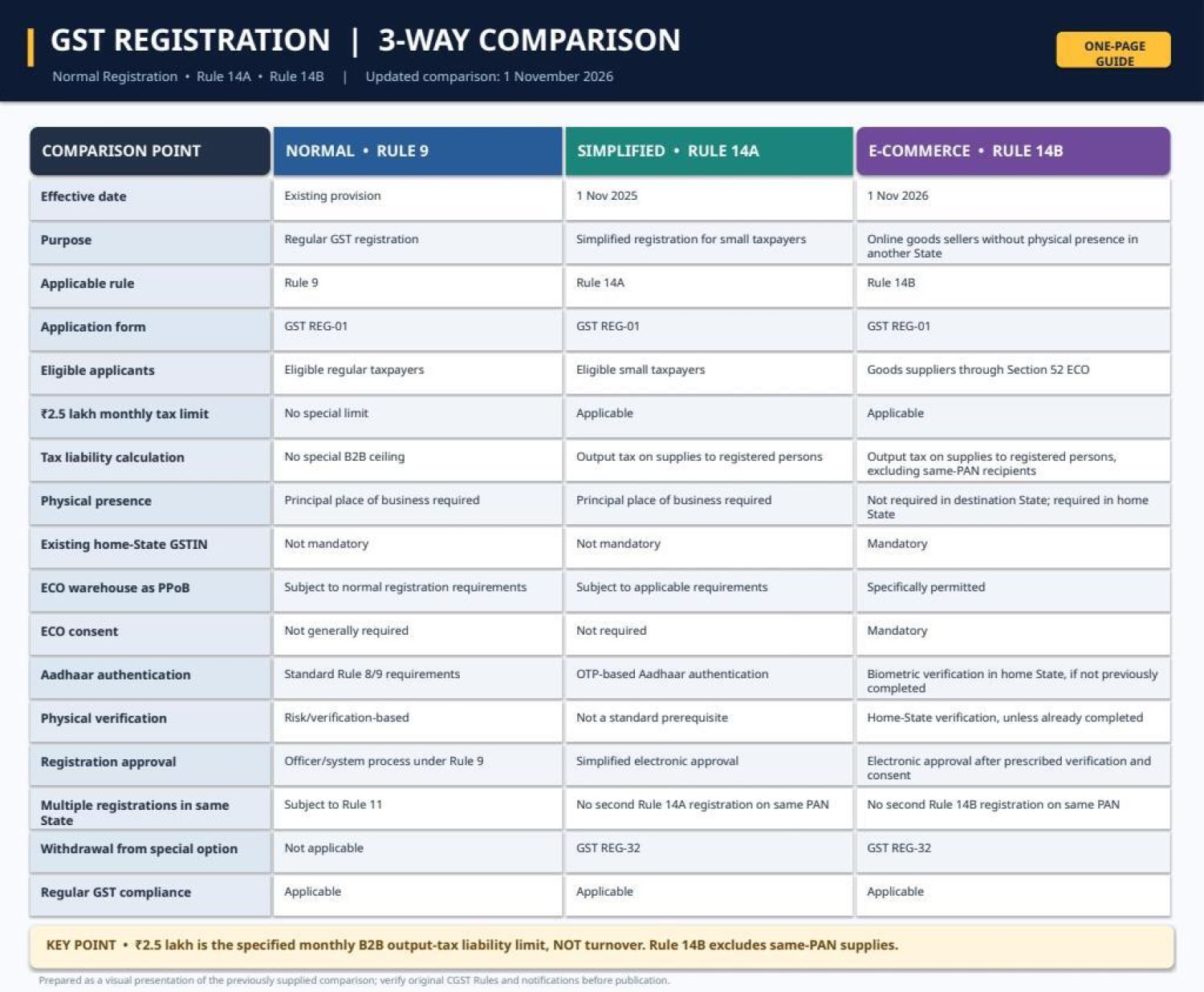
GST Registration Comparison in Normal Registration (Rule 9), E-Commerce Registration (Rule 14B) and Simplified Registration (Rule 14A)
|
Feature / Parameter |
Normal Registration (Rule 9) |
E-Commerce Registration (Rule 14B) |
Simplified Registration (Rule 14A) |
|
Effective Date |
Existing provision |
1 November 2026 |
1 November 2025 |
|
Purpose |
Regular GST registration for all eligible taxpayers |
Registration for goods suppliers selling through E-Commerce Operators (ECOs) without physical presence in the destination State |
Simplified registration process for small taxpayers |
|
Applicable Rule |
Rule 9 |
Rule 14B |
Rule 14A |
|
Application Form |
GST REG-01 |
GST REG-01 |
GST REG-01 |
|
Eligible Applicants |
Regular businesses, service providers, manufacturers, traders and other eligible taxpayers |
Suppliers of goods through Section 52 E-Commerce Operators such as Amazon, Flipkart, Meesho, etc. |
Small taxpayers with limited B2B tax liability |
|
Applicability & Target Group |
Standard businesses, high-turnover entities, interstate suppliers and businesses requiring full ITC benefits |
Sellers operating exclusively through e-commerce platforms in States where they have no physical establishment |
Small businesses, start-ups, professionals and micro enterprises |
|
Monthly Output Tax Liability Limit |
No limit |
Maximum INR 2.50 lakh per month |
Maximum INR 2.50 lakh per month |
|
Nature of INR 2.50 Lakh Limit |
Not applicable |
Applies to output tax liability on supplies made to registered persons, excluding same-PAN recipients |
Applies to output tax liability on specified B2B supplies |
|
Tax Liability Basis |
No specific restriction |
Output tax on registered-person supplies excluding transactions with same PAN entities |
Output tax on supplies made to registered persons |
|
Physical Presence Requirement |
Principal Place of Business (PPOB) mandatory |
Physical presence not required in destination State; home-State presence required |
Principal Place of Business (PPOB) mandatory |
|
Existing Home-State GSTIN |
Not mandatory |
Mandatory |
Not mandatory |
|
ECO Warehouse as PPoB/APoB |
Allowed subject to normal GST provisions |
Specifically permitted to be declared as PPoB or APoB |
Allowed subject to applicable requirements |
|
ECO Consent Requirement |
Generally not required |
Mandatory consent from the E-Commerce Operator |
Not required |
|
Aadhaar Authentication |
Optional for faster processing; otherwise physical verification may be required |
Mandatory biometric verification and Aadhaar-based authentication in home State if not previously completed |
Mandatory OTP-based Aadhaar authentication for authorized signatory and promoter/partner |
|
Physical Verification |
Risk-based verification by department |
Home-State verification required unless already completed |
Normally not required |
|
Registration Approval Process |
Approval by officer/system under Rule 9 |
Electronic approval after prescribed verification and ECO consent |
Simplified electronic approval |
|
Approval Timeline |
Normally 7 working days; up to 30 days where physical verification is triggered |
Electronic approval subject to verification and prescribed conditions |
Generally within 3 working days after successful Aadhaar authentication |
|
Place of Business Amendment |
Requires officer approval within prescribed timeline |
Warehouse facility of ECO can be declared for registration purposes |
System-driven amendment process |
|
Multiple Registrations in Same State |
Permitted subject to Rule 11 conditions |
Second Rule 14B registration on same PAN not permitted |
Second Rule 14A registration on same PAN not permitted |
|
Consequences of Exceeding INR 2.50 Lakh Limit |
Not applicable |
Taxpayer must comply with withdrawal provisions and satisfy Rule 14B conditions |
Taxpayer must withdraw through Form GST REG-32 and shift to regular registration |
|
Withdrawal from Special Scheme |
Not applicable |
Form GST REG-32 |
Form GST REG-32 |
|
Regular GST Compliance Requirements |
Applicable |
Applicable |
Applicable |
Practical comparison of all the above three GST registrations
|
Situation |
Suitable Registration |
|
Regular business with office/shop |
Rule 9 |
|
Small taxpayer requiring quick registration |
Rule 14A |
|
Amazon/Flipkart seller expanding to multiple States |
Rule 14B |
GST Registration Comparison: Rule 9 vs Rule 14A vs Rule 14B
|
Particulars |
Rule 9 |
Rule 14B |
Rule 14A |
|
Best Suited For |
Regular businesses |
E-commerce sellers operating in multiple States |
Small taxpayers with limited B2B transactions |
|
Fastest Registration |
No |
Yes, subject to prescribed verification |
Yes |
|
Physical Office in State Required |
Yes |
No |
Yes |
|
GSTIN in Home State Required |
No |
Yes |
No |
|
E-Commerce Operator Involvement |
Not required |
Mandatory |
Not required |
|
Monthly Tax Liability Restriction |
No |
INR 2.50 lakh |
INR 2.50 lakh |
The INR 2.50 lakh limit prescribed under Rule 14A and Rule 14B is based on monthly output GST liability, not on turnover. Therefore, taxpayers may have substantially higher turnover while still remaining eligible, depending upon the applicable GST rate and nature of supplies.
New GST Registration Guidelines from 1st Nov 2026 - As per Circular-No-257-03-2026 (2) and central-tax-05-gst-27102026
Major Changes Applicable from 1 November 2026
| Particulars | Earlier Position | New Position from 1 Nov 2026 |
|---|---|---|
| GST Registration Documentation | Different practices followed by officers | Standardized list of acceptable documents prescribed |
| PPOB Documents | Frequent disputes and additional notices | Detailed prescribed list for each category of premises |
| Co-working Space Registration | No uniform guidelines | Specifically permitted with the membership agreement |
| Consent-Based Premises | Frequent objections | The standard consent format is prescribed. |
| Registration Processing | Many avoidable queries | Officers restricted from seeking unnecessary documents |
| Rule 14B Registration | Not available | New registration mechanism for e-commerce sellers |
| Address Verification | General address accepted | A specific and complete address is mandatory |
| Registration Application | Limited guidance | Detailed FAQs and document checklist were issued |
Detailed Principal Place of Business (PPOB) Requirements
CBIC has clarified acceptable documents for every type of premises. PPOB Document Checklist
| Nature of Premises | Documents Required |
|---|---|
| Owned Property | Property Tax Receipt, Municipal Khata, Property Identification Document, Electricity Bill or Water Bill |
| Property of Deceased Ancestor | Death Certificate + Affidavit + Ownership Proof |
| Rented Property | Rent/Lease Agreement + Ownership Proof |
| No Rent Agreement | Undertaking + Utility Bill |
| Consent-Based Property | Consent Letter + Ownership Proof |
| Co-working Space | Membership Agreement + Supporting Ownership/Rent Documents |
| SEZ Unit | LOA/LOP from Development Commissioner |
Conclusion
The most significant change is Rule 14B, which allows e-commerce sellers to obtain GST registration in another State without having their own physical establishment there, provided they already have a home-State GSTIN and obtain consent from the E-Commerce Operator. Rule 14A, on the other hand, aims to simplify registration for small taxpayers through a faster and less burdensome process
New GST Registration Guidelines from 1st Nov 2026 - As per Circular-No-257-03-2026 (2) and central-tax-05-gst-27102026