Project Financing > Credit Rating Service
A credit rating calculates the credit worthiness of an issuer of specific types of debt,
particularly debt issued by a business enterprise such as a corporation or a government. A
credit rating agency makes an evaluation of the debt issuer’s likelihood of default. Credit
ratings agencies determine Credit ratings. Credit Rating is an independent third party
comprehensive assessment of the overall credit worthiness of an entity. It takes into
account not only the financial condition of the entity, but also various qualitative
parameters that have bearing on its credit worthiness. The credit rating represents the
credit rating agency's evaluation of qualitative and quantitative information for a company
or government; involving non-public information procured by the credit rating agencies
analysts.
Credit ratings are not based on mathematical formulas. Instead, credit rating agencies use
their judgment and experience to determine what public and private information should be
considered in providing a rating to a particular company or government. The credit rating is
used by individuals and entities that buy the bonds issued by companies and governments to
indicate the likelihood that the government will pay its bond obligations. A poor credit
rating determines a credit rating agency's opinion that the company or government has a high
risk of defaulting, on the basis of agency's analysis of the entity's history and analysis
of long term economic aspects.
Credit ratings are not based on mathematical formulas. Instead, credit rating agencies use
their judgment and experience to determine what public and private information should be
considered in providing a rating to a particular company or government. The credit rating is
used by individuals and entities that buy the bonds issued by companies and governments to
indicate the likelihood that the government will pay its bond obligations. A poor credit
rating determines a credit rating agency's opinion that the company or government has a high
risk of defaulting, on the basis of agency's analysis of the entity's history and analysis
of long term economic aspects.
Benefits of the Credit Rating
Credit ratings help investors facilitate comparative assessment of investment options,
complement the investors' own credit analysis, and permit monitoring of asset
Advantages for Entities to be rated mentioned below:
- Reduction in Interest Rates as per CAR to be maintained by the Bank
- Better financial terms and confidence while negotiating with banks and FI’s
- Financial institution looks for investment graded company in their portfolio
- Contributes in marketing and serves as first point to promote interest among potential
partners
- Rishhhh
- It is a “holistic health check-up of the unit” that establishes credibility, goodwill
and assists to deal with large companies.
- Enhance acceptability with Banks, Financial Institutions and provides access to cheaper
and timely credit.
- Provides assistance in risk management by highlighting parameters measuring operational,
financial and business risk.
- Better market visibility and better corporate image of the company
- Improve the comfort level with prospective/existing lenders
- Credibility and confidence building with business partners
- Self Improvement Tool
Benefits for Lenders to be mentioned below:
- Offer an objective, independent and reliable opinion on quality of credit
- Serve as an additional input in the credit decision making process
- Provide assistance in risk pricing and capital allocation
- Fixing upon the terms of lending – interest rate, collateral, tenure etc.
- Reduce time and cost in data analysis
- Detailed rating rationale improving credit assessment of Client
LIMITATIONS OF THE CREDIT RATING
- Possibility of Bias Exist: The information gathered by the rating
agency may be subject to personal bias of the rating team. However, rating agencies try
their best to provide an unbiased opinion of the credit quality of the company and/or
instrument. If not, they will not be trusted.
- Improper Disclosure May Happen: The company being rated may not
disclose certain material facts to the investigating team of the rating agency. This can
have impact on the quality of credit rating.
- Impact of Changing Environment: Rating is done on basis of present and
past data of the company. So, it will be typical to predict the future financial
position of the company. Many changes take place due to changes in economic, political,
social, technological, legal and other environments. All this will have its impact on
the working of the company being rated. Hence, rating is not a guarantee for financial
soundness of the company.
- Problems for New Companies: There may be problems for new companies to
collect funds from the market. This is because; a new company may not be in a position
to prove its financial soundness. Thus, it may receive lower credit ratings. This will
make it typical to collect funds from the market.
- Downgrading by Rating Agency: The credit-rating agencies periodically
review the ratings provided to a particular instrument. If the performance of a company
is not as expected, then the rating agency will downgrade the instrument. This will have
its impact on the image of the company.
- Difference in Rating: There are cases, where different ratings are
provided by different rating agencies for the same instrument. These differences may be
due to many reasons. This will create confusion in the minds of the investor.
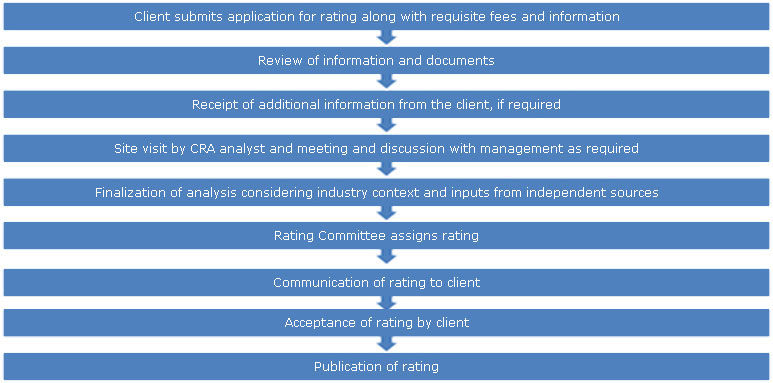
Rating process adopted by the rating agencies
NORMALLY FOLLOWING THE RATING PROCESS ADOPTED BY THE RATING AGENCIES:-
MAIN RATING AGENCIES PREVAILING IN INDIA ARE MENTIONED BELOW:
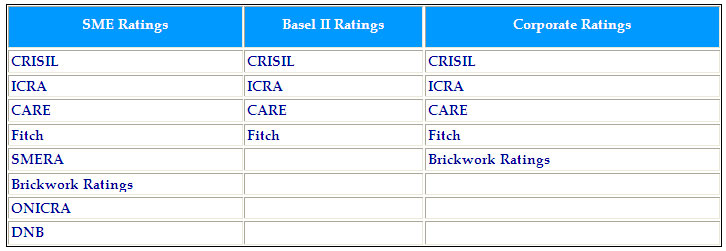
Types of Rating
- SME RATING – For companies registered as SSI and having Bank Limit of
< Rs. 5 crores.
- BASEL II RATING –Compulsory as per RBI guidelines having a bank limit
of > Rs. 5 crores.
- CORPORATE RATING – Mandatory as per SEBI guidelines for Corporate
Instruments i.e. Bonds, Debentures, Commercial Paper, etc.
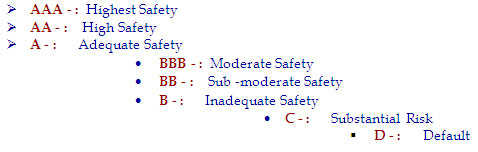
Ratings awarded by major credit rating agencies:
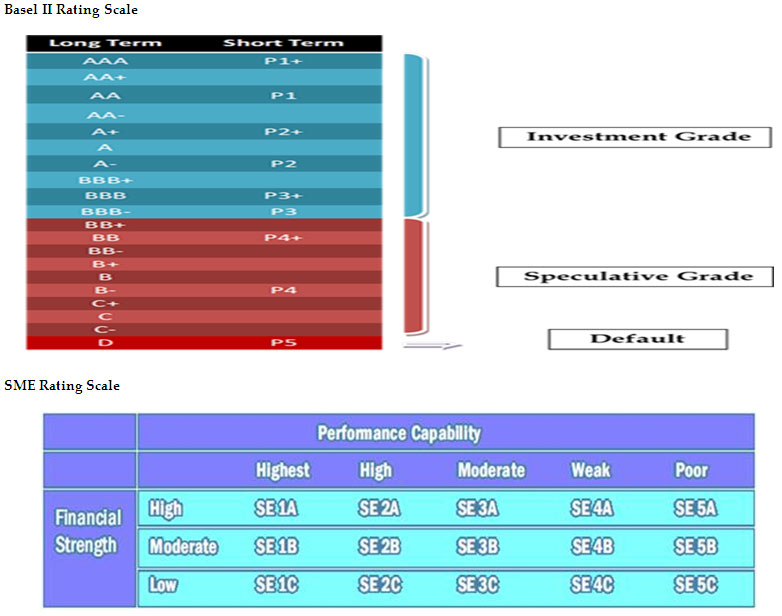
Basel II Rating Scale & SME Rating Scale
What Rajput Jain & Associates Offers
Rajput Jain & Associates providing credit rating consultancy for consulting for SME Rating
and Basel II Credit Rating by offering customized, comprehensive and structured solution
that aims to compensate your investment in our services with a saving of hefty interest cost
and smooth platform for your future financial needs in order to achieve financial success.
With the implementation of Basel II norms, corporate now have to be more vigilant about their
credit rating, to ensure not just a high rating but also adequate flow of lending in order
to sustain their operations along with reasonable level of interest rate. For companies
seeking finance from a bank/bank related institution, the company will require a Basel II
rating.
This is all the more relevant in the SME segment where a lot of lending is now rating based
as opposed to lending that is based on the name and reputation of the management. Effective
corporate rating management systems and processes will enable both banks and SMEs to grow
their businesses.
How Rajput Jain & Associates can help in achieving a higher grade rating:-
Rajput Jain & Associates is managed by professionals who are specialized in their domain and
have a good expertise in finance industry. The team has worked in rating agencies and has
built their own expertise in the related domain. Our team knows how to prepare information,
how to explain company’s policy, business model, future plan, growth plans, past history and
how to present company. Rajput Jain & Associates provides assurance that the company will
get a rating, which will lead to higher credibility and better financing term for the
company. Rajput Jain & Associates takes care of each and every need of rating agencies and
will be your one stop rating solutions.
DISCLAIMER
We are rating consultant and not a rating agency. Rating will be provided only by RBI / SEBI
approved rating agencies but we will be your consultant to help you in getting a better
rating, which will help you to avail all the advantages of a good rating. A credit rating
recommendation from Rajput Jain & Associates is not a recommendation or opinion that is
intended to substitute for a financial adviser's or investor's independent assessment about
whether to lend money, extend credit in any form or purchase, sell or hold any financial
products. This information and the related corporate ratings and related analysis submitted
in the reports by Rajput Jain & Associates do not represent an offer to trade in securities.
Rajput Jain & Associates has a belief that all of its reports are based on reliable data and
information or based on information offered to us by the party requesting the analysis, but
Rajput Jain & Associates has not verified this or obtained an independent verification to
this effect. Rajput Jain & Associates does not guarantee with respect to the accuracy or
completeness of the data relied upon, nor the conclusions derived from the data. Each rating
is a relative, probabilistic assessment of the credit risk of the relevant entity and its
potential to meet financial obligations. It is not a statement that default will or will not
occur provided that circumstances change and management can adopt new strategies. Reports
have been prepared at the request of, and for the purpose of, the subscribers to our credit
and/or composite risk rating service only, and neither Rajput Jain & Associates nor any of
our employees hold any responsibility on any ground whatsoever, involving liability in
negligence, to any other person. Finally, Rajput Jain & Associates and its employees accept
no liability whatsoever for any direct, indirect or consequential loss of any kind arising
from the use of its ratings and rating research in any way whatsoever, unless & until Rajput
Jain & Associates is negligent in misinterpretation or manipulation of the data, in which
case, our maximum liability to our client is the amount of our fee for the report.