Whirlpool convicted & imposed penalty
Page Contents
Whirlpool convicted in accordance with Rs. 4,07,451/- of profiteering by the National Anti Profiteering Authority on its fridges
NAA discovered the long-term consumer corporation Whirlpool of India convicted of not having to pass on a GST rate reduction advantage of more than Rs 4.07 lakh to its refrigerator purchasers.
Kerala State Screening Committee Anti-Profiteering (NAA) vs. Whirlpool India Ltd.
The concise details of the matter are that the petitioner had made reference a case against Whirlpool to the Standing Committee on Anti-Profit-making alleging profiteering on the supply of fridge Whirlpool (HSN code 84182100), by not passing on the benefit of reducing tax rate w. e. f. 1 July 2017 Pursuant to Section 171 of the CGST Act, 2017, by way of a substantial price decrease.
Few justifications by the defendant and the authority to reply
The plaintiff contended that the rise in prices could not be created because of other commercial factors, which had the impact of placing unlawful restraint on his fundamental right and was consequently in accordance with Article 19(1)(g) of the Indian Constitution.
In this relation, it would also be important to state that section 171(1) requires only the participant to pass on the advantage of the reduction in taxes to the purchasers and does not require him to set his prices in accordance with any authority direction. The above profit was provided by the government to ordinary buyers by sacrificing their valuable tax revenue which the respondent can not be permitted to misappropriate and enrich themselves at the detriment of unorganized, voiceless, and vulnerable common buyers. The respondent is free to exercise his right to trade and set prices, but under the pretext that it infringes his right to trade, he can not deny the above benefit.
More reads: Reasons for the Movement of Goods under the GST
The defendant also argued that the product’s manufacturing cost (BOM) had experienced a rise since August 2016 due to a rise in the cost of raw materials which had been computerized to come at the MAP at the end of each and every month.
In this relation, it would also be necessary to note that on the very date from which the tax rate was reduced, there was no reason for the respondent to increase its basic price.
There is also no justification for ascertaining why the respondent had not raised its price every month during the period from August 2016 to June 2017 when he computed the MAP every month.
The representative also claimed that there had been an increase in the total freight cost in 2017 compared to Rs. 29 per unit in 2016, which was expected to be added to the price.
As mentioned above, the defendant had no reason to raise its price on the occasion of the reduction in taxes, and thus the respondent’s argument is frivolous and not bonafide, which was made with an ulterior purpose for the betterment of the tax cut.
Held by Authority:
on the grounds of the details of the matter, the amount profited by Whirlpool shall be determined as Rs. 4,07,451/-.
The Respondent is instructed to lower the price with the above-mentioned product and also to deposit the benefited amount together with interest at 18 percent.
A notice of cause shall be issued to him to illustrate why the punishment under the GST Act should not be enforced on him.
Basic about GST
Goods and Services Tax has significantly transformed India’s indirect taxation system by creating a unified tax structure, reducing cascading taxes, enhancing transparency, improving compliance through digital mechanisms, and facilitating ease of doing business.
GST : GST (Goods and Services Tax) is a comprehensive indirect tax levied on the supply of goods and services, replacing multiple cascading taxes like VAT, Service Tax, Excise, etc.
Types of Goods and Services Tax
- CGST – Central Government (intra-state)
- SGST / UTGST – State/UT Government (intra-state)
- IGST—Interstate transactions & imports
GSTIN (Goods and Services Tax Identification Number) : A 15-digit unique identification number assigned to every registered taxpayer, based on PAN + State Code + Entity Number. Structure of Goods and Services Tax Identification Number
- First 2 digits → State Code
- Next 10 digits → PAN of taxpayer
- 13th digit → Entity number under same PAN
- 14th digit → Default alphabet “Z”
- 15th digit → Check code
HSN & SAC Codes:
HSN (Harmonized System of Nomenclature) – for goods
SAC (Service Accounting Code) – for services Used for uniform classification and correct tax rates
Goods and Services Tax registration is required to register
- Businesses exceeding INR 40 lakh (goods) / INR 20 lakh (services) (INR 10 lakh for special category states)
- Inter-state suppliers
- E-commerce sellers/operators
- Casual taxable persons & non-residents
Input Tax Credit: Input Tax Credit allows a taxpayer to set off tax paid on purchases against tax payable on sales, subject to possession of a valid invoice, receipt of goods/services, tax actually paid to the government, and filing of returns. Conditions for Availing Input Tax Credit
- Tax paid to the Government by supplier
- Possession of a valid tax invoice/debit note
- Compliance with Section 16 of the Central Goods and Services Tax Act, 2017
- Receipt of goods or services
- Filing of prescribed Goods and Services Tax returns
Reverse Charge Mechanism: Under Reverse Charge Mechanism, the recipient pays Goods and Services Tax instead of the supplier in notified cases (e.g., legal services, GTA). Common Examples: Legal services by advocates , Goods Transport Agency (GTA) services, Certain notified supplies u/s 9(3) & 9(4).
Important Goods and Services Tax Returns
- GSTR-1 → Outward supplies
- GSTR-3B → Monthly summary return
- GSTR-9 → Annual return
E-Way Bill: An electronic document required for movement of goods exceeding INR 50,000, ensuring tax compliance and tracking. Purpose of E-Way Bill:
- Tracking movement of goods
- Preventing tax evasion
- Ensuring compliance during transportation
Zero-Rated Supply: Exports & SEZ supplies and tax rate is 0% with full input tax credit/refund eligibility. Key Features of Zero-Rated Supply is GST rate effectively 0% , full input tax credit available, and a refund of unutilized ITC permitted
Composition Scheme : A simplified scheme for small taxpayers Pay tax at lower fixed rate, no input tax credit allowed, and limited compliance. Features of Composition Scheme:
- Tax payable at prescribed lower fixed rates
- Reduced compliance burden
- Quarterly return filing (subject to applicable provisions)
- No Input Tax Credit allowed
- Cannot collect tax from customers
Time of Supply: Determines when Goods and Services Tax liability arises:
- For goods : Earlier of invoice or payment. Generally, the earlier of the date of invoice and date of payment.
- For services : Similar but with additional rules. Generally, the earlier of the date of invoice or date of payment. Subject to prescribed statutory timelines
Place of Supply : Decides whether a transaction is intra-state or inter-state, hence, Goods and Services Tax type applicability. The Place of Supply provisions determine whether a transaction is intra-state → CGST + SGST/UTGST. Interstate → IGST. These provisions are crucial for determining the nature and applicability of the Goods and Services Tax.
Exempt Supplies : Supplies that attract 0% tax but no input tax credit allowed (unlike zero-rated). No Input Tax Credit is available on exempt supplies.
Difference Between Composite Supply and Mixed Supply
| Basis | Composite Supply | Mixed Supply |
| Nature | Naturally bundled supplies | Not naturally bundled |
| Tax Treatment | Taxed at rate of principal supply | Taxed at highest applicable rate |
| Example | Goods packed with insurance and transport | Gift hamper containing unrelated items |
- Composite Supply: Naturally bundled → taxed at principal supply rate
- Mixed Supply: Not naturally bundled → taxed at highest rate
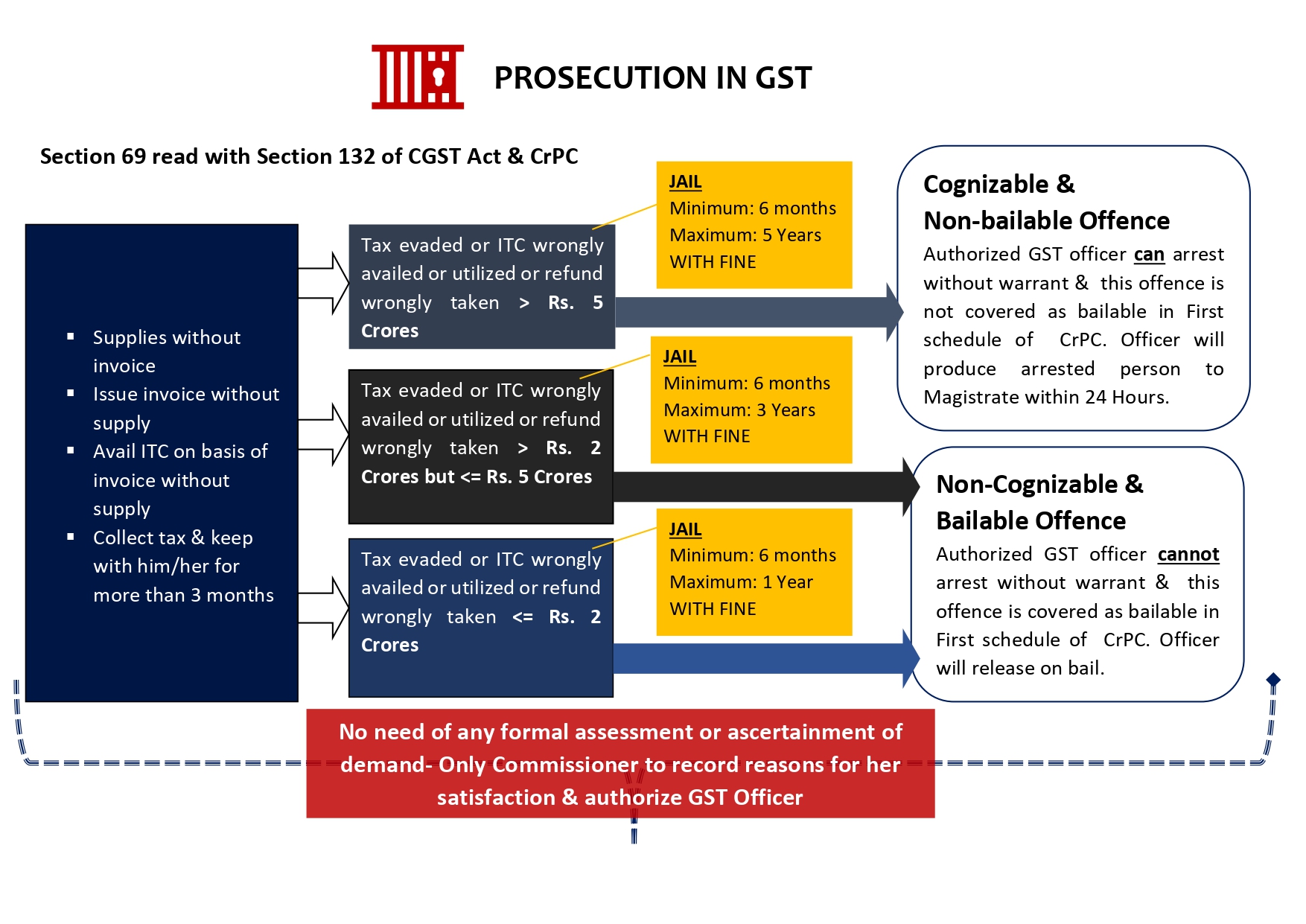
Prosecution under GST are as follows: