
BIG GOODS AND SERVICES TAX CHANGES FROM 1 MAY 2026
Page Contents
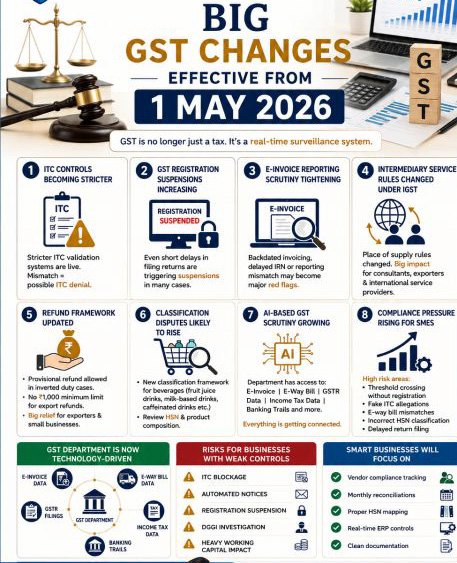
Businesses can no longer afford “approximate compliance.”
- From 1 May 2026, Goods and Services Tax compliance has evolved into a technology-driven, data-integrated, and risk-focused system.
- The Goods and Services Tax Dept. is now leveraging real-time data matching, artificial intelligence-based scrutiny, and advanced analytics to detect discrepancies with unprecedented speed and accuracy.
- What earlier remained unnoticed for months can now trigger notices, Input Tax Credit blockage, registration suspension, or even investigation within days.
Key Goods and Services Tax Changes Businesses Must Watch
- Stricter Input Tax Credit Validation: Mismatches in GSTR-2B, fake invoices, vendor noncompliance, and incorrect reporting may directly impact input tax credit claims.
- Increase in Goods and Services Tax Registration Suspensions: Even small delays in return filing or continuous non-compliance can lead to suspension of Goods and Services Tax
- E-Invoice Reporting Under Scanner: Backdated invoicing, delayed Invoice Reference Number generation and invoice mismatches are becoming major red flags for the department.
- Artificial Intelligence-Based Goods and Services Tax Monitoring: Artificial Intelligence-Based Goods and Services Tax monitoring involves the use of advanced algorithms and data analytics by the tax department to automatically track, compare, and verify information across multiple sources such as Goods and Services Tax returns, e-invoices, e-way bills, and financial data.
- It enables faster detection of mismatches, fake transactions, and compliance risks. Departments now have access to e-invoice data, e-way bill data, GSTR filings, income tax data, and banking trails. With artificial intelligence-based scrutiny, Goods and Services Tax authorities can identify mismatches in real-time, flag suspicious transactions instantly, track input tax credit fraud or fake invoicing, and trigger notices automatically, and this significantly reduces the scope for errors and delays in detection.
- Everything is becoming digitally connected. Compliance Pressure on SMEs Rising: Small and medium businesses are facing higher scrutiny in harmonized system of nomenclature classification, input tax credit claims, E-Way Bill matching, timely return filing, and vendor compliance.
Other Important Goods and Services Tax Changes Businesses Must Watch
- LUT Filing Mandatory Before Export: Taxpayers intending to export goods or services without payment of GST must file the Letter of Undertaking for FY 2026–27 before issuing any export invoice from 1 April 2026. Delayed filing may lead to non-compliance and tax complications.
- No Minimum Threshold for GST Refunds : The earlier restriction of a minimum refund claim of INR 1,000 has been removed. This allows businesses to claim even small and valid refund amounts, improving liquidity and cash flow.
- New Invoice Series Required: A fresh document series must be started from 1 April 2026 for tax invoices, debit notes, and credit notes. Proper numbering ensures better tracking and compliance and avoids duplication errors.
- Smart businesses will focus on vendor reconciliation, monthly compliance reviews, proper Harmonized System of Nomenclature mapping, real-time accounting controls, clean documentation, and Goods and Services Tax + Income Tax data consistency. 2026 is not just about filing goods and services taxes. It is about building a strong compliance system.
- Businesses that stay proactive will stay protected. Businesses that ignore compliance may face serious financial and legal consequences.
- The start of FY 2026–27 is a critical compliance checkpoint. File LUT immediately (if exporting), reset the invoicing system, review refund processes to claim eligible amounts, and align accounting and GST systems for the new financial year. Ensuring timely action can help businesses avoid penalties, maintain smooth operations, and improve cash flow efficiency.