
Practical Guide Old vs New Section Social Security Code 2020
Page Contents
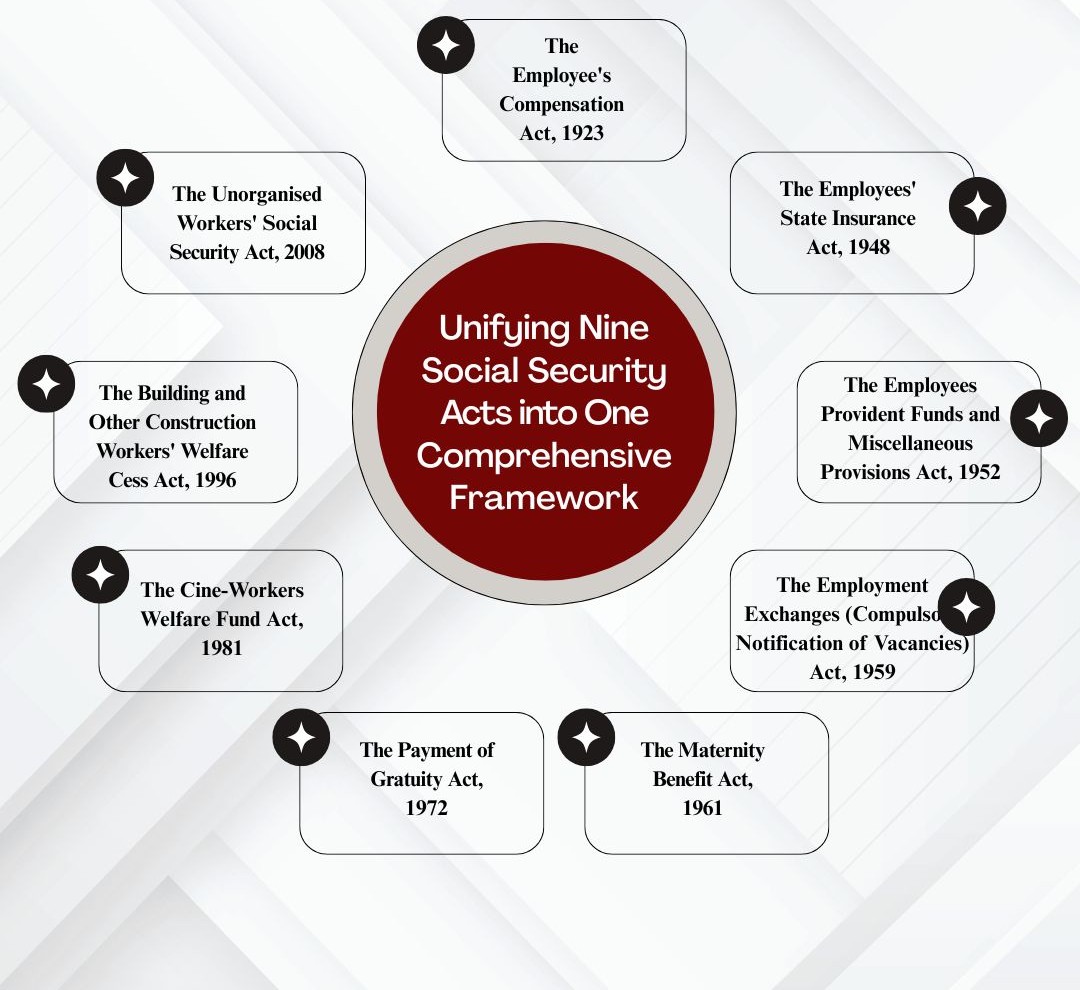
Understanding the Transition: Old vs New under Social Security Code, 2020
India’s labour law framework has undergone a major transformation with the introduction of the Social Security Code, 2020. Traditionally, HR and compliance professionals referred to separate laws such as PF, ESI, Gratuity, and Maternity Acts. However, the new code consolidates and restructures these laws into a single unified framework, bringing significant changes in definitions, applicability, and compliance requirements. The Social Security Code, 2020 is a game-changing reform in labour law compliance. Understanding the old vs. new mapping is now essential, not optional.
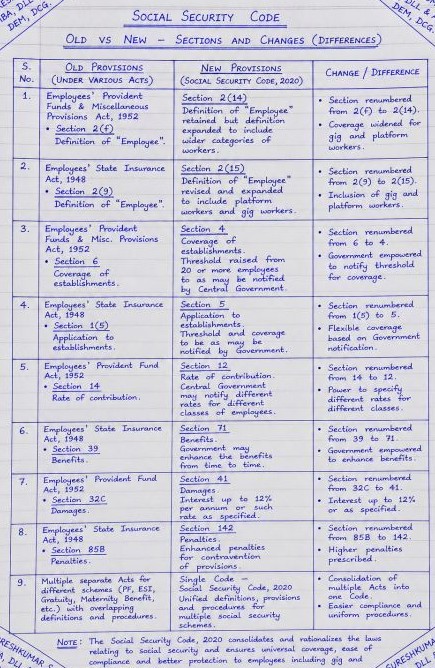
The handwritten note highlights a practical mapping of key changes between old provisions and new sections under the Social Security Code.
Current Reality of Social Security Code, 2020 – Old vs New Sections Explained
The guide provides a practical overview of India’s labour law reform, focusing on the transition from multiple laws to the Social Security Code, 2020 and its impact on employers and HR compliance.
India consolidated 29 labor laws into 4 Labour Codes to simplify compliance. The objective of the Social Security Code, 2020, is to reduce complexity, improve ease of doing business, and introduce uniform definitions and processes. The result of the Social Security Code, 2020, is a significant reduction in sections, forms, registers, and returns.
Social Security Code, 2020 From fragmented laws to a unified code. Multiple registrations, returns, and licenses are replaced with a single registration and a single electronic return. Registers reduced from 84 to 8, and forms from 181 to 73. Social Security Code, 2020 is Focus shifted from procedural burden → digital & simplified compliance.
Many companies are still Referring to old sections and Acts, maintaining legacy compliance systems, ignoring new definitions and coverage rules and This creates serious compliance risks
Action Points for Professionals are Map old provisions with new code sections, Update HR policies and SOPs, Align payroll systems with new contribution rules and Revisit employment contracts and benefits structures.
Key Highlights of Social Security Code, 2020
Wider Coverage of Employees : Expanded definition of “employee.” Inclusion of gig workers, platform workers, and unorganized workers. First-time formal recognition of new-age workforce
Definition of Employee
- Earlier: Defined separately under each Act (EPF Act, ESI Act, etc.)
- Now (Section 2(14)):
- Unified and expanded definition
- Includes gig workers and platform workers
- This is a major shift towards inclusive social security coverage
Employee State Insurance (ESI) Definition
- Earlier: Section 2(9) of ESI Act
- Now (Section 2(15)):
- Expanded to include platform-based employment
Coverage of Establishments (PF)
- Earlier: Fixed threshold (generally 20 employees)
- Now (Section 4):
- Threshold flexibility given to the government
- Can notify applicability based on sector or size
Applicability of ESI
- Earlier: Section 1(5) – fixed coverage
- Now (Section 5):
- Dynamic applicability based on notification
Contribution Provisions
- Earlier: Fixed contribution rates (e.g., PF Section 14)
- Now (Section 12):
- Government empowered to prescribe different rates for different classes
Benefits Framework under Social Security Code, 2020
- Earlier: Defined benefit structures under ESI Act (Section 46)
- Now (Section 71):
- Flexibility to enhance or modify benefits
Social Security Code, 2020 Applicability Provisions
- EPF: Applicable to establishments with 20+ employees
- ESI: Applicable to 10+ employees, even 1 employee in hazardous industries
- Gratuity & Maternity: Applicable to establishments with 10+ employees
Contribution & Benefits of Social Security Code, 2020
- Provident Fund: Employer contribution: 10% of wages and Equal employee contribution
- ESI Benefits: Sickness, maternity, disablement, dependents, medical benefits
- Gratuity: Payable after 5 years (or for fixed-term employees after 1 year) and Calculated at 15 days wages per year
Employee Welfare Enhancements
- Maternity leave: 26 weeks
- Mandatory crèche facility for 50+ employees
- Medical bonus and nursing breaks provided
Social Security Expansion
- Mandatory coverage for Gig & platform workers
- Aggregators required to contribute 1–2% of turnover
Construction Sector Compliance
- Cess on construction cost: 1%–2%
- Registration of workers with welfare boards is mandatory
Compliance Simplification for Employers: The Code introduces:
- Digital filings and records
- Unified returns
- Standardized registers
- Reduced inspections with facilitative approach
Emphasis on ease + transparency + accountability
Employer Action Framework under Social Security Code 2020
The guide provides a compliance lifecycle approach:
🔹 Foundational Compliance
- Registration, licenses, EPF/ESI setup
- Maintaining basic registers
🔹 Monthly Compliance
- Wage payments
- Deposit of PF/ESI
- Issue wage slips
🔹 Annual Compliance
- Filing unified return
- Updating wage rates
- Safety audits
🔹 Event-Based Compliance
- Reporting accidents
- Exit settlements
- Retrenchment/closure approvals
Interest & Damages under Social Security Code, 2020
- Earlier: PF Act Section 32C – limited provisions
- Now (Section 122):
- Interest up to 12% or as prescribed
Penalty Provisions under Social Security Code, 2020
- Earlier: ESI Act Section 85B
- Now (Section 142):
- Stronger and enhanced penalties for violations
Consolidation of Laws under Social Security Code, 2020
- Earlier: Multiple laws (PF, ESI, Gratuity, etc.) with separate compliance
- Now:
- Single Social Security Code
- Unified definitions and procedures
The Biggest Change: India has moved from multiple fragmented labor laws To one integrated social security code. This is not just renumbering of a section; it is a complete shift in compliance approach
Old vs New Approach under Social Security Code, 2020
| Old Framework | New Code |
| Multiple laws (PF, ESI, Gratuity, etc.) | Single unified Social Security Code |
| Different definitions | Standardized definitions |
| Manual & multiple filings | Digital & single filing |
| Limited coverage | Expanded coverage (gig workers) |
| Complex compliance | Simplified & streamlined |
Impact on Businesses & HR Professionals after Social Security Code 2020 :
- The new code directly affects HR compliance systems, payroll structuring, contractor & gig workforce management, labor law documentation, and employee benefit planning.
- The Social Security Code, 2020, is a major compliance reform, not just a legal consolidation. It brings uniformity in labour laws, wider employee coverage, technology-driven compliance, and reduced administrative burden.
- The guide emphasizes that employers must move from old law-based compliance to code-based compliance. Understanding old vs. new section mapping and applicability is critical for HR professionals, payroll teams, and compliance managers.