
Interim Dividend as per Companies Act
Page Contents
Interim Dividend as per Companies Act
Brief Introduction
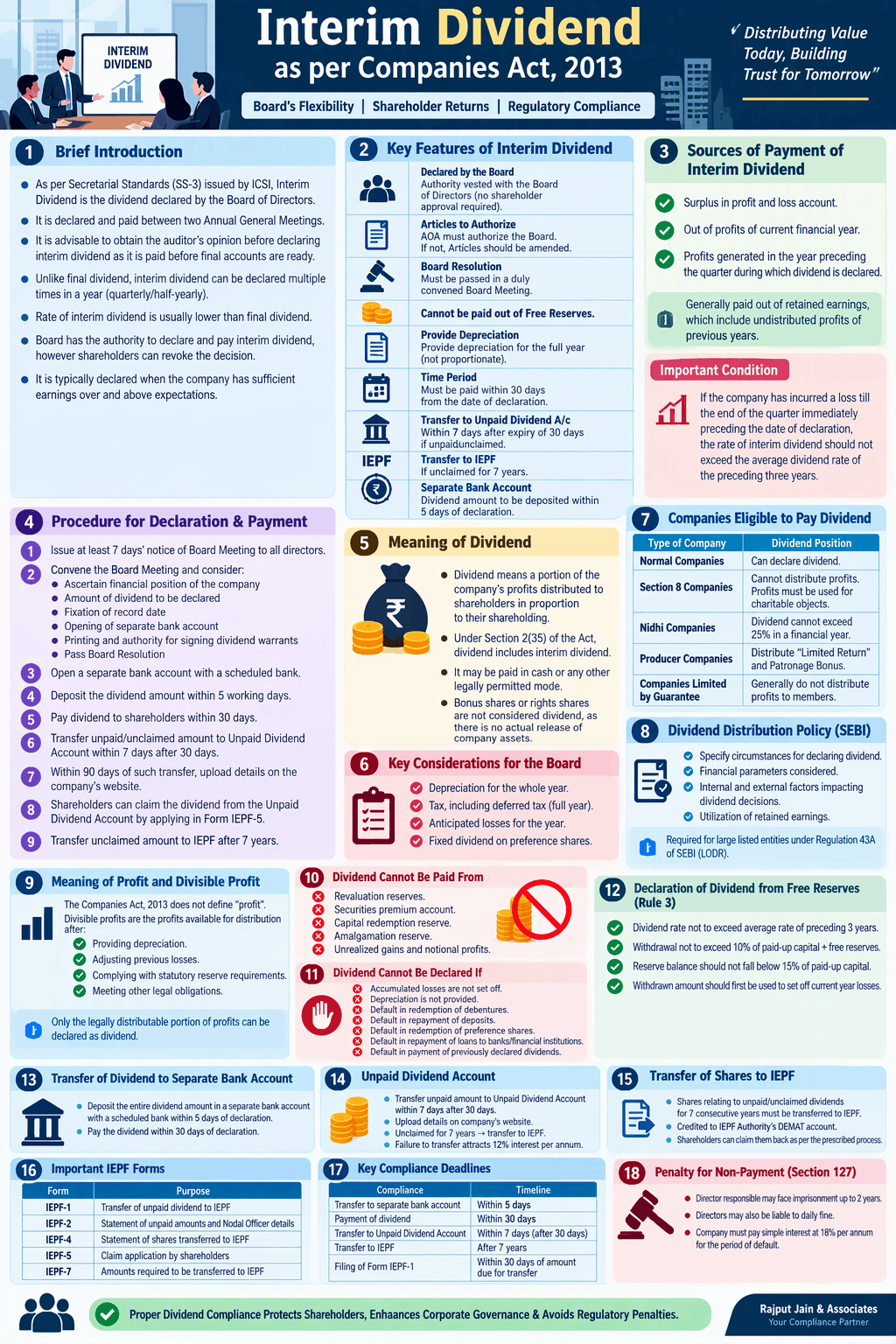
- In accordance with the Secretarial Standards, being issued by the Institute of Company Secretaries of India, Interim Dividend has been defined as the dividend which is declared by the Board of Directors.
- Such amount of dividend is declared and paid between two Annual General Meetings. Before declaration and payment of Interim Dividend, it’s advisable to require an opinion of Company’s Auditor as Interim Dividend is paid before Final Accounts of the corporate is ready and finalized.
- Unlike Final Dividend, Interim Dividend may be paid multiple times in an exceedingly year. Most of the companies tends to follow a practice of paying interim dividends on a quarterly or half-yearly basis.
- Rate of Interim Dividend is usually less than that of final Dividend.
- Board of directors have the authority to declare and pay Interim Dividend but on the opposite hand Shareholders of the corporate have the facility to revoke the choice of the Board and hence, refuse for the payment of Interim Dividend.
- Interim Dividend is typically declared by the Board of Directors when the corporate has sufficient earnings on top of expected.
Features of Interim Dividend
Interim Dividend Features are mention below :-
- Declaration by the Board- Under the Companies Act, 2013, the authority for declaration and payment of Interim Dividend has been vested only with the BOD’s (Board of Directors) and hence, there is no interference of shareholders in the same.
- Articles shall authorize- AOA(Articles of Association) of the corporate shall authorize Board for declaration of Interim Dividend. If Articles don’t authorize then, it must get altered before declaration of same.
- Pass Board Resolution- BOD shall pass Board Resolution within the committee meeting convened to declare Interim Dividend.
- Free Reserves- Interim Dividend can’t be paid out of Free Reserves.
- Provide Depreciation- Before declaring Interim Dividend, the corporate shall provide depreciation for full year not for partial/proportionate year.
- Time Period- Amount of such dividend shall be paid to respective shareholders, within 30 days from the date of declaration of dividend.
- Transfer to Unpaid Dividend Account- In case dividend remains unclaimed or unpaid within seven days of expiry of thirty days of declaration, then such amount shall be transferred to “Unpaid Dividend Account”.
- Transfer to IEPF- Any amount of dividend remains unclaimed for a continuous period of seven years, the same shall be transferred to Investor Education and Protection fund.
- Separate Bank Account- Within 5 days of declaration of Dividend, Amount to be distributed as a Dividend shall be transferred to a separate bank account.
Also Read : income tax treatment of a company’s dividend
Sources of Payment of Interim Dividend
The amount of Interim Dividend be paid from:
- Surplus in profit and loss account.
- Out of Profit of current financial year that such Interim Dividend is paid.
- Profit generated within the year preceding the Quarter during which such Dividend is asserted.
It is commonly seen that the amount of Interim Dividend is paid out of retained earnings, which, to some extent, consists of undistributed profits of previous financial years.
Till the tip of the quarter immediately preceding the date of declaration of Interim Dividend if the corporate has incurred loss, then the rate of dividend on such shares shall not be on top of the average rate of dividend during the immediately preceding three years.
Key Considerations on Interim Dividend
Some of the basic key points, which the Board of Directors must consider are –
- Depreciation of whole year
- Tax including deferred tax of the corporate of whole year
- Losses which are anticipated for year
- Fixed rate of Dividend that’s required to be paid on preference shares
Difference between Interim and Final Dividend
Procedure of Declaration & Payment on Interim Dividend
The procedure that’s required to be follow for the declaration & payment of dividend are as follows:
- At least 7 days’ notice of committee meeting shall be issued to every and each director of the corporate to call a committee meeting for a purpose of declaration of Interim Dividend.
- Board meeting shall be convened, and consideration of all matters associated with payment of Interim Dividend shall happen and it also includes:
o Ascertainment of financial position of the corporate
o Amount of dividend to be declared
o Fixation of record date
o Opening of bank account for the aim of transferring dividend
o Printing & granting authority for signing dividend warrants
o Pass Board Resolution for declaration and payment of Dividend.
- After passing Board resolution, separate bank account must be opened with the scheduled bank.
- Deposit the amount of Dividend payable therein account within five working days of declaration of such dividend.
- Dividend be paid to the respective shareholders, within 30 days from the date of declaration of said dividend.
- Where the amount of dividend remains unclaimed or unpaid, the same shall be transferred to a “Unpaid Dividend Account” and such transfer be made within 7 days from the expiration of thirty days from the date of declaration of such dividend.
- Within a period of ninety days of constructing any transfer in “Unpaid Dividend Account”, the corporate shall prepare an announcement containing names, address, etc and place it on a website, if any
- In case the a person desires to assert his amount of dividend from Unpaid Dividend account, then such person should apply in Form IEPF-5 to the corporate.
- Also, where any amount remains unclaimed in the “Unpaid Dividend Account” for a continuous period of 7 years, the said amount of unclaimed dividend be transferred to Investor Education and Protection Fund.
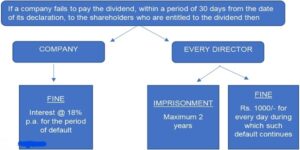
Section 127 : Punishment For Failure To Distribute Dividends
Wrapping up on Dividend
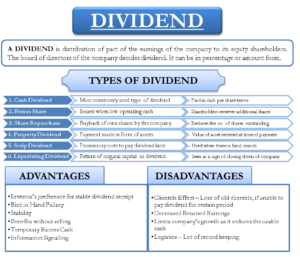
- It is important to note that no dividend shall be paid only in cash; nevertheless, dividends payable in cash may also be paid to the shareholder who is entitled to a dividend by cheque, warrant, or electronic communication.
- Interim Dividend is the amount of dividend, being declared by the Board of Directors before the finalisation of Annual accounts.
- this is also considered as debt of the corporate, that after declared it cannot be revoked.
- Board of directors shall analyse the financial position of the corporate before declaring any variety of Interim Dividend and such dividend shall be paid out of surplus in profit and loss account of the corporate.
- Rate of Interim Dividend is mostly lower as compared to the rate of final Dividend.
Key Judicial Principles on Distribution of Dividends
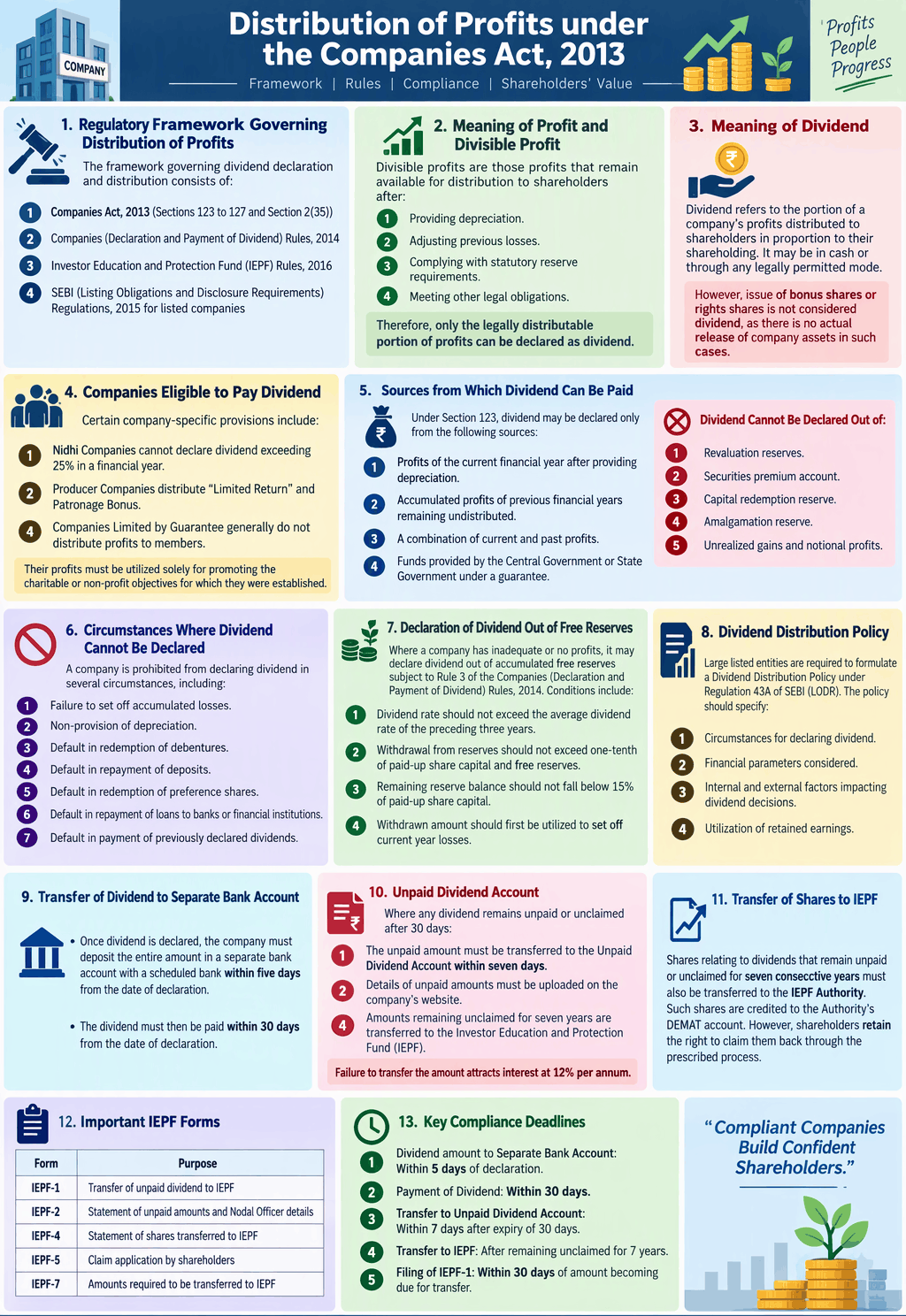
Based on the judicial pronouncements governing dividend distribution, several important legal principles have evolved that continue to guide companies, directors, and shareholders in matters relating to declaration and payment of dividends.
1. Dividend Can Be Declared Only Out of Legally Distributable Profits
The courts have consistently held that a company cannot distribute its entire profits as dividend. Before declaring any dividend, the company must provide for depreciation, adjust accumulated losses, and comply with statutory reserve requirements. Only the remaining divisible profits are available for distribution among shareholders. This principle was recognized in cases such as Moulton L.J.’s observations in Re. Spanish Prospecting Co. Ltd. and Bharat Insurance Co. Ltd. v. CIT.
2. Recommendation of Dividend by the Board Does Not Create a Legal Obligation
A recommendation made by the Board of Directors is merely a proposal and does not create an enforceable liability against the company. The legal obligation to pay dividend arises only when the shareholders formally approve and declare the dividend at the Annual General Meeting. This principle was affirmed in Vazir Sultan Tobacco Co. Ltd. v. Commissioner of Income-Tax.
3. Once Declared, Dividend Becomes a Debt and Cannot Be Revoked
After a dividend is validly declared, it becomes a debt due from the company to its shareholders. The company cannot subsequently withdraw, modify, or cancel such declared dividend. This principle was reiterated in Kishinchand Chellaram v. Commissioner of Income Tax and Tarajan Tea Co. (P) Ltd. v. CIT.
4. Shareholders Cannot Compel the Company to Declare Dividend
The declaration of dividend remains a business decision of the company and its management. Even where a company has earned profits, shareholders do not possess an absolute legal right to force the declaration of dividend through court proceedings. This principle was clearly established in C.W. Spencer v. ITO.
5. Dividend Is Payable Primarily to Registered Shareholders
For the purpose of dividend distribution, the company recognizes only those persons whose names appear in the Register of Members. A beneficial owner generally cannot claim dividend directly from the company unless specific authorisation exists. This legal position was affirmed in Rameshwar Lal Sanwarmal v. Commissioner of Income Tax and Chunilal Kuhshaldash Patel v. H.K. Adhyaru.
6. Unclaimed Dividend and Related Shares May Be Transferred to IEPF
Amounts remaining unpaid or unclaimed for the prescribed statutory period are required to be transferred to the Investor Education and Protection Fund Authority (IEPF). Similarly, shares in respect of which dividends remain unclaimed for seven consecutive years are liable to be transferred to the IEPF. The constitutional validity of these provisions was upheld in Kamala Srinivasan v. Union of India.
7. Courts Aim to Balance Shareholder Rights with Corporate Financial Prudence
Judicial authorities have repeatedly emphasized that while shareholders are entitled to a fair share of distributable profits, companies must also retain sufficient resources for business operations, future growth, and financial stability. Accordingly, courts have sought to strike a balance between investor protection and prudent financial management.
8. Final Dividend Can Be Declared Only by Shareholders at the AGM
The Board of Directors may recommend the amount of final dividend, but the actual declaration must be made by the shareholders in a duly convened Annual General Meeting. However, shareholders cannot declare a dividend exceeding the amount recommended by the Board. This principle was established in Raghunandan Neotia v. Swadeshi Cloth Dealers Ltd. and Maharani Lalita Rajya Lakshmi v. Indian Motor Co. (Hazaribag) Ltd..
9. Interim Dividend May Be Declared by the Board of Directors
Unlike final dividend, interim dividend can be declared directly by the Board of Directors, provided the Articles of Association authorize such action and adequate profits are available. The requirement of shareholder approval is not mandatory in such cases. This principle was recognized in J. Dalmia v. Commissioner of Income Tax.
10. Non-Declaration of Dividend Does Not Amount to Oppression or Mismanagement
The mere fact that a company chooses not to declare dividend does not automatically constitute oppression or mismanagement under company law. Courts have recognized that business considerations may justify the retention of profits within the company. This principle was upheld in Indowind Energy Ltd. v. ICICI Bank Ltd..
Conclusion
The judicial interpretation of dividend laws under the Companies Act establishes that dividend is a distribution of legally divisible profits, not an automatic right arising from profitability. While shareholders are protected once a dividend is declared, the courts have consistently recognized the discretion of the Board and shareholders in determining whether profits should be distributed or retained for the long-term interests of the company. These principles collectively promote transparency, financial discipline, and sound corporate governance