
Employment Information Return -Code on Social Security, 2020
Page Contents
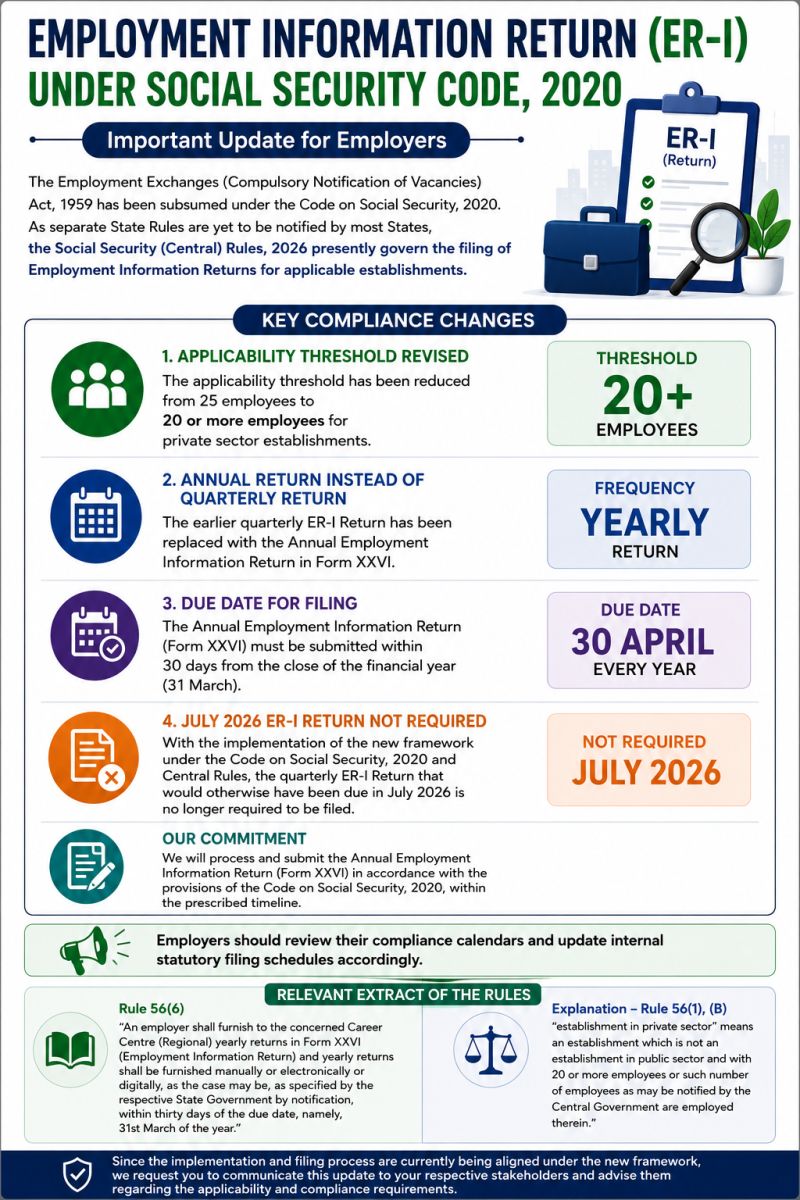
Employment Information Return (Form XXVI) under the Code on Social Security, 2020
The Employment Exchanges (Compulsory Notification of Vacancies) Act, 1959 has now been integrated into the Code on Social Security, 2020. As most states are yet to notify their respective rules, the Code on Social Security (Central) Rules, 2026 currently govern the filing requirements for employment information returns.
Key Compliance Updates for Employers
Expanded Applicability of the Threshold: under Code on Social Security, 2020
The threshold for private sector establishments has been reduced from 25 employees to 20 or more employees, bringing a larger number of employers within the compliance framework.
Annual Filing Replaces Quarterly Reporting under Code on Social Security, 2020
The erstwhile ER-I quarterly return has been discontinued and replaced with the Annual Employment Information Return (Form XXVI).
- Filing Due Date: Form XXVI must be filed within 30 days from the close of the financial year.
- Due Date for FY 2026-27: 30 April 2027
- No ER-I Return Required for July 2026
With the transition to the new compliance regime under the Code on Social Security, 2020, the quarterly ER-I return that would have been due in July 2026 is no longer applicable. Going forward, covered establishments are required to file only the annual Form XXVI.
Action Required: from Employers
Employers should promptly review their workforce strength, assess applicability under the revised threshold, and update compliance calendars to ensure timely filing under the new framework. The following are key takeaways for employers: The Social Security rules significantly increase compliance obligations through:
- Digitization and electronic filings.
- Strict timelines for claims and reporting.
- Expanded protections for gig and platform workers.
- Detailed maternity and crèche standards.
- Stronger obligations regarding gratuity, compensation, and worker registration.
- Enhanced record-keeping and annual return requirements.
Organizations should review HR, payroll, labor-law compliance, contractor management, and digital record-keeping processes to ensure readiness under the Social Security Code framework.
Common Compliance Mistakes Employers Must Avoid in 2026
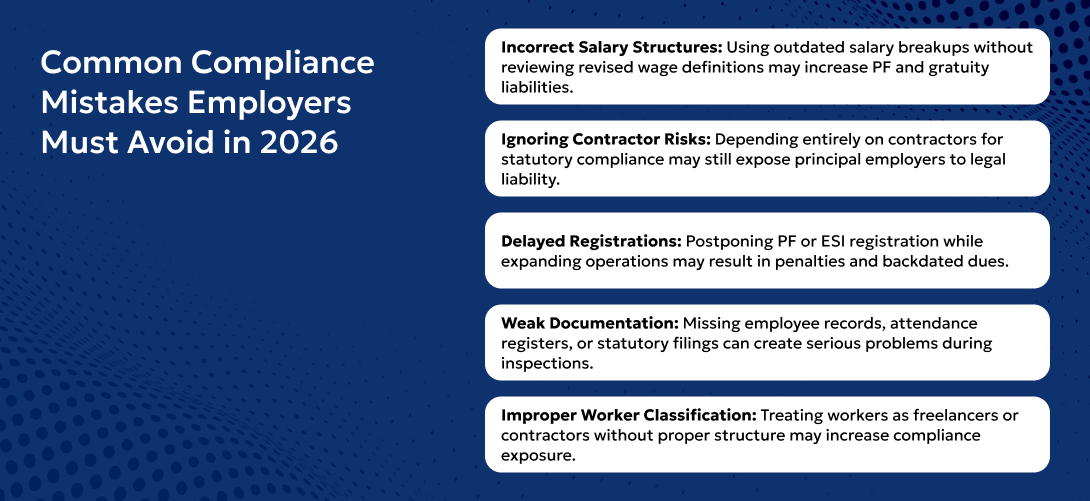
The Social Security Code and the newly notified Social Security Rules are transforming the compliance landscape for employers. With increased digitisation, stricter reporting obligations, expanded social security coverage, and enhanced record-keeping requirements, organisations must proactively review their HR, payroll, and labour law practices. Employers should particularly avoid the following mistakes:
1. Incorrect Salary Structures
Many organisations continue to use legacy salary structures without evaluating the revised wage definitions under labour codes. An improper salary breakup can result in:
- Higher PF contribution liabilities
- Increased gratuity obligations
- Retrospective compliance exposures
- Payroll restructuring costs
A periodic review of compensation structures is critical to ensure compliance and cost predictability.
2. Ignoring Contractor Compliance Risks
Principal employers often assume that labour law compliance is solely the contractor’s responsibility. However, regulators frequently hold principal employers accountable for:
- PF and ESI defaults
- Worker registration failures
- Wage payment irregularities
- Social security violations
Robust contractor due diligence and regular compliance audits are essential.
3. Delayed Registrations
Delaying EPF, ESI, BOCW, or other statutory registrations while expanding operations can lead to:
- Interest and penalties
- Backdated contribution liabilities
- Regulatory scrutiny
- Litigation risks
Businesses should assess registration requirements before crossing statutory thresholds.
4. Weak Documentation and Record-Keeping
The Social Security Rules place significant emphasis on records, returns, registrations, and electronic filings. Failure to maintain proper documentation may create serious issues during inspections and audits.
Key records include:
- Employee registers
- Attendance and muster rolls
- Wage and overtime records
- Gratuity and maternity benefit records
- Contractor compliance documents
- Annual statutory returns
Employers should maintain records in a readily accessible and auditable format.
5. Improper Worker Classification
Classifying workers as freelancers, consultants, contractors, gig workers, or fixed-term employees without proper assessment can create substantial compliance exposure.
Incorrect classification may lead to:
- PF and ESI demands
- Gratuity claims
- Compensation liabilities
- Litigation and reputational risk
Worker engagement models should be reviewed against the actual nature of work and control exercised by the organisation.
The compliance focus in 2026 is shifting from merely filing returns to maintaining a defensible compliance ecosystem supported by proper documentation, timely registrations, accurate worker classification, and continuous monitoring of statutory obligations. Organisations that invest in compliance governance today will be better positioned to avoid penalties, disputes, and operational disruptions tomorrow