
𝐓𝐚𝐱 𝐀𝐮𝐝𝐢𝐭 𝐀𝐩𝐩𝐥𝐢𝐜𝐚𝐛𝐢𝐥𝐢𝐭𝐲 𝐟𝐨𝐫 𝐅𝐮𝐭𝐮𝐫𝐞𝐬 & 𝐨𝐩𝐭𝐢𝐨𝐧𝐬 𝐓𝐫𝐚𝐝𝐞𝐫𝐬
Page Contents
Taxation of F&O trading as non-speculative business:
- F&O trading is treated as non-speculative business income u/s 43(5) and is taxable at normal income tax slab rates, with expenses such as securities transaction tax, brokerage, and exchange charges allowed as deductions.
- Futures & options traders are generally required to maintain books of account u/s 44AA if prescribed income or turnover thresholds are exceeded. Essential records include broker statements, contract notes, bank statements, ledgers, journals, and supporting documents for expenses. Failure to maintain books can attract a penalty of INR 25,000 u/s 271A.
- The balance sheet should disclose capital, loans, bank balances, broker margin, investments, and other assets/liabilities. Trading-related expenses such as brokerage, securities transaction tax, exchange charges, interest, internet costs, research subscriptions, depreciation, and chartered accountant fees are deductible when supported by proper records. Open F&O positions should be accounted for on a consistent MTM basis as reflected in the broker ledger at year-end.
- futures & options losses cannot be set off against salary income but can be adjusted against capital gains and certain other incomes in the same year, and any unabsorbed loss can be carried forward for 8 years if the return is filed on time. Unlike intraday equity trading (speculative), futures & options trading enjoys broader loss set-off and carry-forward benefits.
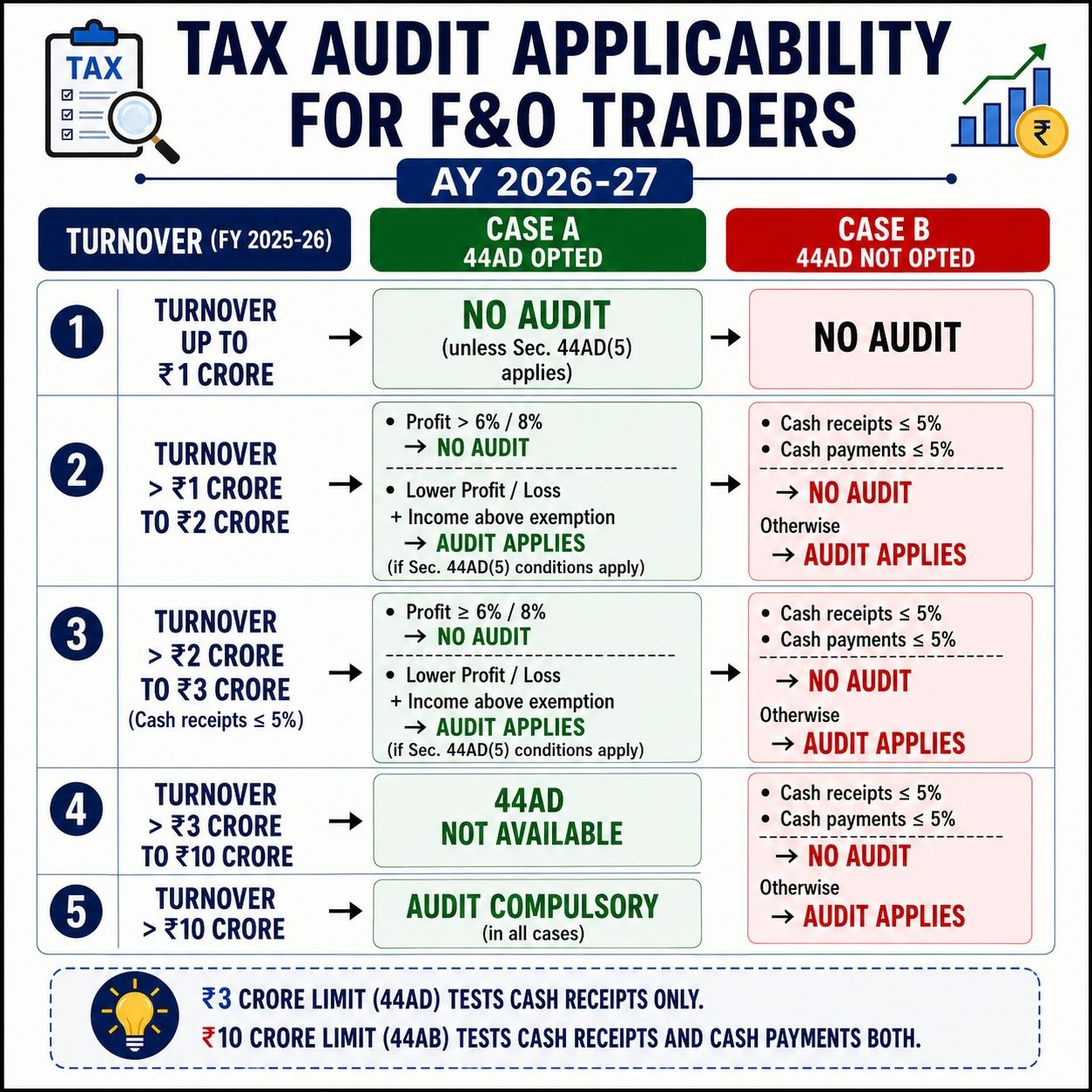
𝐓𝐚𝐱 𝐀𝐮𝐝𝐢𝐭 𝐀𝐩𝐩𝐥𝐢𝐜𝐚𝐛𝐢𝐥𝐢𝐭𝐲 𝐟𝐨𝐫 𝐅𝐮𝐭𝐮𝐫𝐞𝐬 & 𝐨𝐩𝐭𝐢𝐨𝐧𝐬 𝐓𝐫𝐚𝐝𝐞𝐫𝐬 (𝐀𝐘 𝟐𝟎𝟐𝟔-𝟐𝟕)
We are here going to summarize when a tax audit under Section 44AB may apply to taxpayers engaged in futures & options trading, which is treated as non-speculative business income under the Income Tax Act. The applicability primarily depends upon Futures & Options Turnover, Whether Section 44AD is opted for, profit declared, and Cash receipts and cash payments percentage
A tax audit for futures & options traders is not mandatory in all cases. It is generally required only when turnover exceeds prescribed limits under Section 44AB or when the taxpayer had opted for Section 44AD presumptive taxation in the previous 5 years and is now declaring lower income or losses.
For digital futures & options traders, the audit threshold can extend up to INR 10 crore, reducing audit requirements. However, non-compliance where a tax audit is mandatory can attract a penalty up to INR 1.5 lakh, and the audit must be conducted by a practicing chartered accountant who submits Form 3CB/3CD before filing ITR-3.
Understand Futures & Options Turnover
For F&O traders, turnover is not the contract value. Generally, turnover includes:
- Absolute profit and loss from futures & options transactions.
- Premium received on sale of options.
- Differences arising on reverse trades.
For most modern futures & options traders, transactions are carried out through banks and stockbrokers, resulting in cash receipts and cash payments well below 5%. Consequently, a tax audit is generally not required even for a turnover up to INR 10 crore, provided the prescribed cash transaction conditions are satisfied. However, traders declaring lower profits u/s 44AD, reporting losses, or crossing the INR 10 crore threshold should carefully evaluate audit applicability before filing their income tax return.
Futures & Options income and equity capital gains are taxed separately, with Futures & Options treated as business income and capital gains taxed at special rates. GST registration is not required for futures & options trading, no TDS is deducted on F&O profits, and advance tax may apply. Where a taxpayer has both business and Futures & Options activities, their turnovers are aggregated to determine tax audit applicability.
The turnover calculation is crucial because audit applicability is based on turnover thresholds.
Case A: Section 44AD Opted
Turnover up to INR 1 crore:
- The audit position is clear here, and no tax audit is applicable in this case. However, an audit may become applicable if Section 44AD(5) provisions are triggered.
Turnover Above INR 1 Crore up to INR 2 Crore:
- In this case If profit declared is ≥ 6% / 8%, then No tax audit is applicable and 6% for eligible digital receipts and 8% for other receipts
- If profit is lower or loss is declared, then a tax audit is applicable in case total income exceeds the basic exemption limit and conditions of Section 44AD(5) are attracted.
Turnover Above INR 2 Crore up to INR 3 Crore: (Cash Receipts ≤ 5%)-
- If profit is ≥ 6% / 8%, then No tax audit is applicable
- In case we declare it as a lower profit or loss, then an audit is applicable if conditions u/s 44AD(5) are applicable.
Turnover Above INR 3 Crore up to INR 10 Crore
- In this case Section 44AD is not available, and the presumptive taxation scheme cannot be opted for beyond the prescribed limit. Tax audit applicability will then be examined under normal provisions of Section 44AB.
Turnover Above INR 10 Crore:
Audit Position: A tax audit is compulsory regardless of profit level.
Case B: Section 44AD Not Opted
This is the situation for many active F&O traders who maintain books and declare actual profits or losses.
- Turnover up to INR 1 crore, then No Tax Audit
- In case Turnover Above INR 1 Crore up to INR 10 Crore
When Both Conditions Are Satisfied
- Cash Receipts ≤ 5% of total receipts
- In case cash payments are ≤ 5% of total payments
In case there will be no tax audit. This relaxation is particularly beneficial for futures & options traders because most transactions occur via bank accounts, trading accounts, and electronic settlement mechanisms.
- If Either Condition Fails: Audit Applicable Where cash transactions exceed prescribed limits.
- Turnover Above INR 10 Crore: Audit Mandatory. Audit becomes compulsory u/s 44AB.
Special Point for Futures & Options Traders Reporting Loss
This is where many traders get confused.
Example: F&O Turnover: INR 80 lakh, Net Loss: INR 5 lakh and Total Income below exemption limit
- Generally, In this case Tax audit may not be required. However, facts such as filing under a presumptive scheme, opting out of Section 44AD, and total income level. must be examined carefully. Every loss case should be reviewed separately before concluding whether an audit is applicable.
INR 3 Crore Limit (Section 44AD): The INR 3 crore threshold checks: Cash Receipts only
INR 10 Crore Limit (Section 44AB) : The enhanced ₹10 crore threshold checks cash receipts ≤ 5% and cash payments ≤ 5% if both conditions must be satisfied.
Practical Example in Futures & Options Traders:
-
- Example 1 : F&O Turnover: INR 1.50 Crore, Profit Declared: INR 12 Lakh (8%), Section 44AD Opted, No tax Audit application
- Example-2: Futures & Options Turnover: INR 1.50 Crore, Loss Declared: INR 2 Lakh, Section 44AD Opted: Income above exemption limit, and finally, audit may apply.
- Example 3: F&O Turnover: INR 5 Crore, Cash Receipts: Nil, Cash Payments: Nil, Section 44AD Not Opted: In this case, no audit as cash receipts and cash payments are within 5%.
- Example-4: Futures & Options Turnover: INR 11 crore. Regardless of profit or loss, in this case, a tax audit is mandatory.
ITR filling in case of 𝐅𝐮𝐭𝐮𝐫𝐞𝐬 & 𝐨𝐩𝐭𝐢𝐨𝐧𝐬 𝐭𝐫𝐚𝐝𝐞𝐫𝐬
- Salaried individuals who trade in F&O must file ITR-3, reporting salary income under Schedule S and F&O profits/losses under Schedule BP. F&O profits are taxed at normal slab rates, while F&O losses cannot be set off against salary income and can be carried forward for 8 years.
- Futures & options traders commonly receive defective return notices under Section 139(9) due to filing the wrong income tax return form, not furnishing the balance sheet and P&L account, incomplete Schedule BP details, or failure to submit a mandatory tax audit report. Such defects can usually be rectified by filing a corrected ITR-3 within the prescribed time.
- F&O traders should generally file ITR-3 (not ITR-1, ITR-2, or ITR-4 when reporting losses or actual profits). The due date is 31 August 2026 for non-audit cases and 31 October 2026 where a tax audit is applicable. Timely filing is essential to preserve the carry-forward of losses.
- To file ITR-3, traders need broker statements, bank records, Form 26AS/AIS, Form 16 (if applicable), and financial statements. Futures & options income is reported in Schedule BP as business income, and any mistake such as filing ITR-2 can be corrected through a revised return under Section 139(5) up to 31 March 2027.
Taxation of F&O traders
- A scrutiny notice under Section 143(2) should be responded to promptly with proper supporting documents. Maintaining a well-prepared balance sheet that clearly reconciles sources and uses of funds helps substantiate trading activities, reduces the risk of adverse assessments, and makes handling scrutiny proceedings much easier.
- F &O traders can download their annual profit & loss statement from their broker platform (such as Zerodha Console), but turnover for income tax purposes may need to be recomputed as per ICAI guidelines by a CA. Traders should preserve broker statements, contract notes, bank records, tax challans, income tax return acknowledgements, financial statements, expense bills, and tax-related correspondence for at least 6 years.
- Futures & options profits are not subject to TDS, so traders must independently pay advance tax if their net tax liability exceeds INR 10,000. Advance tax is payable in prescribed installments during the financial year, and failure to comply may attract interest under Sections 234B and 234C of the Income Tax Act.
How Rajput Jain and associates officer
- Rajput Jain and Associates provides comprehensive F&O tax compliance services, including turnover computation as per Institute of Chartered Accountants of India guidelines, preparation of books of account, balance sheet, and P&L; tax audit applicability assessment; tax audits u/s 44AB, ITR-3 filing; loss carry-forward reporting; notice handling; scrutiny representation; advance tax planning; tax regime analysis; and AIS/Form 26AS reconciliation.
- While hiring a chartered accountant for futures & options return filing is not mandatory, it is highly recommended due to the complexities of ITR-3, turnover computation, tax audit requirements, and compliance procedures. Professional fees paid to chartered accountants are also allowable as a business expense against futures & options income.