
CFO Cum WTD? ROC Gwalior Says No in EKI Energy Services Case
Page Contents
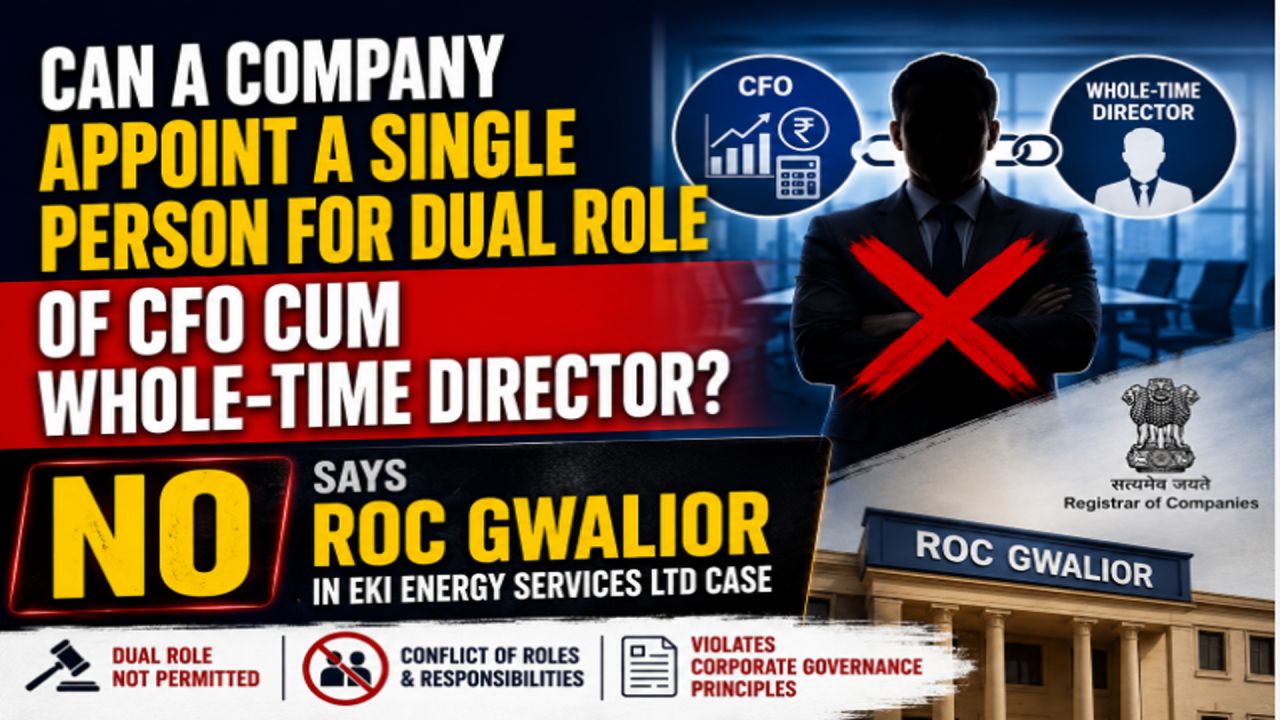
CFO Cum whole-time director? ROC Gwalior Says No in EKI Energy Services Case
Corporate governance is built on the principle of accountability, transparency, and segregation of responsibilities. A recent order by the Registrar of Companies, Gwalior, has reinforced this principle by holding that a company cannot appoint the same individual as both the chief financial officer and whole-time director u/s 203(1) of the Companies Act, 2013.
The ruling in the EKI Energy Services Ltd. case serves as a significant reminder for companies to ensure strict compliance with key managerial personnel requirements and avoid combining statutory roles that are intended to function independently.
The Key Observation
- One of the most significant observations in the order is that “the legislative intent underlying the provision is an appropriate segregation of the key managerial functions and accountability within the corporate governance framework.
- The appointment of the same person as WTD and CFO, without appointing another person to discharge the functions of CFO, defeats the underlying purpose of Section 203(1) of the Act.”
- This observation makes it clear that the ROC is focusing not merely on the literal wording of the law but also on the legislative intent behind the provision.
The EKI Energy Services Ltd. Case
The RoC, Gwalior, passed a landmark order against EKI Energy Services Ltd. for appointing the same individual as both the CFO and whole-time director of the company.
Penalties Imposed
- INR 500,000 penalty on EKI Energy Services Ltd.
- INR 50,000 penalty on the Managing Director as the officer in default
The order highlights the regulator’s strict approach towards compliance with the provisions relating to Key Managerial Personnel under the Companies Act, 2013.
Company’s Argument
The company contended that the Companies Act, 2013 does not expressly prohibit a dual appointment where the same individual acts as both CFO and whole-time director.
According to the company, since there was no specific restriction mentioned in the Act, such an appointment should not be considered a violation. However, the RoC rejected this argument.
ROC Gwalior’s Interpretation of Section 203(1)
The RoC clarified that Section 203(1) of the Companies Act, 2013 mandates the appointment of separate whole-time Key managerial personnel, namely:
- Managing Director / Whole-Time Director / Manager
- Company Secretary
- Chief Financial Officer (CFO)
According to the Registrar of Companies, each position represents a distinct statutory function and cannot be merged merely because the law does not contain an explicit prohibition against such dual appointments.
The legislative intent behind Section 203(1) is to ensure an effective framework of corporate governance through the segregation of powers, responsibilities, and accountability.
Why Dual Appointment Was Held Invalid
Distinct Roles Under the Law
The Registrar of Companies observed that every position specified under Section 203(1) is an independent “limb” of the statutory framework.
A chief financial officer is entrusted with the following:
- Financial reporting
- Internal financial controls
- Budgeting and treasury management
- Financial compliance
A whole-time director, on the other hand, is responsible for:
- Strategic decision-making
- Day-to-day management
- Operational oversight
- Implementation of board decisions
Combining these functions in one individual defeats the objective of establishing checks and balances within the organization.
Segregation of Functions
The central principle emphasized in the order is the segregation of managerial responsibilities. When the same individual performs both roles:
- Financial oversight becomes concentrated.
- Independent accountability is diluted.
- Corporate governance standards weaken.
- Internal checks and balances become ineffective.
The Registrar of Companies held that legislation intends these functions to remain separate to ensure transparency and accountability.
Violation Identified
Non-Compliant Appointment
The violation arose because
- One individual was appointed as a whole-time director.
- The same individual was simultaneously designated as chief financial officer.
- No separate person was appointed to discharge the functions of CFO.
As a result, the company failed to comply with the statutory requirement relating to the appointment of separate key managerial personnel.
Key Legal Principles Emerging From the Order
1. Statutory Roles Must Be Kept Separate
The Companies Act may not expressly state that one person cannot hold both positions, but the structure and intent of Section 203(1) require separate appointments.
2. Legislative Intent Prevails
The Registrar of Companies emphasized that legal interpretation must consider the purpose of the provision and not merely its literal wording.
3. Corporate Governance Requires Independence
Independent oversight of financial functions cannot be achieved if financial management and executive management are concentrated in one individual.
4. Accountability Cannot Be Aggregated
Combining multiple key managerial personnel positions in a single person aggregates power rather than creating the accountability framework envisioned by the Companies Act.
Lessons for Companies
The EKI Energy Services ruling offers several practical lessons:
Review Existing Key managerial personnel Structure
Companies should immediately review whether their key managerial personnel appointments comply with Section 203.
Avoid Dual-Hatting Arrangements
The practice of assigning multiple statutory roles to a single individual may attract regulatory scrutiny and penal consequences.
Strengthen Corporate Governance
A robust governance framework requires the following:
- Clear segregation of duties
- Independent accountability
- Proper documentation of appointments
- Periodic compliance reviews
Focus on Substance Over Form
Regulators will examine the actual purpose and effect of appointments rather than relying solely on technical interpretations.
The Registrar of Companies Gwalior order in the EKI Energy Services Ltd. case sends a strong message that corporate governance is not merely about complying with the letter of the law, but also with its spirit.
While the Companies Act, 2013 may not expressly prohibit a CFO from also serving as a Whole-Time Director, the regulator has made it clear that combining these positions defeats the fundamental objective of Section 203(1), namely, the segregation of key managerial functions and independent accountability.
Final Thoughts
- The Registrar of Companies Gwalior order in the EKI Energy Services Ltd. case sends a clear message to the corporate sector. Key managerial personnel positions are not merely designations but independent statutory offices designed to ensure accountability and sound corporate governance.
- Companies should not treat Section 203(1) as a procedural requirement. The provision embodies a fundamental governance principle that separates financial oversight from executive management.
- This landmark order is likely to become an important reference point in future discussions on key managerial personnel appointments, corporate governance, and compliance under the Companies Act, 2013.
It serves as a timely reminder that when it comes to governance, independence of roles matters as much as the qualifications of the individuals occupying them.
- The ruling reinforces that compliance is not about finding loopholes but about upholding the spirit of the law.
- Businesses must ensure that key managerial personnel appointments are structured carefully, with distinct individuals occupying distinct statutory positions.
In short: No shortcuts, no dual-hatting, and no compromise on corporate governance.