
Gurugram Public Advisory Against Unauthorized PG/Guest House
Page Contents

Gurugram Issues Public Advisory Against Unauthorized PGs and Guest Houses
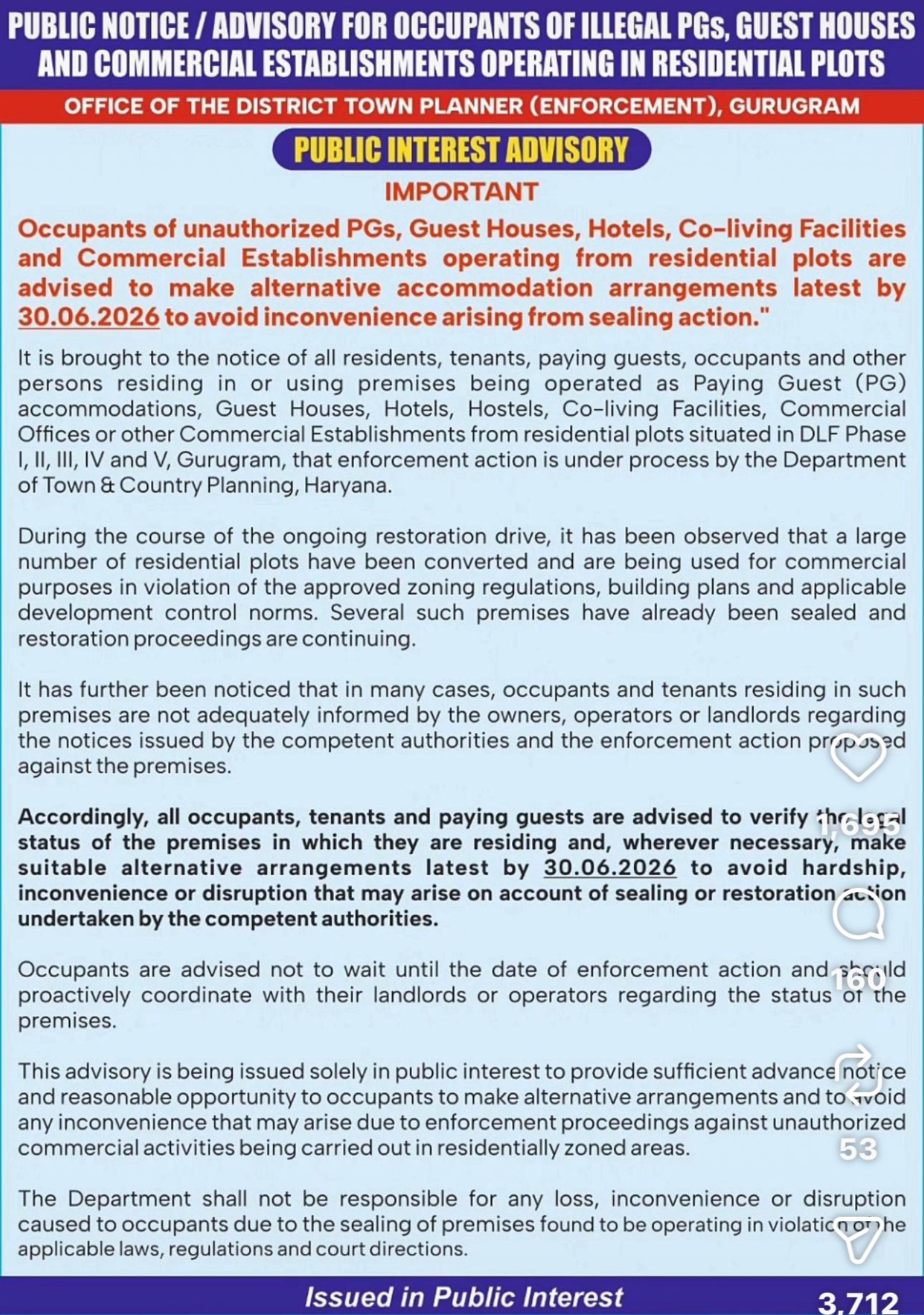
The Office of the District Town Planner (Enforcement), Gurugram, has issued a significant public notice warning occupants of unauthorized Paying Guest (PG) accommodations, guest houses, hotels, co-living facilities, and commercial establishments operating from residential plots in DLF Phases I to V. The Gurugram advisory asks residents, tenants, and paying guests to make alternative accommodation arrangements by 30 June 2026, as enforcement and sealing actions are underway against properties found violating zoning and development regulations. This development has created concern among thousands of working professionals, students, and property owners who rely on the city’s extensive PG and co-living ecosystem.
What Does the Notice Say?
According to the Office of the District Town Planner (Enforcement), Gurugram advisory A large number of residential plots have allegedly been converted into commercial establishments. Such usage is stated to be in violation of approved zoning regulations, building plans, and development control norms. Several premises have already been sealed. Further restoration and enforcement proceedings are continuing. Occupants are advised to verify the legal status of their accommodation, and tenants and paying guests are encouraged to shift before 30 June 2026 to avoid disruption.
The Office of the District Town Planner (Enforcement), Gurugram department, has also clarified that it shall not be responsible for any inconvenience or losses caused due to sealing actions undertaken against unauthorized establishments.
Why Is the Government Taking Action?
The crackdown is part of a larger effort by authorities to restore residential neighborhoods to their intended use. Over the years, areas such as DLF Phase I, II, III, IV, and V have witnessed rapid growth in PG accommodations, Co-living facilities, small guest houses, commercial offices, and Boutique hotels
Many of these establishments emerged to cater to Gurugram’s growing workforce employed in IT, consulting, finance, startups, and multinational corporations. However, authorities argue that several operators are running commercial activities from plots approved solely for residential purposes. Government has common regulatory concerns, including:
- Land Use Violations: Residential properties are often governed by specific zoning regulations. Running commercial establishments without necessary permissions may amount to misuse of land.
- Building Safety Issues: Higher occupancy levels can strain Parking facilities, Fire safety arrangements, structural capacity, and Sewage and water infrastructure
- Neighborhood Impact: Residents frequently raise concerns regarding Traffic congestion, Parking problems, noise disturbances, and Increased commercial activity in residential colonies
Who Will Be Affected?
- Paying Guests and Tenants: The immediate impact will be on occupants residing in affected properties. They may face Sudden eviction risks, Relocation expenses, Security deposit disputes and Difficulty finding alternative accommodation during peak demand
- Property Owners: Owners operating PGs or guest houses without required approvals may face sealing of premises, financial losses, regulatory penalties, and litigation costs.
- Investors: Investors who purchased residential property with the intention of operating commercial accommodation may need to reassess compliance requirements.
Legal Questions That May Arise
Several important legal issues are likely to emerge:
Whether All PGs Are Illegal?
- Not necessarily. The legality of a PG or guesthouse depends upon applicable zoning regulations, licensing requirements, municipal permissions, building approval conditions, and Fire and safety compliance norms. Every property must be examined individually.
Can Tenants Claim Compensation?
- Occupants may have contractual rights depending upon rent agreement terms, security deposit arrangements, and representations made by landlords. Disputes may arise if tenants were not informed about pending notices or enforcement proceedings.
Can Sealing Orders Be Challenged?
- Property owners may avail themselves of legal remedies before appropriate authorities or courts, depending on the facts of the case and the nature of alleged violations.
Economic Impact on Gurugram’s Rental Market
- Gurugram has one of India’s largest PG and co-living markets. A large-scale enforcement exercise could potentially result in increased rental demand, higher accommodation costs, reduced availability of affordable housing near corporate hubs, and migration of PG businesses to compliant commercial zones. For working professionals employed in Cyber City, Golf Course Road, and surrounding business districts, availability and affordability may become immediate concerns.
What Should Occupants Do Now?
If you are staying in a PG, guest house, or co-living facility in the affected areas:
- Verify Property Status: Ask the owner or operator whether any notices have been received, the establishment possesses required permissions, and any sealing proceedings are pending.
- Keep Documentation Ready: Maintain copies of Rent agreements, Payment receipts, Security deposit records and Communication with landlords
- Explore Backup Options: Considering the advisory deadline, it may be prudent to evaluate alternative accommodation options in advance.
- Seek Refund Clarity: Obtain written confirmation regarding security deposit refunds, advance rent adjustments, and exit procedures.
Conclusion
The Office of the District Town Planner (Enforcement), Gurugram, advisory signals a serious enforcement drive against unauthorized PGs, guest houses, co-living facilities, and commercial establishments operating from residential plots. While the objective is to ensure compliance with zoning and development regulations, the move could significantly affect tenants, property owners, and the city’s rental ecosystem.
For occupants, the immediate priority should be verifying the legal status of their accommodation and preparing contingency plans. For property owners, this serves as a reminder that regulatory compliance is no longer optional and that enforcement actions are actively underway.
As the 30 June 2026 deadline approaches, both tenants and operators must act proactively to avoid disruption and legal complications.