
Can Employer introduce New Rules After Standing Orders
Page Contents
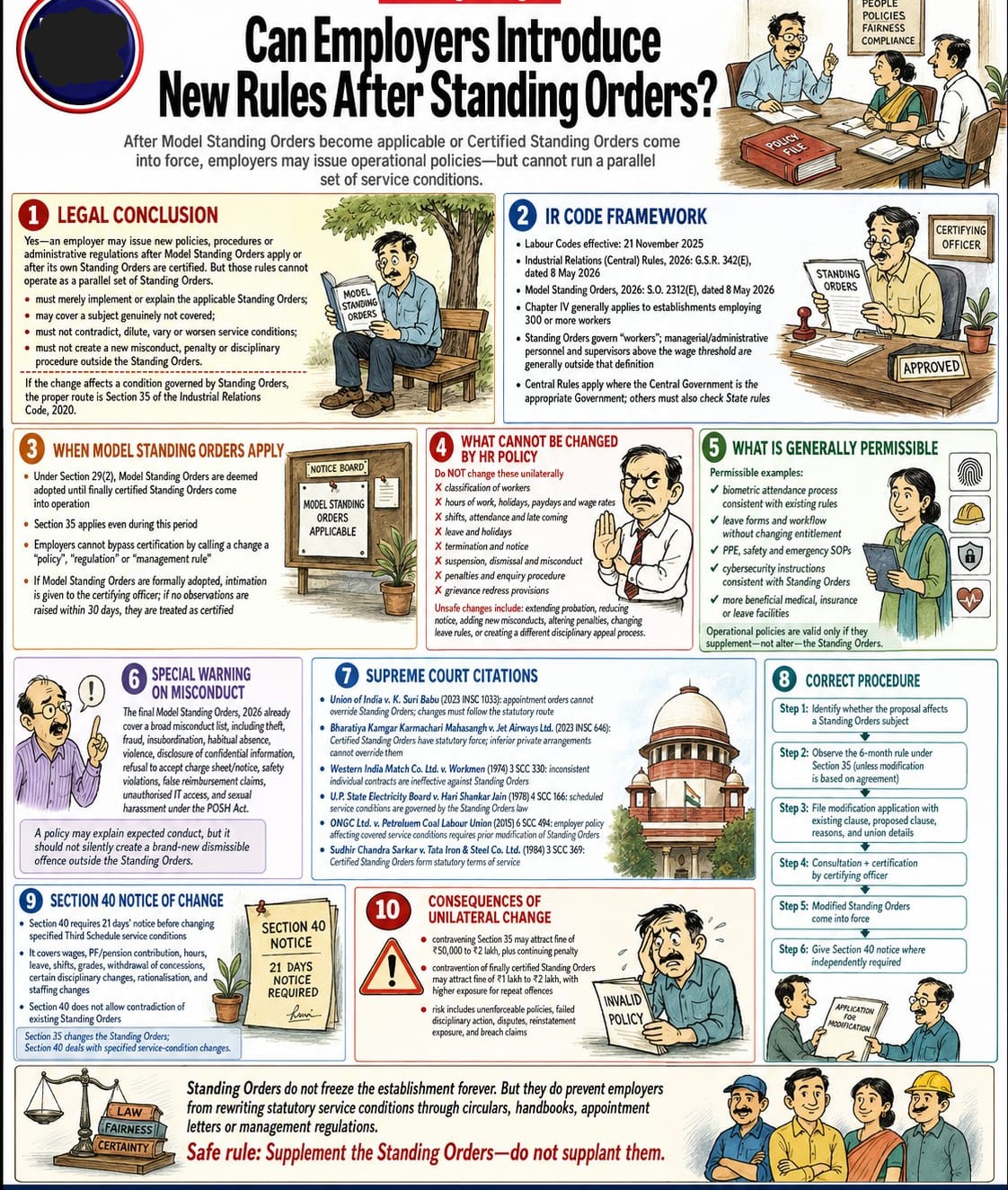
Can an Employer Introduce New Rules After Standing Orders Come Into Force?
Many employers believe that once an organization grows, management has complete freedom to issue new HR policies, amend service conditions, or introduce fresh disciplinary rules through circulars, employee handbooks, appointment letters, or codes of conduct.
Statements such as “We can issue a new HR policy anytime.”, “The appointment letter will override the old rule.” and “A code of conduct is only an internal document” are commonly heard in workplaces.
However, from a labour law perspective, these assumptions can be legally risky.
Once Model Standing Orders become applicable or Certified Standing Orders come into force, the employer’s authority to regulate service conditions is no longer unrestricted. Standing Orders acquire a statutory character and act as the governing framework for conditions of employment. Employers may supplement them through administrative policies, but they cannot create a parallel regime that alters or contradicts statutory service conditions.
Understanding the Legal Position
Standing Orders are intended to bring certainty, transparency, and uniformity to employment conditions. They define crucial aspects of the employer-employee relationship, including classification of workers, attendance, leave, misconduct, disciplinary procedures, termination, suspension, and grievance mechanisms. Therefore, management cannot bypass standing orders simply by issuing
- HR circulars
- Employee handbooks
- Internal regulations
- Appointment letters
- Codes of conduct
Any policy that conflicts with or modifies matters already governed by Standing Orders may be legally unenforceable.
The guiding principle is simple: Standing Orders may be supplemented, but they cannot be supplanted.
What Remains Permissible for Employers?
The existence of Standing Orders does not prevent management from introducing operational improvements or administrative procedures. Employers may issue policies that:
- Explain or implement existing Standing Orders
- Address operational areas not covered by Standing Orders
- Prescribe safety procedures and use of PPE
- Introduce cybersecurity and data protection protocols
- Establish administrative workflows and reporting systems
- Provide employees with benefits more favourable than existing conditions
Example
An employer may introduce the following:
- Biometric attendance systems
- Digital leave management platforms
- Cybersecurity compliance requirements
- Health and safety protocols
- Emergency response procedures
However, the employer cannot use such policies to alter statutory service conditions. For instance:
✔ Introducing biometric attendance is permissible.
✘ Creating a new monetary penalty for late attendance, where no such provision exists in the Standing Orders, is not permissible.
What Cannot Be Changed Through an HR Policy?
Several subjects are specifically governed by Standing Orders and therefore cannot be altered unilaterally through internal policies. These include:
- Classification of workers
- Probation and confirmation
- Working hours and shifts
- Attendance requirements
- Leave and holidays
- Termination procedures
- Notice periods
- Misconduct
- Disciplinary penalties
- Domestic enquiry procedures
- Suspension and dismissal
- Grievance redressal mechanisms
Accordingly, management cannot
- Extend probation through a policy if standing orders prescribe a different framework.
- Reduce notice periods through appointment letters.
- Create a new category of misconduct leading to dismissal.
- Introduce punishments not recognized by Standing Orders.
- Establish an alternative disciplinary process outside the certified framework.
Such actions may be challenged as being contrary to statutory service conditions.
The Correct Legal Route for Modification
Whenever management intends to alter a matter governed by Standing Orders, the proper course is not an HR circular but statutory modification. Under Section 35 of the Industrial Relations Code, 2020, employers seeking changes must:
- Identify the affected Standing Order provision.
- Prepare the proposed modification.
- File an application for modification with reasons.
- Provide details regarding the recognized union or employee representatives.
- Undergo the process of consultation and certification.
- Implement the change only after it is legally brought into force.
This procedure ensures transparency, employee participation, and regulatory oversight.
Section 35 and Section 40: Understanding the Difference
Many organizations mistakenly assume that issuing a notice of change is sufficient. This is not always correct.
Section 35
Section 35 specifically deals with the modification of standing orders. It applies when the proposed change affects subjects already governed by the Standing Orders.
Section 40
Section 40 governs:Changes in specified service conditions listed in the Third Schedule. Where applicable, employers may be required to give 21 days’ notice before implementing such changes. However A Section 40 notice cannot legalize a policy that contradicts existing Standing Orders. In essence:
- Section 35 modifies Standing Orders.
- Section 40 regulates specified service-condition changes.
The two provisions operate differently, and compliance with one does not automatically satisfy the requirements of the other.
Supreme Court’s Clear Message
The judiciary has repeatedly emphasized the superiority of Standing Orders over private arrangements.
Union of India v. K. Suri Babu (2023 INSC 1033)
The Supreme Court reiterated that service conditions governed by Standing Orders cannot be overridden through appointment orders or contractual arrangements.
Bharatiya Kamgar Karmachari Mahasangh v. Jet Airways (2023 INSC 646)
The court reaffirmed that inferior private arrangements cannot supersede certified standing orders, which possess statutory force. The consistent judicial view remains that once Standing Orders apply, employers cannot contract out of them through unilateral policies or private agreements.
Final Takeaway
Standing Orders do not freeze management forever. Organizations remain free to introduce operational procedures, technological improvements, safety measures, and employee-friendly benefits.
However, employers cannot rewrite statutory service conditions through HR circulars, handbooks, appointment letters, or internal codes of conduct.
Before introducing any policy affecting employment conditions, management must ask one critical question:
Does the proposed rule merely supplement the Standing Orders, or does it attempt to replace them?
If it replaces, modifies, or contradicts a standing orders provision, the lawful path is statutory modification under the Industrial Relations Code—not unilateral policy issuance.