
All about KMP : Roles, Appointment & Remuneration
Page Contents

Key Managerial Personnel Under the Companies Act, 2013: Roles, Appointment, Compliance and Remuneration
The success of any company depends significantly on its leadership team. Under the Companies Act, 2013, certain top-level executives are designated as Key Managerial Personnel (KMP) and are entrusted with managing the affairs, strategy, compliance, and governance of the organization. Sections 196 to 205 of the Companies Act, 2013, together with Schedule V, lay down detailed provisions governing the appointment, responsibilities, and remuneration of KMPs.
Who are Key Managerial Personnel (KMP)?
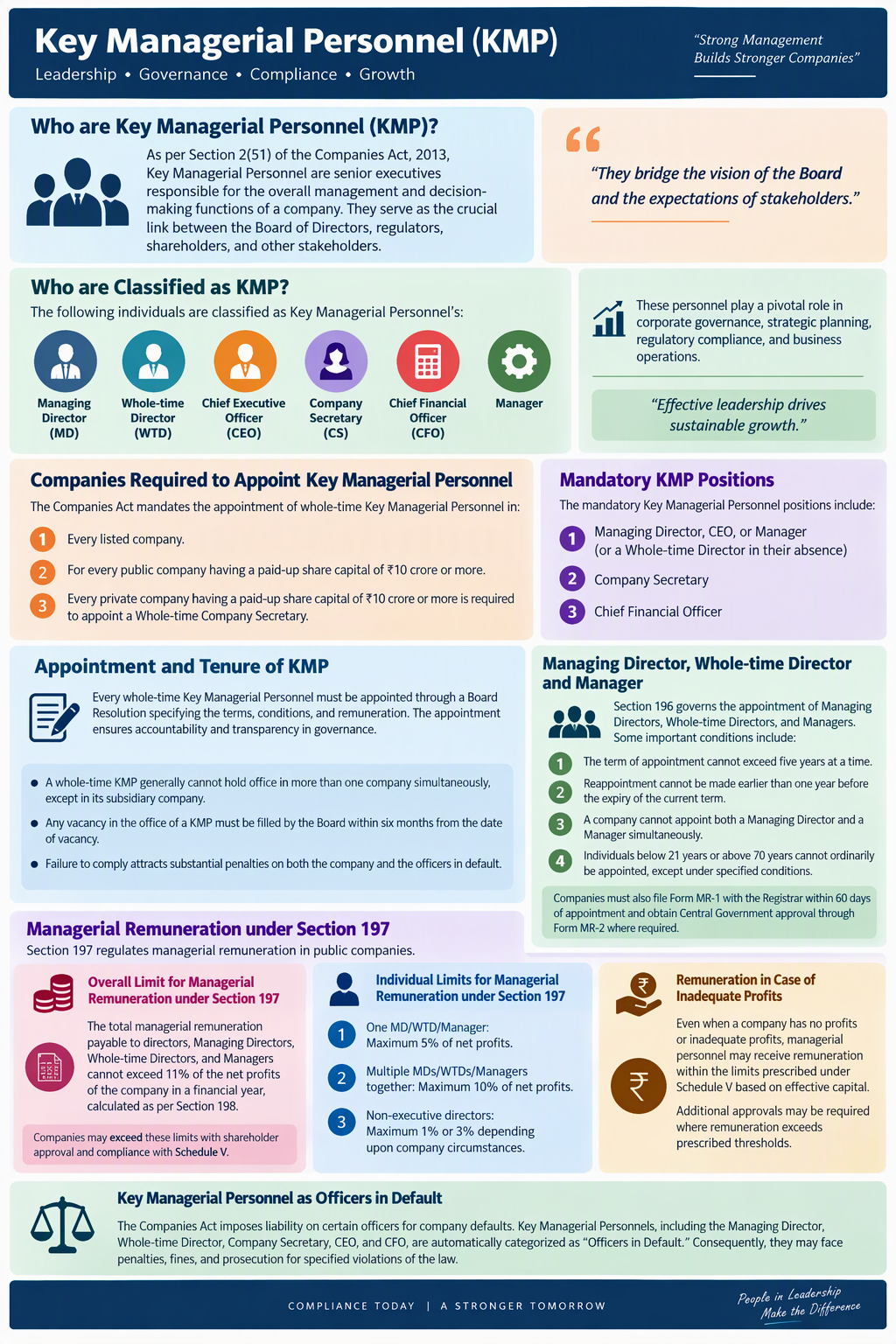
As per Section 2(51) of the Companies Act, 2013, Key Managerial Personnel are senior executives responsible for the overall management and decision-making functions of a company. They serve as the crucial link between the Board of Directors, regulators, shareholders, and other stakeholders. The following individuals are classified as Key Managerial Personnel’s :
- Managing Director (MD)
- Whole-time Director (WTD)
- Chief Executive Officer (CEO)
- Company Secretary (CS)
- Chief Financial Officer (CFO)
- Manager
These personnel play a pivotal role in corporate governance, strategic planning, regulatory compliance, and business operations.
Companies Required to Appoint Key Managerial Personnel
The Companies Act mandates the appointment of whole-time Key Managerial Personnel in:
- Every listed company.
- For Every public company having a paid-up share capital of ₹10 crore or more.
- Every private company having a paid-up share capital of ₹10 crore or more is required to appoint a Whole-time Company Secretary.
The mandatory Key Managerial Personnel positions include:
- Managing Director, CEO, or Manager (or a Whole-time Director in their absence)
- Company Secretary
- Chief Financial Officer
Appointment and Tenure of KMP
Every whole-time Key Managerial Personnel must be appointed through a Board Resolution specifying the terms, conditions, and remuneration. The appointment ensures accountability and transparency in governance.
A whole-time Key Managerial Personnel generally cannot hold office in more than one company simultaneously, except in its subsidiary company. Any vacancy in the office of a KMP must be filled by the Board within six months from the date of vacancy. Failure to comply attracts substantial penalties on both the company and the officers in default.
Managing Director, Whole-time Director and Manager
Section 196 governs the appointment of Managing Directors, Whole-time Directors, and Managers. Some important conditions include:
- The term of appointment cannot exceed five years at a time.
- Reappointment cannot be made earlier than one year before the expiry of the current term.
- A company cannot appoint both a Managing Director and a Manager simultaneously.
- Individuals below 21 years or above 70 years cannot ordinarily be appointed, except under specified conditions.
Companies must also file Form MR-1 with the Registrar within 60 days of appointment and obtain Central Government approval through Form MR-2 where required.
Role of Chief Executive Officer and Chief Financial Officer
Chief Executive Officer :
The CEO is regarded as a Key Managerial Personnel and may also become an officer in default under the Companies Act in case of non-compliance. The CEO is responsible for:
- Strategic decision-making
- Business growth and expansion
- Corporate leadership
- Overall management and implementation of policies
Chief Financial Officer :
Every qualifying public company must appoint a whole-time CFO, who must sign the financial statements of the company. The CFO is the principal financial officer of the company and is responsible for:
- Financial planning and budgeting
- Treasury management
- Regulatory compliance
- Financial reporting
- Risk management
Company Secretary:
The Governance Professional: The Company Secretary occupies a unique position within corporate management and acts as a compliance officer, governance advisor, and facilitator between the Board and stakeholders. For listed companies, the Company Secretary also serves as the Compliance Officer under SEBI (LODR) Regulations. Key Functions of a Company Secretary
- Ensuring compliance with the Companies Act and other applicable laws.
- Advising the Board on governance matters.
- Conducting and managing Board, committee, and general meetings.
- Maintaining statutory records and registers.
- Representing the company before regulators and authorities.
- Ensuring adherence to Secretarial Standards.
- Facilitating effective corporate governance practices.
Managerial Remuneration under Section 197 : Section 197 regulates managerial remuneration in public companies.
Overall Limit for Managerial Remuneration under Section 197
The total managerial remuneration payable to directors, Managing Directors, Whole-time Directors, and Managers cannot exceed 11% of the net profits of the company in a financial year, calculated as per Section 198. Companies may exceed these limits with shareholder approval and compliance with Schedule
Individual Limits for Managerial Remuneration under Section 197
- One MD/WTD/Manager: Maximum 5% of net profits.
- Multiple MDs/WTDs/Managers together: Maximum 10% of net profits.
- Non-executive directors: Maximum 1% or 3% depending upon company circumstances.
Remuneration in Case of Inadequate Profits
Even when a company has no profits or inadequate profits, managerial personnel may receive remuneration within the limits prescribed under Schedule V based on effective capital. Additional approvals may be required where remuneration exceeds prescribed thresholds.
Key Managerial Personnel as Officers in Default
The Companies Act imposes liability on certain officers for company defaults. Key Managerial Personnels, including the Managing Director, Whole-time Director, Company Secretary, CEO, and CFO, are automatically categorized as “Officers in Default.” Consequently, they may face penalties, fines, and prosecution for specified violations of the law.
Conclusion
Key Managerial Personnel form the backbone of corporate governance and operational management in every company. The Companies Act, 2013 establishes a robust framework governing their appointment, duties, accountability, and remuneration. Proper compliance with these provisions not only ensures legal adherence but also strengthens transparency, governance standards, and stakeholder confidence.
For companies, appointing competent Key Managerial Personnel’s and maintaining timely statutory compliances is essential for sustainable growth and effective corporate governance in today’s evolving regulatory environment.
Important Compliance Forms
Organizations must ensure timely filing of the following forms:
| Form | Purpose | Due Date | |
| DIR-12 | Appointment/cessation of KMP | Within 30 days | |
| MGT-14 | Filing Board Resolution | Within 30 days | |
| MR-1 | Appointment of MD/WTD/Manager | Within 60 days | |
| MR-2 | Central Government approval | Within 90 days | |
| Stock Exchange Intimation | Change in KMP (Listed Companies) | Within 24 hours |