
Inverted duty refunds to include input services w.e.f. 1 Nov 2026
Page Contents
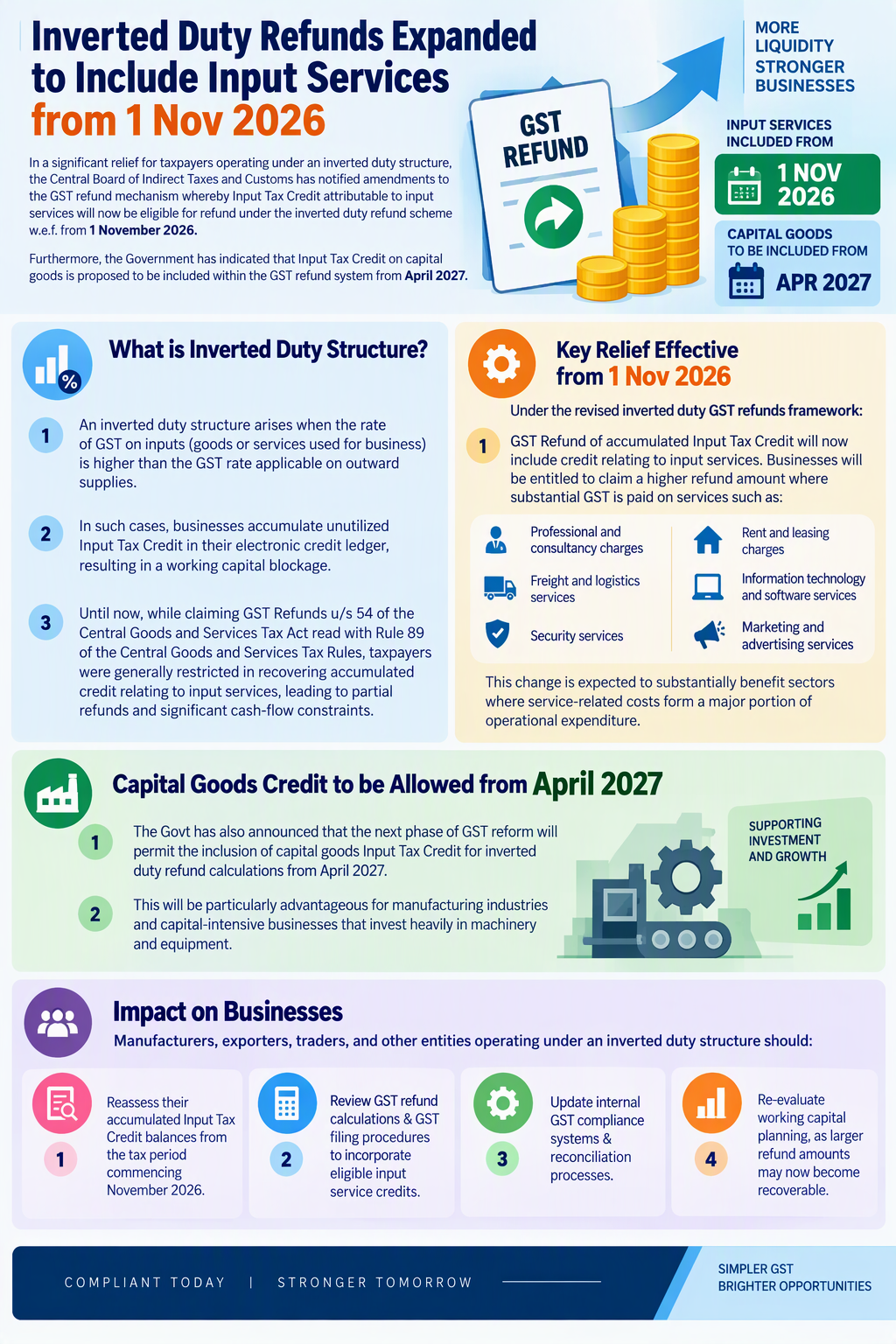 Inverted Duty Refunds Expanded to Include Input Services from 1 Nov 2026
In a significant relief for taxpayers operating under an inverted duty structure, the Central Board of Indirect Taxes and Customs has notified amendments to the GST refund mechanism whereby Input Tax Credit attributable to input services will now be eligible for refund under the inverted duty refund scheme w.e.f. from 1 November 2026.
Furthermore, the Government has indicated that Input Tax Credit on capital goods is proposed to be included within the GST refund system from April 2027.
Inverted duty structure:
- An inverted duty structure arises when the rate of GST on inputs (goods or services used for business) is higher than the GST rate applicable on outward supplies.
- In such cases, businesses accumulate unutilized Input Tax Credit in their electronic credit ledger, resulting in a working capital blockage.
- Until now, while claiming GST Refunds u/s 54 of the Central Goods and Services Tax Act read with Rule 89 of the Central Goods and Services Tax Rules, taxpayers were generally restricted in recovering accumulated credit relating to input services, leading to partial refunds and significant cash-flow constraints.
Inverted duty GST refunds to include input services, which Key Relief is effective from 1 Nov 2026.
Under the revised inverted duty GST refund framework:
- GST refund of accumulated input tax credit will now include credit relating to input services. Businesses will be entitled to claim a higher refund amount where substantial GST is paid on services such as professional and consultancy charges, freight and logistics services, security services, rent and leasing charges, information technology and software services, and marketing and advertising services
This change is expected to substantially benefit sectors where service-related costs form a major portion of operational expenditure.
Capital Goods Credit to Be Allowed from April 2027
- The Govt has also announced that the next phase of GST reform will permit the inclusion of capital goods input tax credit for inverted duty refund calculations from April 2027.
- This will be particularly advantageous for manufacturing industries and capital-intensive businesses that invest heavily in machinery and equipment.
Impact on Businesses
Manufacturers, exporters, traders, and other entities operating under an inverted duty structure should:
- Reassess their accumulated input tax credit balances from the tax period commencing November 2026.
- Review GST refund calculations & GST filing procedures to incorporate eligible input service credits.
- Update internal GST compliance systems & reconciliation processes.
- Re-evaluate working capital planning, as larger refund amounts may now become recoverable.
Practical Implications of revised Inverted duty GST refunds framework
- Businesses that were previously excluding input service credits while computing inverted duty refunds should immediately revisit their refund eligibility from the Nov 2026 tax period onwards.
- The amendment is expected to reduce the blockage of working capital and improve liquidity for a large number of GST-registered taxpayers.
E-Invoice Portal Maintenance
- Taxpayers should also note that the GST e-Invoice portal was reported to be under scheduled maintenance from 9:00 AM on 31 October 2026 until 1:00 PM on 1 November 2026.
- Businesses planning to generate e-invoices during this period should make alternative arrangements and complete invoicing activities in advance to avoid disruption in compliance and business operations.
- Review November 2026 GST refund computations carefully and ensure eligible input service credits are considered while filing refund claims under the revised inverted duty refund provisions.